Managing rental properties requires consistent financial reviews to avoid small issues turning into major problems. Here’s a quick summary of what you need to know:
- Why it matters: Monthly reviews help landlords track cash flow, simplify tax preparation, and catch discrepancies early.
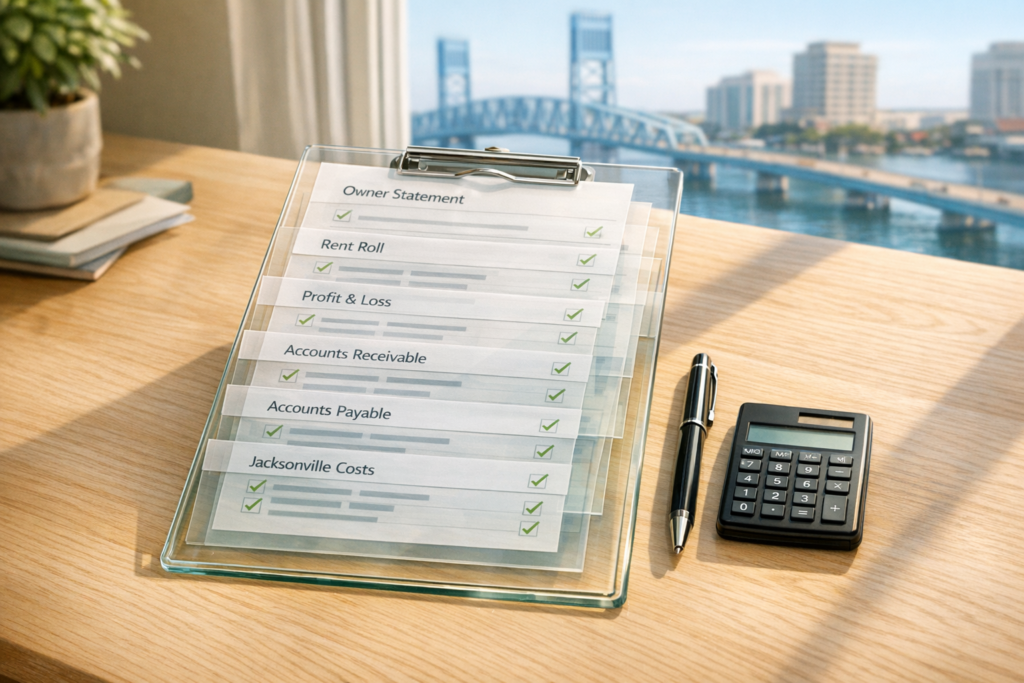
- Key reports to review: Profit & Loss (P&L), rent roll, accounts receivable/payable, and maintenance reports.
- Steps to start:
- Confirm rent payments and invoices are processed.
- Gather external financial documents like bank statements and mortgage bills.
- Review each property individually for accurate performance insights.
- Common Jacksonville challenges: High humidity, storm-related repairs, and rising insurance premiums make detailed tracking crucial.
- Tools to simplify: Owner portals centralize financial data, making it easier to monitor income, expenses, and property performance.
Staying on top of these steps ensures your properties remain profitable and well-managed. For those feeling overwhelmed, property management services can provide the tools and expertise to streamline this process.
Steps to Take Before Starting the Monthly Review
Preparation is key when it comes to reviewing your financial data. By organizing everything ahead of time, you can avoid delays caused by missing or incomplete information.
Confirm Rent Payments and Invoices Are Processed
Before diving into financial reports, double-check that all rent payments for the month have been posted and vendor invoices are matched to completed work orders. This step ensures you’re working with a complete and accurate financial picture.
Take a close look at your Accounts Receivable (AR) and Accounts Payable (AP) reports. Confirm which tenants have paid, identify any outstanding rent, and verify that mortgage payments, utility bills, and vendor invoices are fully processed. As a general guideline, if your monthly statement arrives after the 20th, it could signal a bookkeeping delay. Many professional property managers aim to issue statements within 10 days of the accounting period’s close.
Once you’ve verified internal data, move on to gathering external documents for cross-referencing.
Gather External Financial Documents
While your owner portal provides a wealth of information, external records are essential for double-checking accuracy. Collect your bank statements, mortgage statements, property tax notices, and insurance bills to compare against the portal data. This step helps identify any discrepancies early on.
Also, pull out your signed Property Management Agreement. If you spot charges that don’t align with your contracted rates, flag them immediately. Be particularly cautious with vague line items that lack corresponding invoices – these deserve further investigation.
Finally, take the time to evaluate each property individually to ensure nothing is overlooked.
List Each Property for Individual Review
If you own multiple properties, reviewing them as a single combined total can hide potential problems with individual assets.
"Separate views prevent a strong property from masking a weak one. One property might have a one-time expense that skews the combined totals." – RentRedi
Create a list for each property and record key metrics such as gross rent, expenses, net operating income (NOI), vacancy days, lease renewal dates, and reserve balances. This individualized approach is particularly important for properties in areas like Jacksonville, where market conditions can vary significantly. Neighborhood-specific turnover rates and seasonal repair needs often differ across the city, making property-by-property reviews essential.
sbb-itb-73b3b1a
Monthly Financial Reporting Checklist
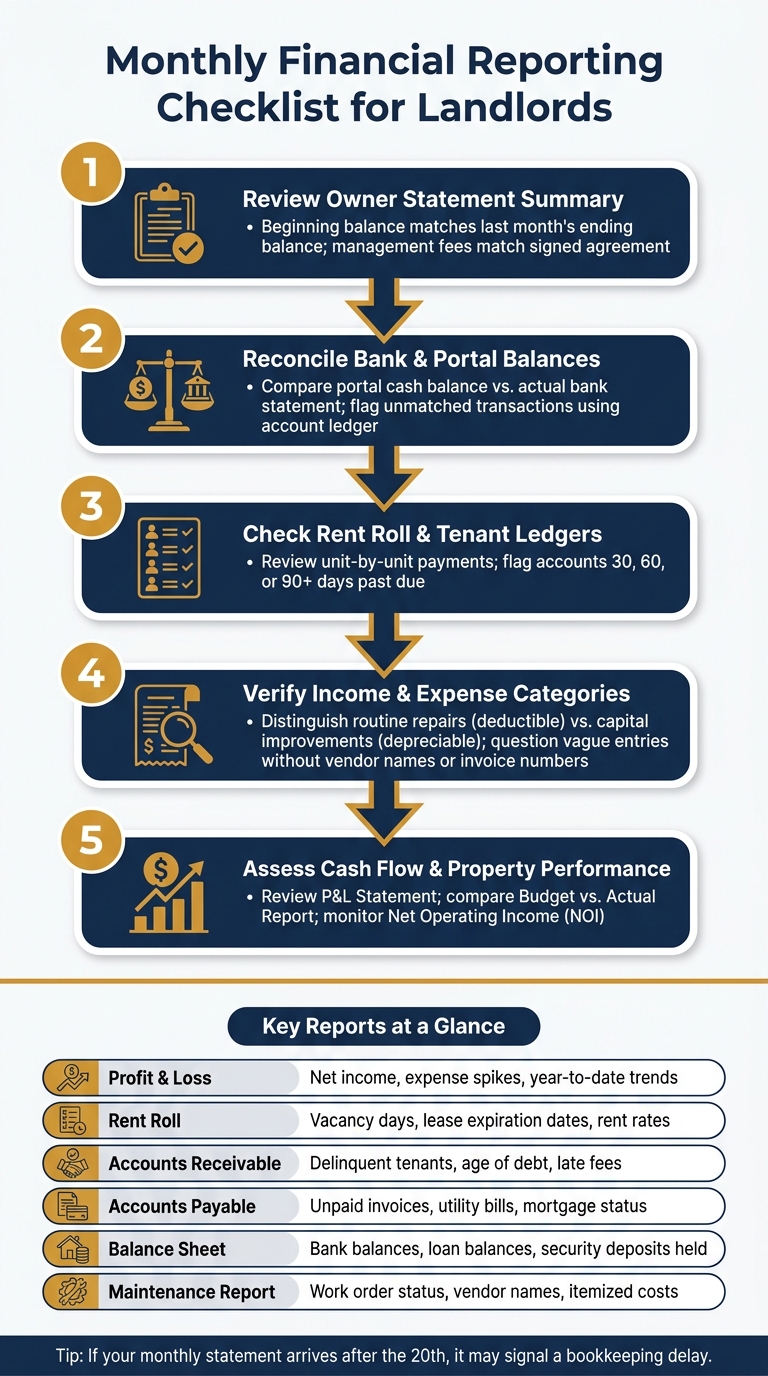
Monthly Financial Reporting Checklist for Landlords
With your properties listed and documents in hand, it’s time to dig into the financial details. Here’s a step-by-step guide to ensure nothing gets overlooked.
Review the Owner Statement Summary
Start with the owner statement. This document provides a clear overview of the beginning balance, total income, expenses, management fees, and net disbursement. Check that the beginning balance aligns with last month’s ending balance – any mismatch could indicate a data entry error or timing issue.
"A property manager’s monthly statement should account for every dollar that came in, every dollar that went out, and every dollar still sitting in reserve, with enough detail to verify each line without picking up the phone." – Peter Lohmann, RL Property Management
Double-check that all management fees match the rates outlined in your signed Property Management Agreement. Mistakes in this area are common and easy to miss if you’re not paying close attention.
Reconcile Bank and Portal Balances
Next, compare the cash balance in your owner portal with your actual bank statement. While slight differences due to pending vendor invoices or disbursements are normal, you should be able to account for every discrepancy.
Use the portal’s account ledger to track transactions in chronological order. If you spot a withdrawal listed in the bank but missing from the portal (or vice versa), flag it and request supporting documentation.
Check the Rent Roll and Tenant Ledgers
The rent roll provides a unit-by-unit breakdown of tenant payments, overdue balances, and what’s owed. Review tenant ledgers and the AR/Delinquency Report for accounts that are 30, 60, or 90+ days past due. If a tenant is 60+ days behind without any action noted, it’s time to have a direct conversation with your property manager.
Verify Income and Expense Categories
Go through each expense line item to ensure it’s categorized correctly. Pay special attention to the distinction between routine repairs (deductible operating expenses) and capital improvements (depreciable over time). Misclassifications here can lead to tax reporting issues.
"A single ‘Maintenance: $342’ entry is not enough information to verify the work happened or was priced fairly." – Peter Lohmann, RL Property Management
Question any vague entries that lack details like vendor names, invoice numbers, or descriptions. Your portal should provide access to documentation – such as photos, technician notes, and invoices – to confirm that the work was authorized, completed, and billed appropriately.
Assess Cash Flow and Property Performance
Finally, review the Profit and Loss (P&L) Statement, which calculates your net profit or loss for the month by subtracting total operating expenses from rental income. Compare this to your Budget vs. Actual Report to catch any unexpected expense spikes or income gaps early.
"Most property owners don’t lose money overnight. They lose it slowly, by not reviewing the right reports regularly." – Lazar Accounting Solutions
Here’s a quick-reference table for verifying key reports:
| Report | What to Check |
|---|---|
| Profit & Loss | Net income, unusual expense spikes, year-to-date trends |
| Rent Roll | Vacancy days, lease expiration dates, rent rates |
| Accounts Receivable | Delinquent tenants, age of debt, late fees |
| Accounts Payable | Unpaid vendor invoices, utility bills, mortgage status |
| Balance Sheet | Bank balances, loan balances, security deposits held |
| Maintenance Report | Work order status, vendor names, itemized costs |
With these steps, you’ll have a clear picture of your property’s financial health and be able to address any issues proactively.
Florida-Specific Factors Jacksonville Landlords Should Track
Staying Compliant with Florida Rental Laws
In Florida, landlords must handle tenant security deposits with care. These funds legally belong to the tenant and must be kept separate from your operating accounts. Mixing security deposits with rental income or expenses – even unintentionally – violates compliance rules.
"Security deposits are tenant funds that must be tracked separately and are governed by specific rules. They should never be treated as owner money." – Henderson Properties
To stay on track, check your portal each month to confirm that all security deposit balances are maintained in a separate account. Also, double-check that any late fees comply with Florida regulations: a flat $50 fee plus $10 per day after the grace period (starting after 5:00 PM on the fifth day). If there’s a mismatch between late fees and your lease terms, address it immediately.
For out-of-state landlords, there’s one more thing to note: Florida requires a Statutory Agent Service fee, which is around $50 annually, to maintain a registered agent in the state.
Now, let’s look at how Jacksonville’s distinct climate impacts property costs.
Tracking Common Jacksonville Property Costs
Jacksonville’s weather brings its own set of challenges for property owners. The city’s high humidity, heavy seasonal rain, and storm risks can lead to higher recurring costs for HVAC upkeep, pest control, and drainage repairs. These expenses can grow quickly if not monitored closely.
"Jacksonville owners need reporting that reflects what is happening in their own market… Weather, seasonal repair patterns, neighborhood turnover, and rental pricing can all affect performance." – Blakely Hughes, Broker, Nest Finders
To avoid surprises, review your monthly Budget vs. Actual Report to catch seasonal spikes in costs before they turn into major repairs. As a rule of thumb, plan to set aside 1% to 2% of your property’s value annually for maintenance and repairs. For example, if your property is worth $250,000, you should budget between $2,500 and $5,000 per year – or roughly $210 to $415 per month.
Don’t forget to include other recurring expenses in your reports, such as HOA dues, landlord insurance (typically $1,000–$2,000 annually), and property taxes (usually 1%–1.5% of the assessed value each year). Keeping these costs consistently tracked will help you maintain a clear picture of your cash flow.
How 1 Realty Management Supports Financial Reporting
Owner Portal Features for Financial Reporting
1 Realty Management simplifies financial tracking for Jacksonville landlords with a user-friendly portal that provides 24/7 access to key financial and property documents. From monthly owner statements to income and expense records, maintenance invoices, lease documents, and property activity, everything is available in one place and accessible from any device.
"You don’t have to wait for the end of the month to see how your property is performing. Our owner portal gives you on-demand access to your financial statements, work orders, lease documents, and property activity – any time, from any device." – 1 Realty Management
The portal breaks down every expense, linking it to specific vendor invoices and maintenance records, making reconciliation and verification straightforward. At the end of the year, it generates a tax-ready annual report, saving time for you and your accountant during tax season. Additionally, it automatically reconciles your property’s accounting records with actual bank activity every month, identifying discrepancies early to ensure everything is accurate and audit-ready.
For landlords managing multiple units, the rent roll report is a game-changer. It consolidates vital details like current rent amounts, lease expiration dates, payment statuses, and vacancy data. This feature helps you plan for lease renewals and avoid unexpected gaps in rental income.
On top of its tech-driven solutions, 1 Realty Management leverages local expertise to make these reports even more valuable.
Local Market Knowledge and Reporting Accuracy
Numbers alone don’t tell the full story. To understand what they mean for your Jacksonville property, local context is essential – something 1 Realty Management brings with over 45 years of experience in the Jacksonville rental market.
For instance, an increase in HVAC or drainage expenses during storm season might not signal a problem but could simply reflect normal seasonal maintenance in Northeast Florida. 1 Realty Management’s deep understanding of local cost patterns helps landlords differentiate between predictable seasonal expenses and actual performance issues.
"Clear, accurate, detailed financial statements give you full visibility into how your Jacksonville rental property is performing, what it’s costing you, and exactly where your money is going." – 1 Realty Management
Tracking Net Operating Income (NOI) monthly, rather than just annually, is another key advantage. It allows landlords to spot opportunities for timely rent adjustments. Missing even a modest rent escalation – like a 3% increase on a $1,500 monthly rent – could mean losing over $500 in annual income. Regular monitoring ensures you’re maximizing your property’s financial potential.
Conclusion
Keeping a close eye on your rental property finances every month is essential to protect your income and avoid unpleasant surprises. By consistently reviewing your owner statement, bank balances, rent roll, and NOI, you can maintain a clear picture of your financial health and make timely, informed decisions.
"Most property owners do not lose money overnight; they lose it slowly by failing to review the right reports regularly." – Lazar Accounting Solutions
Diving into key reports like your Profit & Loss statement, rent roll, accounts receivable, accounts payable, and balance sheet gives you a full snapshot of your property’s financial condition. This habit separates landlords who are prepared and proactive from those who are caught off guard. Think of this checklist as your guide to staying on top of your property’s financial management.
If this process feels overwhelming, 1 Realty Management provides Jacksonville landlords with tools and expertise built on 45 years of local experience. Their owner portal, automated bank reconciliations, and tax-ready annual reports take the manual work off your plate, so you can focus on making smarter investment choices.
"You can’t manage what you can’t measure." – 1 Realty Management
FAQs
What numbers should I watch every month to spot problems early?
Monitoring your monthly profit and loss statement is essential for keeping an eye on your net income and identifying any unusual increases in maintenance or operating costs. It’s equally important to review your rent roll to stay updated on vacancies, upcoming lease expirations, and any delinquencies.
Additionally, keep a close watch on accounts receivable to address overdue rent promptly and ensure your accounts payable are up to date, including bills and mortgage payments. Regularly comparing your actual income and expenses against your budget, while tracking net operating income over time, can help you pinpoint potential performance issues before they grow into larger problems.
How do I tell if a charge is a repair or a capital improvement?
To figure out whether a charge qualifies as a repair or a capital improvement, think about the purpose of the work. Repairs are everyday fixes meant to keep the property in its current state. On the other hand, capital improvements involve major upgrades that either boost the property’s value or extend its lifespan. Getting this classification right is essential for proper financial tracking and tax compliance. 1 Realty Management offers detailed, itemized reporting to help ensure everything is categorized correctly.
What should I do if my bank balance doesn’t match my owner portal?
If your bank balance doesn’t align with your owner portal, it could be due to timing differences, voided transactions, or pending entries. To clarify, reach out to your property management team for assistance. Professional managers, such as 1 Realty Management, conduct monthly bank reconciliations to maintain accuracy. If issues continue, you might want to request more detailed reports or include this as a discussion point in your management agreement.