
Should you manage your rental property yourself or hire a property manager? The decision depends on your time, expertise, and financial goals.
Here’s the breakdown:
- Self-Managing:
- Pros: Save 8–12% in management fees (about $120–$180/month for a $1,500 rental). Gain full control over tenant selection, repairs, and rent collection.
- Cons: Requires significant time and effort. You handle tenant issues, legal compliance, and emergencies. Mistakes with Florida laws, like mishandling deposits, can lead to penalties.
- Hiring a Property Manager:
- Pros: Saves time and reduces stress. Professionals handle tenant screening, legal compliance, and maintenance. They can minimize vacancies and improve financial performance.
- Cons: Costs include 8–12% of rent, tenant placement fees (50–100% of one month’s rent), and lease renewal fees ($200–$1,000). You lose some control over property decisions.
Quick Comparison
| Factor | Self-Managing | Hiring a Property Manager |
|---|---|---|
| Cost | No management fee, but personal expenses | 8–12% of rent + additional fees |
| Time Commitment | High: You handle everything | Low: Manager takes care of daily tasks |
| Legal Compliance | You must stay updated on Florida laws | Manager ensures compliance |
| Repairs | You coordinate and pay retail rates | Manager uses vendor networks (with markups) |
| Control | Full control over decisions | Limited control, depending on contract |
If you have time and knowledge, self-managing can save money. But if you’re short on time or own multiple properties, hiring a manager can simplify your life. Choose based on your goals and resources.
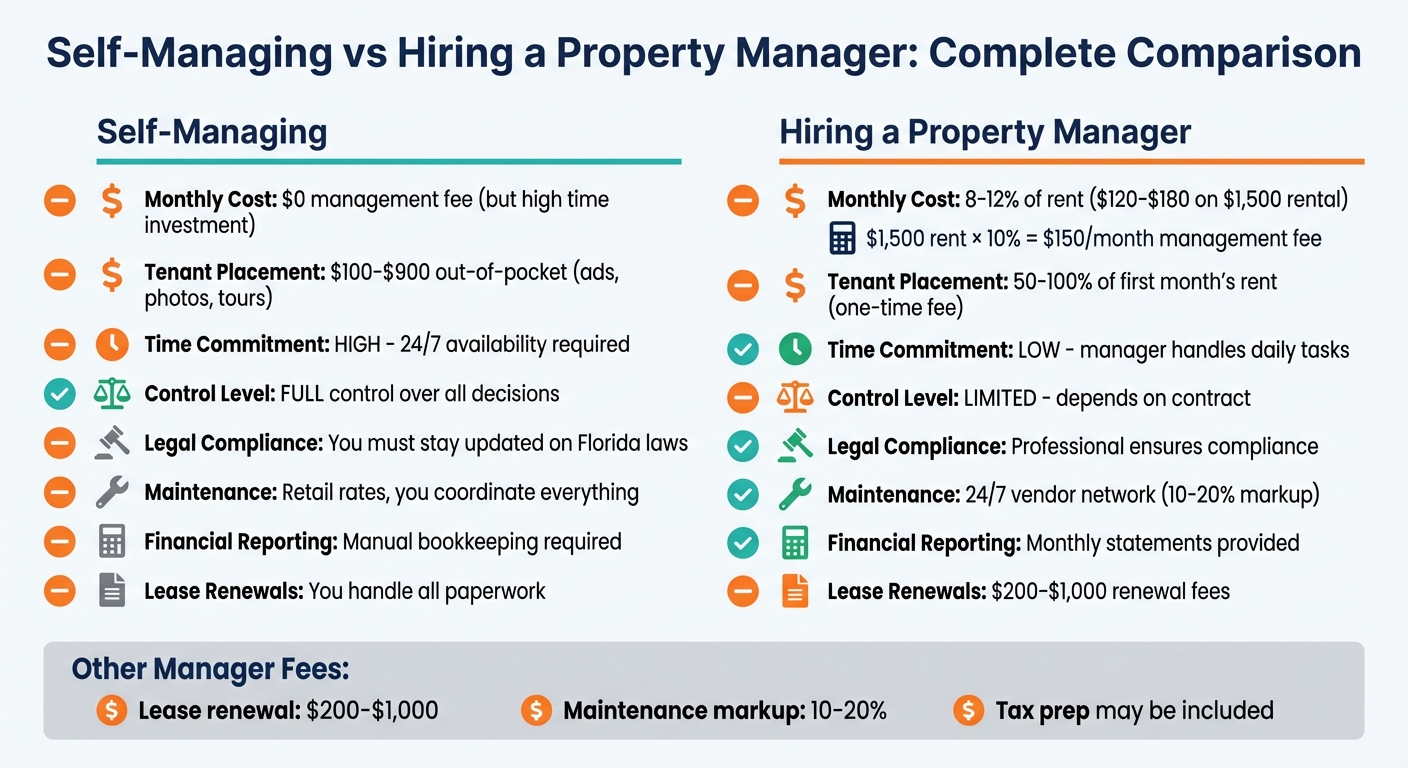
Self-Managing vs Hiring Property Manager Cost Comparison Chart
Self-Managing Rental Properties: Pros and Cons
Pros of Self-Managing
Managing your own rental property can save you a substantial amount of money. For instance, you avoid paying a monthly management fee of 8–12%, which translates to about $120–$180 on a $1,500 rental. On top of that, you sidestep tenant placement fees (typically 50–100% of one month’s rent) and lease renewal charges that range between $200 and $1,000 annually.
Self-management also gives you complete control over your property. You handle everything from choosing tenants to negotiating with contractors, which eliminates markups and allows for direct communication with tenants. Building these relationships often leads to better communication and longer tenancy.
Cons of Self-Managing
However, the financial savings come with significant time and effort. As a self-managing landlord, you’re responsible for tasks like tenant screening, ensuring compliance with the Fair Housing Act, collecting rent, arranging repairs, and responding to emergencies. In Florida, landlords must address repair requests within seven days of receiving written notice and provide at least 24 hours’ notice before entering a tenant’s unit. These requirements are particularly important for Jacksonville landlords navigating the region’s unique market dynamics. Missing deadlines could lead to tenants withholding rent or even legal disputes.
Legal compliance is another critical challenge. Jacksonville landlords must provide specific disclosures, such as radon gas notifications, lead-based paint warnings for homes built before 1978, and details about how security deposits are stored. Security deposits must be returned within 15 days if no claim is made, or landlords must issue a notice of intent to impose a claim within 30 days.
Florida law prohibits charging tenants for normal wear and tear, such as faded paint or minor wall scuffs.
Additionally, Florida’s “Useful Life” principle adds complexity. For example, paint is considered to have no value after three years, and carpet after five years. Missteps with security deposit returns could result in hefty penalties, including the full deposit amount, court costs, and attorney fees.
Self-managing also requires meticulous financial planning. You’re responsible for budgeting property taxes, insurance, utilities, routine maintenance, and unexpected repairs. This can be particularly challenging for older properties in neighborhoods like Riverside or Springfield. Don’t forget to account for vacancy periods, which represent lost income when transitioning between tenants. In Jacksonville’s current market – where property values have climbed faster than rents – maintaining positive cash flow demands careful expense tracking and setting competitive, data-informed rents. These challenges explain why many landlords ultimately turn to professional property managers.
sbb-itb-73b3b1a
Hiring a Property Manager: Pros and Cons
Pros of Hiring a Property Manager
One of the biggest perks of hiring a property manager is the time it saves. They handle the day-to-day grind – like responding to tenant inquiries around the clock, coordinating maintenance, marketing vacant units, and collecting rent – so you can focus on other priorities.
Property managers also help you stay on the right side of Florida’s rental laws, which can be tricky to navigate. They handle everything from security deposit rules to eviction timelines and notice requirements, reducing your chances of making costly legal mistakes. For example, mishandling a security deposit or violating fair housing laws can wipe out years of savings on management fees. Professional managers use legally sound leases and stay updated on housing regulations at all levels, protecting your property from compliance issues.
Another major advantage is improved financial performance. Property managers are skilled at minimizing vacancies and keeping tenants happy through effective marketing, thorough screening, and quick responses to issues. This is crucial for your bottom line – a vacant $2,000/month rental costs you roughly $67 a day in lost income.
Professional managers often improve net income through tighter rent collection, better turnover handling, and stronger tenant retention.
Many Jacksonville property management companies also provide 24/7 online portals. These give you instant access to financial reports, maintenance records, and lease documents, so you can stay informed without being hands-on.
While these benefits are compelling, there are some tradeoffs to consider.
Cons of Hiring a Property Manager
The biggest downside? The cost. In Jacksonville, property management fees typically range from 8–12% of collected rent. On top of that, you’ll likely pay tenant placement fees (50–100% of one month’s rent), lease renewal fees ($100–$200), and maintenance markups (10–20%). For a $1,500/month rental, this means $120–$180 in monthly fees, plus extra charges for turnovers and repairs. These costs can add up quickly and should be weighed against what’s typical in the local market.
Another drawback is the loss of control. When you hire a manager, you’re trusting them to make decisions about tenant selection, maintenance, and lease enforcement. If they mishandle tenant rights, ignore lease terms, or neglect safety issues, you could still be held legally responsible. For instance, a poorly managed eviction or neglected maintenance could result in lawsuits with you, as the property owner, named in the case.
To reduce these risks, make sure management fees are tied to “collected rent” rather than “gross rent”, so you’re not paying for vacancies. Regularly review the manager’s practices and consult a legal advisor if any disputes arise. This oversight can help you avoid potential pitfalls while still benefiting from professional management.
Comparison Table: Self-Managing vs Hiring a Property Manager
Here’s a breakdown of how self-managing compares to hiring a property manager for landlords in Jacksonville:
| Category | Self-Managing | Hiring a Property Manager |
|---|---|---|
| Monthly Costs | No management fee, but requires a significant time commitment | Management fees range from 8–12% of rent or a flat fee |
| Tenant Placement | Costs for ads, photos, and 3D tours (around $100–$900 total) come out of pocket | One-time fee of 50–100% of the first month’s rent; includes marketing, showings, and screening |
| Time Commitment | High; includes daily responsibilities, 24/7 availability for emergencies, and travel for inspections | Low; daily tasks and emergencies are handled by professionals |
| Tenant Screening | Requires personal effort for background checks and ensuring legal compliance | Professional screening ensures compliance with legal standards |
| Maintenance | You coordinate repairs at retail rates and handle emergency calls | Managers use vendor networks with 24/7 support; repairs may include a 10–20% markup |
| Legal Compliance | You must stay updated on and follow Florida rental laws | Professional oversight ensures adherence to regulations |
| Financial Reporting | Manual bookkeeping is required; tax prep may cost an extra $50–$150 | Monthly statements provided, often including tax documents |
| Lease Renewals | You handle the paperwork and negotiations yourself | Renewal fees in Jacksonville range from $200 to $1,000 |
Jacksonville-specific factors: Properties in coastal areas like Jacksonville Beach often need more frequent maintenance due to salt air corrosion. Historic neighborhoods such as Riverside and Springfield may require specialized repairs, which are easier to arrange through a property manager’s vendor connections.
For high-rent properties in areas like Ortega or Avondale, where rents can exceed $3,000, opting for a flat-fee model (around $199–$300 per month) can save over $100 monthly compared to the typical 10% management fee.
This table highlights the key differences, helping you weigh your options as a Jacksonville landlord.
Jacksonville-Specific Considerations for Landlords
Property Management Costs in Jacksonville
Property management fees in Jacksonville are typically structured in two ways: percentage-based or flat-rate models. Percentage-based fees usually fall between 8% and 12% of the gross monthly rent. For instance, managing a $1,500 rental would cost around $120 to $180 per month at these rates. Flat fees, on the other hand, generally range from $150 to $300 monthly. For a $3,000/month property in Ortega, a 10% percentage fee would cost $300, but a flat fee of $199 could save over $100 each month.
Other common charges include tenant placement fees, which often range from 50% to 100% of the first month’s rent, and lease renewal fees, which can vary between $200 and $1,000. Landlords who choose to self-manage properties in Jacksonville should also account for extra expenses like marketing and initial setup costs.
Florida Rental Laws and Compliance
Navigating Florida’s rental laws is essential for Jacksonville landlords. For example, security deposits and advance rent must be held in a Florida-based financial institution, with proper disclosure of interest and account details, as outlined in §83.49. If a tenant fails to pay rent, landlords are required to issue a three-day written notice under §83.56. Additionally, email notices for urgent matters are only valid if a signed written addendum is in place, per §83.505. Month-to-month leases require at least 30 days’ notice before termination.
“Under Florida landlord-tenant laws, even small mistakes, such as missing a deadline or using the wrong notice, can turn into costly legal problems.” – Blakely Hughes, Broker, Nest Finders
If a tenant stays in the property after the lease expires without permission, landlords are legally allowed to charge double the monthly rent under §83.58. It’s also worth noting that rent control or price caps are not permitted in Florida, as stated in §125.0103.
Understanding these legal requirements is crucial, but Jacksonville’s unique market conditions also bring additional challenges.
Jacksonville Market Trends and Challenges
Coastal properties in Jacksonville, such as those in Jacksonville Beach and Neptune Beach, often come with higher maintenance costs. Salt air can accelerate the wear and tear on HVAC systems and building exteriors. Historic areas like Riverside and Springfield present their own challenges, requiring specialized repairs and adherence to stricter local codes.
Rapid development in neighborhoods like Nocatee and the Westside has led to frequent rent adjustments to match the evolving market. Additionally, areas near Jacksonville University and along the beaches experience high tenant turnover, which can increase the need for marketing and tenant placement efforts. The growing presence of out-of-state and international investors has also driven demand for full-service property management, as remote landlords often depend on local experts to handle daily operations.
These factors highlight the importance of tailoring your management approach to Jacksonville’s distinct market dynamics.
When to Self-Manage vs When to Hire a Property Manager
Deciding whether to manage your property yourself or hire a professional boils down to three key factors: the time you can dedicate, your experience level, and the type of property you own. Self-management can save you anywhere from 7% to 12% in management fees, but it demands constant availability and the ability to handle unexpected issues – day or night.
“If a tenant’s ceiling is leaking at 2 a.m., you must act immediately.”
If you’re short on time or lack expertise, hiring a property manager can take that weight off your shoulders. This is especially helpful if you prefer minimal involvement, own multiple properties, or juggle a full-time job. Professional managers are particularly beneficial for properties that align with the 2% rule. These properties often have older infrastructure and higher tenant turnover, requiring more hands-on oversight. In these situations, outsourcing management lets you focus on growing your portfolio or advancing your primary career.
Short-term rentals present their own challenges, such as frequent guest communication and constant cleaning demands. These factors often justify higher management fees, which can range from 15% to 40% of rental income. If you’re looking for a middle ground between full management and self-management, landlord software can help. It automates tasks like rent collection and maintenance requests, easing your workload without fully outsourcing.
On the other hand, if you’re new to property management and don’t have reliable systems for collecting payments, resolving disputes, or staying compliant with Florida’s rental laws, a professional manager can help protect your investment and reduce potential risks. Ultimately, the decision comes down to evaluating your time, skills, and the specific needs of your property to determine the best approach for safeguarding your investment.
Conclusion: Making Your Decision
Your decision boils down to three key factors: your available time, management expertise, and whether your property’s NOI (Net Operating Income) can handle management fees. To calculate NOI, subtract all expenses – like property taxes, insurance, maintenance, vacancy costs, and potential management fees – from your rental income. If your NOI is strong and you’re ready for the 24/7 demands of property management, self-managing could save you from paying management fees. This is particularly relevant for landlords in Jacksonville, where market dynamics present unique challenges.
On the other hand, if you lack established systems for rent collection or tenant screening, hiring a professional property manager might be the better choice. Professional oversight can safeguard your investment, especially in Jacksonville, where staying on top of regulatory updates and quickly addressing maintenance issues is critical for maintaining property value and performance. Properties with healthy cash flow – meeting trusted investment standards – often cover management fees without eating into profitability.
If you decide to hire a property manager, take the time to evaluate them thoroughly. Check for proper licensing and ensure their contracts include a 60- to 120-day cancellation clause. Watch out for managers who refuse to provide references or a clear breakdown of fees. If their fees exceed 7%, ask for specifics on what extra services they offer.
Ultimately, your choice should align with your overall investment goals. If you’re focused on maximizing immediate cash flow and don’t mind handling tenant calls or maintenance requests, self-management could be a good fit. But if you’re looking to scale your portfolio and focus on long-term growth, professional property management can help you manage multiple properties more efficiently.
FAQs
How do I know if my rental’s cash flow can cover a property manager?
To figure out if your rental income can handle property management fees, start by ensuring your income exceeds all expenses – including those management costs. A popular guideline many investors use is the 2% rule. This means your monthly rent should be at least 2% of the property’s purchase price.
For example, if you bought a property for $150,000, your target rent would be $3,000 per month to meet this rule. This can give you a clearer picture of whether your rental is generating enough income to afford a property manager.
In Jacksonville, property management fees can differ, so it’s crucial to calculate carefully. Make sure the income left after covering all expenses, including these fees, stays positive and aligns with your financial goals. This will help ensure hiring a manager doesn’t eat into your profits.
What Florida landlord-tenant laws are easiest to mess up when self-managing?
Florida landlords face a range of challenges, including navigating eviction procedures, drafting lease agreements, managing security deposits, and understanding protections for military tenants. These tasks demand strict adherence to Florida’s state laws. Under the Florida Residential Landlord and Tenant Act, landlords are held responsible for following these regulations, even if they are unaware of them. For instance, self-help evictions – like changing locks or shutting off utilities – are illegal, no matter the circumstances, such as unpaid rent or lease violations. This makes understanding the correct legal processes absolutely critical.
What should I look for in a Jacksonville property management agreement?
When reviewing a Jacksonville property management agreement, it’s important to pay close attention to a few critical details. Start with the fees – make sure all charges are transparent and clearly listed. Next, examine the services provided to understand what the management company is responsible for, such as tenant screening, maintenance, and rent collection.
Check the contract terms, including the length of the agreement and how termination is handled. Also, verify that the document complies with local rental laws in Jacksonville to avoid any legal complications.
If any terms seem unclear or overly complicated, it’s a good idea to consult a legal professional. They can help break down specific obligations and ensure everything aligns with your interests and local regulations.