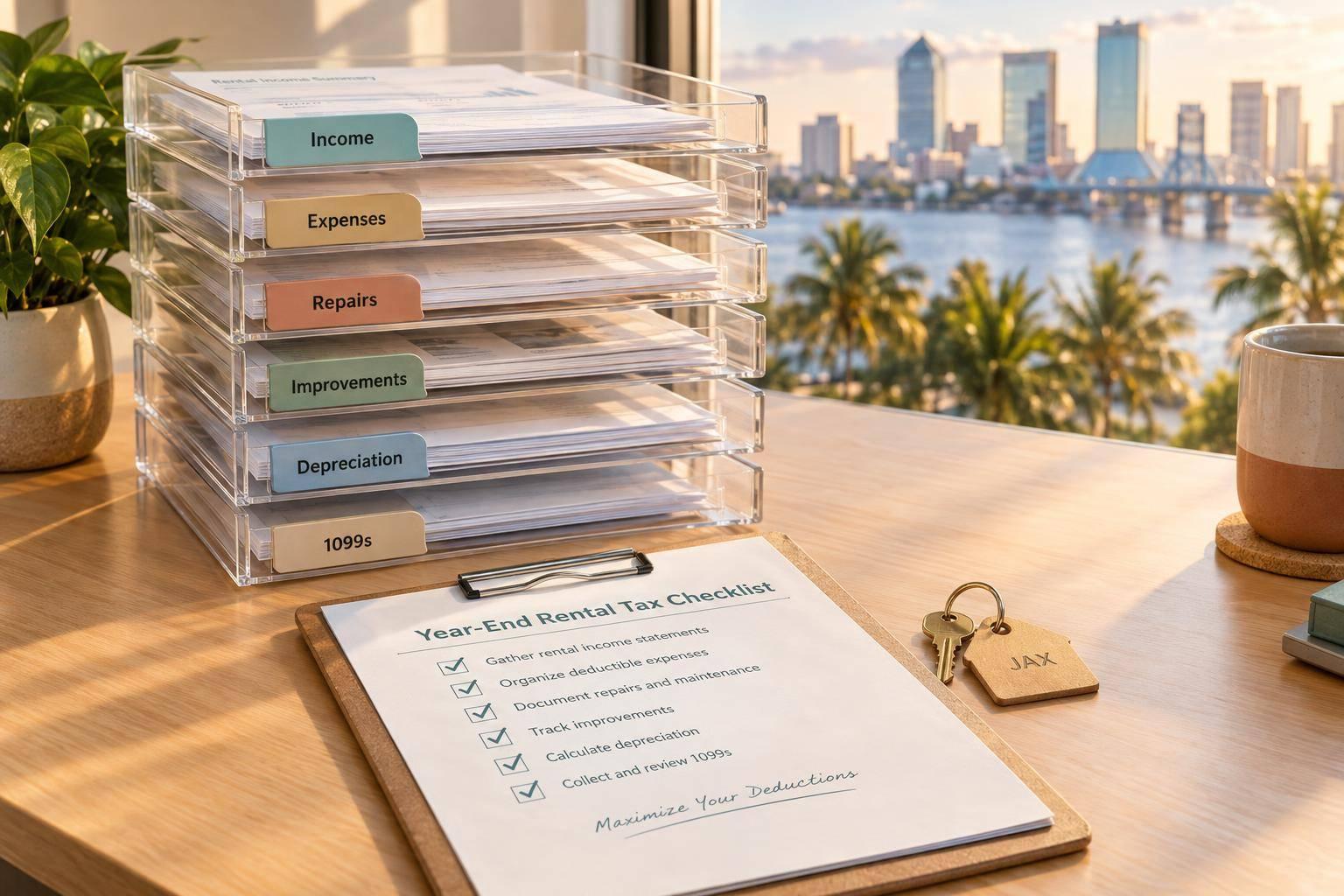
Managing cash flow as a landlord in Jacksonville means staying organized, tracking finances, and planning for challenges unique to the area. Here’s a quick rundown of what you need to know:
- Rent Collection: Use secure online platforms, enforce late fees, and avoid cash payments to ensure steady income.
- Income and Expense Tracking: Open a dedicated bank account, categorize transactions, and consider property management software for accuracy.
- Cost Control: Regularly review maintenance, utilities, and property taxes. Keep a reserve fund for emergencies.
- Tenant Management: Monitor occupancy rates, address late payments immediately, and focus on tenant retention to reduce turnover costs.
- Rental Rates: Research the market every six months and adjust rates based on property condition, location, and demand.
- Financial Records: Digitize receipts, use the right tools for your portfolio size, and prepare for tax filing with detailed documentation.
- Regular Reviews: Conduct monthly, quarterly, and annual financial reviews to catch issues early and ensure profitability.
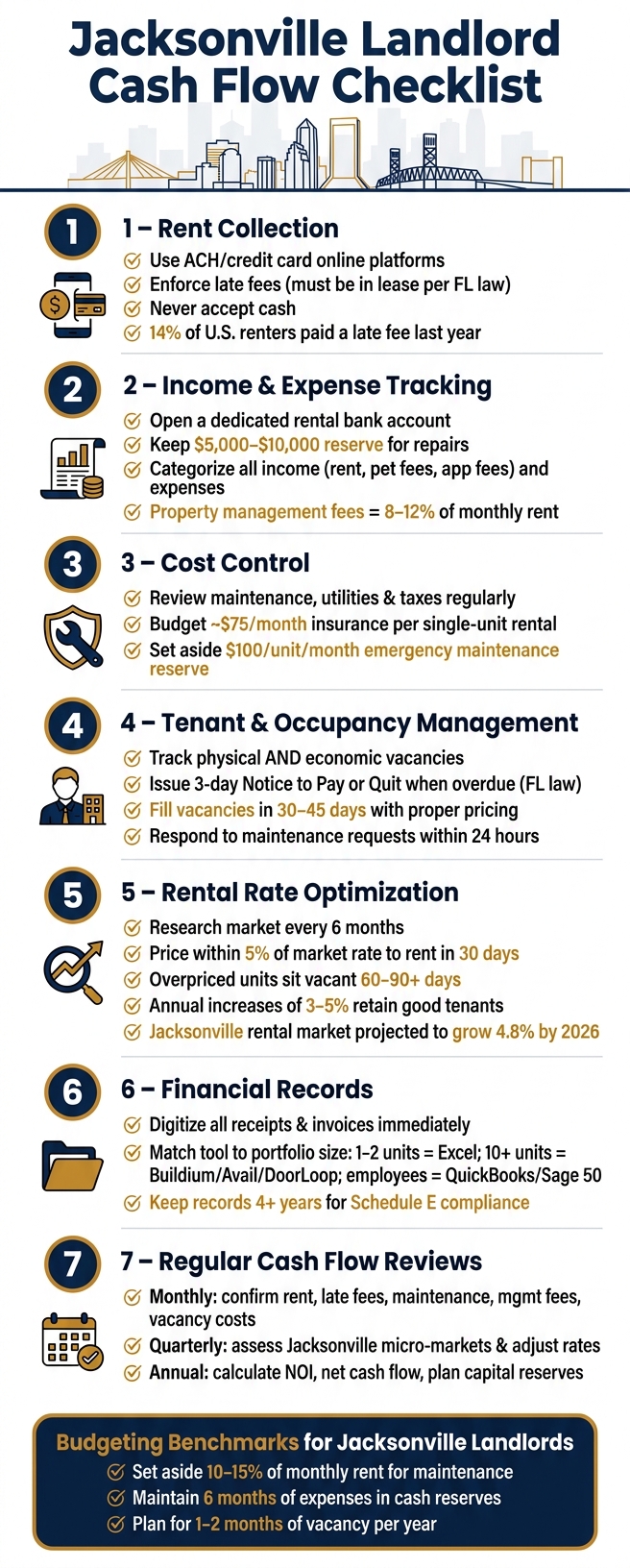
Jacksonville Landlord Cash Flow Checklist: 7 Key Areas
1. Set Up a Reliable Rent Collection System
Inconsistent rent collection can throw your cash flow into chaos. Late payments or untraceable methods not only waste time but also cost you money. A secure, automated payment system ensures steady cash flow and simplifies recordkeeping.
Use a Secure Online Payment Platform
Make paying rent as straightforward as possible.
“The easiest way to collect rent on time is to make paying simple.” – TG Property Management
Choose a platform that supports ACH transfers, credit and debit cards, and offers automatic payment reminders. Look for features like scheduled direct deposits to your account and a detailed transaction history. This history should include rent payments, applied late fees, and outstanding balances. Such records are invaluable during tax season or if any disputes arise.
Set Clear Late Fee and Payment Policies
Your lease agreement must clearly define your rent collection rules. This includes due dates, grace periods, and late fee amounts. In Florida, for example, courts enforce late fees only if they’re explicitly written into the lease.
“In Florida, courts enforce late fees only if they are clearly written into the rental lease agreement.” – TG Property Management
Data from the Consumer Financial Protection Bureau shows that 14% of U.S. renters paid a late fee in the last year. To avoid issues, set a firm due date – typically the 1st of the month – and enforce late fees immediately after the grace period ends. Consistency here is key to maintaining smooth financial management.
Stop Accepting Cash Payments
Cash payments create unnecessary risks. They lack an automatic paper trail, and handwritten receipts can be easily lost or disputed. Clearly state in your lease that cash is not an accepted payment method. This approach not only simplifies recordkeeping but also ensures you can enforce late fees fairly and consistently.
| Feature | Cash Payments | Online Payment Platforms |
|---|---|---|
| Documentation | Manual receipts; easily lost | Automatic digital record-keeping |
| Late Fee Enforcement | Often inconsistent | Automated and reliable |
| Security | Risk of theft or loss | Secure, encrypted transactions |
| Automated Reminders | Requires manual follow-ups | Automatic notifications |
| Audit Readiness | Hard to reconstruct for taxes | Instant tax-ready reports |
A well-structured rent collection system, often managed by a property management company in Jacksonville, not only keeps your finances organized but also ensures a smoother landlord-tenant relationship.
sbb-itb-73b3b1a
2. Track Monthly Income and Expenses
Keeping a detailed record of your monthly transactions is essential for understanding a property’s profitability and maintaining consistent cash flow. Once you’ve got your rent collection system in place, the next step is to get a clear picture of where your money is coming from and where it’s going. Without this information, it’s tough to determine whether your property is actually making money.
Open a Dedicated Bank Account for Rental Income
One of the first steps is to open a separate bank account specifically for your rental income. This makes it easier to calculate your net operating income (NOI) and catch potential issues early. Plus, come tax season, having all your rental transactions in one place makes life a lot simpler.
There’s also a legal aspect to this. For example, Florida law requires that security deposits be kept in a separate account for the tenant’s benefit and not mixed with your other funds. If you’re a first-time landlord in Jacksonville, it’s also smart to keep a reserve of $5,000 to $10,000 in this account to cover repairs, upgrades, or unexpected expenses.
Once your account is set up, it’s time to organize every transaction by categorizing your income and expenses.
Categorize All Income and Expenses
Tracking your rental business finances only works if you organize the data effectively. Categorizing transactions helps you calculate cash flow, identify spending patterns, and stay prepared for taxes.
Your income might go beyond just rent. For instance, you might collect pet fees or application fees. On the expense side, you’ll need to track property management fees (which usually range from 8% to 12% of monthly rent in Jacksonville), maintenance costs like lawn care or HVAC servicing, property taxes, insurance, HOA dues, and contributions to your capital expenditure reserve. Here’s an example of how you might organize these categories:
| Income | Expenses |
|---|---|
| Gross rental income | Property management fees (8–12%) |
| Pet fees | Maintenance & repairs (lawn, pool, HVAC) |
| Application fees | Property taxes & insurance |
| Laundry/vending income | HOA dues & utility payments |
| Capital expenditure reserves |
Once your categories are set, consider using software to simplify and automate the process.
Use Property Management Software
Spreadsheets can work for a while, but they’re prone to errors and can quickly become unmanageable as your business grows. Property management software offers a better solution by automating tasks like income tracking, bank reconciliations, and generating profit and loss statements. For landlords in Jacksonville, teaming up with local experts like 1 Realty Management can give you access to integrated tools and professional advice.
These tools also make it easy to calculate your NOI (gross rental income minus operating expenses), giving you a clear view of your property’s performance. Holly Akins from REI Hub explains:
“The cash flow statement shows us what transactions affected a business’s cash accounts during a set period and how effectively and efficiently a company can use its cash to finance its operations and expansions.” – Holly Akins, REI Hub
One extra tip: track your mileage when driving to properties for inspections or maintenance. It’s a legitimate tax deduction, but you’ll need to keep a log to claim it.
3. Control and Reduce Operating Costs
Once you’ve mapped out your income and expenses, the next step is finding ways to cut costs without sacrificing quality. This approach ensures every dollar is contributing to your financial goals and long-term stability.
Review Utility and Maintenance Costs Regularly
Small increases in utility bills or overlooked maintenance issues can quickly add up. For instance, a minor roof leak left unattended could escalate into a costly repair, straining your cash flow.
“Examine costs such as repairs, management fees, and taxes closely to identify savings.” – Rentastic
Make it a habit to compare your monthly expenses with past records. If you notice a specific expense increasing, investigate it immediately. Regular maintenance – like seasonal check-ups and inspections – can save you money in the long run by preventing emergency repairs. Staying on top of these costs helps you maintain a steady cash flow, which is essential for landlords in Jacksonville.
Budget for Property Taxes and Insurance
Property taxes and insurance may not be monthly expenses, but they can take a big bite out of your profits if you don’t plan for them. For example, a single-unit rental in Jacksonville typically incurs about $75 per month in insurance costs.
Review these expenses at least annually. Insurance premiums can fluctuate due to market conditions or claims history, and Jacksonville’s property tax assessments often change. Accounting for these shifts ahead of time helps protect your profit margins.
Build an Emergency Maintenance Reserve
Set aside around $100 per unit per month for a maintenance reserve. This fund can cover unexpected issues like a broken HVAC system, a failing water heater, or plumbing emergencies. Having this reserve in place ensures that surprise repairs don’t derail your cash flow.
For more tips on managing costs and improving your property’s performance, you can consult 1 Realty Management, a reliable resource for property management services in Jacksonville, Florida.
4. Monitor Occupancy Rates and Tenant Payment Behavior
Keeping an eye on occupancy rates and tenant payment habits is essential to ensure steady cash flow in your Jacksonville rental business. Late payments or empty units can quickly disrupt your finances, so spotting and addressing issues early is key.
Review Rent Roll and Occupancy Data
Your monthly rent roll is a valuable tool for identifying vacancies and payment delinquencies. Pay attention to both physical vacancies (empty units) and economic vacancies (units occupied by tenants who are behind on rent). Both types can harm your profitability, so track them separately and take action as needed.
If your rent roll reveals problems, address them promptly to minimize their impact.
Address Tenant Payment Issues Immediately
When your rent roll flags late payments, act without delay. Following up quickly can prevent these issues from becoming recurring problems.
“Do NOT collect rent in cash. Do NOT accept excuses. Do NOT let late payments slide just this once.” – TG Property Management
Florida law allows landlords to issue a 3-day Notice to Pay or Quit as soon as rent is overdue. Use this tool when necessary, and be diligent about keeping detailed records of payments, notices, and all related communications. These records are invaluable if you need to move forward with evictions in Jacksonville.
Reduce Vacancy Periods
In Jacksonville, filling a vacancy usually takes 30–45 days if you price and market the unit effectively. That’s a significant amount of lost income, making tenant retention just as critical as tenant acquisition.
“Turnover, not repairs, is what destroys cash flow fastest.” – Adam Locklear, 1 Realty Management
To encourage tenants to stay, respond to maintenance requests within 24 hours, maintain open communication, and price your rentals competitively. If a unit does become vacant, use professional photos and detailed listings that highlight the neighborhood’s benefits to attract new tenants quickly. Keeping turnover low and vacancies short is one of the best ways to safeguard your financial health.
5. Review and Adjust Your Rental Rates
Keeping your rental rates aligned with Jacksonville’s ever-changing market is key to maintaining steady cash flow.
Research the Jacksonville Rental Market
Jacksonville is a city of diverse neighborhoods, each with its own rental dynamics. For instance, areas like San Marco, Riverside, and the Beaches often command higher rents compared to neighborhoods like the Northside or Westside. A 2-bedroom unit in Riverside or Avondale might rent for anywhere between $1,200 and $2,000 per month. Meanwhile, a family home in Mandarin or Orange Park could bring in $1,800 to $2,800 per month.
When researching, prioritize recently rented listings over active ones. Why? Active listings often reflect asking prices, not what tenants are actually paying. Regularly conducting this research – at least every six months – can help you stay ahead, especially since Jacksonville’s rental market is projected to grow by 4.8% by 2026.
“Properties priced within 5% of market rate typically rent within 30 days, while overpriced units can sit vacant for 60–90 days or longer.” – ReiToday.Ai
And don’t forget – your property’s condition and features also play a big role in determining rent.
Factor In Property Condition and Amenities
A property’s location may set the baseline for rent, but its condition and amenities can significantly raise – or lower – that number. In Jacksonville, where the climate can be demanding, having a new or energy-efficient HVAC system is a huge plus. Features like in-unit washers and dryers can add $50–$100 to the monthly rent, while a garage might justify an extra $50–$75.
Upgrades like luxury vinyl plank flooring, modern kitchen fixtures, and inviting outdoor spaces can also boost your rental value. On the flip side, issues like scuffed walls, outdated appliances, or neglected landscaping can make your property less appealing. Taking stock of your property’s condition ensures you price it accurately, helping you avoid prolonged vacancies or high tenant turnover.
Avoid Overpricing or Underpricing Your Units
Setting your rent too high could leave your property vacant for 60–90 days, while pricing it too low eats into your profits. The sweet spot is within 5% of the current market rate. Before making changes, consider the costs of tenant turnover. Often, it’s more cost-effective to keep a reliable tenant by implementing a modest annual rent increase of 3%–5%.
If you’re unsure about how to fine-tune your rental rates, reaching out to a local expert can make all the difference. For example, 1 Realty Management offers tailored property management services and market insights to help you stay competitive. Smart rate adjustments not only protect your bottom line but also contribute to long-term financial stability.
6. Keep Accurate Financial Records
Keeping precise financial records is crucial to protecting your income. For example, missing out on $100 in deductions could cost a landlord in a 25% tax bracket an extra $25 in federal income taxes.
Store Receipts and Invoices Digitally
Make it a habit to digitize every repair receipt, vendor invoice, and fee receipt as soon as possible. Digital storage not only keeps your records organized but also makes them searchable and easy to access.
The tool you choose should match the size of your property portfolio. If you manage one or two properties, a basic Excel spreadsheet can handle income and expense tracking. But as your portfolio grows, specialized software becomes a better option. Tools like Buildium, Avail, or DoorLoop cater specifically to landlords, offering features like tenant management alongside financial tracking. For landlords with employees, platforms like QuickBooks or Sage 50 are ideal since they handle payroll and fixed asset tracking that basic property management tools lack.
| Portfolio Size | Tool | Benefit |
|---|---|---|
| 1–2 units | Excel spreadsheet | Simple income/expense tracking |
| Small portfolio | Quicken | Bank syncing, automated reports |
| 10+ units | Buildium / Avail / DoorLoop | Landlord-specific features |
| Landlords with employees | QuickBooks / Sage 50 | Payroll, fixed assets, bank reconciliation |
A helpful tip: connect your chosen software directly to your bank account. Automated syncing minimizes manual entry errors and ensures every transaction is recorded without relying on memory.
Prepare Records for Tax Filing
Once you’ve set up a digital system, ensure it aligns with tax compliance requirements. For landlords, it’s essential to maintain detailed, separate records for each property to meet Schedule E standards.
Supplement your digital ledger with supporting documentation, including receipts, credit card statements, and canceled checks. Report each property’s income and expenses individually on Schedule E and keep these records for at least four years. Additionally, if you’re in Florida, remember that security deposits must be held in a separate account and documented accurately, as the state has specific rules on how these funds should be managed.
Run Regular Financial Audits
Digital recordkeeping is only part of the equation – regular audits help you catch discrepancies early and keep your finances on track.
“Digging into the numbers is an important part of being a landlord. You have to know how much you’re spending and how much you’re bringing in each year to fine-tune your business.”
Follow these four steps during an audit: calculate your gross income (including fees and deducting vacancies), total your operating expenses, subtract expenses to find your net operating income (NOI), and finally, deduct mortgage payments to determine your net cash flow. Performing this analysis quarterly – rather than waiting until year-end – gives you enough time to address any issues and adjust your strategy. Regular audits not only ensure compliance but also help maintain the cash flow stability landlords in Jacksonville rely on. This is especially true in high-demand areas like Southside Jacksonville.
7. Schedule Regular Cash Flow Reviews
Keeping a close eye on cash flow can help you catch small issues before they turn into big financial headaches.
Monthly Income and Expense Reviews
At the start of each month, go through a checklist to ensure your financials are in order. Start by confirming rent collection and documenting all payments. Check that late fees have been applied after the grace period. Don’t forget to account for management fees, which typically range from 8% to 12% of monthly rent in Jacksonville. Florida law requires landlords to maintain habitable properties, so fixed monthly expenses like HVAC, plumbing, and electrical maintenance should always be included. If a unit recently turned over, factor in any marketing or vacancy costs. By focusing on these five key areas – rent collected, late fees, maintenance, management fees, and vacancy costs – you’ll get a clear picture of your monthly cash flow. These insights are essential for planning quarterly and annual assessments.
Quarterly Rental Market Assessments
Jacksonville’s rental market is as diverse as its neighborhoods. Every three months, take time to evaluate the city’s micro-markets. TG Property Management highlights this complexity: “Jacksonville isn’t one rental market but dozens of micro-markets”. Instead of relying on current listing prices, which can be inflated, focus on recently rented properties to get a realistic view of rental rates. If operating costs like insurance, taxes, or maintenance have gone up, check whether your current rent still supports a healthy cash flow. Lease renewals might be a good opportunity to adjust rates if needed. Ideally, a well-priced unit in Jacksonville should rent within 30 to 45 days. If your property is sitting vacant longer than that, it’s time to reassess.
Annual Financial Analysis
Once a year, conduct a full financial review to get a big-picture view of your property’s performance. Start by calculating your NOI (net operating income), which is your total income minus operating expenses. Then subtract your annual mortgage payments to determine your net cash flow. This step is crucial for understanding your property’s profitability. Use this review to plan for major expenses by setting aside reserves for capital improvements. As Eaton Realty puts it, “Understanding cash flow is vital to making smarter decisions about rental properties and investing”. It’s also a good time to compare your rental rates to current market trends in Jacksonville’s micro-markets. If needed, adjust rates for the next lease cycle to ensure your property remains competitive.
If managing these reviews feels overwhelming, consider reaching out to 1 Realty Management for professional financial management services.
Conclusion: Building Financial Stability as a Jacksonville Landlord
Managing cash flow as a landlord requires consistent effort and organization. Successful Jacksonville landlords approach their rental properties as businesses, focusing on key areas like tracking income, thoroughly screening tenants, and addressing maintenance issues without delay. These practices ensure steady rent collection, precise financial records, and well-maintained properties.
Budgeting plays a major role in staying financially stable. Experts recommend setting aside 10% to 15% of your monthly rental income for maintenance costs, keeping cash reserves that cover at least six months of expenses, and preparing for one to two months of vacancy each year. Additionally, thorough tenant screening is critical – it helps prevent disruptions to your cash flow and minimizes the risk of costly issues down the line.
If managing these responsibilities feels overwhelming, consider working with professionals. 1 Realty Management offers property management services in Jacksonville, handling everything from tenant screening and rent collection to financial reporting and maintenance coordination. With a disciplined approach and the right support, you can build and maintain financial stability as a landlord.
FAQs
How much cash reserve should I keep per Jacksonville rental?
It’s a good idea to keep a cash reserve that covers 3–6 months of expenses for your Jacksonville rental property. This should account for costs like mortgage payments, property taxes, insurance, and maintenance. Having this financial cushion can help you handle unexpected expenses and maintain stability.
What’s the best way to handle late rent in Florida?
Setting clear expectations from the start is the most effective way to address late rent in Florida. Make sure tenants are aware of the rent due date – commonly the 1st of the month – and emphasize the importance of timely payments. It’s also wise to avoid accepting excuses or cash payments, as this ensures accurate record-keeping. By establishing these guidelines early on, you can promote consistent rent collection and reduce the likelihood of late payment problems.
How often should I adjust rent in Jacksonville?
Rent adjustments in Jacksonville usually happen once a year or as stated in the lease agreement. This approach ensures rates stay in line with market trends and support profitability. The specific timing often depends on local market factors and the details outlined in your lease.