Want to boost your rental property income in Florida? Start by focusing on tenant-friendly upgrades, efficient pricing, and smart management strategies tailored for Jacksonville’s market. Here’s a quick rundown of actionable steps:
- Target high-demand neighborhoods like Riverside, Mandarin, or Jacksonville Beach for steady rental income.
- Use proven tenant screening strategies to avoid late payments and costly evictions.
- Price rentals accurately using local market data to minimize vacancies.
- Improve marketing with professional photos and local platforms for faster occupancy.
- Negotiate vendor rates to reduce maintenance costs.
- Leverage Florida tax benefits like depreciation and deductions for higher savings.
- Schedule preventive maintenance to avoid expensive repairs.
- Work with property managers to streamline operations and stay compliant.
- Consider short-term or room rentals to capitalize on Jacksonville’s visitor demand.
- Invest in turnkey properties for immediate cash flow with minimal effort.
Each strategy is designed to help you optimize income, minimize costs, and maintain consistent cash flow in Florida’s competitive rental market.
Self-Management vs Professional Property Management for Jacksonville Rentals
1. Choose High-Performing Jacksonville Neighborhoods
Impact on Cash Flow
When it comes to real estate, location is everything. A well-chosen neighborhood can mean steady rental income, while a poor choice might lead to long vacancies. In Jacksonville, the 1% rule is a helpful guideline: for a property priced at $200,000, you should aim for $2,000 in monthly rent.
Certain Jacksonville neighborhoods stand out for their rental potential. Coastal areas like Neptune Beach, Atlantic Beach, Ponte Vedra, and Jacksonville Beach are particularly appealing. These spots attract tenants willing to pay higher rents for easy beach access and desirable lifestyle perks. If you’re targeting families, neighborhoods like Mandarin and Orange Park offer rents ranging from $1,800 to $2,800 per month. Meanwhile, areas like Downtown and Riverside are popular with young professionals and urban dwellers, with rents typically between $1,200 and $2,000.
These trends highlight Jacksonville’s unique rental market dynamics.
Relevance to Jacksonville/Florida-Specific Market Conditions
Jacksonville benefits from stable rental demand, thanks to its major employers. Properties near key hubs like Naval Air Station Jacksonville, Mayo Clinic, and CSX Corporation tend to stay occupied because of their proximity to these workplaces. Military families, in particular, drive a surge in relocations from October through April, while summer often brings families looking for suburban rentals before the school year begins.
Vacancy rates in Jacksonville neighborhoods typically range from 8% to 12%. Opting for areas with lower vacancy rates can help minimize downtime between tenants, ensuring more consistent cash flow. Smaller residential properties – such as single-family homes, condos, townhomes, or 2-4 unit buildings – are worth considering. These types of properties often deliver better rent-to-value ratios compared to larger investments.
sbb-itb-73b3b1a
2. Screen Tenants Thoroughly
Impact on Cash Flow
Reliable tenants are key to maintaining steady rental income. When you select tenants who pay on time and respect the property, you minimize the risks of income disruptions caused by late payments, evictions, or frequent tenant turnover. Each vacancy comes with unavoidable costs like lost rent, marketing expenses, and time spent finding a replacement.
Evictions, in particular, can be a major financial drain. Legal fees, accounting costs, and the time it takes to resolve the situation can significantly cut into your net operating income.
By thoroughly screening tenants upfront, you can reduce the likelihood of these expensive setbacks.
Ease of Implementation for Landlords
A well-organized screening process is essential for landlords. Property management software can simplify tasks like running credit and background checks, verifying income, and contacting rental references. It’s important to confirm that applicants earn enough to comfortably afford the rent and to check with previous landlords for any history of property damage or lease violations. Having a standardized set of screening criteria not only speeds up the process but also helps you stay legally compliant and avoid discrimination claims.
Streamlining tenant screening not only saves time but also lays the groundwork for other strategies to boost cash flow in Florida’s competitive rental market.
Compliance with Florida Rental Regulations
Tenant screening in Florida must adhere to the state’s rental regulations. Partnering with professional property managers can help ensure compliance, protecting you from potential legal issues. Staying within the bounds of these regulations safeguards your property and contributes to a consistent income stream.
“Taking the time to screen properly helps reduce turnover, protect your investment, and ensure a steady income stream for your Florida rental property.” – Suncoast Property Management
Efficient screening allows you to quickly identify trustworthy tenants, reducing vacancy periods while maintaining high standards for your rental property.
3. Price Your Rental Using Local Market Data
Impact on Cash Flow
Getting your rental price right has a direct impact on your earnings. Here’s why: if you overprice your unit by just $200 a month, it might sit vacant for two months. That’s $3,600 of lost rent. To make up for that loss, you’d need 18 months of collecting that extra $200. On the flip side, underpricing by $200 a month means losing $2,400 annually.
Typically, pricing your rental within 5% of the market rate results in leasing within 30 days. Overpriced units, though, often remain vacant for 60 to 90 days. If your property sits empty for more than 60 days, it’s a strong indicator that your price is too high.
Relevance to Jacksonville/Florida-Specific Market Conditions
Jacksonville’s rental market isn’t one-size-fits-all. It’s a collection of smaller, distinct markets, each with its own pricing trends. For example, Riverside attracts young professionals who are willing to pay between $1,200 and $2,000 per month for an urban lifestyle. Meanwhile, suburban areas like Mandarin and Orange Park cater to families, with rents ranging from $1,800 to $2,800. Premium neighborhoods like San Marco average $2,125 for a one-bedroom unit, while Springfield offers much lower rates, averaging $749.
Central air conditioning is a must-have in Jacksonville. Without it, your property will be much harder to rent. Other features, like in-unit washers and dryers, can justify an extra $50 to $100 a month, and having a garage can add $50 to $75. Rental demand also fluctuates throughout the year. Summer is prime time as families move before the school year starts, while a secondary demand spike happens from October to April, driven by military relocations to Naval Air Station Jacksonville and retirees.
Ease of Implementation for Landlords
To price your rental effectively, focus on what properties have actually rented for, not just the asking prices you see online. Active listings can often reflect overpriced units that tenants have passed over. Tools like Rentometer or Zillow’s rental history features can help you find real lease prices. For even more precise data, local property managers with access to MLS rental records can provide insights into what tenants are paying.
It’s also smart to revisit your rental pricing every six months. Jacksonville’s market changes rapidly due to new developments and shifts in local employers. And before you raise the rent, think about the cost of turnover. Keeping a good tenant often saves more money than pushing for a higher rent.
Accurate pricing isn’t just about getting tenants – it’s an essential piece of the puzzle for maximizing your rental income in Jacksonville. It ties in perfectly with strategies like tenant screening and choosing the right neighborhood, helping you build a solid approach to boost cash flow.
4. Reduce Vacancy with Better Marketing
Impact on Cash Flow
After setting the right price and carefully screening tenants, better marketing can speed up occupancy and stabilize your cash flow. Every day your property sits empty costs you money – around $50 per day on a $1,500 monthly rental. Spending an extra $100 on marketing might delay filling the unit by a month, resulting in a $1,500 loss – far outweighing the $1,200 annual gain.
High-quality marketing tools like professional photography can make a big difference. Listings with professional photos can see up to a 40% increase in inquiries. This is particularly important in Jacksonville, where vacancy rates hover between 8% and 12%, depending on the neighborhood. Effective marketing not only helps you fill units faster but also ensures a steady cash flow.
Ease of Implementation for Landlords
Reaching potential tenants doesn’t have to be complicated. Use major platforms like Zillow and Apartments.com, but don’t overlook local options. Facebook groups such as “Jacksonville Rental Homes” or “Duval County Rentals” can connect you with renters actively searching in the area. If your property is near Naval Air Station Jacksonville, military housing groups and personal referrals can work particularly well.
Quick responses are key. Aim to reply to inquiries within 2–4 hours and schedule showings within 24 hours to avoid losing prospective tenants. If your listing isn’t generating at least five inquiries in two weeks, try reducing your price by 3% to 5% or upgrading your photos. Timing also matters – posting your property on a Thursday or Friday can attract more weekend traffic. Adapting these strategies to Jacksonville’s diverse neighborhoods can improve your results even further.
Relevance to Jacksonville/Florida-Specific Market Conditions
Jacksonville tenants often look for features that address the area’s climate and lifestyle. Highlight energy-efficient HVAC systems, which are essential for Florida’s humid summers, and features like hurricane shutters or storm doors for weather protection. Outdoor spaces are another big draw – whether it’s a patio, balcony, or fenced yard, these are highly valued in the Sunshine State. Using location-specific phrases like “near UNF”, “beach access”, “Town Center”, or “downtown walking distance” can also help your listing stand out.
Different areas of Jacksonville attract different types of renters. For example, Riverside and Avondale are popular with professionals who enjoy walkable neighborhoods and historic charm. Meanwhile, suburbs like Mandarin and Fleming Island appeal to families looking for good schools and larger yards. Properties near the beaches can benefit from emphasizing unique features like outdoor showers or hurricane-resistant upgrades. Adjust your marketing to reflect what local renters want, and you’ll fill vacancies faster while keeping your income consistent.
5. Lower Operating Costs Through Vendor Negotiations
Impact on Cash Flow
Vendor expenses – like landscaping, HVAC repairs, roofing, and plumbing – can quickly eat into your monthly rental income. By negotiating better rates with vendors, you can achieve noticeable annual savings. Interestingly, during times of economic uncertainty, about 64% of businesses report an increase in supplier renegotiations as vendors become more flexible to retain long-term customers. This creates an opportunity for Jacksonville landlords to secure better deals while building dependable vendor relationships.
Negotiation isn’t solely about cutting costs. You can also discuss extended payment terms, such as Net 60 or Net 90, to help manage cash flow during tenant vacancies. Additionally, negotiating for extended warranties or service level agreements (SLAs) can protect against unexpected expenses, reducing financial risks in the long run.
Ease of Implementation for Landlords
To start, gather at least three quotes for any service – whether it’s landscaping, roofing, or HVAC work. This gives you a competitive edge and leverage during negotiations. Use the “70/30 rule” – listen 70% of the time and speak 30% – to better understand vendor priorities and uncover areas where savings might be possible. Offering testimonials or referrals in return for better pricing can also work to your advantage.
Keep track of all operating expenses using property management software or even simple spreadsheets. Clear, organized data on past spending helps you identify trends and negotiate based on recurring needs or volume. If you manage multiple properties, consider bundling non-urgent repairs together to negotiate bulk discounts with local contractors. Furthermore, professional property management firms in Jacksonville often have access to pre-vetted vendor networks with preferred pricing due to their high volume of work. This strategy aligns with earlier efforts to maximize income by reducing operating costs.
Relevance to Jacksonville/Florida-Specific Market Conditions
In Jacksonville, managing vendor expenses is crucial for maintaining a profitable rental portfolio. The local environment presents unique challenges, such as storm preparation and flood risks, which make reliable and cost-effective vendors essential. When negotiating contracts, address these risks directly. For instance, include terms that specify storm response times to ensure vendors meet the demands of seasonal weather challenges. Use local data on labor and material costs to keep negotiations grounded and avoid making decisions based on emotion. Regular maintenance is especially important in coastal areas like Atlantic Beach and Neptune Beach, where salt air and moisture accelerate wear and tear.
6. Use Florida Tax Deductions and Depreciation
Impact on Cash Flow
One of the perks of being a landlord in Florida? No state income tax on rental income. That means you only have to deal with federal taxes, which simplifies things and leaves more money in your pocket. But the real game-changer is depreciation – a non-cash deduction that lowers your taxable income.
Let’s break it down: If you buy a property for $350,000 and allocate $70,000 to the land, the remaining $280,000 is depreciable. Spread over 27.5 years, you’re looking at an annual depreciation of about $10,182. If you’re in the 22% federal tax bracket, that translates to roughly $2,240 in tax savings every year. And that’s just from depreciation. You can also deduct other expenses like:
- Mortgage interest
- Property taxes
- Insurance premiums (including flood and wind coverage)
- Repairs and maintenance
- HOA fees
- Property management fees (typically 8% to 12% of monthly rent)
“Depreciation allows you to deduct the cost of your residential rental property (excluding land) over 27.5 years. This creates a significant tax deduction even though it doesn’t represent an out-of-pocket expense.” – Stessa
There’s more: Thanks to the “One Big Beautiful Bill Act” signed in July 2025, you can fully deduct qualifying property improvements acquired after January 19, 2025, in the first year instead of spreading the cost over several years. This includes expenses like appliances, furniture, and landscaping. Plus, with the SALT cap raised to $40,000 in 2025, property taxes on rentals can be deducted as business expenses, sidestepping personal limitations.
These tax breaks not only improve your cash flow but also highlight the importance of keeping detailed records – something we’ll touch on next.
Ease of Implementation for Landlords
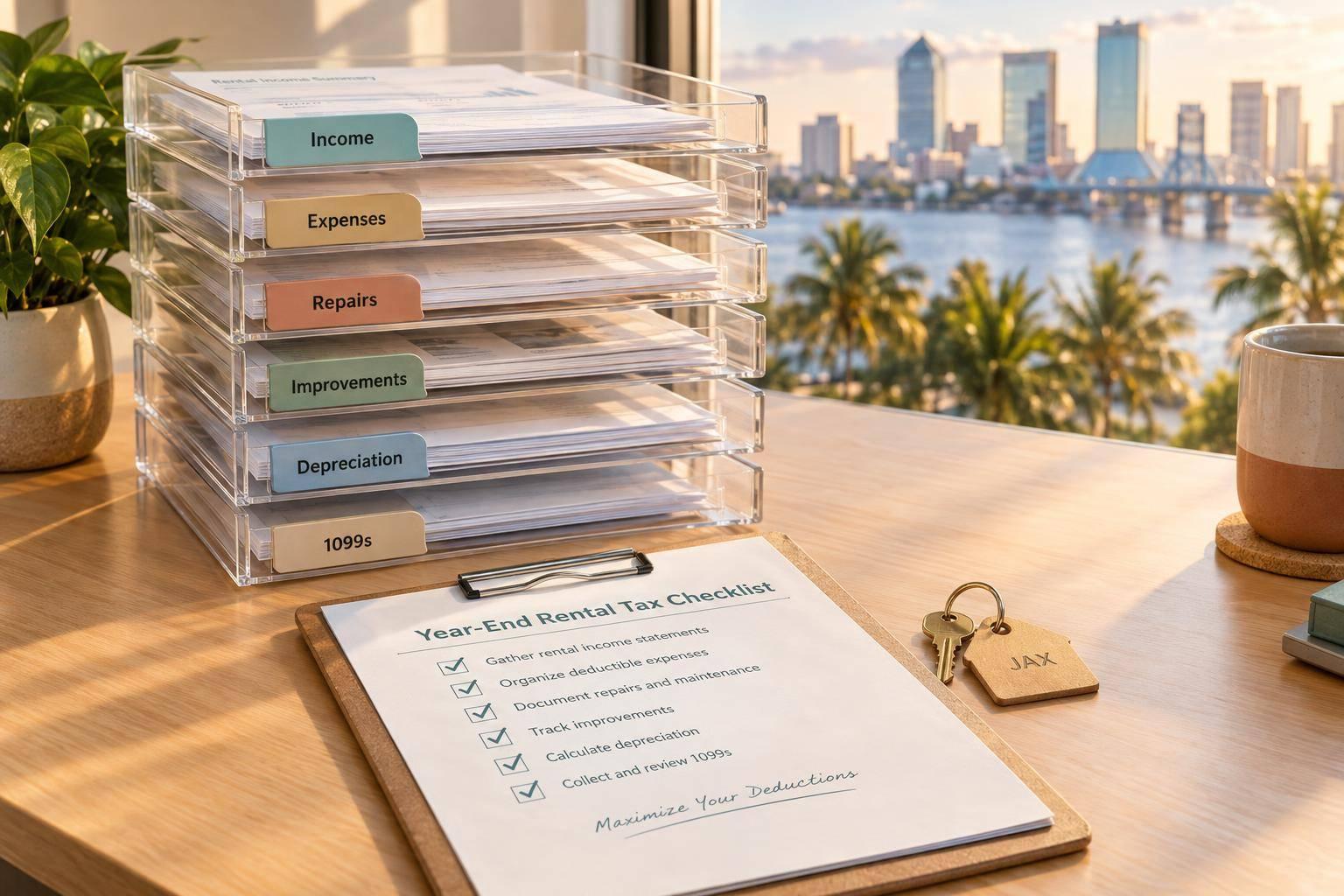
Start by separating the land value from the building value using your property tax assessments – remember, only the building portion is depreciable. Use property management software to track expenses and generate tax-ready financial reports organized by Schedule E categories. This way, you won’t miss smaller deductions like travel expenses for inspections, advertising, or pest control.
It’s also crucial to distinguish between repairs and improvements. Repairs, like fixing a broken AC unit, are deductible in the current year, while improvements, such as replacing an entire roof, must be depreciated over time. Keep digital copies of all receipts for easy access. For properties valued over $500,000, consider hiring a specialist for a cost segregation study (costing $5,000 to $15,000) to reclassify components into assets with shorter depreciation periods.
When paired with effective tenant screening and competitive pricing, these tax strategies can play a major role in boosting your rental income in Jacksonville.
Relevance to Jacksonville/Florida-Specific Market Conditions
Florida’s unique conditions make these deductions even more valuable for Jacksonville landlords. For example, insurance premiums for wind, flood, and hurricane coverage – often higher in Florida – are fully deductible, helping offset these costs. Additionally, capital improvements tailored to Florida’s climate, like hurricane-impact windows and reinforced garage doors, can be depreciated while protecting your property from severe weather.
If you’re renting properties for six months or less, you’ll need to collect and remit a 6% state sales tax, along with any local discretionary surtaxes and Tourist Development Tax (TDT), to the Florida Department of Revenue. Be sure to register with both the state and your local county tax collector to avoid penalties. While Florida’s Homestead Exemption doesn’t apply to rental properties, the state does limit annual assessment increases on non-homestead properties to 10%, protecting you from sudden tax spikes.
7. Schedule Regular Preventive Maintenance
Impact on Cash Flow
Preventive maintenance is one of the smartest ways to protect your bottom line. By addressing small issues early, you can avoid the kind of costly repairs that can seriously dent your profits. For instance, fixing a minor roof leak promptly can save you from dealing with extensive water damage or mold remediation later.
“Schedule preventative maintenance to avoid major repairs” – Suncoast Property Management
Regular maintenance also helps justify rent increases and draws in reliable tenants. Simple updates – like a fresh coat of paint, modern fixtures, or well-kept landscaping – can make your property more attractive. Many investors aim for $100 to $200 in positive monthly cash flow per unit after expenses, but skipping routine upkeep can quickly eat into those margins. This is especially true in Jacksonville neighborhoods with older infrastructure, where maintenance lapses can lead to unexpected and expensive problems. By staying ahead of potential issues, you not only protect your investment but also make maintenance planning more predictable.
Ease of Implementation for Landlords
Getting started with preventive maintenance is easier than you might think. A simple maintenance calendar tailored to Florida’s seasonal needs is a great place to begin. Plan for regular inspections: twice-yearly HVAC checkups, roof inspections before hurricane season, and periodic plumbing reviews. These steps ensure your property’s systems are running smoothly year-round.
Property management software like Buildium or AppFolio can help you track maintenance tasks and expenses. These tools are a natural extension of earlier strategies for streamlining rental management. For landlords managing multiple properties, partnering with a professional property manager can be a game-changer. They can handle scheduling, ensure compliance with Florida regulations, and coordinate tasks efficiently.
Budgeting for biannual inspections and using digital tools to log maintenance costs can help you stay organized while planning for future improvements. In Florida’s competitive rental market, preventive maintenance is key to maintaining steady, reliable income.
Relevance to Jacksonville/Florida-Specific Market Conditions
Preventive maintenance is especially important in Jacksonville, where the weather and tenant expectations demand extra care. Florida’s humid subtropical climate means HVAC systems need consistent servicing to handle the heat of Jacksonville summers. Preparing for hurricane season is also critical – inspect storm shutters, reinforce garage doors, and check roof integrity well ahead of time.
Pest control is another must-do, given Florida’s warm, humid conditions that attract termites, roaches, and mosquitoes. Jacksonville renters also place a high value on outdoor spaces and fenced yards. Keeping up with landscaping, irrigation systems, and fence repairs can make your property stand out. These efforts not only enhance the appeal of your property but also align with the unique demands of the Jacksonville market.
8. Work with Professional Property Managers
Impact on Cash Flow
Teaming up with professional property managers can make a noticeable difference in your rental property’s cash flow. These experts bring a wealth of knowledge in tenant management and legal compliance, ensuring your rental income is handled efficiently. They excel at reducing vacancies by leveraging local marketing strategies, professional photography, and quick responses to inquiries. Additionally, they use local market data to set competitive rent prices, striking a balance between high occupancy rates and maximum income.
Another way property managers improve cash flow is by retaining reliable tenants. High tenant turnover leads to extra costs, including lost rent, marketing expenses, and repairs. Professional managers work to keep good tenants satisfied, encouraging lease renewals. They also take care of rent collection, property maintenance, and financial reporting, minimizing errors that can come with self-management. As Randy, a Jacksonville property owner, explained:
“Handles my property management so well. I forget I own the place. I just get a check in my bank account.”
Ease of Implementation for Landlords
Getting started with professional property management is simple and often worth the investment. In Jacksonville, management fees usually range from 8% to 12% of the monthly rent, with extra charges for tenant placement and lease renewals. However, these fees are often offset by improved rent collection, reduced vacancy periods, and discounts negotiated with vendors.
When selecting a property manager, look for clear fee structures and local expertise. For instance, 1 Realty Management has over 45 years of experience in Jacksonville, managing assets worth over $50 million. They provide full-service management and specialized options like PadSplit, which focuses on rent-per-room arrangements that can boost cash flow for certain properties. A good property manager will understand Jacksonville’s diverse neighborhoods – whether it’s catering to young professionals in Riverside, families in Mandarin, or military personnel near NAS Jax. They also ensure all operations follow Florida’s regulations, safeguarding your investment.
Compliance with Florida Rental Regulations
Beyond improving operations, professional property managers help protect you from legal risks. They ensure full compliance with Florida’s landlord-tenant laws, handling lease agreements, security deposits, eviction notices, and other legal requirements. As Suncoast Property Management points out:
“Legal risk is one of the most overlooked challenges of rental property ownership in Florida… even small compliance mistakes can quickly lead to [losses].”
Property managers also ensure your property meets health and safety standards, manage evictions properly, and keep you out of court. They handle property taxes, insurance, and tax filings, guiding you through deductions and depreciation to maximize profits. This legal expertise not only protects your investment but also provides peace of mind, especially if you own multiple properties or live out of state.
9. Add Income with Short-Term or Room Rentals
If you’re looking to diversify your income streams, short-term or room rentals can be a smart addition to your strategy. This approach builds on maintaining steady occupancy and tenant retention while tapping into a growing demand for flexible rental options.
Impact on Cash Flow
Switching to short-term or room rentals can significantly boost your monthly income. Jacksonville sees about 8 million overnight visitors annually, creating a strong market for vacation rentals. Larger properties with four or five bedrooms tend to bring in the most revenue due to their ability to accommodate more guests and command higher nightly rates. On the other hand, smaller one-bedroom units are great for maintaining high occupancy, especially with solo travelers and last-minute bookings.
The financial upside is clear. Vacation rentals often achieve gross profit margins between 40–60% and net profit margins ranging from 25–45%. Annual returns typically fall between 15–25%. Jacksonville’s seasonal trends also play a role in this profitability, with peak demand running from spring through July. Properties offering perks like private pools, modern outdoor spaces, or beach gear often fetch higher nightly rates.
Ease of Implementation for Landlords
Jacksonville offers an accessible entry point for landlords interested in short-term rentals. With an average home list price of around $279,000 – well below the national average – investors can avoid the hefty premiums common in other coastal markets. Targeting high-demand areas like the St. Johns River, Jacksonville Beach, or Neptune Beach can help maximize bookings.
To attract guests, focus on essential amenities. Features like central air conditioning, a fully equipped kitchen, and high-speed internet are must-haves. However, keep in mind the costs associated with cleaning and maintenance, which typically account for 15–25% of revenue. Additional expenses, such as platform fees and marketing, range from 8–15%. Managing these rentals can also be time-intensive, requiring roughly 100 hours of work for every $10,000 in gross revenue. Before diving in, make sure to review Jacksonville’s specific short-term rental rules to ensure compliance.
Relevance to Jacksonville/Florida-Specific Market Conditions
Jacksonville’s 22 miles of coastline and vibrant downtown create year-round demand for short-term rentals. The city’s revitalized downtown area and attractions like the Jacksonville Zoo appeal to a variety of travelers, including families, couples, business visitors, and solo adventurers. As Evolve notes:
“Jacksonville has quietly become one of Florida’s most dynamic vacation rental markets.”
While two- and three-bedroom homes dominate the local inventory due to their balance of price and performance, larger four- and five-bedroom properties are relatively scarce and often command higher rates. If you’re not ready for a full property conversion, offering room rentals within your home can be a flexible alternative. Plus, if you’re living on-site, you won’t need a state license from the Florida Department of Business and Professional Regulation.
Compliance with Florida Rental Regulations
Navigating Florida’s rental regulations is essential. Renting an entire unit more than three times a year for stays under 30 days requires a DBPR license, which includes a $50 application fee and a $170 annual license fee. In Jacksonville Beach, you’ll also need a Short-Term Vacation Rental Certificate ($150 for initial and annual registration) and a Local Business Tax Receipt ($79.20 annually).
Other requirements include registering for the Duval County Tourist Tax and obtaining a Florida Department of Revenue Certificate. Additionally, scheduling a fire safety inspection with the Fire Marshal is critical to avoid a $100 “no show” fee. Keep in mind, if you rent out more than 50% of an owner-occupied property, it could affect your eligibility for Florida’s Homestead Exemption. Lastly, always check your HOA rules and CC&Rs, as they might restrict or prohibit short-term rentals even if local zoning laws allow them.
10. Invest in Turnkey and Build-to-Rent Properties
Impact on Cash Flow
Turnkey properties can generate cash flow right away by skipping over common delays like renovations and tenant searches. These properties are typically move-in ready, with renovations completed and tenants already in place. This setup eliminates the vacancy period that often delays the first rent payment. Many turnkey investments also include professional property management, making them especially appealing for out-of-state investors or landlords juggling multiple properties.
Ease of Implementation for Landlords
Jacksonville stands out as an ideal market for turnkey investments due to its affordable property prices and a steady demand for rentals. The city attracts a diverse group of renters, including military families, healthcare workers, logistics professionals, and students. TG Property Management highlights the appeal of turnkey rentals:
“Turnkey rentals aren’t magic. But they remove the biggest stress points: construction delays, tenant searches, and early repairs that eat into cash flow.”
That said, thorough due diligence is still crucial. Check the quality of renovations by inspecting key systems like HVAC, roofing, plumbing, and electrical work. If a property includes an existing tenant, review their payment history and confirm that the rent matches current market rates. These steps ensure that the process remains as seamless as advertised.
Relevance to Jacksonville/Florida-Specific Market Conditions
Jacksonville offers an environment well-suited for turnkey and build-to-rent properties. The city’s housing market has shown steady appreciation and avoids the extreme price fluctuations seen in other Florida coastal areas. A strong local economy – bolstered by industries like healthcare, logistics, finance, and a significant military presence – supports stable rental demand. Many investors who previously focused on Tampa or Orlando are now turning to Jacksonville, drawn by rising rents and consistent population growth. TG Property Management emphasizes this point:
“Jacksonville’s rental demand is strong, and that’s why turnkey rentals work so well here. Homes don’t sit empty, and investors don’t waste time waiting for tenants.”
When choosing turnkey properties, prioritize neighborhoods with long-term appeal. Look for areas near good schools and major highways to ensure consistent tenant interest. This approach taps into Jacksonville’s strengths, making it easier to secure steady rental income.
Compliance with Florida Rental Regulations
To protect your investment, it’s important to understand Florida’s tax rules and benefits. Florida’s lack of a state income tax means rental income is only taxed at the federal level, allowing you to keep more of your earnings. You can also claim federal deductions for expenses like mortgage interest, property management fees, insurance, advertising, and maintenance. Depreciation – a tax benefit that lets you deduct the property’s cost over its useful life – can be particularly advantageous for turnkey and build-to-rent properties.
If you’re using the property as a short-term rental (less than six months), you’ll need to collect and remit Florida state sales tax along with local tourist development taxes, such as those in Duval County. Professional property managers can help ensure compliance and maintain detailed records, which is key to maximizing your tax deductions.
Comparison Table
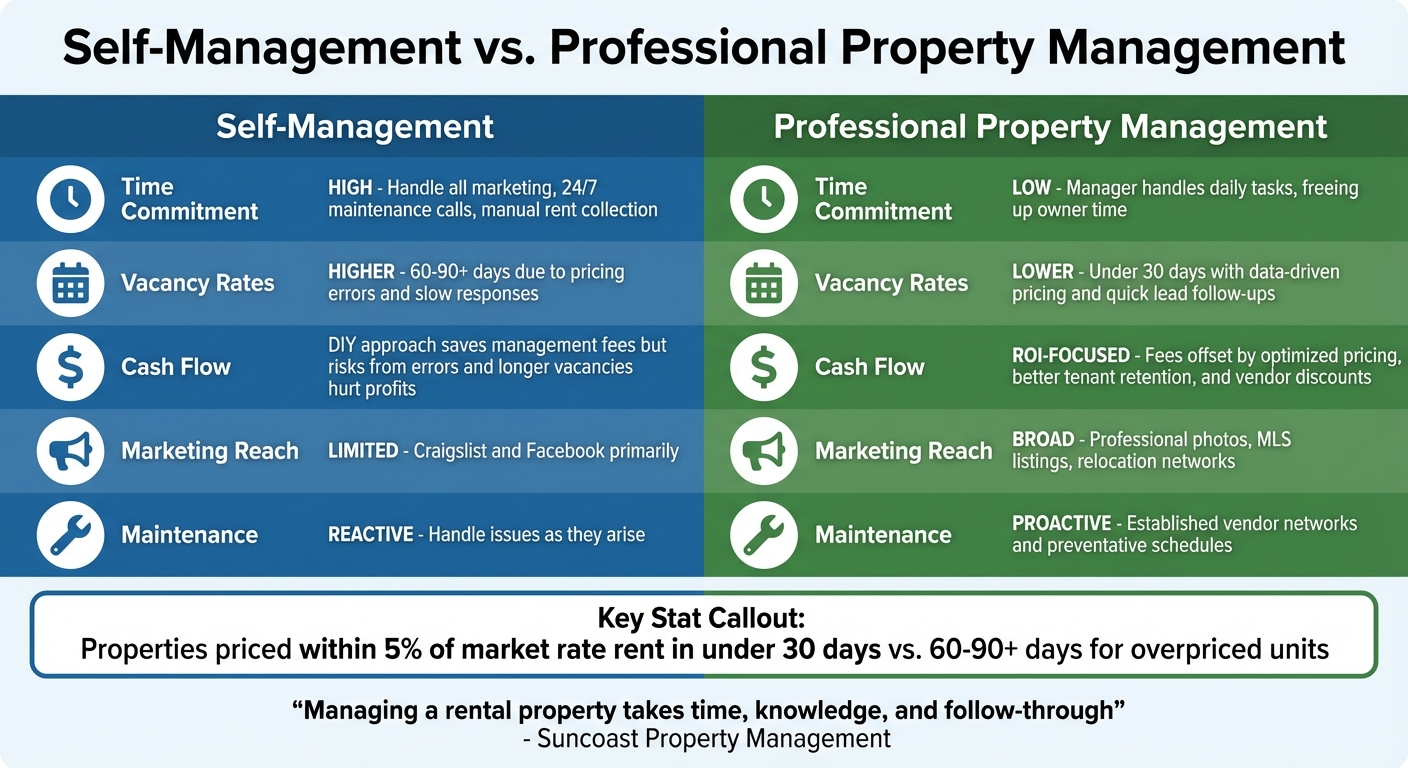
Deciding whether to manage your Jacksonville rental property yourself or hire a professional service can have a big impact on your time, vacancy rates, and overall cash flow. The table below highlights the key differences, drawing on real data from the Jacksonville market.
| Feature | Self-Management | Professional Property Management |
|---|---|---|
| Time Commitment | High: You’re responsible for everything – marketing, handling maintenance calls 24/7, and collecting rent manually. | Low: A property manager takes care of daily tasks, freeing you up to focus on bigger-picture decisions. |
| Vacancy Rates | Often higher: Vacancies can stretch to 60–90+ days due to pricing mistakes or slow responses. | Lower: Vacancies usually last less than 30 days thanks to data-driven pricing and quick lead follow-ups. |
| Cash Flow | DIY: While you save on management fees, risks from errors and longer vacancies can hurt profits. | ROI-focused: Fees are offset by benefits like optimized pricing, better tenant retention, and vendor discounts. |
| Marketing Reach | Limited: Tools like Craigslist or Facebook are often the go-to. | Broad: Includes professional photos, MLS listings, and relocation networks. |
| Maintenance | DIY: Maintenance is handled reactively, as issues arise. | Proactive: Uses established vendor networks and preventative maintenance schedules. |
Efficient management is essential to keeping rental income steady. For instance, properties priced within 5% of the market rate tend to rent out in under 30 days, while overpriced units can sit vacant for 60 to 90 days – or even longer.
“Managing a rental property takes time, knowledge, and follow-through”.
Becky House from Suncoast Property Management highlights this reality. While managing your property yourself might save you the cost of a management fee, it requires a significant time investment and increases the chances of extended vacancies or legal challenges. Suncoast Property Management also emphasizes that professional services bring “added efficiency”, resulting in “fewer mistakes, faster response times, and better overall results for your property”.
This breakdown makes it clear: professional management simplifies operations and reduces risks, aligning with the strategies discussed earlier.
Conclusion
Boosting rental cash flow in Jacksonville comes down to smart pricing, thoughtful upgrades, and efficient tenant management. Pricing your property within 5% of the market rate and installing energy-efficient HVAC systems can make a huge difference. These steps address key factors that determine whether your property rents quickly – within 30 days – or sits vacant for 60–90 days.
Vacancies are costly. Just two months without a tenant can take a big bite out of your profits. Proactive maintenance also plays a crucial role in avoiding expensive, last-minute repairs. As Becky House from Suncoast Property Management explains:
“Learning how to maximize rental income isn’t just about raising the rent – it’s about making smart, strategic decisions that increase rental property revenue over time”.
Jacksonville’s rental market is constantly shifting, but it also offers unique opportunities for landlords who stay flexible and informed. Whether you’re renting out downtown lofts that go for $1,200–$2,000 a month or family homes in Mandarin priced at $1,800–$2,800, knowing the local demographics and seasonal trends can help you avoid long vacancies and maintain steady cash flow.
The key is choosing a management approach that reduces risks while keeping operations efficient. In Jacksonville’s competitive market, landlords who act quickly and rely on solid local data – not guesswork – are the ones who succeed.
Start by tackling your biggest hurdles: cutting down on vacancies, managing costs, and improving tenant retention. Each step strengthens your overall strategy, creating a reliable system that safeguards your investment and ensures steady income in Florida’s ever-changing rental landscape.
FAQs
How do I estimate my true cash flow after all expenses?
To figure out your actual cash flow, start by subtracting all your expenses from your rental income. Be sure to include everything – mortgage payments, property management fees, maintenance costs, taxes, insurance, and even those unexpected expenses that tend to pop up.
This simple calculation reveals your net cash flow, giving you a clear picture of your property’s profitability. With this insight, you can make smarter decisions to boost the financial health of your rental property.
When does hiring a property manager pay for itself in Jacksonville?
Hiring a property manager in Jacksonville can be a smart investment. The key is when the additional rental income and cost savings they bring in exceed their management fees. This is especially true for properties with strong cash flow, like high-value rentals or multi-unit buildings, where professional oversight can boost both efficiency and profitability.
Do I need a license or extra taxes for short-term rentals in Duval County?
If you’re planning to rent out a property in Jacksonville for less than 30 days, you’ll need to secure a short-term rental license from the Department of Business and Professional Regulation. Additionally, you’ll need a business tax receipt from Duval County. Florida law also requires you to collect sales tax on short-term rentals. Make sure to meet these requirements to stay compliant and avoid any penalties.