I’d rent by the room only if the extra income covers the extra costs and work. Separate leases can keep some rent coming in when a bedroom is empty. But before listing a Jacksonville home, I’d check local rental rules and subtract utilities, cleaning, furnishings, and turnover costs.
For tenants, the choice is lower costs versus more privacy. A room may include Wi-Fi and utilities; a whole home gives the household more control over shared spaces and roommates.
Quick Comparison
| Factor | Individual rooms | Whole property |
|---|---|---|
| Income and vacancy | Multiple payments; occupied rooms still earn rent | One household payment; no rent during a full vacancy |
| Tenant costs | Often lower; some bills may be included | Usually higher; utilities often separate |
| Privacy and roommates | Shared spaces; less roommate choice | More privacy and household control |
| Lease terms | Shorter terms may be available | Often a 12-month lease |
| Management | Separate billing, turnovers, and roommate complaints | Fewer accounts and tenant relationships |
| Compliance | Check whether separate room rentals are allowed | Check residential use and occupancy rules |
My starting point: <u>compare net income, not advertised rent</u> – then weigh the property’s layout, local demand, lease duties, and who will handle the work.
Room Rentals vs. Whole-Property Leasing
1. Renting Individual Rooms
Income and Vacancy
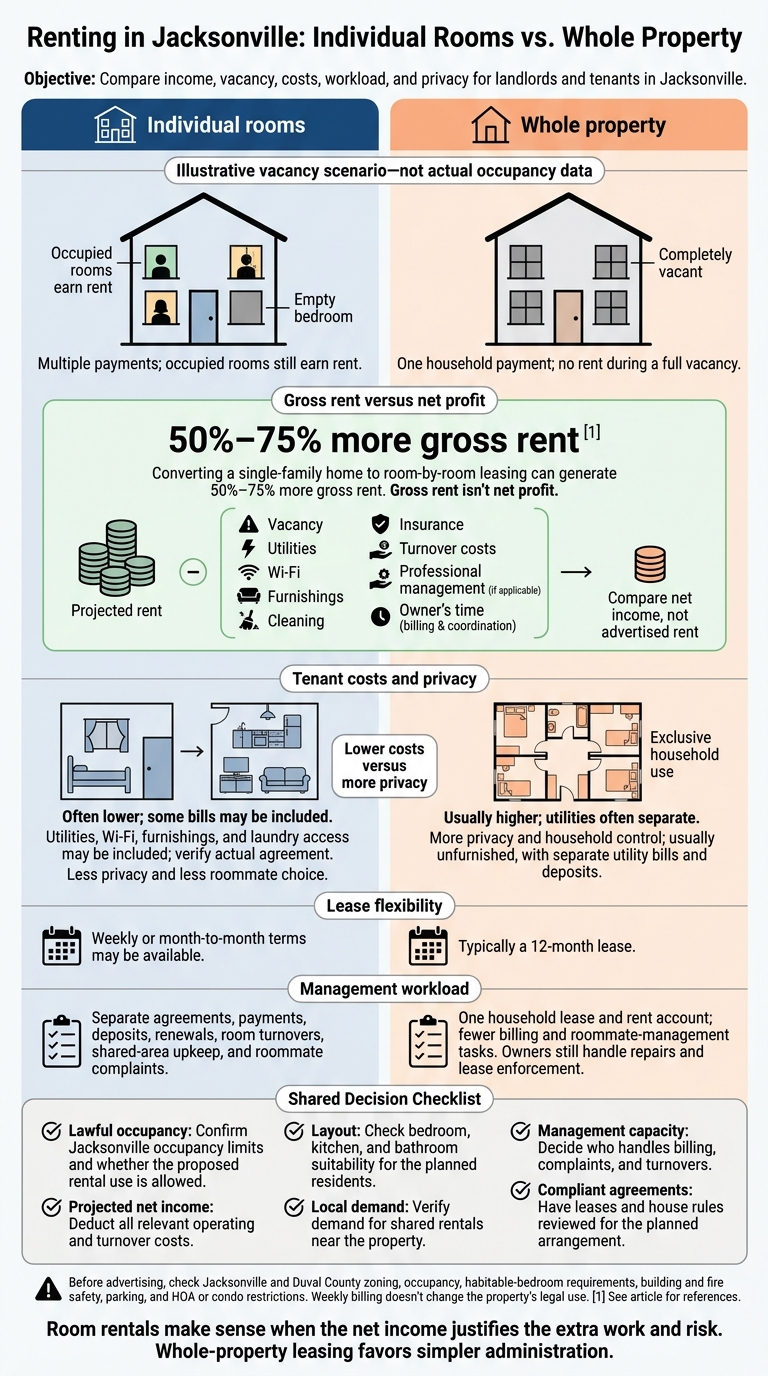
Leasing rooms separately can bring in more rent, but it also changes how landlords handle vacancies and tenant turnover. Converting a single-family home to room-by-room leasing can generate 50%–75% more gross rent. Separate bedroom leases spread vacancy risk: an empty room earns nothing, while occupied rooms can still bring in income. Track vacancies by bedroom, not by house.
But gross rent isn’t net profit. Subtract utilities, shared-space cleaning, and the cost of time spent on billing before comparing net income.
Tenant Costs and Shared Living
Room rent often includes electricity, water, Wi-Fi, and laundry access in one payment, making billing simpler. The trade-off for lower rent is usually less privacy and less say over roommates. Tenants should check what rent covers and whether they’ll share a bathroom.
Screening can help, but it can’t guarantee that roommates will get along. Clear expectations about noise, guests, and kitchen use still matter. Saving on rent also means accepting more rules, more coordination, and less control over who lives next door.
Compliance and Management Duties
Room-by-room leasing also means more management work. Before converting a Jacksonville home, check that local zoning and safety rules allow it. Require secure bedroom locks, screen each resident, and set clear rules for shared spaces.
Every separate lease adds billing, onboarding, and maintenance coordination. Put responsibilities for common-area cleaning, repair reporting, and handling roommate disputes in writing.
sbb-itb-73b3b1a
2. Renting the Whole Property
The other option is one lease for the entire home.
Income and Vacancy
A whole-property lease means one payment from one household, making billing simpler. The trade-off? When the tenant leaves, all rental income stops until someone else rents the home. Renting room by room can bring in more combined rent while preserving income from rooms that remain occupied.
Tenant Costs and Shared Living
Tenants who rent the entire home usually get more privacy and fewer shared-household conflicts. But their total monthly costs are typically higher than renting a single room. They also usually pay utilities and upfront deposits themselves.
If roommates sign a whole-property lease together, they may share responsibility for the total rent.
Compliance and Management Duties
Owners still handle repairs and enforce the lease under Florida landlord-tenant rules. With one lease, though, they have fewer billing and roommate-management tasks – and less direct control over roommate selection than with separate room leases. The choice depends on cost, privacy, and how much management work the landlord wants to take on.
Tenant Costs, Privacy, and Roommate Fit
After comparing landlord income, look at how each lease affects the tenant’s monthly bills and daily life.
Compare the full cost – not just advertised rent. Get rent, deposits, move-in fees, utility charges, furniture costs, and the lease term in writing.
| Factor | Individual room | Whole property |
|---|---|---|
| Costs and amenities | May include utilities, Wi-Fi, furnishings, and shared kitchen access; upfront costs may be lower | Usually unfurnished, with separate utility bills and deposits |
| Privacy | Private bedroom with a lock; shared common areas | Exclusive access for the leasing household |
| House rules and roommate fit | Shared rules, cleaning habits, noise, and guest expectations shape daily life | More control over household routines and roommate selection |
| Flexibility | Weekly or month-to-month terms may be available | Typically a 12-month lease |
Weigh cost and privacy alongside the tenant’s commute and schedule. In Jacksonville, commute time and transit access can matter as much as rent and furnishings.
For room rentals, put shared-living rules in writing. Review expectations for cleaning, quiet hours, guests, parking, storage, locks, utility caps, and maintenance reporting. These details help tenants judge whether the arrangement suits their privacy needs and daily routines.
Jacksonville Rental Rules and Management Duties
Once you’ve chosen a lease model, check what’s allowed at the property. Before advertising, review Jacksonville and Duval County requirements for zoning, occupancy, habitable bedrooms, building and fire safety, and parking. Check any HOA or condo restrictions, too. If you’re converting the property for room-by-room rentals, verify bedroom egress and fire safety.
Confirm whether the property’s legal use permits residential room rentals or short-term lodging. Weekly billing doesn’t change that use. Also review Florida requirements for leases, security deposits, notices, landlord access, and fair housing.
With separate room leases, don’t automatically hold one resident responsible for another’s rent or conduct. If residents have no shared lease obligations, enforce each lease separately. Document complaints and your responses.
Your lease model also shapes the day-to-day workload.
| Management duty | Individual rooms | Whole property |
|---|---|---|
| Compliance checks | Confirm that separate room rentals, occupancy, and any conversion are permitted | Confirm residential use, occupancy, and property restrictions |
| Screening | Process each resident’s application and screening | Screen applicable adult applicants |
| Rent administration | Track separate agreements, payments, deposits, and renewals | Manage one household lease and rent account |
| Turnover | Coordinate room-by-room move-outs, inspections, and preparation | Coordinate possession and preparation of the entire home |
| Common-area upkeep | Assign cleaning duties and arrange shared-area maintenance | Set household upkeep duties in the lease |
| Disputes | Address complaints between residents under separate agreements | Enforce the household lease and its stated obligations |
Pros, Cons, and Choosing a Leasing Model
Choose the model that delivers the best net return after all operating costs. Compare each option against your income target and the amount of management work you can handle.
| Model | Advantages | Disadvantages | Best fit |
|---|---|---|---|
| Individual rooms | Multiple rent streams; more affordable for budget-conscious renters | More management work, potential roommate conflicts, and less privacy | Areas with strong demand for shared rentals |
| Whole property | Simpler administration; one tenant relationship to manage | No rental income during vacancy; higher monthly cost for a single household | Owners who prefer simpler management and one household lease |
Room rentals make sense when the net income justifies the extra work and risk. Whole-property leasing suits owners who place more weight on simpler administration.
Before deciding, check the numbers, the property, and who will handle the work:
- Lawful occupancy: Confirm Jacksonville occupancy limits and whether the proposed rental use is allowed.
- Projected net income: Deduct vacancy, utilities, Wi-Fi, furnishings, cleaning, maintenance, insurance, and turnover costs.
- Layout: Check that bedrooms, kitchens, and bathrooms can comfortably serve the planned number of residents.
- Local demand: Verify demand for shared rentals near the Jacksonville property.
- Management capacity: Decide who will handle billing, complaints, and room turnovers. Account for any professional management costs.
- Compliant agreements: Have the leases and house rules reviewed for the planned arrangement.
FAQs
How do I calculate whether renting by the room is worth it?
Compare net cash flow from room-by-room and whole-property rentals. For each option, add up expected rent, then subtract utilities, maintenance, taxes, insurance, vacancy losses, management fees, tenant-screening costs, and rent-collection costs.
Account for how vacancies affect each setup. With room-by-room rentals, one empty room means losing only that room’s rent. With a whole-property rental, a vacancy means losing all rental income from the property.
Calculate net operating income (NOI) by subtracting operating expenses from rental income, accounting for vacancy losses. Include management fees in those expenses, and check that NOI stays positive after paying them.
Where can I verify Jacksonville’s room-rental requirements?
Check Jacksonville’s local government resources for rules on short- and long-term rentals. Renting a unit for stays under 30 days more than three times a year requires a license from the Florida Department of Business and Professional Regulation.
Also review local zoning laws, HOA rules, Covenants, Conditions, and Restrictions, and Florida’s landlord-tenant laws. Pay attention to security deposit and notice requirements.
What should I ask before moving into a shared rental?
Ask which utilities your weekly payments cover and who handles maintenance in shared spaces. Confirm that all housemates have had background checks, and make sure the rules on guests, smoking, and pets fit your lifestyle. For privacy, check whether your room has a door that locks.