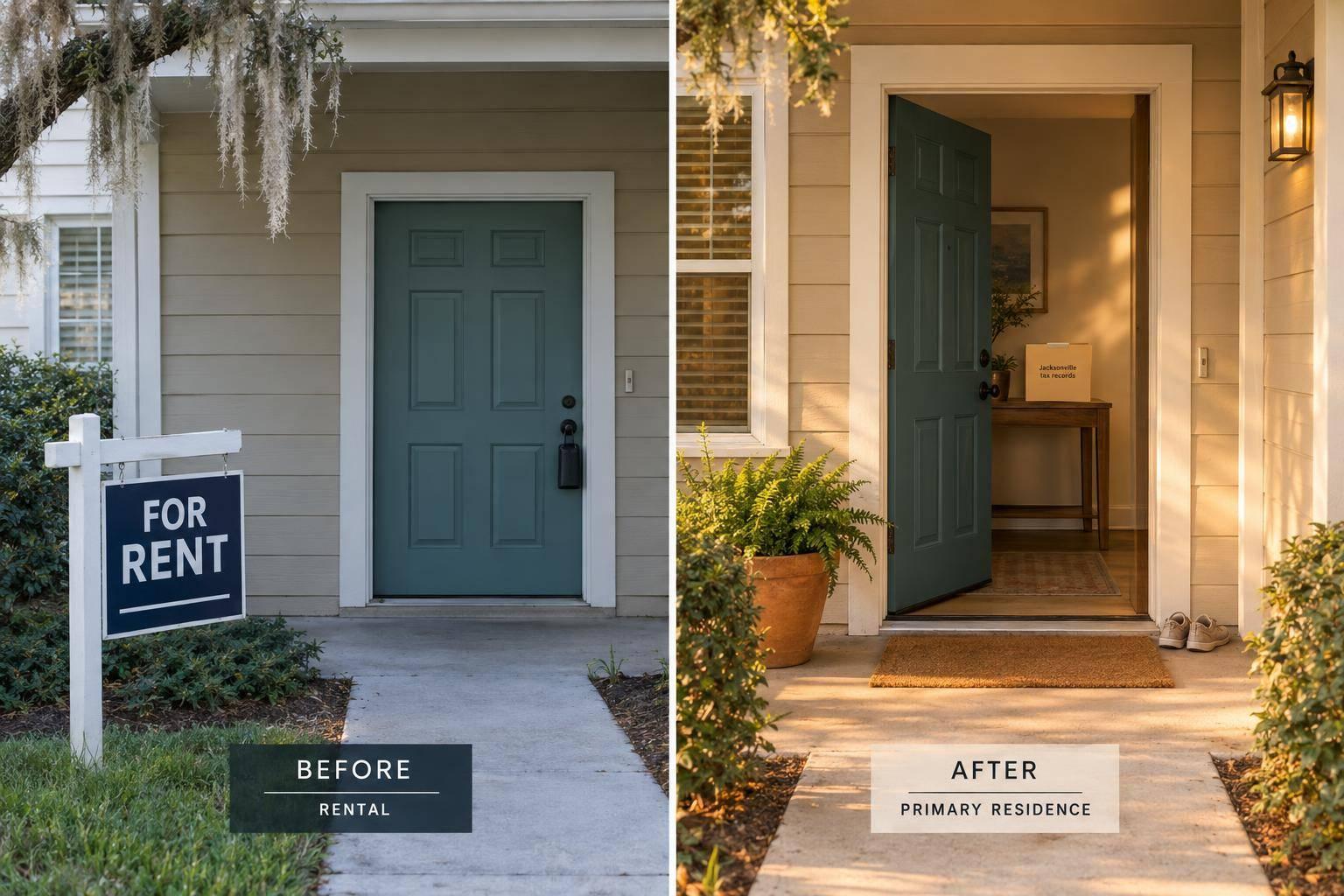
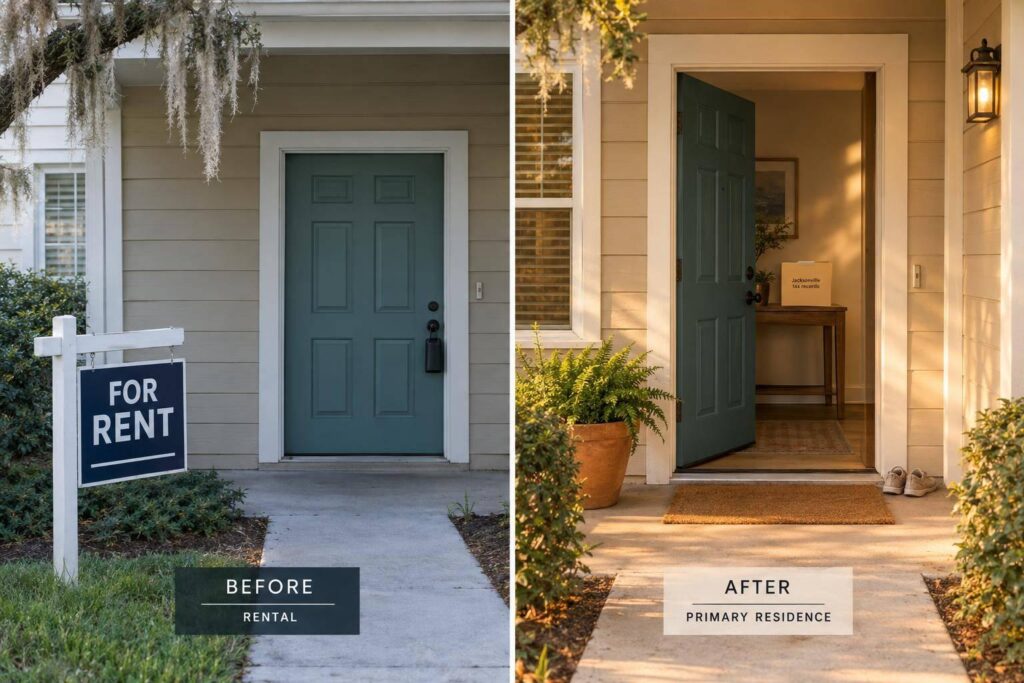
Moving into your rental may cut your tax bill – but it won’t make all your sale profit tax-free. I’d first check whether you meet the two-of-five-year ownership and residence tests. Eligible sellers may exclude up to $250,000 of gain, or $500,000 for married couples filing jointly who meet the rules.
Before converting a Jacksonville rental to your home, here’s what I’d review:
- Tax limits: Prior rental use after 2008 may limit the exclusion, and depreciation-related gain generally remains taxable.
- Sale math: Gather purchase costs, improvement invoices, depreciation schedules, and selling expenses.
- Move-in records: End the tenancy under the lease and Florida law, document your move-in, and update insurance.
- Local paperwork: Request rental records from 1 Realty Management, if applicable, and check Duval County’s homestead rules separately.
My bottom line: <u>have a tax professional review the numbers before accepting an offer</u>. Living there for two years alone doesn’t erase the property’s rental history.
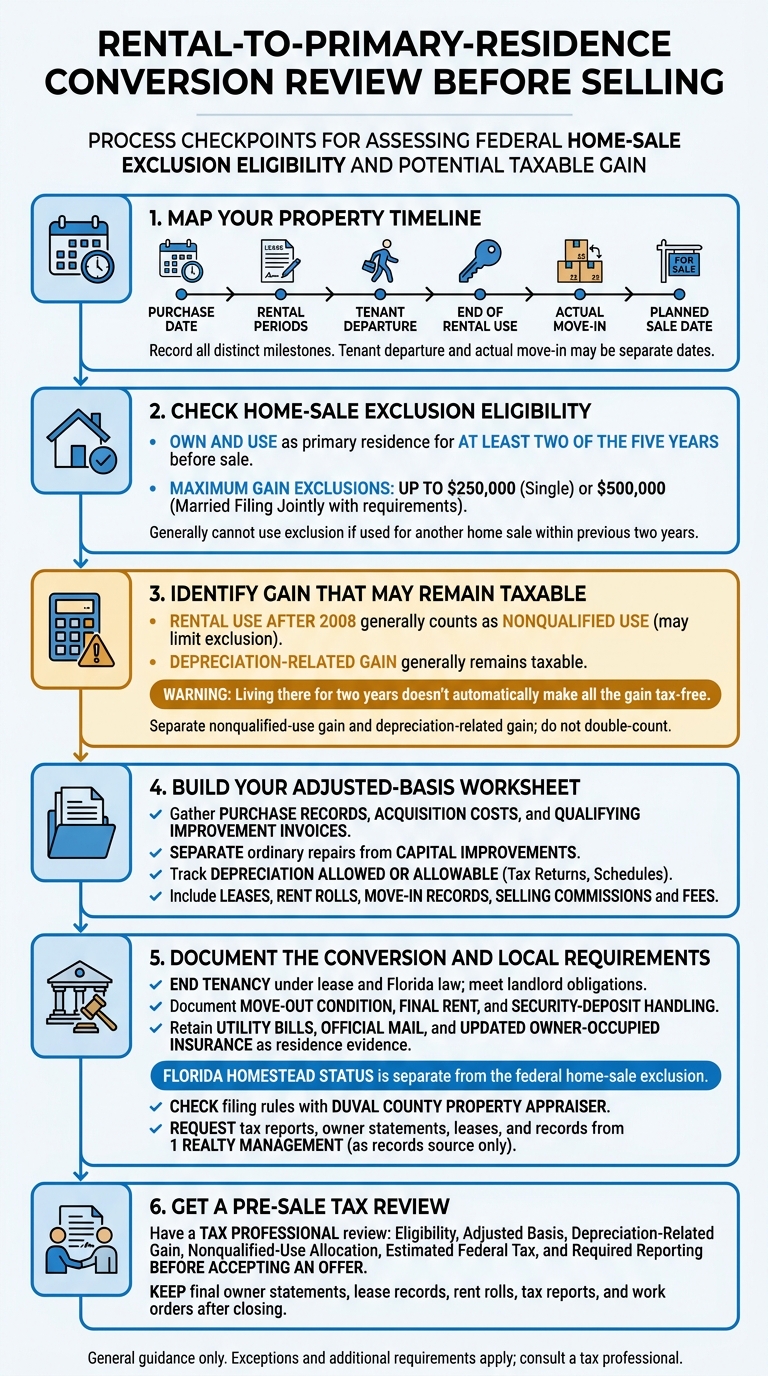
Rental to Primary Residence: Pre-Sale Tax Checklist
Step 1: Check Home-Sale Exclusion Rules and Timing
Check the Ownership and Residence Tests
Start with three dates: when you bought the property, when you moved in, and when you plan to sell. To qualify for the home-sale exclusion, you generally must own and use the property as your primary residence for at least two of the five years before the sale.
Eligible sellers can exclude up to $250,000 of gain, or $500,000 for married couples filing jointly who meet additional requirements.
Earlier rental periods may count as nonqualified use, which can limit the exclusion. Your sale date helps determine whether you qualify and how much gain remains taxable.
Identify Rental Periods and Nonqualified Use
Review your rental history, tax reports, monthly statements, signed leases, final move-out inspections, and turnover inspection records. Use them to establish when tenants occupied the property, when it sat vacant before you moved in, and when it changed from a rental to your primary residence.
Generally, rental use after 2008 and before you made the property your primary residence counts as nonqualified use, though exceptions apply. Living there for two years doesn’t automatically make all the gain tax-free.
Compare Move-In and Sale Dates
Compare your planned closing date with the two-of-five-year ownership and residence tests. Generally, you also can’t claim the exclusion if you used it for another home sale within the previous two years.
Keep these dates in one timeline to work out how much gain may qualify for the exclusion. You’ll need that record to separate taxable rental gain from gain covered by the home-sale exclusion before calculating tax in Step 2.
sbb-itb-73b3b1a
Step 2: Calculate Gain and Depreciation-Related Tax
Create an Adjusted-Basis Worksheet
Once you know whether the home-sale exclusion applies, use your sale, rental, and depreciation records to build an adjusted-basis worksheet. Gather annual statements, historical records, and invoices to distinguish repairs from improvements and track depreciation allowed or allowable.
| Worksheet item | What to gather |
|---|---|
| Basis records | Purchase records, acquisition costs, and qualifying improvement invoices |
| Repair vs. improvement records | Records separating ordinary repairs from capital improvements |
| Depreciation history | Prior tax returns and depreciation schedules |
| Rental-use timeline | Leases, rent rolls, and move-in records |
| Selling expenses | Commission and fee records that affect final gain |
Use these records to calculate gain in the next step.
Separate Depreciation-Related Gain From Nonqualified-Use Gain
Start with depreciation recapture, including unrecaptured Section 1250 gain. Your accountant can use historical records to separate this amount from the remaining sale gain. Then use rent rolls and leases to divide the remaining gain between nonqualified and qualified use – without counting the same gain twice.
Estimate Federal Tax and Required Reporting
Missing records? Download historical statements, leases, and work orders from the owner portal. Once you have the records for Section 121 and Section 1250 calculations, your tax preparer can estimate federal tax and confirm which reporting is required.
After calculating gain and depreciation recapture, organize proof of move-in, rental termination, and ownership history.
Step 3: Prepare Jacksonville Property and Tax Records
Document the End of Rental Use and Your Move-In
Keep records showing when rental use ended and personal use began. You cannot move in before the lease ends. Follow the lease and Florida notice rules before changing occupancy, and meet your landlord obligations until the tenancy ends. Document the property’s move-out condition, final rent, and security-deposit handling under Florida rules.
Record separate dates for the tenant’s departure, the end of rental use, and your actual move-in. Save utility bills, updated insurance, and official mail that show you live there – an address change alone isn’t enough. Change your insurance from rental to owner-occupied coverage.
Gather Financial Records and Proof of Residence
Keep sale documents, rental-termination records, and proof of residence in one file. Clearly label the rental and personal-use periods by date. Track repair costs separately from capital improvements, and retain your basis records throughout ownership.
Florida homestead status is separate from the federal home-sale exclusion. Confirm the filing rules with the Duval County Property Appraiser. Keep your file ready for the final sale and tax review.
Request Rental Records From 1 Realty Management
Ask 1 Realty Management for a final reporting package that includes tax reports, owner statements, leases, rent rolls, maintenance records, and deposit records.
Before converting the property to personal use, identify any unresolved tenant or maintenance matters. Use the reporting package to help verify the conversion date and support your tax filing.
Conclusion: Review Your Tax Position Before Selling
Moving into a rental can reduce your taxable gain, but it won’t erase depreciation recapture or gain from nonqualified use.
Use the dates and records you gathered above to check your tax position before listing the property. Before accepting an offer, work through this pre-sale tax checklist:
- Confirm your move-in date, planned sale date, ownership period, filing status, and whether you used the home-sale exclusion in the previous two years.
- Update your adjusted-basis worksheet to account for capital improvements, depreciation, and any nonqualified-use allocation.
- Have a tax professional review your numbers before you accept an offer.
- Plan to keep your final owner statements, lease records, rent rolls, tax reports, and work orders after closing.
FAQs
How is my taxable gain allocated between rental and personal use?
How taxable gain is split depends on how long you used the property as a rental versus for personal use. Have a tax professional determine the final allocation when you sell.
Keep detailed records of your basis, accumulated depreciation, and mixed-use costs. Depreciation recapture applies even if you didn’t claim the deduction. Work with a qualified CPA to separate the rental and personal portions for your tax filing.
Do I owe depreciation-related tax if I never claimed depreciation?
Yes. The IRS requires depreciation recapture when you sell your property – even if you never claimed the deduction on your tax returns. Skipping it means losing annual tax savings without avoiding the recapture tax.
Work with a tax professional to check that your records and filings are accurate.
When should I apply for Jacksonville’s homestead exemption after moving in?
Once the property becomes your permanent residence, contact the Duval County Property Appraiser’s office to confirm filing deadlines and requirements. The information provided does not state a mandatory waiting period before you can apply.
Renting out more than 50% of an owner-occupied property may affect your eligibility for Florida’s homestead exemption.