Overpricing your rental can cost you more than you think. A vacant property drains your income, while overpriced listings often linger on the market, hurting your property’s reputation and attracting fewer qualified tenants. To avoid these pitfalls, focus on setting the right rent by understanding your local market, using rental comps, and pricing competitively.
Key Takeaways:
- Vacancies are expensive: Each month a property sits vacant can cut 8–10% off your annual rental income.
- Overpricing leads to longer vacancies: Properties priced within 5% of market value rent faster – often within 30 days.
- Tenant turnover is costly: Replacing a tenant can cost $2,000–$3,000. Modest rent increases (3–5%) are better for retention.
- Location matters: Jacksonville’s neighborhoods have distinct rental trends. Adjust prices based on local demand and features.
- Use data, not guesswork: Rely on signed lease data from the past 60–90 days rather than active listings to determine market rent.
Pricing your rental correctly ensures steady income, attracts quality tenants, and avoids the financial losses associated with vacancies and turnover.
The Risks of Overpricing Rental Properties
Pricing your rental property too high can lead to hidden costs that pile up quickly, ultimately impacting your property’s performance over time.
Vacancy and Lost Income
In Jacksonville’s competitive rental market, the math on vacancies is simple – and painful. A property listed at $1,500 per month that sits empty for just two months results in $3,000 in lost rent. Even a single month of vacancy can cut 8–10% off your annual rental income. Holding out for an above-market rent often means longer vacancy periods, all while fixed expenses like your mortgage, taxes, and insurance keep adding up.
These financial losses don’t just hurt in the short term – they can also create ripple effects that make it harder to attract or keep tenants down the line.
How Overpricing Hurts Your Property’s Reputation
When a rental listing lingers on the market for more than 60 days, it becomes what many refer to as “stale.” Platforms like Zillow prominently display how long a property has been listed, and the longer it sits, the more potential renters assume there’s something wrong with it – even if the only issue is the price. Once a property gains this stigma, even lowering the rent might not be enough to attract high-quality applicants. Unlike homebuyers, renters rarely try to negotiate; if the price is too high for their budget, they simply move on to the next option.
This perception problem can make it even harder to find the right tenants, and it doesn’t end with vacant properties – overpricing can also disrupt relationships with your current renters.
How High Rent Increases Tenant Turnover
Setting rents too high doesn’t just lead to empty units – it can also drive away your existing tenants. When it’s time to renew a lease, tenants who feel the rent hike isn’t in line with the market are more likely to leave. And replacing them is rarely as simple – or cheap – as it sounds.
The costs of tenant turnover can add up quickly. Expenses like screening new tenants, cleaning, repairs, and marketing can easily outweigh the slight increase you might get from raising the rent. In many cases, keeping a reliable tenant at a fair rate is far more profitable than risking turnover for a small bump in income.
In Jacksonville, modest annual rent increases of 3% to 5% are typically well-accepted by tenants and don’t trigger unnecessary move-outs. But push beyond that without solid market data to back it up, and you could find yourself stuck in a costly cycle of vacancies and turnover. This highlights the importance of using precise, data-driven pricing strategies – something we’ll dig into later in the article.
sbb-itb-73b3b1a
Understanding Jacksonville’s Rental Market
Setting the right rental price starts with knowing the ins and outs of Jacksonville’s diverse housing market. The city isn’t a single, uniform market – it’s a collection of smaller neighborhoods, each with its own pricing trends, tenant expectations, and demand factors. This means understanding these local dynamics is crucial to pricing your rental competitively and minimizing costly vacancies through proactive lease execution and renewals.
What Drives Rental Demand in Jacksonville
Jacksonville’s rental demand is shaped by a mix of factors, including population growth, military relocations, and its proximity to major employment hubs in industries like healthcare, logistics, and finance. These steady streams of new residents help keep rental demand strong, often outperforming other markets in Florida.
Looking ahead, Jacksonville’s rental market is expected to grow. By 2026, rental rates are projected to climb by 4.8%, positioning it as one of the top-performing markets. For context, the median rent in February 2026 reached $2,250 – a 7.1% jump from $2,100 in February 2025. During this same period, active rental listings dropped significantly, from about 4,100 in November 2025 to roughly 3,350 by February 2026. This tightening supply gives well-priced properties a competitive edge.
However, rental demand in Jacksonville isn’t consistent year-round. Spring and summer typically see higher activity, while fall and winter months bring slower leasing cycles, increasing the risk of vacancies. For properties hitting the market in December, pricing aggressively from the outset can help avoid prolonged vacancies.
These trends highlight the importance of relying on accurate data when determining rental prices, which brings us to the use of rental comps.
How to Use Rental Comps to Set the Right Price
When setting a rental price, avoid relying on active listings – they only reflect asking prices, not actual rents. Instead, focus on comparable properties with signed leases from the past 60 to 90 days for a clearer picture of market rates.
Key features play a big role in determining rent. For example, central air conditioning is a must-have in Jacksonville. Properties without it often struggle to attract tenants. Similarly, amenities like in-unit washers and dryers or garages can increase rent by $50–$100 and $50–$75 per month, respectively. If a property has a history of long vacancies, it’s often a sign that the rent was initially set too high.
Beyond rental comps, the property’s specific location within Jacksonville is another critical factor in shaping your pricing strategy.
How Location Within Jacksonville Affects Rent
Where your property is located in Jacksonville has a major impact on rent rates and the types of tenants it attracts. Below is a breakdown of key neighborhoods, their demand drivers, and typical renter profiles:
| Neighborhood | Primary Demand Drivers | Typical Renter Profile |
|---|---|---|
| Beaches | Coastal lifestyle, recreation | Professionals, furnished rental seekers |
| Southside | Office hubs, St. Johns Town Center | Young professionals, families |
| Riverside/Avondale | Historic character, walkability | Young professionals |
| Mandarin | Top-rated schools, suburban stability | Long-term family renters |
| Sandalwood | Proximity to UNF | Students, young professionals |
| Northside | Logistics and transportation corridors | Working-class renters |
Location not only influences rent potential but also affects operating costs. For example, coastal properties near Jacksonville Beach or Atlantic Beach often command higher rents but come with increased insurance premiums and maintenance expenses due to salt-air exposure. On the other hand, newer developments in areas like Nocatee or parts of Southside may include HOA and CDD fees ranging from $200 to $600 per month. These fees can significantly impact your net returns if not factored into your pricing strategy.
How to Set Competitive Rent Prices
Understanding Jacksonville’s neighborhoods and what drives demand is just the beginning. The real challenge lies in turning that knowledge into a rent price that not only attracts tenants quickly but also keeps your property occupied over time.
Research the Local Rental Market
Start by looking at what tenants are actually paying for recently rented properties – not just what landlords are asking. For example, Jacksonville’s average rent is $1,706. Three-bedroom single-family homes typically fall between $1,775 and $1,900, while one-bedroom units in Southside’s Southpoint neighborhood average $2,387. In contrast, properties in Arlington and Southwest Jacksonville rent for $735 to $799, while Northside rental properties also offer distinct market dynamics. These differences highlight the importance of pricing by neighborhood rather than relying on metro-wide averages.
With the city’s overall vacancy rate at 5.2% and single-family homes at 4.9%, the market rewards landlords who price strategically. Your goal should be to fill a vacancy within two to four weeks. If your property sits empty for more than 60 days, it’s time to reassess your pricing.
Once you’ve got a handle on local trends, the next step is to consider how your property’s specific features and condition affect its value.
Factor In Your Property’s Condition and Features
Market trends are important, but your property’s condition is just as critical when setting rent. With a wave of new apartment construction between 2024 and 2025, tenants now have more choices than ever. A unit with outdated finishes or visible maintenance issues won’t command the same rent as one with fresh paint and modern updates – even if both are in the same neighborhood.
However, it’s important to avoid over-improving. Spending on high-end upgrades in a working-class area often doesn’t pay off. Instead, focus on practical improvements like luxury vinyl flooring, energy-efficient fixtures, and dependable appliances. Features like an in-unit washer/dryer or a garage can justify an extra $50–$100 and $50–$75 per month, respectively, but only if comparable units nearby offer similar amenities. Above all, ensure your property is move-in ready. Charging full market rent for a unit with visible flaws can lead to longer vacancies and attract less reliable tenants.
Price With Lease Renewals in Mind
Setting an initial rent price isn’t just about filling the unit – it also lays the groundwork for tenant retention and lease renewals. A well-thought-out starting price can help establish a relationship with a tenant who’s likely to stay.
In Jacksonville, landlords typically raise rent by 3–5% annually for reliable tenants. A 7% increase, however, might push a good tenant to leave, while a modest 3% hike often encourages them to stay. Before deciding on a renewal increase, weigh the full cost of turnover. Between cleaning, repairs, marketing, and lost rent, replacing a tenant can cost Jacksonville landlords $2,000 to $3,000 per vacancy. Retaining a dependable tenant with a modest increase is almost always more cost-effective in the long run.
How Professional Property Management Helps With Rent Pricing
Setting the right rent is crucial, but keeping it aligned with market trends is just as important. Professional property management ensures your rental rates stay competitive by using precise market data and making regular adjustments. Partnering with experts like 1 Realty Management can help you stay ahead with data-driven strategies.
Data-Driven Rent Analysis
Many landlords rely on public listings for pricing guidance, but these often show asking rents, not what tenants actually pay. Professional property managers, however, use MLS data to access real lease prices, providing a more accurate reflection of the market.
In addition to MLS data, property managers analyze up to 20 comparable rentals nearby, exclude outliers, and consider your property’s unique features. They also account for all financial factors – like property taxes, insurance, and management fees – to ensure the rent supports your investment goals.
This thorough, data-driven approach allows managers to monitor the market continuously and adjust as needed.
Regular Rent Monitoring and Adjustments
The Jacksonville rental market is anything but static. Demand typically surges in summer, fueled by military relocations and the school year, but tends to dip in winter. Rents can drop by over $100 between July and December or January. To stay competitive, active monitoring is essential.
Experienced property managers conduct regular reviews – every six months for long-term tenants or weekly for vacant units. They adjust prices incrementally, often every 7–10 days, and use short-term incentives like move-in specials instead of lowering the base rent permanently. These strategies help maintain competitive pricing while protecting long-term revenue.
Tenant Placement and Marketing Services
Accurate rent pricing is only part of the equation; effective marketing ensures your property gets noticed. Professional property managers utilize MLS listings and other platforms to give properties maximum exposure. This approach significantly reduces vacancy periods compared to relying on basic “For Rent by Owner” posts.
Tenant screening is another key service. By thoroughly vetting applicants – checking credit, verifying income, and reviewing rental history – property managers help ensure tenants can afford the rent and are likely to stay. For landlords in Jacksonville, combining precise pricing with robust marketing and screening is a proven way to keep properties occupied with reliable tenants.
How to Monitor and Adjust Rent Over Time
Overpriced vs. Competitively Priced Rental: Real Cost Breakdown
Setting the right rent at the start is just the beginning. Keeping an eye on market trends and making adjustments ensures your property stays competitive.
Use Vacancy Rates and Tenant Feedback to Identify Issues
Extended vacancies often signal that your rent is too high. For example, at $1,500/month, every vacant day costs you around $50.
Keeping tabs on neighborhood vacancy rates can also offer key insights. If the vacancy rate in your area climbs above 7%, it usually means rents need to come down. On the flip side, a rate below 4% might allow for slightly higher-than-market pricing. In Jacksonville, the citywide vacancy rate hovers around 5.2%, with single-family homes even tighter at 4.9%.
Tenant feedback is just as important. If you’re hearing repeated complaints about high rent or noticing frequent turnover without clear maintenance issues, it could mean tenants don’t see enough value, or you may need to choose a property management company to help optimize your operations for the price.
These signals are essential for planning smart rent adjustments each year.
Make Annual Rent Adjustments Using Market Data
Persistent vacancies, along with the daily losses and turnover costs they create, often call for annual rent updates of 3–5%. Going beyond this range – especially without making property improvements – can lead to higher tenant turnover and extra expenses.
Here’s the math: if you raise rent by $200 and your property sits vacant for two months at $1,800/month, you’d lose $3,600. In this case, the new tenant would need to stay for 18 straight months just to break even on that vacancy loss. And don’t forget turnover costs, which in Jacksonville typically fall between $2,000 and $3,000 per instance. Adjusting rent thoughtfully, with solid market data, helps you avoid these kinds of losses.
If you’re looking to increase rent without risking a long vacancy, consider offering incentives like a move-in special or waiving certain fees. This keeps your “official” rent intact for future adjustments while giving tenants an immediate reason to sign – building on earlier proactive pricing strategies.
Overpriced vs. Competitively Priced Rentals: A Comparison
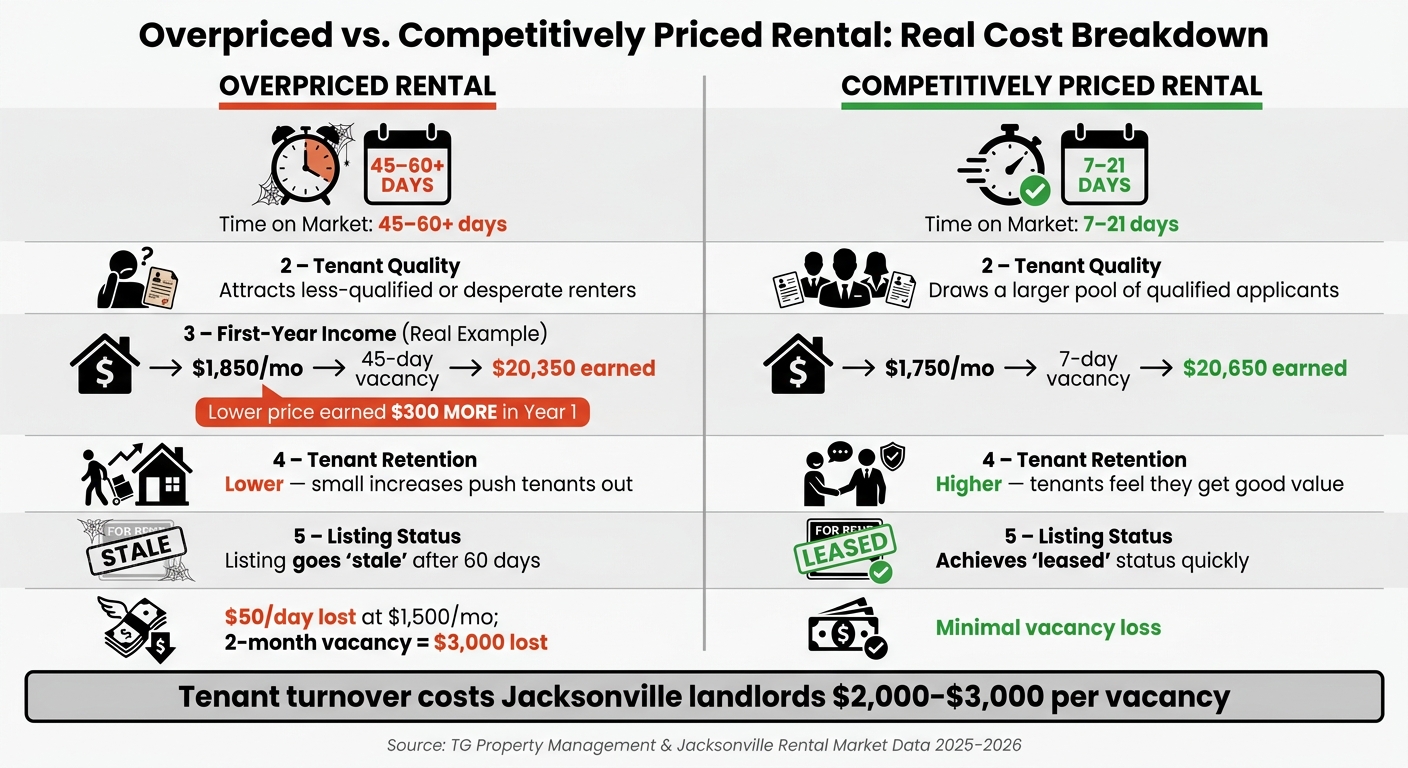
Monitoring vacancy trends and tenant feedback can help you directly compare the impact of different pricing strategies. Pricing affects how quickly you lease your property, the quality of tenants you attract, and your overall income. Here’s a breakdown:
| Metric | Overpriced Rental | Competitively Priced Rental |
|---|---|---|
| Time on Market | 45–60+ days | 7–21 days |
| Tenant Quality | Attracts less-qualified or desperate renters | Draws a larger pool of qualified applicants |
| First-Year Income | Lower due to extended vacancy | Higher thanks to quick leasing |
| Tenant Retention | Lower, as even small rent increases can push tenants out | Higher, with tenants feeling they’re getting good value |
| Marketing Status | Listing becomes “stale” over time | Achieves “leased” status quickly |
A real example highlights this difference. In March 2026, a property listed at $1,850/month took 45 days to rent and earned $20,350 in its first year. Meanwhile, the same property priced at $1,750/month rented in just 7 days and brought in $20,650 for the year. The lower price actually generated $300 more, simply by reducing vacancy time. Competitive pricing doesn’t just boost income – it also keeps tenants satisfied and ensures steady occupancy.
Conclusion: What Jacksonville Landlords Should Take Away
The risks of overpricing rental units are hard to ignore. As we’ve explored, even slightly overestimating rent can lead to prolonged vacancies and a significant loss of income. Remember, vacancy is the ultimate profit drain – an empty unit doesn’t bring in a dime, yet your mortgage, insurance, and maintenance costs keep piling up.
The solution? Competitive pricing. This means basing your rates on actual rents rather than what other landlords are asking. Aim to stay within 5% of market rates to minimize vacancy periods. Overpricing, on the other hand, could leave your property sitting empty for 60 to 90 days or more. It’s also worth noting that each neighborhood in Jacksonville has its own unique rental trends, so understanding your local market is critical.
“The lost rent from two months of vacancy far exceeds any premium you might achieve by pricing too high.” – ReiToday.Ai
For current tenants, moderate annual increases – between 3% and 5% – can help you maintain reliable renters while avoiding frequent turnover. These strategies, grounded in data, are key to effective property management. They not only help you secure steady income but also build long-term tenant relationships.
If this feels like a lot to manage, consider working with 1 Realty Management. Their team specializes in helping Jacksonville landlords set competitive rents, track market trends, and retain quality tenants – ensuring you’re making informed decisions every step of the way.
FAQs
What’s the fastest way to find my true market rent in Jacksonville?
The fastest way to figure out the actual market rent in Jacksonville is to look at active rental listings and recently rented properties nearby. Pay attention to comparable properties to make sure your rental price fits the local market while staying competitive.
How can I tell if my rental listing is overpriced before it goes stale?
To set a fair rental price, start by researching similar properties in your area. Look at both active listings and recently rented homes to understand the going rate. Pricing your property too high can lead to extended vacancies, which often cost more in the long run than setting a slightly lower rent. Stay on top of market trends and adjust your pricing when necessary to keep your property appealing and avoid long periods without tenants.
Should I lower rent or offer a move-in special to fill a vacancy?
Offering a move-in special can be a smarter approach than lowering rent to fill a vacancy. Extended vacancies caused by overpricing often cost more than offering a short-term promotion. Move-in specials help attract tenants faster, cutting down on the time a property sits empty while keeping rental rates competitive. This method strikes a balance between drawing in renters and ensuring steady, long-term income.