Evicting tenants in Florida requires strict adherence to the law. Florida’s Residential Landlord and Tenant Act (Chapter 83, Part II) regulates the entire process. Landlords cannot use self-help methods like changing locks or cutting utilities – violations can result in penalties. Implementing proven tenant screening strategies can help avoid these issues by securing reliable renters from the start. Here’s what you need to know:
- Grounds for Eviction:
- Nonpayment of Rent: Requires a 3-day notice to pay or vacate. Only unpaid rent can be demanded.
- Curable Violations: Examples include unauthorized pets or improper parking. Requires a 7-day notice to fix the issue or vacate.
- Incurable Violations: Severe issues like property damage or criminal activity require a 7-day unconditional quit notice.
- Timelines:
- Notices must follow specific counting rules (e.g., business days for 3-day notices).
- Errors in timing or notice content can lead to case dismissal.
- Filing Requirements:
- Landlords must file eviction complaints with proper documentation, including notices, leases, and rent ledgers (if required).
- Filing fees range from $185 to $335, with total costs averaging $800–$1,200.
- Court Process:
- Tenants have 5 business days to respond after being served.
- If tenants fail to respond or deposit rent, landlords can seek a default judgment.
- Final Steps:
- After a judgment, landlords request a Writ of Possession for sheriff enforcement.
- The sheriff posts a 24-hour notice, after which tenants are removed if they don’t leave voluntarily.
Following the law precisely is essential to avoid delays or legal issues. Starting July 1, 2026, a new rule extends the 3-day notice period to 5 business days. Also, electronic notices will be allowed starting July 2025 if both parties agree in writing.
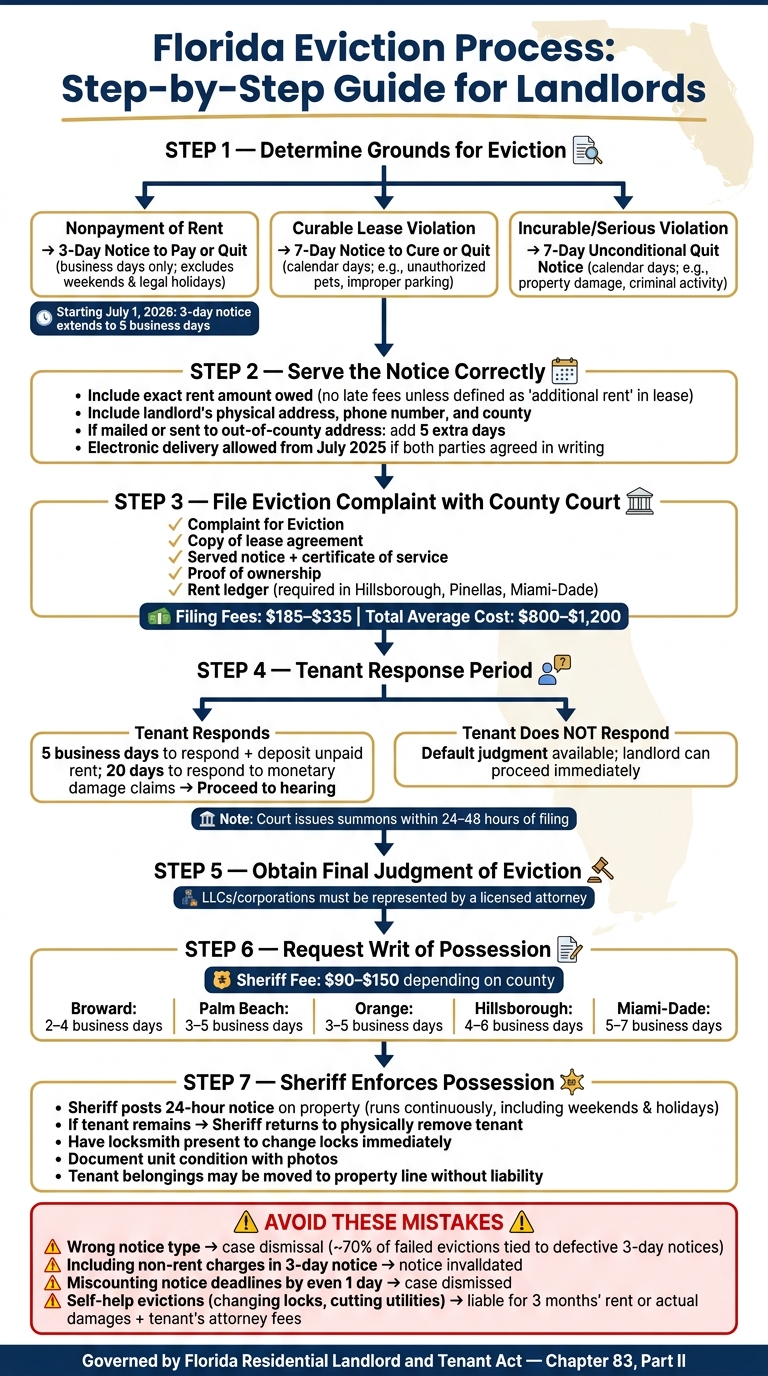
Florida Eviction Process: Step-by-Step Guide for Landlords
Grounds for Eviction in Florida
In Florida, landlords must have legally documented reasons to evict a tenant. Evictions without proper grounds are not permitted under state law. The specific grounds for eviction dictate the type of notice landlords must serve, and any errors in selecting or issuing the notice can lead to a dismissal of the case. Below, you’ll find the three main reasons for eviction and the corresponding notice requirements.
Nonpayment of Rent
Nonpayment of rent is the most common reason for eviction in Florida. If a tenant fails to pay rent by the due date outlined in the lease agreement, the landlord can initiate the eviction process. The lease serves as the key document here, detailing the rent amount, due date, and any applicable grace period.
Important note: A 3-day notice can only demand the unpaid rent. It cannot include additional charges like late fees, utilities, or attorney fees unless the lease explicitly states those charges are considered "additional rent." Including non-rent items in the notice is a technical mistake that can invalidate it entirely.
Curable Lease Violations
Some lease violations allow tenants the opportunity to correct the issue. Examples include unauthorized pets, unapproved guests, improper parking, or failure to maintain the unit. In these cases, landlords must serve a 7-day notice to cure, giving tenants seven calendar days to resolve the problem or vacate.
One critical exception is the 12-month rule: If a tenant repeats the same violation within 12 months of receiving a written warning for a similar issue, the landlord can bypass the cure period and treat it as an incurable violation. That initial written notice isn’t just a warning – it’s a legal record that changes how future violations are handled.
Incurable or Serious Violations
Certain violations are severe enough to warrant immediate action, leaving no opportunity for tenants to fix the issue. These include intentional property damage, criminal activity on the premises, or repeated breaches of the same nature. For such cases, landlords issue a 7-day unconditional quit notice, requiring the tenant to vacate within seven days without the option to remedy the situation.
"Doing it wrong is more than a headache; it’s a costly, time-consuming nightmare that can get your case thrown out, forcing you to start all over while the non-paying tenant stays put." – Barnes Walker
Summary of Notice Types
The table below outlines the notice requirements for each type of eviction ground:
| Ground for Eviction | Notice Type | Tenant’s Option | Calculation Rule |
|---|---|---|---|
| Nonpayment of Rent | 3-Day Notice to Pay or Quit | Pay in full or vacate | Business days only; excludes weekends and legal holidays |
| Curable Lease Violation | 7-Day Notice to Cure or Quit | Fix the issue or vacate | Calendar days |
| Incurable/Serious Violation | 7-Day Unconditional Quit Notice | Vacate only; no cure option | Calendar days |
Proper documentation is essential for all eviction cases. This includes maintaining a rent ledger, copies of the lease, photos, or even police reports when applicable. Florida courts handle eviction cases quickly, so having all your paperwork in order before filing is crucial. Thoroughly documenting each violation strengthens your case and ensures a smoother legal process. Professional property management in Jacksonville can help ensure all documentation meets strict legal standards.
sbb-itb-73b3b1a
Serving Notices: Requirements and Timelines
Choosing the correct notice is just the beginning. How you serve it – and how you calculate deadlines – can make or break your case. Even a small mistake, like miscounting by a single day, can result in dismissal.
3-Day Notice to Pay Rent or Quit
Accuracy is non-negotiable when it comes to a 3-day notice. The notice must clearly state the exact amount owed. Phrases like "plus applicable late fees" will render the notice invalid. Additionally, it must include the landlord’s physical address, phone number, and the county where the property is located.
When counting days, the day of service doesn’t count. Weekends and legal holidays observed by the local Clerk of Court are excluded. For instance, if a notice is posted on a Thursday and the following Monday is a holiday, the tenant’s deadline would extend to the next Wednesday. Always check your county’s holiday calendar – some counties recognize unique holidays, such as General Election Day.
Looking ahead, Senate Bill 716 will extend the notice period from 3 business days to 5 business days starting July 1, 2026.
7-Day Notice to Cure or Quit
This notice is for fixable violations, giving tenants 7 calendar days to either resolve the issue or vacate. The countdown begins the day after the notice is served, and weekends and holidays are included.
If the notice is mailed, sent to a P.O. Box, or delivered to an out-of-county address, you must add 5 extra days to the deadline. Starting July 1, 2025, electronic delivery – via email or a secure portal – will be allowed, but only if both parties have agreed in writing beforehand. This usually involves a lease addendum with time-stamped proof of delivery.
For violations that cannot be corrected, refer to the rules for the unconditional quit notice below.
7-Day Unconditional Quit Notice
This notice requires tenants to vacate within 7 calendar days, with no opportunity to fix the issue . It’s used for severe problems, such as intentional property damage, criminal activity, or repeated curable violations within a 12-month period.
To avoid issues in court, document how the notice was served. Use timestamps or certified receipts to ensure your records are complete. Eviction proceedings in Florida move quickly, so having thorough and accurate paperwork is critical before filing, which is why many landlords rely on professional eviction handling services.
Filing and Proceeding with an Eviction Case
Once the notice period ends without tenant compliance, it’s important to act quickly by filing the eviction case. Delays can lead to unnecessary complications and expenses.
Filing the Eviction Lawsuit
To begin, file your eviction complaint at the county court where the rental property is located. The required documents typically include:
- A Complaint for Eviction
- A copy of the lease agreement
- The notice served to the tenant (e.g., a 3-day or 7-day notice) with a certificate of service showing how and when it was delivered
- Proof of ownership, such as a deed or a management agreement (if a property manager is filing on behalf of the owner)
In some Florida counties, like Hillsborough, Pinellas, and Miami-Dade, courts require an additional document – a rent ledger – to be submitted with the complaint. Failing to include this can lead to your case being rejected outright. Filing fees vary but typically range from $185 to $335 in counties like Duval. When factoring in legal fees and process serving, the total cost of an eviction can average between $800 and $1,200.
Once the case is filed, it’s crucial to understand the tenant’s response process and the associated legal deadlines.
Tenant Response and Legal Timeframes
After filing, the court clerk generally issues a summons within 24 to 48 hours. Once the tenant is served, they have:
- 5 business days to respond and deposit any unpaid rent
- 20 days to respond to claims for monetary damages
If the tenant does not respond or fails to deposit the required rent, this opens the path for a default judgment.
Default Judgments and Rent Registry Issues
Under Florida law (Section 83.60), tenants who fail to deposit past-due rent within 5 days forfeit their defenses.
"Failure to deposit rent into the registry can result in the Landlord obtaining a Default Judgment for possession without further hearing." – Tyler Dixon, Esq.
Tenants must continue depositing rent as it becomes due during the litigation process. If they miss even one payment, you may seek an immediate default judgment. If a tenant files a counterclaim to delay proceedings, file a motion to sever the counterclaim. This ensures that the possession matter stays on the accelerated timeline outlined in Section 51.011.
It’s also important to note that Florida law requires landlords who own rental properties through an LLC or corporation to be represented by a licensed attorney during eviction proceedings.
Final Judgment and Writ of Possession
Once you’ve navigated the filing process and tenant responses, the final stage is all about carrying out the judgment. Even after securing a favorable ruling, there are still steps to take before regaining control of your property.
Obtaining the Writ of Possession
After the judge signs the Final Judgment of Eviction, the next move is to formally request a Writ of Possession from the court clerk. This request typically involves a fee for the sheriff’s services, which can range between $90 and $150, depending on the county.
"The writ of possession is a court-issued order directing the county sheriff to remove a tenant from the property. It’s the final step in an eviction, available only after a landlord has received a judgment for possession." – Kelley, Grant, & Tanis, P.A.
Once the clerk processes your request, they send the writ to the county sheriff’s office, which will handle the enforcement. At this point, the process transitions to law enforcement.
The Sheriff’s Role in Enforcing Possession
The sheriff begins by posting a 24-hour notice on the property, giving the tenant one last opportunity to leave voluntarily. It’s important to note that this 24-hour period continues uninterrupted, even on Saturdays, Sundays, or legal holidays.
"In an action for possession, after entry of judgment in favor of the landlord, the clerk shall issue a writ to the sheriff describing the premises and commanding the sheriff to put the landlord in possession after 24 hours’ notice conspicuously posted on the premises." – Florida Statute 83.62
If the tenant remains after the 24-hour notice expires, the sheriff will return to physically remove them and return possession of the property to you. At this stage, it’s crucial to have a locksmith or contractor present to change the locks and secure the property immediately. If necessary, you can also request the sheriff to "stand by" during this process to ensure order, though this service may come with an additional hourly fee.
The timeline for writ enforcement can vary by county:
| County | Estimated Writ Enforcement Timeline |
|---|---|
| Broward | 2–4 business days |
| Palm Beach | 3–5 business days |
| Orange | 3–5 business days |
| Hillsborough | 4–6 business days |
| Miami-Dade | 5–7 business days |
Source: Kelley, Grant, & Tanis, P.A.
Once the writ is executed, any tenant belongings left behind can be removed to the property line without liability. To protect yourself, document the condition of the unit with photos immediately after regaining possession.
Common Landlord Mistakes to Avoid
When navigating Florida’s eviction process, even minor errors can cause significant delays or additional legal expenses. The system is strict about procedural accuracy, and mistakes – no matter how small – can force you to start over. Let’s look at some of the most common pitfalls landlords face and how to sidestep them.
Using the Wrong Notice
The type of notice you serve must align with the tenant’s specific violation. For example, issuing a 3-day notice for a lease violation or a 7-day notice for nonpayment of rent is a sure way to get your case dismissed.
"Florida county courts routinely dismiss eviction actions – sometimes after weeks of litigation – because the landlord’s three-day notice was defective." – Revah Law Group
This is a big issue, as around 70% of failed eviction complaints are tied to defective 3-day notices. The solution? Always use the correct notice type and ensure it includes the exact statutory language required by law.
Errors in Rent Amounts or Deadlines
Even small missteps with rent figures or deadlines can derail your case. For 3-day notices, only include the base rent. If you add late fees, utilities, or interest – unless your lease explicitly defines them as "additional rent" – your notice becomes invalid.
Timing is another common problem. Miscounting the notice period or filing even a day too early can invalidate the entire proceeding. For guidance, refer to the notice calculation rules in the "Serving Notices: Requirements and Timelines" section. These errors can lead to costly delays and unnecessary expenses. Professional Southside property management can help ensure all notices and timelines meet strict legal standards.
Attempting Self-Help Evictions
It’s understandable to feel frustrated with a tenant who isn’t paying rent, but taking matters into your own hands – like changing locks, removing belongings, or shutting off utilities – is against the law in Florida. These actions are prohibited under Florida Statute §83.67.
"Self-help eviction is illegal in Florida. A landlord cannot change the locks, remove the tenant’s belongings, shut off utilities, or take any other action to force a tenant out of the premises without first obtaining a court order." – Revah Law Group
Landlords who attempt self-help evictions can face serious consequences, including paying either actual damages or three months’ rent (whichever is greater), plus the tenant’s attorney’s fees. The only legal way to remove a tenant is by following the court process and obtaining a sheriff-enforced Writ of Possession. For investors in high-growth areas, utilizing Westside property management services ensures these complex legal procedures are handled correctly from the start.
Conclusion and Legal Compliance Resources
Evictions in Florida demand strict adherence to procedure – serving the correct notices, meeting precise deadlines, filing on time, and ensuring sheriff-enforced removals. Even small mistakes can result in costly delays. For example, Duval County saw 13,744 evictions in a single year, and something as simple as a defective notice can lead to $1,500 in filing fees and another month of unpaid rent.
Key steps include using the proper notice type, calculating deadlines accurately, and filing correctly. Legislative updates are equally important. Starting July 1, 2025, House Bill 615 allows notices to be delivered via email, provided the lease includes written consent for electronic communication. Additionally, some counties now require rent ledgers to be attached to the initial complaint. Failing to stay updated on these changes can be just as costly as procedural missteps.
By keeping up with these requirements, landlords can better protect their rights and investments.
For Jacksonville landlords needing expert assistance, 1 Realty Management offers comprehensive eviction support. They handle everything from drafting legally compliant notices to coordinating with the Duval County Sheriff for executing the Writ of Possession. As they put it, "Evictions are never ideal – but with the right approach, they protect your time, finances, and property."
FAQs
What makes a Florida eviction notice legally invalid?
A Florida eviction notice can be invalid if it doesn’t meet specific legal standards. Common mistakes include miscalculating the notice period, such as failing to exclude weekends or holidays in a three-day notice. Another frequent issue is improper service or using the wrong type of notice altogether. For nonpayment of rent, the notice must clearly state the exact amount owed – adding extra charges like late fees or utilities can render it void. Additionally, leaving out crucial information, such as the property address, will also invalidate the notice.
How long does a Florida eviction usually take from notice to lockout?
In Florida, the timeline for an uncontested eviction usually ranges from 3 to 4 weeks, starting from the notice to the actual lockout. However, if the tenant disputes the case or requests a hearing, the process can extend to 6 to 8 weeks or even longer, especially for more complicated cases. The duration can also be influenced by factors such as court schedules, holidays, and how quickly documents are served.
1 Realty Management offers eviction handling as part of their property management services in Jacksonville, Florida.
When do Florida landlords need an attorney to file an eviction?
Florida law doesn’t mandate that landlords hire an attorney for evictions. However, the process can be tricky and demands strict adherence to Chapter 83 of the Florida Statutes. Mistakes in serving notices, filing paperwork, or proving legal standing can result in expensive delays. To navigate disputes, minimize risks, and stay compliant, hiring legal counsel is strongly advised. For property owners in Jacksonville, 1 Realty Management provides professional eviction services to help streamline the process.