
Understanding Jacksonville’s landlord-tenant laws is essential to avoid legal and financial problems. Florida Statutes Chapter 83 governs landlord-tenant relationships statewide, while Jacksonville adds local rules like the Minimum Housing Code (Chapter 518). Key points include:
- Evictions: Florida prohibits self-help evictions. Landlords must follow strict legal steps, including serving proper notices. Duval County handled 13,744 eviction filings in one year.
- Property Maintenance: Landlords must meet health and safety standards, including pest control, heating, and structural upkeep. Fines for violations can reach $250 per day.
- Security Deposits: Notify tenants of deposit details within 30 days. Return deposits or send claims within strict deadlines to avoid penalties.
- Legal Notices: Provide at least 12 hours’ notice before entering a tenant’s unit, except in emergencies.
- New Rules: Starting October 1, 2025, leases of one year or more require a flood risk disclosure.
Staying compliant ensures smoother operations and protects your rental investment. Partnering with the right property management company can simplify legal complexities.
Core Legal Requirements for Jacksonville Landlords
Understanding your legal responsibilities as a landlord in Jacksonville is key to managing rental properties effectively and avoiding disputes.
What Florida Statutes Chapter 83 Requires
Florida Statutes Chapter 83, Part II, outlines the rules for landlord-tenant relationships in the state. According to § 83.51, landlords must ensure that rental properties meet building, housing, and health codes. This includes maintaining essential features like roofs, windows, doors, floors, and foundations.
For multi-unit properties, the law imposes additional duties. Landlords are required to provide pest control services, maintain clean common areas, ensure garbage is removed, and supply functioning locks, heating, and hot water. These are not optional; they are legally mandated services.
Two specific statutes often catch landlords off guard. First, § 83.50 requires landlords to provide written disclosure of their name and address – or that of someone authorized to receive legal notices – before or at the start of the lease. Second, § 83.58 allows landlords to charge double the monthly rent if a tenant stays on the property without consent after the lease ends. Knowing these rules can save time and money by avoiding unexpected legal issues. This includes following proper eviction handling procedures if a tenant violates lease terms. These state-level requirements set the stage before factoring in local regulations.
Jacksonville’s Local Ordinances and Housing Codes
Beyond state laws, Jacksonville enforces its own Chapter 518 Property Safety and Maintenance Code, which establishes minimum standards for residential properties. The Neighborhood Services division oversees compliance, and violations can result in fines of up to $250 per day if not resolved within the timeframe ordered by a Special Magistrate.
"The Property Safety and Maintenance Code requires maintenance standards for all residential and commercial structures. The code addresses violations inside and outside the structure, from excessive trash and junk in the yard to obstructed sewer lines and improper plumbing or electric installations." – Jacksonville.gov
Some key requirements include:
- Heating systems must maintain a minimum temperature of 65°F in all habitable rooms during winter.
- At least one working smoke detector must be installed on every floor near sleeping areas.
- Exterior issues like peeling paint or rotting wood can lead to citations for "structural deterioration", making regular upkeep essential.
Additionally, Jacksonville’s Chapter 745 mandates that address numbers be clearly visible from the street, which is an easy way to avoid unnecessary citations. Together, these state and local codes offer a thorough framework for compliance.
Lease Agreements and Required Disclosures
Clear lease agreements and timely disclosures are just as important as property maintenance. They not only ensure legal compliance but also help prevent disputes with tenants.
For example, landlords must, within 30 days of receiving a security deposit or advance rent, provide written notice to the tenant. This notice must specify the name and address of the Florida bank holding the funds and whether the deposit is earning interest. Mixing deposit funds with personal accounts can lead to legal penalties.
Starting October 1, 2025, Florida Statute § 83.512 will require a flood risk disclosure for leases lasting one year or more. Additionally, if landlords want to send legal notices via email, both parties must agree to this arrangement in writing under § 83.505. A simple lease addendum can handle this requirement.
| Disclosure | Timing | Governing Statute |
|---|---|---|
| Landlord name and address | Before or at lease start | § 83.50 |
| Security deposit location and terms | Within 30 days of receipt | § 83.49 |
| Flood risk disclosure (leases ≥ 1 year) | Before lease execution | § 83.512 |
| Email notice agreement (if applicable) | In writing, prior to use | § 83.505 |
Another important consideration for Jacksonville landlords is the city’s large military population, thanks to NAS Jacksonville and NS Mayport. Under the Servicemembers Civil Relief Act, active-duty tenants can terminate a lease early if they receive deployment orders. While this is a federal law, it comes up often in Jacksonville, so landlords should plan for it in their lease terms.
sbb-itb-73b3b1a
Common Landlord Duties and Dispute Triggers
In Jacksonville, disputes between landlords and tenants often revolve around property conditions, security deposits, and unannounced entries. By understanding these common issues, landlords can better navigate their responsibilities and avoid unnecessary conflicts.
Habitability and Maintenance Standards
Under Florida Statute § 83.51, landlords are required to maintain rental properties in a safe and livable condition. This includes ensuring the proper upkeep of roofs, floors, exterior walls, heating systems, and water supply. For multi-family properties, the responsibilities extend further to include pest control (covering rats, mice, roaches, ants, and bedbugs), garbage removal, and cleanliness of common areas.
One often-overlooked obligation is the maintenance of window screens. Florida law mandates that landlords provide window screens in good condition at the start of a tenancy and repair them at least once per year. Neglecting this detail can lead to complaints, particularly with Jacksonville’s Neighborhood Services division.
When tenants report serious health or safety concerns, landlords must start addressing the issue within seven days of receiving written notice. Even if a request is made verbally, responding in writing is a smart move to document timely action.
"Treat maintenance like code compliance, because Jacksonville Chapter 518 and state health codes can drive disputes." – Nest Finders
Failure to meet these maintenance standards often leads to disputes, especially when combined with issues related to mishandled security deposits, as discussed below.
Security Deposits and Advance Rent Rules
Security deposit disputes are a frequent source of litigation in Florida’s landlord-tenant relationships. The rules surrounding security deposits are strict, and missing deadlines can result in significant penalties.
Here’s a breakdown of the key deadlines:
| Action | Deadline |
|---|---|
| Notify tenant of deposit location | Within 30 days of receipt |
| Return deposit (no claim) | 15 days after move-out |
| Send notice of intent to claim | 30 days after move-out |
| Tenant objection window | 15 days after receiving notice |
| Remit remaining balance | 30 days after notice of intent |
If you intend to make a claim on the deposit, you must send a written notice via certified mail to the tenant’s last known address within 30 days of move-out. Missing this deadline forfeits your right to claim damages – no exceptions. Additionally, security deposits must be kept in a separate Florida-based bank account to avoid penalties.
"The landlord shall not commingle such moneys with any other funds of the landlord or hypothecate, pledge, or in any other way make use of such moneys until such moneys are actually due the landlord." – Florida Statute 83.49
Landlord Entry and Tenant Privacy Rights
Florida law protects tenant privacy by requiring landlords to give at least 12 hours’ notice before entering a rental unit for non-emergency repairs or inspections. The only exception is in emergencies. Repeated unannounced entries may be considered harassment, giving tenants legal grounds to terminate the lease.
To avoid disputes, schedule inspections during regular business hours and provide written notice. Keeping records of all entries is a good practice, as it can serve as evidence if a tenant claims improper access. If conflicts still arise, the following section covers procedures for resolving them.
How to Handle Tenant Disputes and Evictions Legally
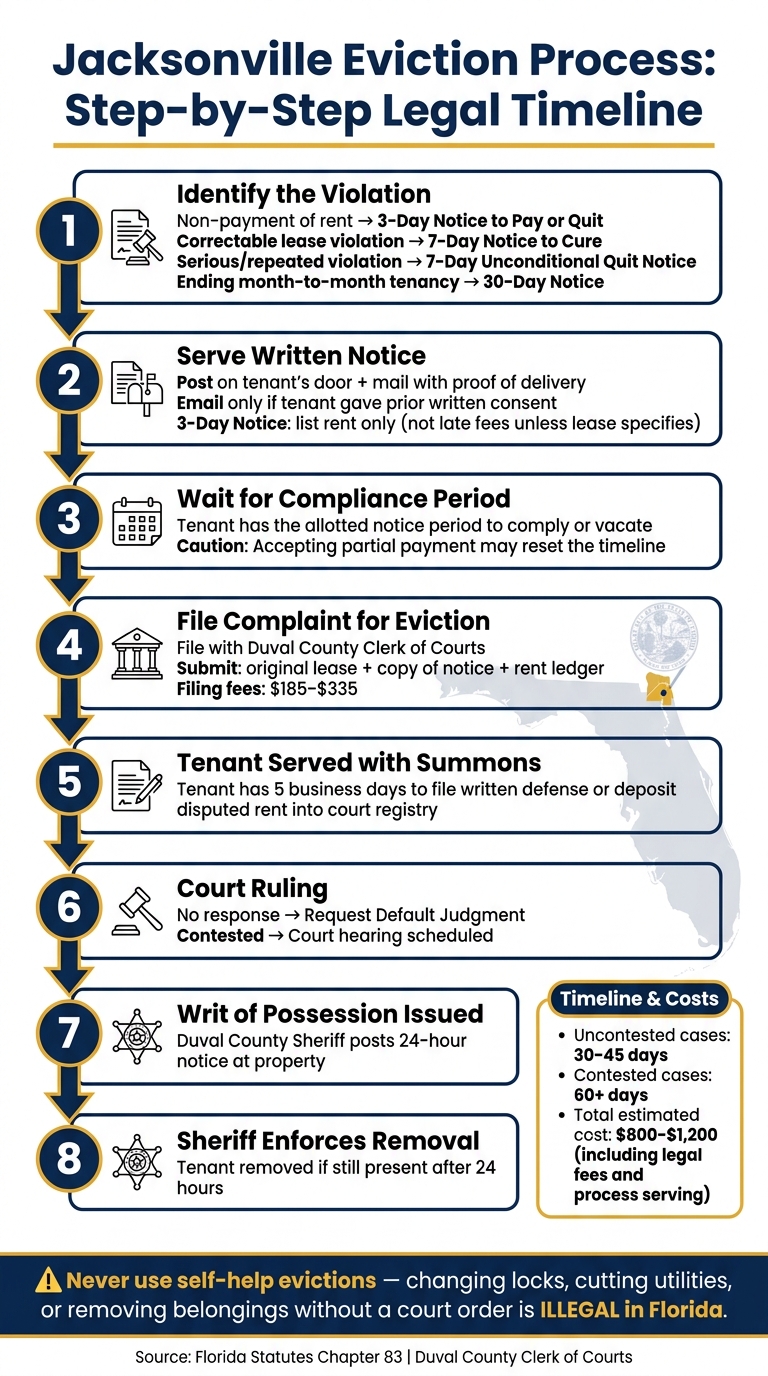
Jacksonville Eviction Process: Step-by-Step Legal Timeline
When tenant disputes escalate beyond minor issues like maintenance complaints or late payments, following the proper legal steps is crucial. In Jacksonville, adhering to the city’s legal framework helps landlords avoid costly mistakes and ensures disputes are resolved efficiently.
Serving Lawful Notices to Tenants
In Jacksonville, the eviction process starts with serving a written notice. The type of notice depends on the situation:
| Notice Type | Reason | Timeline |
|---|---|---|
| 3-Day Notice to Pay or Quit | Non-payment of rent | 3 business days (excludes weekends and court holidays) |
| 7-Day Notice to Cure | Correctable lease violation (e.g., unauthorized pet) | 7 days to fix the issue |
| 7-Day Unconditional Quit | Serious or repeated violation | 7 days to vacate, no option to cure |
| 30-Day Notice | Ending a month-to-month tenancy | 30 days |
For a 3-day notice, the amount listed should reflect only the rent owed – not late fees – unless the lease specifically includes them. The notice must be posted on the tenant’s door and mailed, with proof of delivery retained. Email delivery is acceptable only if the tenant has provided prior written consent.
If a tenant makes a partial payment after receiving the notice, consult an attorney before accepting it. Accepting partial payments could reset the eviction timeline, complicating the process.
Once notices are served correctly, you can move forward with the formal eviction process.
The Eviction Process in Duval County
If a tenant doesn’t comply with the notice, the next step is filing a Complaint for Eviction with the Duval County Clerk of Courts. This requires submitting the original lease, a copy of the notice, and the rent ledger.
After the tenant is served with a summons, they have 5 business days to file a written defense or deposit the disputed rent into the court registry. If they fail to respond, you can request a default judgment. Once the court rules in your favor, you’ll receive a Writ of Possession, which the Duval County Sheriff posts at the property as a 24-hour notice. If the tenant remains after this period, the sheriff enforces their removal.
Duval County recorded 13,744 eviction filings in the year leading up to June 2025. Uncontested cases typically take 30 to 45 days, while contested cases or those with improperly served notices can extend to 60 days or more. Filing fees range from $185 to $335, with total costs – including legal fees and process serving – falling between $800 and $1,200.
"Evictions are never pleasant. They are emotionally taxing, time-consuming, and, if mishandled, legally and financially devastating. But when approached professionally and legally, they become a powerful tool for maintaining profitability and protecting your investment." – 1 Realty Management
It’s important to avoid self-help eviction methods, such as changing locks, cutting off utilities, or removing a tenant’s belongings without a court order. These actions are illegal in Florida and could result in severe penalties.
Resolving Security Deposit Disputes
Proper documentation is key when addressing disputes over security deposits. If you’ve sent a notice of intent via certified mail within 30 days, used the exact statutory language required by F.S. §83.49(3)(a), and have evidence like move-out photos and repair receipts, you’re in a strong legal position.
The required notice language is as follows:
"This is a notice of my intention to impose a claim for damages in the amount of ____ upon your security deposit, due to ____. It is sent to you as required by s. 83.49(3), Florida Statutes. You are hereby notified that you must object in writing to this deduction from your security deposit within 15 days from the time you receive this notice or I will be authorized to deduct my claim from your security deposit." – F.S. 83.49(3)(a)
If a tenant objects within their 15-day window, consider offering a written settlement before pursuing court action. For example, a $400 dispute could lead to $2,500 to $5,000 in attorney fees if the landlord loses, as Florida law requires the losing party to cover court costs and attorney fees. A negotiated resolution often saves time and money in these situations.
Practical Steps to Stay Legally Compliant
To ensure smooth operations and avoid legal pitfalls, here are actionable steps that landlords and property managers in Jacksonville can take to stay compliant with local and state regulations.
Building Clear Policies and Keeping Good Records
Good documentation is your first line of defense against disputes. Keep detailed logs of every maintenance request, repair order, and tenant communication, including dates and any relevant details. These records can be critical in resolving disagreements quickly and effectively.
Conduct thorough move-in and move-out inspections, and back them up with timestamped photos of each room. This simple step can protect you in cases of security deposit disputes. As Austin Spaeth of DiscoveryMark highlights:
"The side with contemporaneous, signed, dated records wins more often and settles faster."
Additionally, ensure compliance with Florida Statutes §83.505 by obtaining written consent from tenants for email notices. If written consent isn’t provided, stick to physical delivery methods and secure proof of service.
Don’t overlook mandatory disclosures. Florida law requires every lease to include the Radon Gas disclosure. Starting October 1, 2025, leases of one year or longer must also include a written flood disclosure. If this disclosure is missing and an uninsured flood loss occurs, tenants may have the right to terminate their lease within 30 days. Keeping these requirements in mind helps avoid unnecessary legal exposure.
Working With a Property Management Company
Staying compliant isn’t just about knowing the rules – it’s about following them to the letter. For instance, even a small error in a 3-day notice, such as including a weekend or listing the wrong rent amount, can lead to rejection in Duval County court. This can force you to restart the process, delaying resolution and creating unnecessary headaches.
Partnering with a property management company like 1 Realty Management can take care of these intricacies. From drafting accurate legal notices and court filings to coordinating with the Duval County Sheriff for Writs of Possession, they handle the details that require precision. They also ensure compliance with security deposit laws:
"Property management requires more than rent collection and maintenance – it demands legal mastery."
Additionally, they implement tenant screening strategies that align with the federal Fair Housing Act and Jacksonville’s Human Rights Ordinance, ensuring fair and consistent practices.
Using Checklists and Templates for Consistency
Consistency is key when managing properties, and standardized tools like checklists and templates can help you avoid mistakes. For example, a move-in checklist signed by both landlord and tenant on day one can become a crucial document if a deposit dispute arises later.
When it comes to security deposit claims, use a template that mirrors the statutory language outlined in F.S. §83.49(3)(a). Follow the required mailing procedures within 30 days of move-out, and pair this with a checklist that includes the tenant’s move-out date, inspection photos, and any repair receipts. This complete paper trail ensures you’re prepared if the tenant objects within their 15-day response window.
Conclusion: Protecting Your Rental Investment Through Legal Compliance
Managing a rental property in Jacksonville means navigating a complex web of legal requirements. Florida’s landlord-tenant laws leave little room for error, and the consequences can be steep. For example, Duval County saw 13,744 eviction filings in a single year, each with the potential for significant legal and financial repercussions. Avoiding these pitfalls requires landlords to stick to strict legal timelines and maintain detailed records.
The good news? Most legal issues can be avoided. By adhering to statutory deadlines, keeping comprehensive documentation, and using lease agreements tailored to Florida law, landlords can significantly lower their risks. This approach not only helps in court but also improves everyday property management. As Blakely Hughes, Broker at Nest Finders, aptly states:
"In today’s rental market, compliance is no longer just protection; it is strategy."
Keeping up with regulatory changes does more than just help landlords avoid fines – it creates a smoother, more efficient business. By aligning with Florida statutes and Jacksonville-specific codes, property owners can ensure long-term stability and peace of mind. For those looking to remove any guesswork, partnering with 1 Realty Management offers expert services like accurate notice preparation and court-ready documentation, providing the legal expertise and structure needed to thrive in Jacksonville’s rental market.
FAQs
What repairs in Jacksonville can lead to code violations?
In Jacksonville, failing to meet the standards outlined in the Property Safety and Maintenance Code (Chapter 518) or health and safety regulations can lead to code violations. Some frequent problems include faulty plumbing, exposed electrical wiring, structural damage (such as rotten wood or peeling paint), and damaged floors or ceilings. Exterior issues like abandoned vehicles, overgrown weeds, neglected pools, or broken fences also fall under these violations. Landlords are responsible for ensuring their properties comply with all building and health codes to keep them livable.
What proof should I keep for security deposit deductions?
Keeping timestamped proof is crucial when handling security deposit deductions. This includes documentation like move-in and move-out inspection records, photos or videos clearly showing damage beyond normal wear and tear, and receipts or invoices for any repairs or cleaning performed. Additionally, ensure you have proof of sending the written deposit claim notice via certified mail to the tenant’s last known address within 30 days of their move-out. Failing to meet this 30-day deadline typically means you lose the right to make deductions from the deposit.
When should I hire 1 Realty Management for compliance help?
When it comes to ensuring your leases and renewals align with Florida Statutes Chapter 83, Hire 1 Realty Management can be a reliable partner. They take care of critical compliance areas like deposits, disclosures, and notice updates.
If you’re dealing with Jacksonville-specific codes or habitability concerns that could lead to tenant remedies, they can address those as well. On top of that, they manage notices and court procedures, ensuring all documentation is accurate and timelines are met.