Florida’s security deposit laws are strict and detailed, focusing on how landlords must manage, store, and return deposits. Here’s what you need to know:
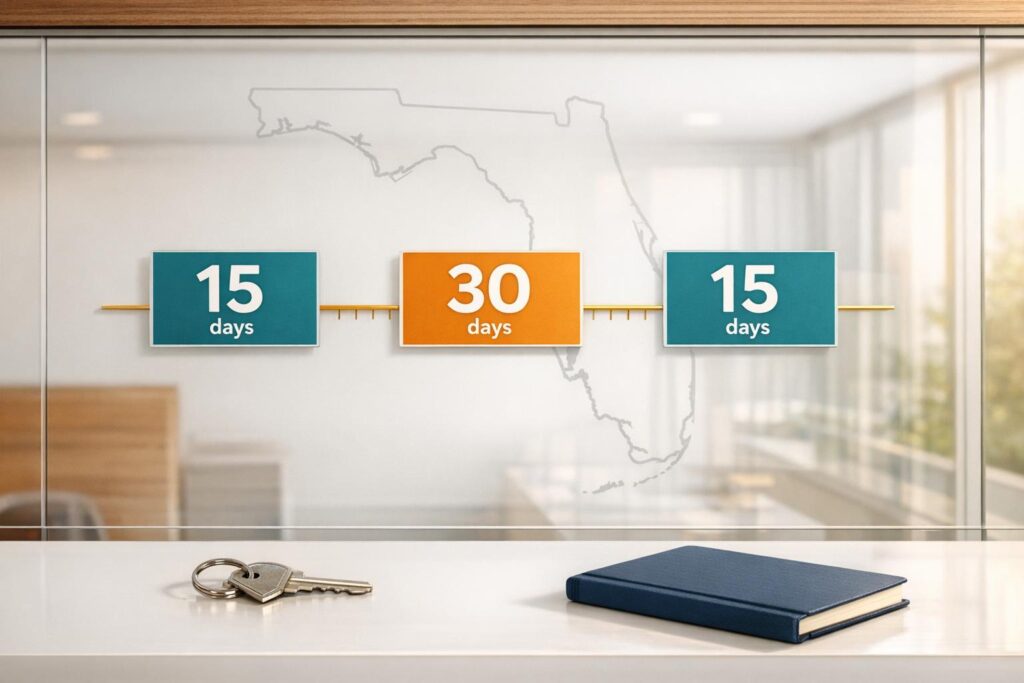
- Timelines Matter: Landlords must follow the “15-30-15” rule:
- Return full deposits within 15 days if no deductions are made.
- Notify tenants of deductions within 30 days via certified mail.
- Tenants have 15 days to object to deductions.
- Storage Rules: Deposits must be kept in Florida-based accounts (non-interest or interest-bearing) or secured with a surety bond.
- Interest Payments: Tenants may be entitled to interest depending on the storage method.
- Deductions: Only unpaid rent, damages beyond normal wear and tear, and certain cleaning costs are allowed.
- Non-Compliance Risks: Missing deadlines or failing to follow procedures can result in losing the right to deductions and potential legal action.
Landlords must screen tenants effectively and handle deposits carefully to avoid disputes and penalties. Compliance with Florida Statutes § 83.49 is essential to protect both parties’ rights.
Landlord Obligations for Security Deposit Management
Florida’s 15-30-15 timeline lays the groundwork for managing tenants’ security deposits, ensuring compliance with state laws. Landlords in Florida are required to handle deposits responsibly – this includes keeping them in a separate account, paying interest when applicable, and providing written notice to tenants. Failure to follow these rules means landlords forfeit their right to claim the deposit. Below, we’ll break down the key aspects of account management, interest rules, and notice requirements.
Separate Account Requirements
In Florida, landlords have three options for storing security deposits: a non-interest-bearing account, an interest-bearing account, or a surety bond. Regardless of the method chosen, the funds must be held in a Florida-based financial institution and cannot be mixed with the landlord’s other monies. Florida Statutes Section 83.49 makes this clear:
“The landlord shall not commingle such moneys with any other funds of the landlord or hypothecate, pledge, or in any other way make use of such moneys until such moneys are actually due the landlord.”
If a surety bond is used, the landlord keeps the deposit funds, while the bond acts as a financial guarantee. Once the deposit is secured, the rules for paying interest depend on the storage method.
Interest Payment Rules
The amount of interest landlords owe tenants depends on how the deposit is stored:
- Non-interest-bearing account: No interest is owed.
- Interest-bearing account: Landlords must pay tenants either 75% of the annualized average interest rate or 5% simple interest per year, whichever they choose.
- Surety bond: A flat 5% simple interest per year is owed to the tenant.
Interest payments must be made directly to the tenant or applied as a credit against rent at least once a year. However, if a tenant vacates before the lease ends, the landlord is not required to pay interest.
| Storage Method | Interest Owed to Tenant | Funds Commingled? |
|---|---|---|
| Non-interest-bearing account | None | No |
| Interest-bearing account | Minimum 75% of earned interest or 5% simple interest/year | No |
| Surety bond | 5% simple interest per year | Yes |
Written Notice to Tenants Within 30 Days
Landlords have 30 days from the time they receive a deposit to provide written notice to the tenant. This notice must include:
- The name and address of the Florida financial institution holding the deposit.
- A statement indicating whether the account is interest-bearing or confirmation of a surety bond arrangement.
- The following statutory disclosure, as required by Florida Statute 83.49(3)(d):
“YOUR RENTAL AGREEMENT REQUIRES PAYMENT OF CERTAIN DEPOSITS. THE LANDLORD MAY TRANSFER ADVANCE RENTS TO THE LANDLORD’S ACCOUNT AS THEY ARE DUE AND WITHOUT NOTICE. WHEN YOU MOVE OUT, YOU MUST GIVE THE LANDLORD YOUR NEW ADDRESS SO THAT THE LANDLORD CAN SEND YOU NOTICES REGARDING YOUR DEPOSIT.”
This notice can be delivered in person, by mail, or by email (if the tenant has signed an email notice addendum). Landlords should keep proof of delivery, such as certified mail receipts or timestamped emails, as evidence of compliance. If the deposit is moved to a different institution, a new notice must be sent within 30 days of the transfer.
It’s worth noting that landlords managing fewer than five individual dwelling units are exempt from this notice requirement. For those who find these regulations overwhelming, working with experienced property managers, such as 1 Realty Management in Jacksonville, Florida, can ensure compliance and simplify the process.
sbb-itb-73b3b1a
Permissible Uses and Deductions from Security Deposits
When it comes to security deposits in Florida, landlords must stick to specific guidelines for deductions. Only costs allowed under Florida law can be deducted. Attempting to make improper charges could result in losing the right to claim the deposit altogether.
Normal Wear and Tear vs. Legitimate Damage
Understanding the difference between normal wear and tear and actual damage is critical. Normal wear and tear happens through everyday use, while damage results from negligence or misuse.
“Normal wear and tear generally refers to the natural deterioration of a property that occurs over time due to regular, intended use.” – Brian Korte, Attorney
Here’s a breakdown of the differences:
| Normal Wear and Tear (Non-Deductible) | Legitimate Damage (Deductible) |
|---|---|
| Faded paint or minor scuffs on walls | Large holes, unauthorized paint colors, or smoking-related discoloration |
| Small nail holes from hanging pictures | Broken windows or mirrors |
| Light carpet wear in high-traffic areas | Stained, burned, or ripped carpeting |
| Loose doorknobs or worn hinges | Broken fixtures or missing hardware |
| Standard cleaning between tenants | Excessive filth, trash, or grime requiring professional cleaning |
| Routine plumbing maintenance | Clogged or broken plumbing caused by tenant misuse |
Painting is a common point of confusion. Generally, landlords cannot charge tenants for repainting unless the tenant painted without permission or caused significant damage, such as large wall stains or holes.
Valid Deduction Categories
Landlords may deduct from security deposits for the following:
- Unpaid rent or utilities: Any outstanding rent or utility bills owed by the tenant.
- Property damage: Repairs for damage beyond normal wear and tear, such as broken fixtures, stained carpets, or damaged walls.
- Excessive cleaning costs: Charges for professional cleaning when the unit is left excessively dirty or filled with trash.
- Smoking-related damage: Costs to address odors, yellowed walls, or burn marks caused by smoking.
- Abandonment or early lease termination: Covering rent for the period the unit remains unrented if a tenant leaves without proper notice or legal justification.
It’s important to note that deductions must comply with Florida law and the lease agreement. For example, landlords cannot charge pet deposits for service animals or emotional support animals, as outlined in Florida Statute § 413.08.
To avoid disputes, landlords should document the property’s condition with photos and videos during both move-in and move-out inspections. Providing tenants with an itemized list of deductions, along with receipts or invoices for any repairs, helps ensure transparency and compliance with the law.
For landlords in Florida, including those in Jacksonville, working with property management experts in Jacksonville like 1 Realty Management can simplify the process and ensure all security deposit procedures meet state requirements.
Next, we’ll explore the legal timelines for refunding security deposits.
Legal Timelines for Security Deposit Refunds
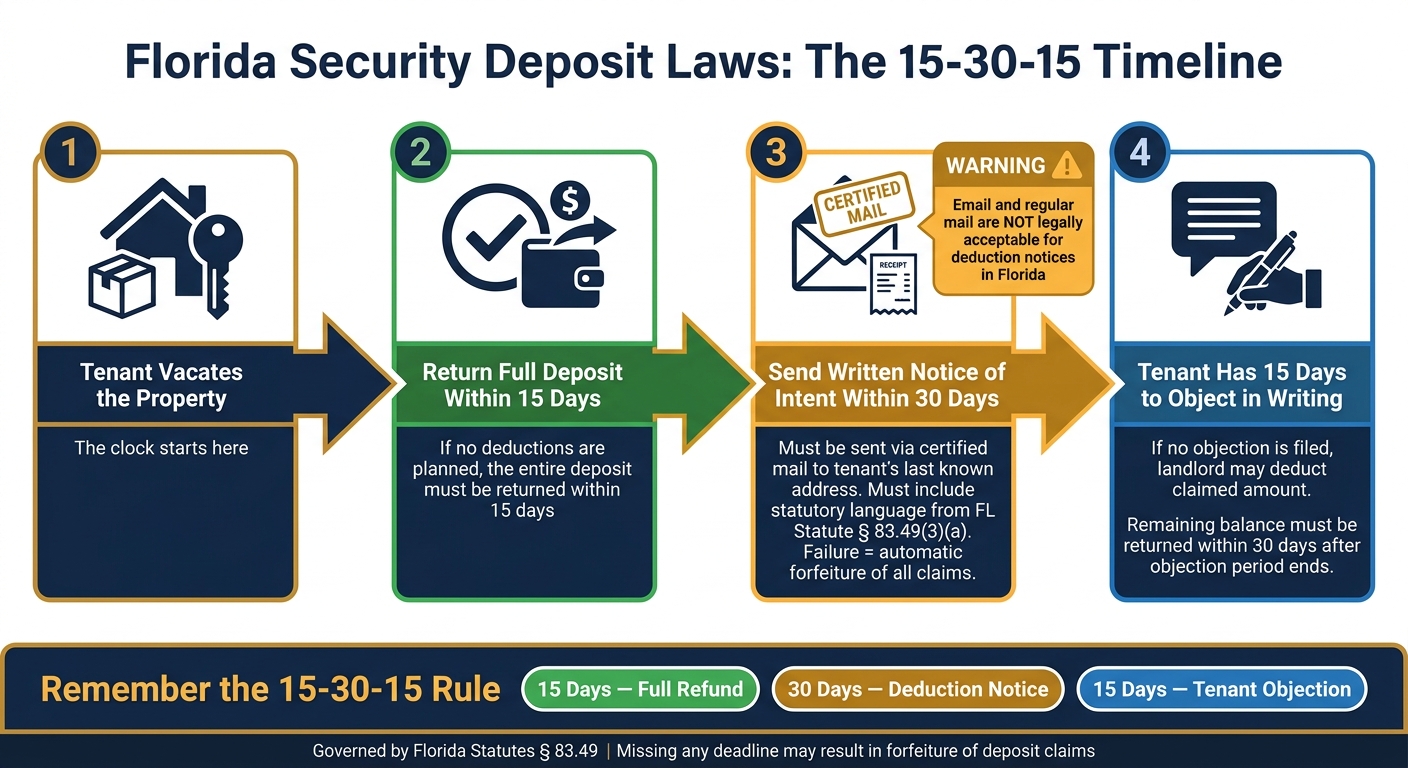
Florida Security Deposit Laws: The 15-30-15 Timeline for Landlords
Florida law enforces clear deadlines for handling security deposit refunds, ensuring landlords follow specific steps once a tenant moves out. Missing these deadlines can lead to serious consequences, including losing the right to deduct any portion of the deposit.
“Florida’s deposit regime can be unforgiving if procedural deadlines aren’t met.” – Commoner Law
Here’s a quick breakdown of the essential timelines landlords must follow:
| Action | Deadline | Requirement |
|---|---|---|
| Full Refund (No Claims) | 15 Days | Return the full deposit to the tenant |
| Notice of Intent to Deduct | 30 Days | Provide a written notice via certified mail |
| Tenant Objection Window | 15 Days | Submit a written objection to the landlord’s claim |
| Return of Remaining Balance | 30 Days | Refund the remaining balance after the notice period |
15-Day Full Refund Rule
If no deductions are planned, landlords must return the entire security deposit within 15 days after the tenant vacates. Failing to meet this deadline could result in legal liability for the landlord.
30-Day Notice for Deductions
When deductions are necessary, landlords must send a written notice of intent within 30 days of the tenant moving out. This notice must be sent via certified mail to the tenant’s last known address – emails, text messages, or regular mail are not legally acceptable in Florida.
The notice must include specific wording from Florida Statute § 83.493:
“This is a notice of my intention to impose a claim for damages in the amount of _____ upon your security deposit… You are hereby notified that you must object in writing to this deduction… within 15 days from the time you receive this notice or I will be authorized to deduct my claim from your security deposit.” – Florida Statute § 83.493
If the notice is sent late or through an improper channel, the landlord forfeits their right to make any deductions. In Durene v. Alcime, 448 So. 2d 1208, Florida courts affirmed that the 30-day deadline is strict and leaves no room for error.
Tenant’s 15-Day Objection Period
Once the tenant receives the notice of claim, they have 15 days to file a written objection. If no objection is made within that time, the landlord can deduct the claimed amount and must return any remaining balance within 30 days after the objection period ends.
Tenants who wish to dispute deductions should send their written objections via certified mail with return receipt to maintain a clear record.
For landlords in Jacksonville and beyond, adhering to these deadlines – supported by professionals like 1 Realty Management – helps ensure compliance and reduces the risk of legal disputes.
Consequences of Non-Compliance for Landlords
Florida’s security deposit rules aren’t just guidelines – they come with serious legal consequences. Missing deadlines or failing to follow the proper procedures can cost landlords far more than the deposit itself. The 15-30-15 timeline outlined earlier is not just a suggestion; it’s a legal framework that landlords must follow to avoid costly mistakes. These penalties highlight why precision in handling security deposits is so important.
Forfeiture of Claims
One of the most immediate consequences of non-compliance is automatic forfeiture. According to Florida Statute § 83.49(4)(a), if a landlord fails to send the required 30-day notice, they lose the right to make any claim against the deposit. Even if the tenant caused clear, documented damage, the landlord must return the full deposit if they miss the deadline or send the notice incorrectly. This rule also applies if the notice doesn’t include the specific statutory language.
Courts enforce these rules strictly. For example, in Durene v. Alcime (448 So. 2d 1208), the court required a landlord to return the deposit before pursuing a separate lawsuit for damages. This process can be both time-consuming and expensive, often outweighing the cost of the damages themselves.
But forfeiture isn’t the only risk. Non-compliance can also open landlords up to legal action from tenants.
Tenant Lawsuits and Penalties
Tenants have multiple options to enforce their rights. They can file claims in Small Claims Court for disputes up to $8,000 or in County Court for claims up to $50,000. Filing fees are relatively low – sometimes as little as $55 – making it accessible for tenants to challenge landlords who don’t comply with the rules.
Florida Statute § 83.49(4)(c) also allows the winning party in a security deposit dispute to recover reasonable attorney’s fees and court costs. This means that if a landlord loses such a case, they could be responsible for both their own legal fees and the tenant’s – potentially resulting in financial liability far greater than the original deposit.
| Violation | Consequence |
|---|---|
| Failure to send notice within 30 days | Loss of the right to claim any portion of the deposit |
| Improperly sent notice (e.g., via email or regular mail) | Forfeiture of the claim |
| Missing required statutory language | Forfeiture of the claim |
| Losing a deposit dispute | Responsibility for both their own and the tenant’s legal fees |
| Illegal utility shutoff or lockout | Liability for three months’ rent or actual damages, whichever is greater |
To avoid these risks, landlords in Jacksonville can work with professional property management services like 1 Realty Management. These services help ensure compliance with Florida’s security deposit laws, reducing the chances of costly legal disputes.
Handling Security Deposits During Property Transfers
When a rental property changes hands in Florida, the security deposit doesn’t stay with the previous owner – it must follow the tenant. Florida Statute § 83.49 mandates that security deposits, along with any earned interest and a detailed accounting of each tenant’s credited amounts, be transferred to the new property owner.
“Upon the sale or transfer of title of the rental property from one owner to another, or upon a change in the designated rental agent, any and all security deposits or advance rents being held for the benefit of the tenants shall be transferred to the new owner or agent, together with any earned interest and with an accurate accounting showing the amounts to be credited to each tenant account.” – Florida Statutes § 83.49
This law ensures that tenants’ deposits are protected during ownership transitions. Until the funds, records, and a written receipt of transfer are handed over, the seller remains responsible for the deposit.
Once the new owner takes possession, they are required to notify tenants in writing within 30 days. This notice must include the name and address of the bank holding the deposit and indicate whether the account earns interest. Florida law also assumes that the new owner received the deposit from the seller, but this presumption is capped at an amount equal to one month’s rent. If the deposit exceeds one month’s rent, the buyer should verify that the full amount was transferred – this is often documented as a credit on the closing settlement statement.
To avoid disputes after the transfer, buyers are encouraged to take extra precautions. One effective step is requiring tenants to sign an estoppel certificate before closing. This document confirms the deposit amount and reduces the risk of discrepancies in the seller’s records. The same rules for transferring deposits apply when there is a change in property management, even if ownership stays the same.
For landlords in Jacksonville, working with a professional management company like 1 Realty Management (https://propertymanagementjacksonvillefl.com) can help ensure that all security deposit transfers and tenant notifications comply with Florida law.
Florida Statutes Section 83.49: What Landlords Need to Know
Florida Statutes § 83.49 serves as the key legal framework for handling security deposits in Florida. It lays out the rules for holding deposits, returning them, and making deductions. Every landlord in the state must familiarize themselves with this law before collecting a security deposit, as it provides detailed instructions critical for compliance.
Instead of maintaining a separate bank account, landlords have the option to file a surety bond with the clerk of the circuit court. For landlords operating in a single county, the bond must cover either the total amount of deposits held or $50,000 – whichever is lower. For those managing properties across five or more counties, the cap increases to $250,000.
The statute also mandates specific disclosure requirements. Leases must include particular language that informs tenants of their rights. This requirement is separate from the notice process and focuses on ensuring the lease itself contains the necessary text. If this language is missing, the lease could be deemed noncompliant, putting the landlord at risk of legal challenges.
There are exemptions outlined in § 83.49 as well. The law does not apply to transient rentals, such as hotels and motels, or to public housing authorities, which follow separate regulations. Additionally, as of 2023 (Ch. 2023-314), Florida law overrides local ordinances, preventing cities and counties from imposing stricter deposit caps or return timelines than those specified in the statute.
“Florida’s deposit regime is one of the most technically unforgiving in the country for landlords.” – Commoner Law
For full compliance, landlords should review the complete text of § 83.49, available on the Florida Legislature‘s official website. Even minor errors can jeopardize a landlord’s ability to make claims on a deposit, underscoring the importance of understanding every aspect of this statute.
Conclusion
Florida’s security deposit laws leave little room for error. Under Florida Statutes § 83.49, landlords must follow specific rules about holding deposits, notifying tenants, and meeting deadlines for returning funds or filing claims. Skipping even a single step can result in losing the right to make any deductions, no matter the circumstances.
Here’s a quick breakdown of the key timelines: if no deductions are needed, the full deposit must be returned within 15 days. If deductions are planned, a certified mail notice of intent must be sent within 30 days, giving tenants 15 days to respond in writing. Missing these deadlines can have serious consequences, including forfeiting the right to withhold any part of the deposit.
Failing to send the 30-day certified mail notice is especially costly – it eliminates the ability to claim any deductions.
To avoid disputes, landlords should stick to these deadlines and maintain thorough documentation. This includes detailed walkthroughs, photos, and signed checklists to justify deductions. Additionally, keeping deposit funds in a properly designated Florida banking account is a legal requirement that cannot be ignored.
FAQs
What counts as “normal wear and tear” in Florida?
In Florida, normal wear and tear covers the kind of gradual damage or aging that happens naturally with everyday use – not damage caused by a tenant’s carelessness. Examples include things like minor floor scratches, faded or discolored paint, loose hinges, small plumbing leaks, flattened or slightly discolored carpet, and general accumulation of dust or dirt. These are seen as routine signs of living, not reasons to deduct from a tenant’s security deposit.
What should I do if my landlord missed the 15- or 30-day deposit deadline?
If your landlord doesn’t return your security deposit within 15 days or fails to send a claim notice within 30 days, they lose the right to make any claims against the deposit. This means they’re required to return the full amount to you. Make sure to keep a record of all communication and important dates for your own reference.
Can my security deposit be used as last month’s rent in Florida?
In Florida, a security deposit cannot be applied as the last month’s rent. Its primary purpose is to cover specific issues like unpaid rent, damage beyond normal wear and tear, or breaches of the lease agreement. By law, landlords are required to manage security deposits separately and in compliance with state regulations.