If you’re a landlord in Florida, you’re legally required to maintain your rental property in a safe, clean, and livable condition under the warranty of habitability. This rule applies to all residential leases, regardless of your lease terms.
Key points:
- Landlord Responsibilities: Fix structural issues, provide running water, hot water, heating, functional locks, and smoke detectors.
- Tenant Rights: Tenants can withhold rent, terminate leases, or pursue legal action if repairs aren’t started within 7 days of written notice.
- What’s Not Covered: Cosmetic issues like chipped paint or worn carpets, and damage caused by tenant misuse.
- Local Codes: Some counties enforce stricter rules, such as mandatory pest control or additional smoke detector requirements.
Failing to meet these standards can result in rent loss, fines up to $500/day, or even lawsuits. Staying on top of repairs and keeping detailed records is critical to avoid legal and financial risks.
Florida’s Legal Framework for Habitability
Key Statutes That Apply
Florida’s rental housing laws are outlined in Chapter 83, Part II of the Florida Statutes. Two key sections stand out: §83.51, which requires landlords to ensure properties are safe and livable, and §83.52, which holds tenants responsible for keeping the property clean and undamaged. If an issue arises due to tenant misuse, landlords are not responsible under §83.52. Proactive tenant screening in Jacksonville can help identify reliable renters and minimize these risks.
Another critical statute is §83.47, which prohibits lease agreements from including clauses that waive habitability protections. According to the law:
“A provision in a rental agreement is void and unenforceable to the extent that it… purports to waive or preclude the rights, remedies, or requirements set forth in this part.” – Florida Statute § 83.47
In other words, tenants and landlords cannot agree to bypass these legal obligations. These statutes clearly define landlord responsibilities and outline what is and isn’t covered under habitability laws, which brings us to the next point.
What Habitability Laws Cover and What They Don’t
Florida law requires landlords to maintain several essential aspects of a rental property. This includes structural components like roofs, walls, floors, foundations, windows, and doors. It also covers utilities such as running water, hot water, and adequate heating. Additionally, landlords must ensure locks and keys are functional and provide well-maintained window screens. For single-family homes and duplexes, landlords are also required to install working smoke detectors at the start of a tenancy.
However, habitability laws don’t cover everything. Cosmetic issues like chipped paint, minor scratches, or worn carpets are outside the scope of these requirements. Similarly, non-essential appliances – such as washers, dryers, or kitchen equipment – are not covered unless the landlord has provided them as part of the rental agreement.
Landlords are also not responsible for damage caused by tenant misuse, as outlined in §83.52.
How Local Codes Factor In
In addition to state statutes, local codes further shape landlord obligations. According to §83.51(1)(a), landlords must comply with all relevant local building, housing, and health codes:
“The landlord at all times during the tenancy shall: (a) Comply with the requirements of applicable building, housing, and health codes.” – Florida Statute § 83.51
If no local code exists, state law applies. However, local jurisdictions often impose stricter requirements. For instance, while state law mandates smoke detectors for single-family homes and duplexes, local codes – such as those in Jacksonville, Duval County – may extend that requirement to multi-family units. Additionally, local governments may require landlords to complete administrative tasks like obtaining rental registrations or Business Tax Receipts (BTR), which are not addressed in state law.
To ensure compliance, landlords should always review local ordinances alongside state statutes. When local codes impose stricter standards than §83.51, those stricter rules take precedence.
sbb-itb-73b3b1a
What Florida Landlords Are Required to Maintain
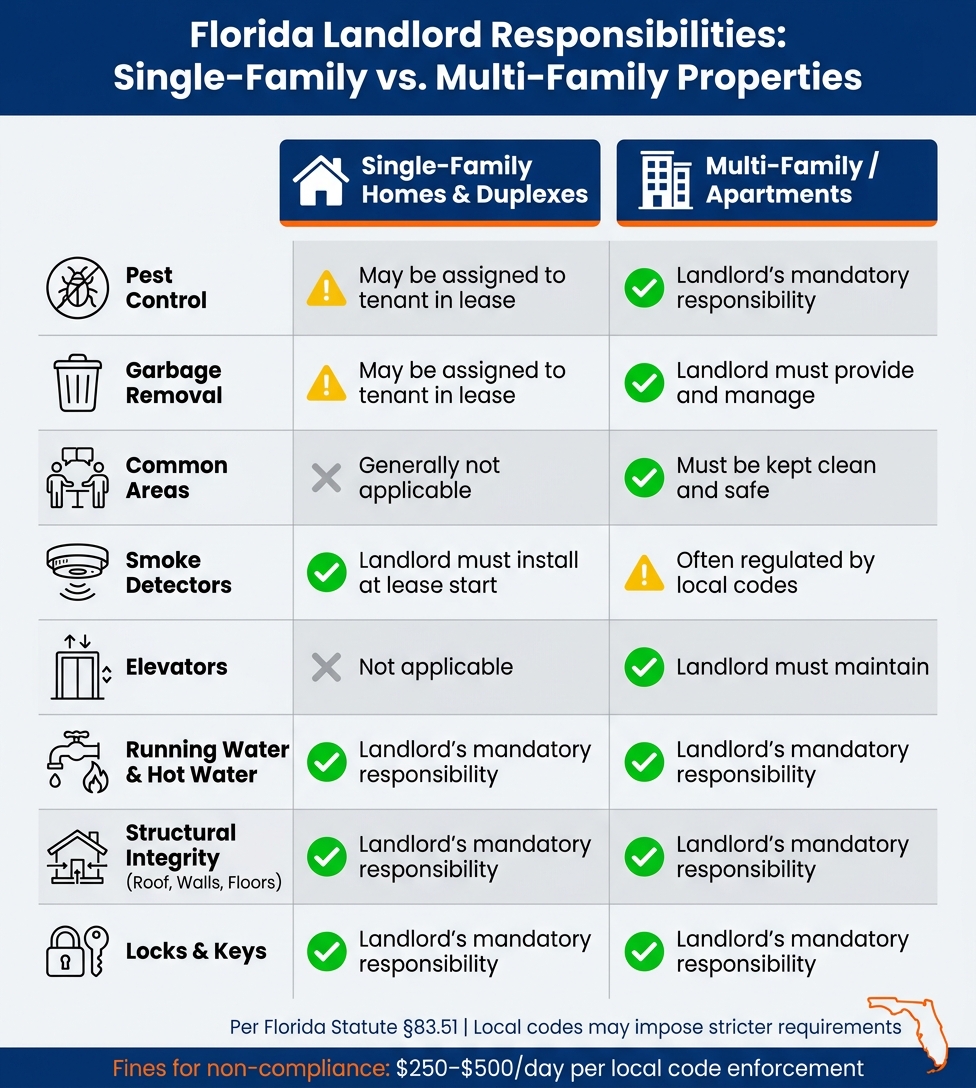
Florida Landlord Responsibilities: Single-Family vs. Multi-Family Properties
Core Systems and Safety Features
Under Florida Statute §83.51, landlords are responsible for ensuring that all structural elements of a property remain in proper working condition. This includes essentials like roofs, walls, floors, foundations, steps, porches, windows, and doors. Additionally, landlords must provide and maintain functioning systems for running water, hot water, and heating during the winter months. Window screens must also be kept in working order, with repairs required annually.
Locks and keys throughout the rental must operate correctly for the entire duration of the tenancy. If the landlord supplies appliances, they are required to ensure these remain safe and operational.
These structural and system upkeep requirements are complemented by additional health and safety measures.
Health and Security Requirements
Florida law mandates that smoke detectors be installed in single-family homes and duplexes, with full replacements required approximately every 10 years. In multi-family properties, landlords are also responsible for pest control, including eliminating any infestations. This responsibility cannot be shifted to tenants.
If pest control treatments require tenants to vacate temporarily, landlords must provide at least 7 days’ written notice. The vacancy period cannot exceed 4 days, and rent must be adjusted for the time tenants are unable to occupy the property.
Common Areas in Multi-Family Properties
For multi-family properties, landlords have additional obligations to maintain shared spaces. Florida Statute §83.51 specifies:
“The landlord of a dwelling unit other than a single-family home or duplex shall, at all times during the tenancy, make reasonable provisions for… The clean and safe condition of common areas.”
This means areas like hallways, lobbies, laundry rooms, stairwells, and elevators must be regularly maintained. These spaces should be well-lit and free from hazards such as loose railings or uneven flooring. Landlords are also required to provide garbage receptacles and arrange for regular waste removal – tasks that cannot be delegated to tenants.
Here’s a quick breakdown of how responsibilities vary between property types:
| Responsibility | Single-Family & Duplexes | Multi-Family (Apartments) |
|---|---|---|
| Pest Control | May be assigned to tenant in lease | Landlord’s mandatory responsibility |
| Garbage Removal | May be assigned to tenant in lease | Landlord must provide and manage |
| Common Areas | Generally not applicable | Must be kept clean and safe |
| Smoke Detectors | Landlord must install at lease start | Often regulated by local codes |
| Elevators | Not applicable | Landlord must maintain |
These distinctions highlight the landlord’s legal obligations to meet both state requirements and local standards, ensuring properties meet Florida’s habitability expectations. For those with diverse portfolios, specialized Westside property management ensures these standards are met across all unit types.
Looking ahead, a proposed bill (HB 241) for the 2026 legislative session could introduce new requirements. If passed, it would mandate landlords to provide and maintain cooling equipment in habitable rooms for leases entered into or renewed on or after July 1, 2026. Landlords managing multi-family properties should monitor this potential change closely. Professional Southside property management services can help owners navigate these evolving compliance requirements.
These rules emphasize how critical it is for landlords to maintain consistent care across all areas of their properties, ensuring tenant safety and compliance with the law.
Tenant Rights and Remedies When Habitability Standards Are Not Met
What Counts as a Habitability Violation
In Florida, tenant remedies are only triggered by material violations that affect health, safety, or essential living conditions. Examples include sewage issues, a leaking roof, lack of running water, or a heating system that fails during cold weather. These issues directly impact the livability of the property. On the other hand, cosmetic problems, such as peeling paint or minor wear and tear, don’t meet the legal threshold for habitability violations.
This distinction is particularly important in legal disputes. If a tenant withholds rent over a minor issue that a judge deems insignificant, they could face eviction, be held responsible for back rent, and even incur court costs and attorney’s fees.
Tenant Options: Notice, Rent Withholding, and Lease Termination
When a material habitability issue arises, tenants must follow specific legal steps. Florida law requires tenants to send a written, verifiable notice to the landlord, typically via certified mail, detailing the violation. If the landlord doesn’t address the issue within seven days, tenants have options, such as withholding rent or terminating their lease. However, these remedies are only available if the tenant’s rent was fully paid at the time the notice was sent. Tenants who are already behind on rent cannot use habitability violations as a defense.
“If the seven days have expired and the landlord still has not corrected the problems, you may withhold your rent. However… if the Court determines the defects were not material you may be subject to eviction, past due rent, court costs and attorney’s fees.” – Bay Area Legal Services
If a landlord files for eviction after rent is withheld, the tenant must deposit all withheld rent into the court registry within five business days of being served. Beyond withholding rent or terminating the lease, tenants can sue for damages, request a court order to force repairs, or file a complaint with local code enforcement. Obtaining an official inspector’s report can strengthen a tenant’s case in legal proceedings.
These tenant rights highlight the importance of understanding the limits placed on landlords.
Actions Landlords Cannot Take
Florida law strictly prohibits landlords from engaging in retaliatory or illegal actions in response to tenant complaints. Self-help evictions – such as shutting off utilities, changing locks, or removing fixtures – are not allowed under any circumstances.
Landlords who violate these rules face serious penalties. For example, if found guilty of an illegal self-help eviction, a landlord could owe the greater of three months’ rent or the tenant’s actual damages, along with court costs and attorney’s fees.
Retaliation is also forbidden. According to Fla. Stat. § 83.64, landlords cannot increase rent, reduce services, or threaten eviction simply because a tenant reported a code violation, requested repairs, or joined a tenant organization. The table below outlines common tenant protections and corresponding landlord restrictions:
| Protected Tenant Activity | Prohibited Landlord Response |
|---|---|
| Submitting written notice of a habitability issue | Increasing rent or adding new fees |
| Reporting violations to code enforcement | Shutting off utilities |
| Joining a tenant organization | Threatening or filing a retaliatory eviction |
| Filing a lawsuit for habitability breaches | Refusing to renew an otherwise-renewable lease |
| Exercising any right under Florida law | Reducing services or access to common areas |
“The landlords who win habitability disputes in Florida aren’t the ones with perfect properties – they’re the ones with perfect paper trails.” – Tenant Screening Background Check
For landlords, the best defense against habitability claims is maintaining detailed records of repair requests, completed work, and all communications with tenants. Thorough documentation can make all the difference in legal disputes.
How Florida Landlords Can Stay Compliant
Setting Up a Preventive Maintenance Schedule
One of the best ways to avoid habitability issues is to tackle potential problems before tenants even notice them. A well-structured maintenance calendar, aligned with Fla. Stat. §83.51, ensures your property stays in good condition while keeping a clear record of upkeep efforts throughout the year.
| Maintenance Task | Recommended Frequency | Why It Matters |
|---|---|---|
| HVAC Servicing | Semi-annual (Spring & Fall) | Prevents air conditioning failures during Florida’s intense heat; proactive servicing can prevent 95% of AC repairs |
| Roof & Gutter Inspection | Annual | Stops water intrusion that could cause structural damage and mold issues |
| Smoke Detector Testing | Twice yearly & between tenants | Ensures tenant safety, as most detectors are reliable for about 10 years |
| Pest Control | Bi-monthly (multi-family) | Required by law for multi-family units; addressing infestations early saves money |
| Plumbing/Leak Check | Every property visit | Identifies small leaks early to prevent water damage and mold |
This type of proactive maintenance schedule pairs perfectly with a quick, organized approach to handling tenant repair requests.
Handling Repair Requests and Emergencies
Responding quickly to repair requests is not just good practice – it’s essential. Florida law requires landlords to begin repairs within 7 days of receiving written notice from tenants.
It’s helpful to categorize repair requests into two main types: emergencies and routine issues. For emergencies – like burst pipes, sewage backups, gas leaks, or broken locks – a response within 24 hours is critical. Urgent issues, such as an air conditioning failure during a Florida summer or no hot water, should be addressed within 24–48 hours. Routine concerns, like a leaky faucet or a sticking cabinet door, can generally be resolved within 7–14 days.
“A documented paper trail showing prompt response is your best protection if a dispute later escalates to a habitability claim.” – Dawn Sealy-Fragale, Property Manager, Bridge of Lions Realty
Always acknowledge repair requests in writing and provide a clear timeline for resolution. Using tools like an online maintenance portal or a dedicated email address can timestamp communications, creating a reliable record. Before-and-after photos of repairs are another excellent way to document your efforts. Starting July 1, 2025, Florida law will allow email as an official notice method, provided both parties have agreed to it in writing.
If you manage multiple properties or properties at a distance, having professional support can make all the difference.
Working with a Professional Property Management Company
Combining proactive maintenance with timely repairs is key to staying compliant. For landlords juggling multiple properties or those located far from their rentals, a property management company can ensure nothing is overlooked.
1 Realty Management specializes in helping Jacksonville landlords maintain compliance. Their services include coordinating maintenance, communicating with tenants, executing leases, and providing detailed financial reports. With a dedicated team handling repair requests and keeping records, you can rest assured that every detail is covered.
“Florida’s landlord-tenant statute is detailed, specific, and unforgiving of mistakes.” – Dawn Sealy-Fragale, Property Manager, Bridge of Lions Realty
As Florida’s legal requirements evolve – such as the proposed cooling mandates under HB 241 and updated disclosure rules – keeping up with the changes can feel overwhelming. A professional management team can monitor these developments, adjust your processes, and help you avoid surprises.
Conclusion: Key Points for Florida Landlords
A Review of Landlord Responsibilities
Florida law requires landlords to uphold a warranty of habitability, as outlined in Fla. Stat. §83.51. This means ensuring that essential systems and safety features, like smoke detectors in single-family homes and duplexes, are in proper working order. For multi-family properties, landlords must also handle pest control, garbage disposal, and maintaining common areas – responsibilities that cannot be shifted to tenants. However, single-family homes and duplexes offer more flexibility in these terms. Failing to meet these obligations can lead to serious financial and legal consequences.
Why Staying Compliant Pays Off
Overlooking habitability issues can lead to rent losses, hefty fines, and even lawsuits. Some legal cases in Florida have ended in multimillion-dollar penalties, and local code enforcement fines in certain counties range from $250 to $500 per day for violations. Staying proactive with property maintenance is a smart way to avoid these risks. For instance, a Tampa duplex case in early 2026 showed how regular HVAC servicing and fixing a minor roof leak helped eliminate emergency maintenance calls for six months and achieved a 100% lease renewal rate.
“The landlords who win habitability disputes in Florida aren’t the ones with perfect properties – they’re the ones with perfect paper trails.” – Tenant Screening Background Check
Good record-keeping is just as critical as making repairs. Landlords who document everything – maintenance schedules, repair receipts, and tenant communications – are better equipped to handle disputes. Compliance doesn’t just protect your investment; it also simplifies property management and boosts tenant satisfaction.
Working with 1 Realty Management
Navigating Florida’s landlord-tenant laws requires ongoing attention, especially as regulations change. 1 Realty Management offers Jacksonville landlords the support they need. From managing repairs within the legally required 7-day timeframe to keeping detailed records, handling leases, collecting rent, and providing financial reports, their team ensures your properties stay compliant. Partnering with experts can help you protect your investment and manage your properties with ease.
FAQs
Does Florida law require landlords to provide air conditioning?
Florida law does not mandate landlords to provide air conditioning under the warranty of habitability. While landlords are required to ensure heating systems work during winter, air conditioning is not classified as a necessity for habitability. However, if air conditioning is part of the rental agreement, landlords are obligated to keep it in proper working condition. 1 Realty Management offers property maintenance services that can assist landlords in meeting these responsibilities efficiently.
What proof should a landlord keep to defend against a habitability claim?
To protect yourself against a habitability claim in Florida, it’s crucial to have a solid record showing compliance with Fla. Stat. § 83.51. Key pieces of evidence include:
- Dated work orders, invoices, and repair documentation: Keep detailed records of any maintenance or repairs completed, along with photos or videos to show the work was done.
- Proof of maintaining life-safety items: This includes ensuring smoke detectors and other essential safety equipment are installed and functional.
- Written records of tenant-reported issues: Maintain logs of complaints or concerns reported by tenants. Include certified mail receipts for any notices sent, as they add credibility to your response.
These records help demonstrate that you’ve addressed tenant concerns promptly and reasonably.
How do local city or county codes change habitability rules in Florida?
Under Florida Statute 83.51, landlords must adhere to all relevant building, housing, and health codes. In most cases, local city or county ordinances establish specific maintenance requirements, and these typically take priority over state law. For areas without local codes, landlords are still responsible for maintaining critical structural elements, such as roofs, windows, and plumbing systems.
1 Realty Management supports property owners in Jacksonville by ensuring compliance with these standards. Their services include handling maintenance tasks, addressing safety requirements, and performing necessary repairs.