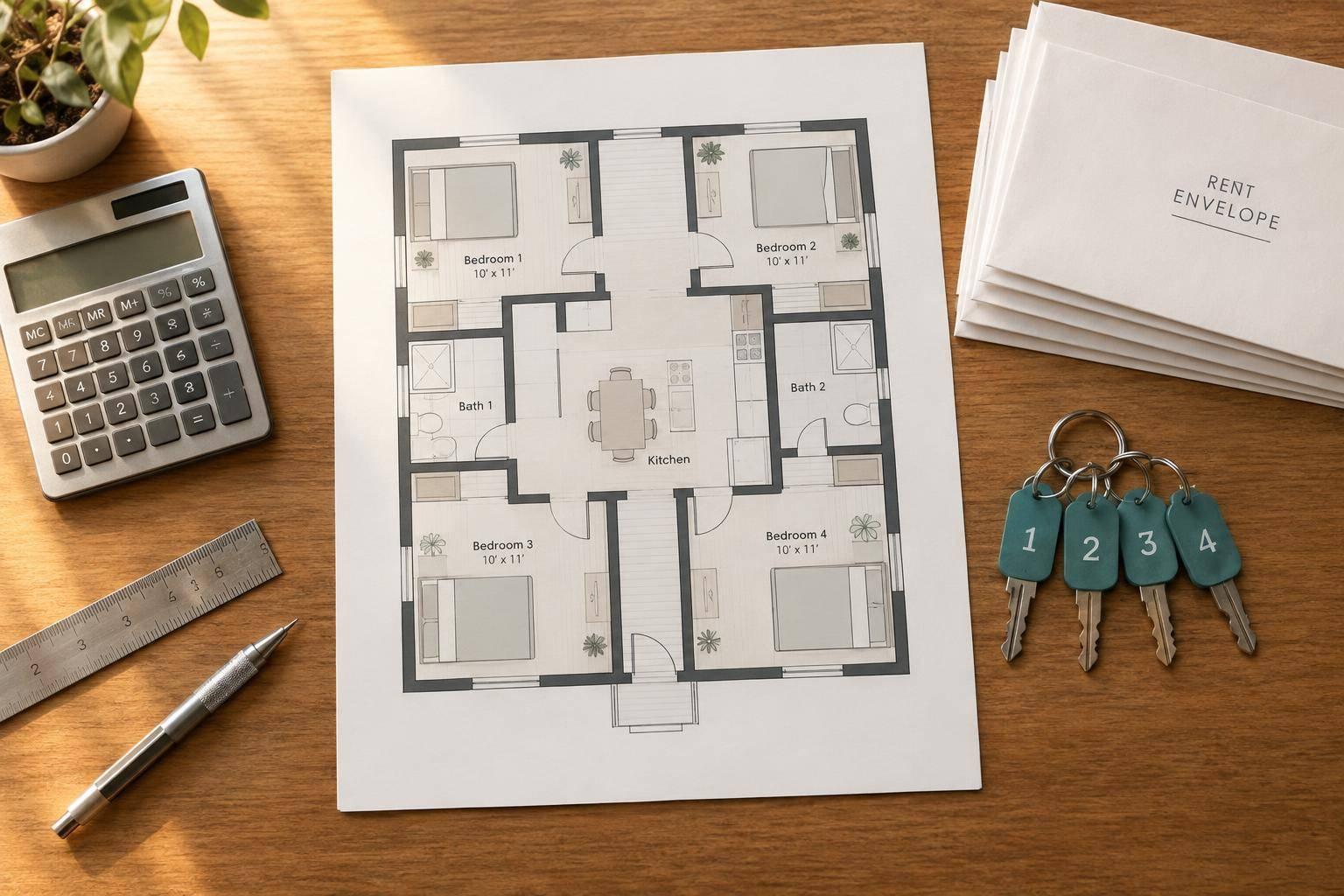
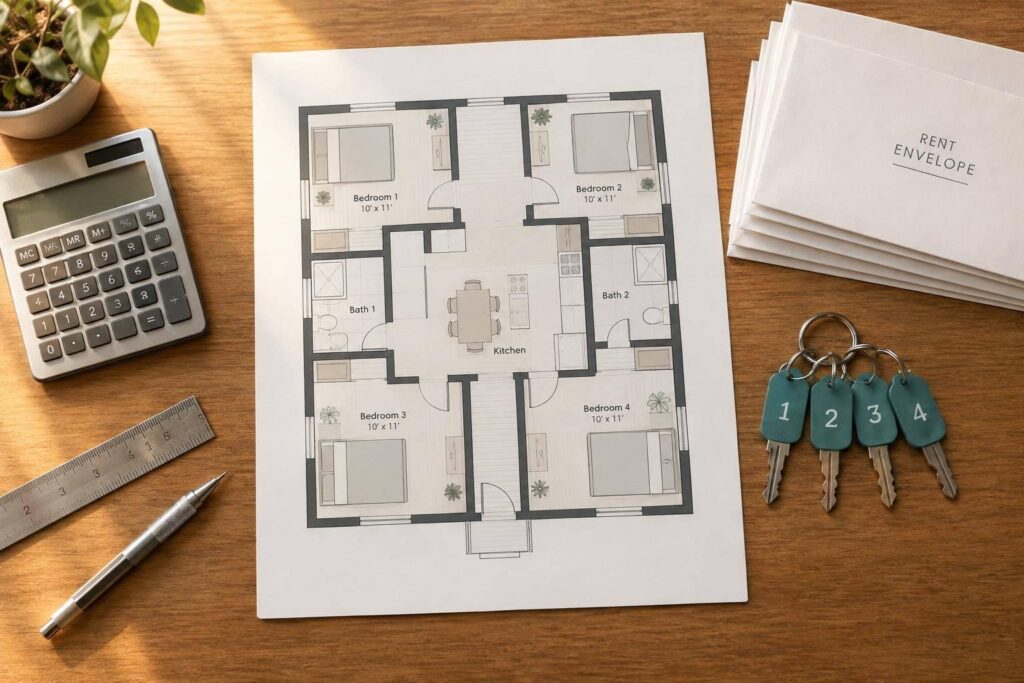
I’d choose PadSplit only if room rentals leave more cash after costs – not just bring in more rent. In this Jacksonville example, rooms at 90% economic occupancy produce about $868 a month after debt payments and a furnishing reserve, versus $250 for a whole-home lease at 95%. At 70%, rooms leave just $86.
Before converting, I’d check four things: net cash flow, room pricing and vacancy, legal use and layout, and the work involved. <u>Five legal bedrooms don’t automatically permit five separate room rentals.</u>
Quick Comparison
| What I’d compare | Whole-home lease | PadSplit rooms |
|---|---|---|
| Cash flow | Lower projected rent; fewer owner-paid costs | Higher rent potential; added fees, furnishings, utilities, and cleaning |
| Vacancy and pricing | One price; vacancy stops all rent | Room-by-room pricing; occupied rooms can keep paying |
| Property and rules | Check zoning, lease rules, and HOA limits | Also verify room-rental approval, safety, insurance, and shared-space capacity |
| Daily work | One household to coordinate | Separate residents, room turnovers, and shared-area upkeep |
My starting point: confirm legal use, price every expense, and test lower occupancy before spending money on the conversion.
1. Whole-Home Rental
A whole-home lease gives one household use of the property, usually for 12 months. The home is typically unfurnished.
Net Cash Flow
Net cash flow = gross rent minus mortgage, taxes, insurance, maintenance reserve, vacancy allowance, and management fees. If your mortgage payment includes escrow for taxes or insurance, don’t subtract those costs twice.
Occupancy and Pricing
Set rent based on recent comparable rentals in Jacksonville. When the home is vacant, rental income drops to zero until a new lease starts. Keep reserves to cover turnover.
Property Suitability and Compliance
Before signing a lease, check Jacksonville and Duval County zoning and occupancy requirements, plus any HOA leasing restrictions. Confirm that the home is permitted for single-household occupancy.
Management Workload
One lease means fewer resident relationships to manage than separate room rentals. But the owner still handles repairs, inspections, and tenant communication.
State in the lease who pays each utility and what repairs the owner must cover. Leftover rent isn’t automatically profit – account for all expenses and reserves first.
The next section compares this single-tenant baseline with furnished room income.
sbb-itb-73b3b1a
2. PadSplit Furnished Room Rental
PadSplit rents private furnished bedrooms with shared kitchens and laundry. Utilities and Wi-Fi are usually included, but higher gross revenue doesn’t necessarily mean higher net income.
Net Cash Flow
Weekly billing helps cash come in more often. To calculate net cash flow, deduct utilities, Wi-Fi, platform fees, furnishings, maintenance, cleaning, and management charges.
Potential gross income may be higher, but what you keep depends on occupancy and operating costs. Compare net income, not gross rent.
Occupancy and Pricing
Example Jacksonville weekly rates range from $166 in Lakeshore to $223 near UNF.
Price each bedroom based on its location, size, and amenities. Convert weekly rent to monthly revenue by multiplying by 52 and dividing by 12, then adjust for occupancy. A higher advertised rate won’t help cash flow if the room sits empty.
Property Suitability and Compliance
Look for private bedrooms with locks, basic furnishings such as a bed and desk, and enough shared kitchen and laundry space. A layout suited to shared living can reduce vacancy risk and make day-to-day tasks easier.
Before converting the home, confirm Jacksonville and Duval County zoning, occupancy, fire-safety, and landlord-tenant rules.
Management Workload
Shared living needs clear rules for cleaning and common-area use. It also calls for prompt repairs, regular inspections, common-area cleaning, and resident communication. A side-by-side comparison of cash flow, occupancy, rules, and workload helps show how these demands differ.
Compare Cash Flow, Occupancy, Property Rules, and Workload
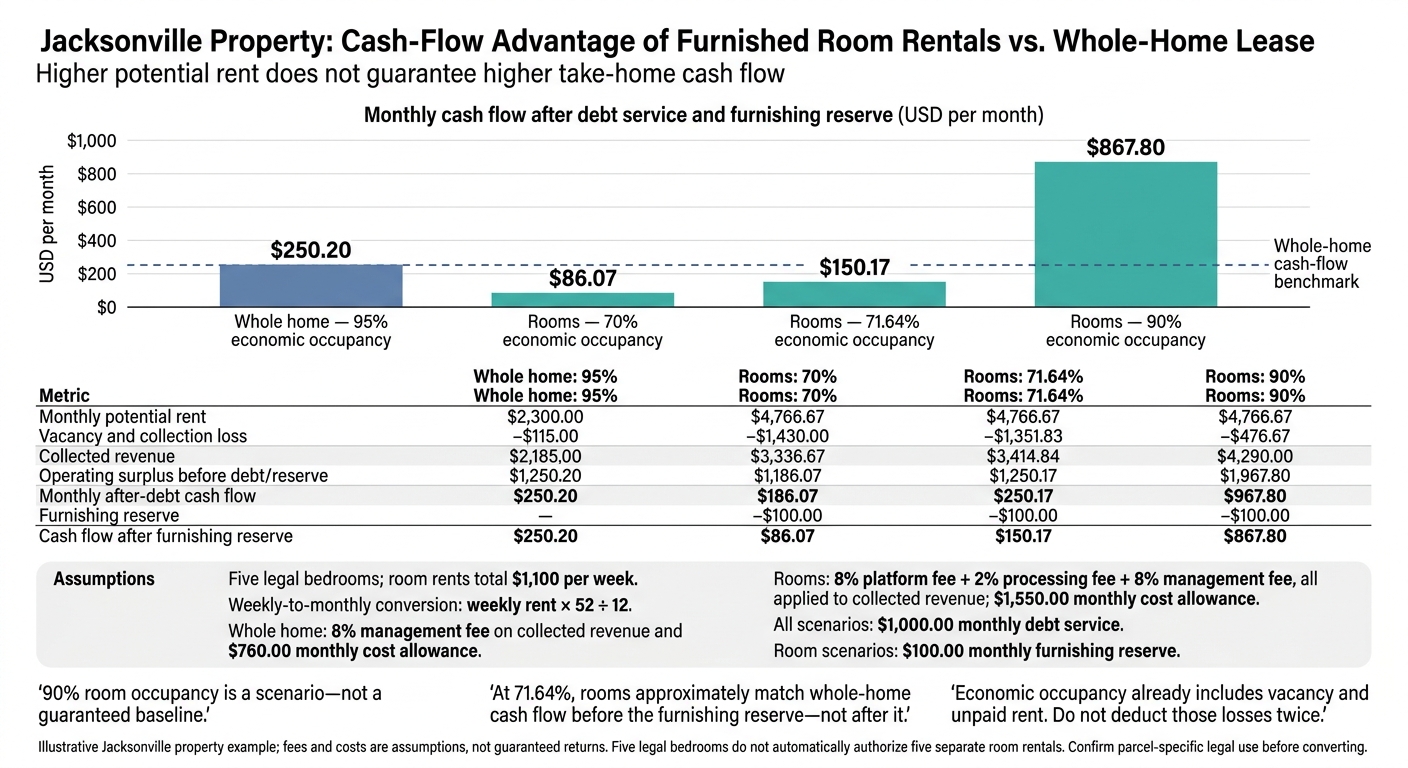
PadSplit vs. Whole-Home Rental: Cash Flow by Occupancy
Start with the numbers. Then check whether the property can legally support the planned room count.
Net cash flow
Test the model on one Jacksonville property: five legal bedrooms, weekly room rents totaling $1,100, and a monthly equivalent of $4,766.67.
Economic occupancy already accounts for vacancy and unpaid rent. Don’t deduct collection losses twice. The fees below are illustrative and apply only to collected revenue.
Income or expense Whole home: 95% Rooms: 70% Rooms: 71.64% Rooms: 90% Monthly potential rent $2,300.00 $4,766.67 $4,766.67 $4,766.67 Vacancy and collection loss −$115.00 −$1,430.00 −$1,351.83 −$476.67 Collected revenue $2,185.00 $3,336.67 $3,414.84 $4,290.00 Platform fee: 8% – −$266.93 −$273.19 −$343.20 Processing fee: 2% – −$66.73 −$68.30 −$85.80 Management: 8% −$174.80 −$266.93 −$273.19 −$343.20 Monthly cost allowance −$760.00 −$1,550.00 −$1,550.00 −$1,550.00 Operating surplus before debt/reserve $1,250.20 $1,186.07 $1,250.17 $1,967.80 Debt service −$1,000.00 −$1,000.00 −$1,000.00 −$1,000.00 Monthly after-debt cash flow $250.20 $186.07 $250.17 $967.80 Furnishing reserve – −$100.00 −$100.00 −$100.00 Cash flow after furnishing reserve $250.20 $86.07 $150.17 $867.80 Annual collected revenue $26,220.00 $40,040.00 $40,978.08 $51,480.00 Annual after-debt cash flow $3,002.40 $2,232.80 $3,002.03 $11,613.60 Annual cash flow after furnishing reserve $3,002.40 $1,032.80 $1,802.03 $10,413.60
Break out taxes, insurance, maintenance, cleaning, utilities/Wi-Fi, and reserves as separate line items. Keep debt service out of NOI.
Higher potential rent doesn’t decide which option pays more. Occupancy and room-level pricing drive the result.
Occupancy and pricing
| Compare | Whole-home leasing | PadSplit rooms |
|---|---|---|
| Room differences | Price the property as one unit | Price each room by size, workspace, storage, and amenities – not one flat rate |
| Vacancy exposure | One vacancy removes all rent | Vacancies affect individual rooms; an empty higher-priced room costs more |
| Sensitivity | Lower occupancy cuts revenue while fixed costs remain | Model lease-up month by month instead of assuming stable collections from the start |
Treat 90% occupancy as a scenario, not a baseline. Extra utility bills or repairs cut cash flow directly and increase the occupancy needed to match whole-home returns.
Property suitability and compliance
Even strong cash-flow projections won’t work if the home can’t legally or practically support shared living.
| Check | Whole-home leasing | PadSplit rooms |
|---|---|---|
| Permitted use | One household occupies the home | Obtain parcel-specific zoning and rooming-house determinations, including required approvals |
| Bedrooms and safety | Review the existing household layout | Verify that individual room locks do not compromise escape routes. |
| Shared capacity | Assess household use | Confirm that bathrooms, kitchen, laundry, and parking support the planned resident count |
| Private restrictions | Review whole-home leasing coverage and restrictions | Confirm that HOA rules permit room rentals and insurance specifically covers them |
| Rental obligations | One household lease | Review separate agreements, screening, deposits, notices, and house-rule enforcement under applicable law |
For current code questions, get written guidance from the authority governing the parcel. Five legal bedrooms do not automatically authorize five separate room rentals.
Management workload
| Task | Whole-home leasing | PadSplit rooms |
|---|---|---|
| Resident coordination | One household and lease relationship | Separate residents, collections, and turnover |
| House rules and cleaning | Define tenant responsibilities | Set rules for guests, noise, cleaning, and common-area use; budget for professional cleaning |
| Repairs and inspections | Track repairs and lawful access | Coordinate shared-system repairs and room access with appropriate notice |
| Performance tracking | Track collections, vacancy, and expenses | Also track room-level rates, economic occupancy, cleaning, utilities, and turnover costs |
Pros and Cons of Each Rental Model
Use the comparison above to decide whether the extra room income is worth the added costs and management work.
| Owner priority | Whole-home leasing | PadSplit room rentals |
|---|---|---|
| Lower upfront cost and simpler day-to-day management | Typically unfurnished, with tenant-paid utilities and fewer turnovers. | Requires furnishings, owner-paid utilities, and more hands-on oversight. |
| Vacancy risk | One household’s departure stops all rental income. | Occupied rooms can keep bringing in income, but low occupancy can wipe out the revenue advantage. |
| Best-fit owner | An owner who wants less management work and fewer turnovers. | An owner with setup capital, cash reserves, and a budget for managing shared spaces. |
Check whether the extra monthly income covers setup costs and cash reserves.
Keep setup money separate from operating reserves. Buying beds and kitchen equipment shouldn’t drain the cash you need for utilities and other recurring expenses. Price out the furnishings and set aside several months of operating expenses before converting.
Build a property-specific budget based on local Jacksonville rental performance and a workable shared-space layout. Compare cash flow after accounting for occupancy losses, utilities, furnishing reserves, and management charges. Use those figures to set your minimum net-income target.
Choose the Model That Meets Your Cash Flow Goal
Use the cash-flow comparison above to decide whether to move forward. Check legal use before advertising. Before listing converted rooms, confirm with Jacksonville authorities that the home can legally support your planned room count.
Base weekly room rates on nearby PadSplit listings. Then subtract platform fees, utilities, Wi-Fi, cleaning, maintenance, and furnishings from expected revenue.
Budget for setup and lease-up costs, then test the numbers at lower occupancy. If vacant rooms push cash flow below your income target, the conversion doesn’t meet your goal.
Choose room rentals only if the added net cash flow justifies the extra setup and management work. Whole-home leasing makes more sense when legal limits, conversion costs, or daily oversight wipe out that gain. Get a property-specific profit analysis before committing.
FAQs
What occupancy do I need to outperform whole-home rent?
Renting by the room needs enough occupied rooms for total rent, minus operating expenses, to beat the net income from leasing the entire home. Compare net operating income, not gross rent.
Count utilities, Wi-Fi, furnishings, cleaning, extra maintenance, and management or platform fees. Use a rental property calculator to compare both options, factoring in vacancy for each. The occupancy you need depends on your room rates and expenses.
How long will it take to recover my conversion costs?
Divide your total upfront conversion costs by the added monthly net cash flow you expect from renting by the room instead of renting the whole property.
For both options, calculate net cash flow after utilities, maintenance, management fees, estimated vacancy losses, and turnover costs. Factor in the extra management work that room-by-room leasing requires.
Room rentals can bring in 50% to 75% more gross rent, but how long it takes to recover your upfront costs depends on the increase in net cash flow.
How do I verify room rentals are legal at my Jacksonville property?
Before you advertise, confirm that your property’s legal use allows residential room rentals. Check that it meets Jacksonville and Duval County requirements for zoning, occupancy, habitable bedrooms, fire safety, and parking. Review any HOA or condo restrictions, too.
If you plan to rent the unit for stays under 30 days more than three times a year, you must obtain a license from the Florida Department of Business and Professional Regulation.