A Florida lease cannot override tenant protections. I recommend putting rent, dates, and upkeep duties in writing, providing required disclosures, and tracking notice deadlines from day one.
Here’s my checklist for a single-family rental:
- Before signing: Provide landlord contact details, radon notification, flood disclosure for leases of 1 year or longer, and lead-paint disclosures for most homes built before 1978.
- During the lease: Follow deposit-handling rules, repair and entry duties, fair housing laws, and local property codes.
- When problems arise: Use the correct rent or lease-violation notice. <u>A termination notice does not permit a lockout.</u>
- At move-out: Track the deposit deadlines – generally 15 days to return it without a claim or 30 days to send a claim notice.
- Keep records: Save signed leases, renewals, payments, notices, repairs, and any early-termination agreements.
I treat lease wording and day-to-day compliance as separate tasks: you need both. This guide is general information, not legal advice; check current law and consult Florida counsel for your situation.
Lease Terms, Disclosures, and Security Deposits
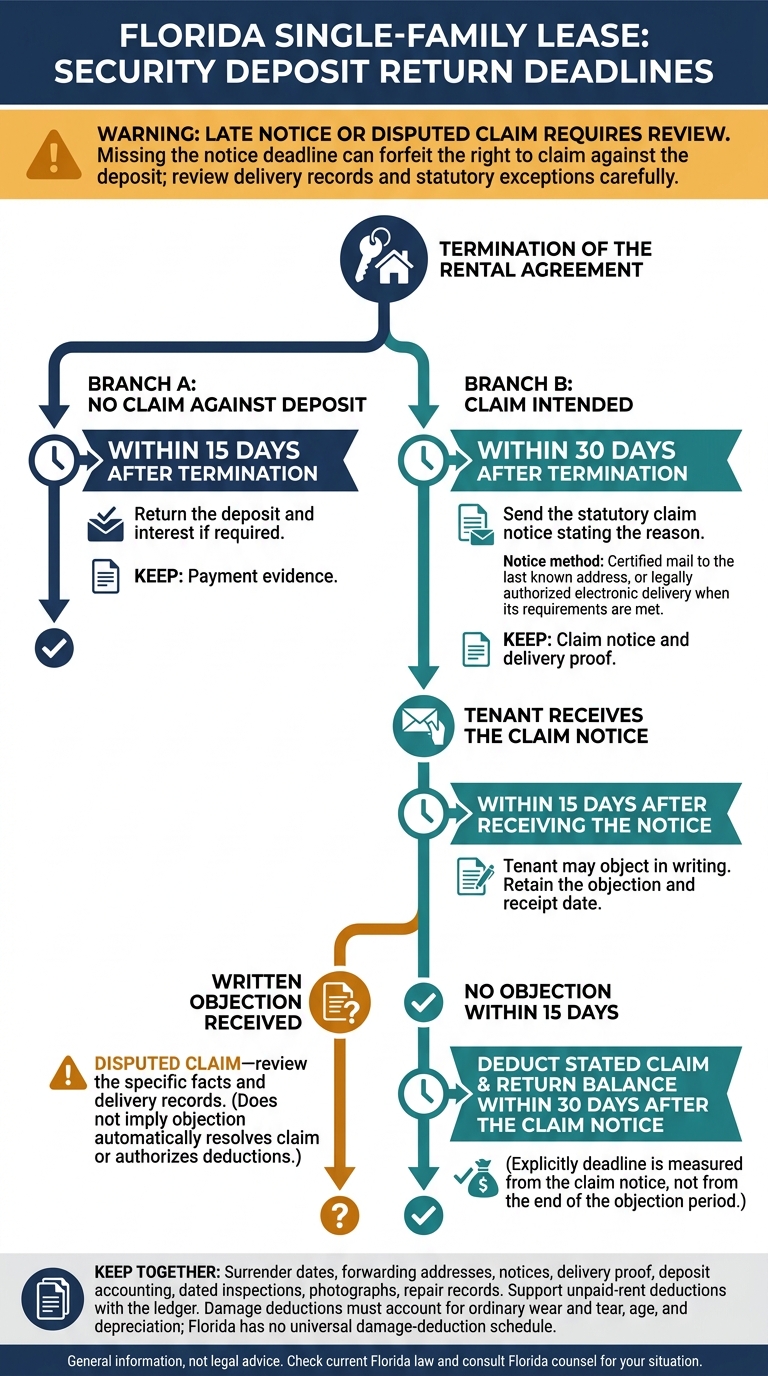
Florida Security Deposit Return Deadlines
Tenant Details, Rent, and Property Responsibilities
After completing tenant screening to find a qualified renter, Once the lease basics are set, put the required notice and payment details in writing. Florida requires written disclosure of the name and address of the landlord or authorized notice recipient. Keep those details current and separate from the contact for maintenance requests.
Spell out utility, parking, and maintenance duties: who pays, who schedules service, and how reimbursements work. Requiring a tenant to mow the lawn does not waive protected rights or excuse applicable building, housing, and health-code duties.
Required Flood, Lead Paint, and Deposit Disclosures
Florida requires a flood disclosure for residential leases lasting 1 year or longer. Provide it as a separate document at or before signing, using the current statutory form covering flooding history and risk information. Include Florida’s required radon-gas notification, too.
Attach disclosures required before signing to the signed lease package. Track deposit notices due later separately.
| Disclosure | Legal trigger | Delivery deadline | Records to retain |
|---|---|---|---|
| Florida flood disclosure | Residential lease of 1 year or longer | Separate document at or before signing the rental agreement | Disclosure, delivery evidence, flood information, signed lease |
| Florida radon-gas notification | Residential rental agreement | Include the statutory notification in the rental document when signed | Rental document containing the notification |
| Federal lead-based-paint disclosure | Most housing built before 1978, subject to exemptions | Before the tenant becomes obligated under the lease | Signed disclosure, Lead Warning Statement, available reports, EPA pamphlet acknowledgment; retain signed records for at least 3 years after the lease begins |
| Deposit or advance-rent holding notice | Receipt of a security deposit or advance rent, subject to statutory exceptions | In the lease or within 30 days after receipt; notify changes within 30 days | Notice, account or bond details, ledger, delivery evidence |
| Fee-in-lieu-of-deposit disclosure | Tenant elects the statutory fee arrangement | Before or when the tenant elects it | Required disclosures, written agreement, election, payment records |
You can hold deposits in a separate Florida non-interest-bearing account, an interest-bearing account that meets statutory conditions, or a permitted surety bond. The notice must identify the depository and its address – or the bond – and explain the tenant’s interest entitlement. Keep deposit funds separate from operating accounts.
A fee in lieu of a deposit is not a security deposit. Document the payment schedule, the tenant’s continued liability for rent and damage, and the statutory option to switch to a deposit. Use the current statutory form, not a generic template.
Security Deposit Returns, Deductions, and Deadlines
Track security deposits separately from advance rent, application charges, and nonrefundable service fees. A “nonrefundable” label does not determine how the law treats a payment.
Support unpaid-rent deductions with the ledger. For damage beyond ordinary wear and tear, keep dated inspections, photographs, and repair records. Account for age and depreciation when calculating damage charges; do not charge full replacement cost without justification. Florida has no universal damage-deduction schedule. Keep surrender dates, forwarding addresses, notices, and delivery proof together.
Use one clear timeline to track every deposit deadline, required notice method, and delivery record.
| Stage | Deadline | Notice method or final handling |
|---|---|---|
| No claim against deposit | 15 days after termination of the rental agreement | Return the deposit and interest if required; retain payment evidence |
| Claim intended | 30 days after termination | Send the statutory claim notice stating the reason; use certified mail to the last known address, or legally authorized electronic delivery when its requirements are met |
| Tenant objects | 15 days after receiving the notice | Tenant objects in writing; retain the objection and receipt date |
| No objection within 15 days | After the 15-day objection period ends | Deduct the stated claim and return the balance within 30 days after the claim notice |
| Late notice or disputed claim | Requires review of the specific facts | Missing the notice deadline can forfeit the right to claim against the deposit; review delivery records and statutory exceptions carefully |
These lease terms should match the landlord’s maintenance and entry duties.
sbb-itb-73b3b1a
Maintenance Rules and Tenant Rights
Repairs and Maintenance in Single-Family Rentals
The lease should spell out maintenance and access rules alongside rent and deposit terms. For single-family homes and duplexes, those duties must follow Florida Statutes Chapter 83 and applicable local codes. Landlords must keep the home habitable and promptly repair defects that affect health or safety.
State each party’s maintenance responsibilities in the lease. Tenants should keep the home clean, use fixtures properly, prevent damage, and promptly report leaks or signs of moisture. Provide a written process for reporting repairs and an emergency contact. Keep repair logs, photos, and records showing when work was completed.
Landlord Entry, Fair Housing, and Tenant Protections
Florida law requires reasonable notice before entering for repairs, except in emergencies. Follow statutory access rules and avoid harassment. Record why you entered, what notice you gave, when you entered, and what work you performed.
Apply screening criteria and lease rules consistently, while allowing legally required disability accommodations. Assistance animals are not pets and should not trigger pet fees. Document the lawful reasons behind lease enforcement decisions.
Use the lease to assign responsibilities, and keep records of how each issue is handled.
| Landlord action | Legal risk | Lawful practice |
|---|---|---|
| Entering for repairs | Unannounced, nonemergency entry | Give reasonable notice except in emergencies, and document the entry. |
| Handling repairs | Unresolved leaks, moisture, or safety hazards | Track reports, arrange repairs, and confirm completion. |
| Screening applicants | Discriminatory or inconsistent decisions | Apply documented criteria consistently and follow fair housing requirements. |
| Reviewing accommodations | Charging pet fees for assistance animals | Review each accommodation request individually. Do not charge pet fees for assistance animals. |
| Enforcing lease terms | Retaliation or self-help eviction | Document legitimate reasons and use lawful court procedures. Do not retaliate for good-faith complaints about repairs or code violations. |
Rent Collection, Lease Termination, and Records
Rent Defaults and Termination Notices
Once the lease takes effect, missed rent and notice deadlines become the next compliance risk.
Spell out the rent amount in U.S. dollars, due date, payment method or portal, when payment counts as received, any grace period, late-fee amount or formula, returned-payment charge, and whether you accept partial payments. A grace period comes from the contract unless another law applies. It does not replace Florida’s statutory nonpayment notice. Leave extra charges out of the rent demand unless Florida law treats them as rent.
| Situation | Notice period and deadline calculation | Cure rights | Delivery method | Next lawful step |
|---|---|---|---|---|
| Unpaid rent | 3 days after delivery, excluding Saturdays, Sundays, and legal holidays; do not count the delivery day | Pay the rent demanded or surrender possession | Use a method authorized by Florida law and the lease; electronic delivery only if clearly authorized | File a possession action after the notice expires without payment or surrender |
| Curable lease violation | Generally 7 days to cure | Correct the stated violation | Use a method authorized by Florida law and the lease; electronic delivery only if clearly authorized | Pursue eviction if the violation is not cured |
| Serious noncurable violation | Generally 7 days to vacate | No ordinary cure opportunity; the tenant may still dispute the allegation | Use a method authorized by Florida law and the lease; electronic delivery only if clearly authorized | Pursue eviction after the notice expires |
| Repeat violation within 12 months | Generally 7 days to vacate, subject to the earlier notice and statutory requirements | Another cure opportunity may not be required | Use a method authorized by Florida law and the lease; electronic delivery only if clearly authorized | Preserve records of both violations before filing |
| Month-to-month termination | At least 30 days before the next rental period begins | Not a cure process | Written notice delivered as required by law | Seek court possession if the tenant holds over |
| Fixed-term expiration | Follow the lease’s end date and any valid renewal or nonrenewal clause; do not assume a month-to-month notice period applies | Not a cure process | Follow applicable law and the lease notice provision | Seek court possession if the tenant remains without permission |
Florida Statutes §§ 83.56–83.57 and Florida Courts materials control these notice periods.
Check the delivery method before calculating the deadline. Florida law allows methods such as hand delivery, mailing, or posting, depending on the notice and circumstances. Do not assume email or a tenant-portal message is valid unless the law and the parties’ agreement clearly authorize it. Keep the notice, delivery date, and proof of service. Review any payment or cure received after service, including whether accepting a partial payment affects the notice or creates a waiver issue.
If the notice expires without payment or cure, the next step may be court possession or a negotiated surrender.
Early Move-Outs and Court Evictions
If the tenant leaves early or stays after notice, determine the legal status of the departure or continued occupancy before acting.
Surrender, abandonment, and negotiated termination are different events. Put any agreed surrender or termination in writing, covering possession, keys, remaining rent, and deposit treatment. Missed rent alone does not establish abandonment. For an unexplained early departure, follow § 83.595, document reletting efforts, and credit recoveries. Review any early-termination fee or liquidated-damages addendum before charging it. Qualifying military tenants may have federal termination rights. Keep their written notice and supporting orders or verification, calculate the lawful termination date, and do not impose a prohibited penalty.
When possession is disputed, consult Florida counsel before taking any self-help step. The usual sequence is proper notice, expiration of the notice period, court filing, service of process, judgment, and a clerk-issued writ executed by the sheriff. Documented voluntary surrender or legally recognized abandonment may permit recovery of possession without eviction. Belongings left behind still need separate legal review. A termination notice does not authorize a lockout, utility shutoff, or removal of belongings.
Lease Signing, Renewals, and Recordkeeping
Keep the signed lease file organized so you can prove every notice, payment, and deadline later.
Give each party the executed lease. Put renewals, rent changes, approved occupant changes, and amendments in writing. Consent to electronic signing is separate from consent to receive statutory notices electronically. Retain the signed file, amendments, consent records, and audit trail, plus a ledger showing charges, payments, allocations, and balances. Keep notices, proof of service, inspections, reletting records, termination agreements, military documents, deposit accounting, and court records in one file.
Conclusion: Jacksonville Lease Compliance Checklist
Use this checklist to check compliance before signing, renewing, or enforcing a lease.
Before signing: Check the parties, rent, dates, maintenance duties, and required disclosures. Complete flood, radon, lead-paint, and deposit notices on time. For applicable pre-1978 housing, provide the federal lead-based-paint disclosure before signing. Document how deposits are handled.
Before renewal: Begin the review 60–90 days before the lease expires. Check notice deadlines, contact details, repair issues, accommodation requests, and enforcement steps. Then confirm that the property still meets local code requirements.
Local code compliance: Florida governs lease terms and notices; Jacksonville code governs property condition. Assigning upkeep to a tenant does not remove the owner’s code obligations.
Owners who need help with these tasks can turn to 1 Realty Management for lease administration, maintenance coordination, rent collection, reporting, and eviction coordination. Management does not replace legal advice, remove owner duties, or guarantee collection, possession, or compliance.
FAQs
What happens if my lease omits a required disclosure?
Leaving out a required disclosure – such as lead-based paint warnings, radon notifications, or a required flood disclosure – can make lease terms unenforceable and leave you open to legal liability.
Landlords must follow these rules even if they don’t know about them. Missing disclosures can lead to court costs, attorney fees, and other financial penalties that cost more than having a professional prepare the lease.
Can I withhold rent if repairs aren’t made?
Under Florida law, tenants must report material maintenance issues in writing. If your landlord doesn’t address them within seven days of receiving your written notice, you may have the right to withhold rent.
Withholding rent requires specific legal steps and carries risks. Keep detailed records of every repair request and all communications with your landlord.
How can I dispute a security deposit deduction?
If you believe a security deposit deduction is wrong, you must send your landlord a written objection within 15 days of receiving the claim notice. Sending it by certified mail is strongly recommended because it documents delivery – proof you may need if the dispute goes to small claims court.
In your objection, refer to your move-in inspection report, payment receipts, and any other documents that support your position.