I’d compare Jacksonville rent collection services by who handles the work – not just the fee. Before signing, ask for a complete fee schedule, sample owner statement, written payout timeline, and late-rent procedure.
This comparison covers four service models, from owner-run collections after tenant placement to manager-run collections for homes, Northside apartments, and room rentals. I compare payment methods, portals, reporting, fees, owner deposits, and delinquency support.
Quick Comparison
| Service model | Who collects rent? | Reporting to check | Costs to confirm | Late-payment responsibility |
|---|---|---|---|---|
| Full-service management | Manager | Property ledgers and owner statements | Management, leasing, renewal, and processing fees | Manager, within contract limits |
| Tenant-placement-only | Usually the owner after move-in | Record exports and owner-maintained ledgers | Placement fee plus any collection services | Usually the owner after handoff |
| Apartment and multifamily | Manager or onsite staff | Unit balances, rent rolls, and property expenses | Management rate, staffing, and per-unit charges | Manager or onsite staff |
| PadSplit and rent-by-room | As assigned in the agreement | Room balances, shared costs, and property totals | Management, room-placement, and platform charges | Named manager or program contact |
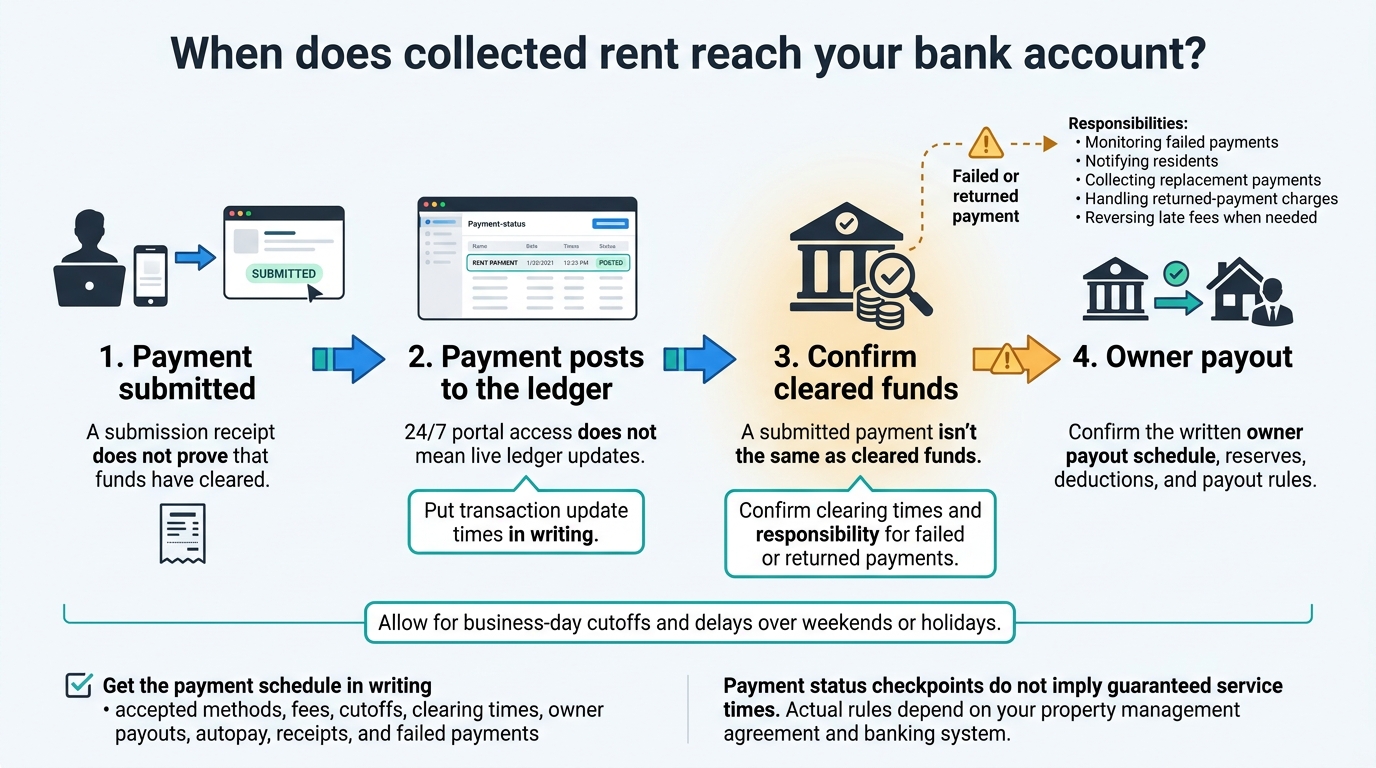
My main check: <u>when does collected rent reach your bank account?</u> A payment marked submitted is not cleared money. I’d also compare 12-month costs using the same rent and occupancy assumptions – and confirm who handles failed payments, required notices, and legal referrals.
1. Full-Service Property Management
1 Realty Management handles rent collection, maintenance, rent-ready work, financial reporting, lease renewals, and evictions. Keeping these services together reduces handoffs between leasing, accounting, and maintenance. The company serves single-family homes, multifamily properties, apartment complexes, and PadSplit properties in Jacksonville. For rent collection, focus on payout timing, portal access, report detail, and how the company handles overdue rent.
Payment Processing and Owner Deposits
A submitted payment isn’t the same as cleared funds. Tenants can pay through the portal by ACH, credit card, or debit card. Cash and personal checks aren’t accepted. Owners should confirm the monthly ACH payout schedule and what happens when a payment is returned.
You’ll also want to know how easily you can track each deposit and deduction.
Portals and Financial Reports
1 Realty Management provides an online owner portal and detailed monthly reports. Ask for reports that separate collected rent, unpaid balances, management fees, repair costs, and owner payouts by property, unit, or room.
Confirm which tenant-portal features are available, including payments, receipts, balances, reminders, maintenance requests, notices, and mobile access.
Fees
Standard management fees are a percentage of monthly rent, with rates based on property type and unit count. Get a quote for your property and ask whether the percentage applies to scheduled rent or rent actually collected.
Also check for separate charges for tenant placement, lease renewals, inspections, maintenance coordination, payment processing, and eviction work.
Late Payments and Support
The company describes delinquency tracking, late-fee enforcement, and late notices. Confirm the collection timeline, including reminders, legally compliant late notices, and when an overdue account goes to legal referral.
Ask who approves payment arrangements, what emergency maintenance coverage includes, and how much the company can spend on repairs without your approval. Maintenance issues can affect both rent collection and owner reporting.
sbb-itb-73b3b1a
2. Tenant-Placement-Only Service
Tenant placement is a narrower option than full-service management. Once the tenant moves in, rent collection usually becomes the owner’s job.
The contract must spell out when the handoff happens, who collects rent, and who handles notices. It should also cover security deposits and initial rent collection. After handoff, the owner usually takes over balance tracking, maintenance coordination, renewals, lease enforcement, required notices, and delinquency follow-up. Clear payment terms and handoff instructions help prevent gaps.
Payment Processing and Owner Deposits
If you collect rent directly, the agreement must identify accepted payment methods, the payment account owner, processing fees and who pays them, and when funds count as received. It should also explain how to handle returned payments. Keep these instructions consistent with the lease.
Record rent, prorated rent, fees, pet charges, and security deposits separately. Issue receipts, document the property’s move-in condition, and reconcile the ledger with deposit records. Florida law generally requires security deposits and some advance rents to be held in a separate account at a Florida financial institution. Specific rules depend on whether the account earns interest.
Portals and Financial Reports
Access to the leasing portal may end after move-in. Confirm whether you’ll keep administrative access and be able to export payment records. If not, set up your own system for receipts, balance tracking, delinquency monitoring, and bank reconciliation.
Reports should separate collected rent, unpaid balances, fees, deposits, and expenses by property and unit. These records also help you check whether placement-only service actually saves money.
Fees
Compare the full 12-month cost, not just the placement fee. Include screening, lease preparation, renewals, rent-collection add-ons, payment-processing fees, notice or eviction fees, and any re-leasing charge. Factor in vacancy days, turnover, and your time.
Late Payments and Support
Lower upfront fees don’t mean less collection work when rent is late. Unless the contract says otherwise, the owner monitors overdue balances, answers billing questions, applies lease-based fees, coordinates repairs, and documents communications.
In Florida, a nonpayment case generally begins with a written three-day notice demanding payment or possession. Saturdays, Sundays, and legal holidays don’t count toward that period.
The agreement should name who sends reminders and required notices, approves partial payments or payment plans, and refers the file to counsel. Put the escalation schedule in writing and follow the lease and current Florida law: send reminders, review the balance after any grace period, deliver the required notice with the applicable cure period, and refer the matter to an attorney or for eviction if the tenant does not cure.
3. Apartment and Multifamily Management
Multifamily management follows the same rent-collection basics, with added tracking for each unit and reporting across the portfolio.
Payment Processing and Owner Deposits
Use one portal to manage unit-level payments and owner disbursements. Confirm the ACH disbursement schedule in the management agreement. Each unit’s payment status should match the owner statement.
Portals and Financial Reports
Ask for a unit-level rent roll that lists rent, payment status, vacancy, and lease expiration dates. This makes overdue units easy to spot. Monthly statements should include NOI and operating expenses. Use these reports to check whether the fees match the service you receive.
Fees
Typical management fees range from 8% to 12% of collected rent, though larger portfolios may qualify for negotiated pricing. Ask whether maintenance markups are included or billed separately. Also check how quickly the manager spots overdue units and moves them through the collection process.
Late Payments and Support
A unit-level delinquency report should flag overdue balances and track late fees based on each lease. Resident portals should send payment questions and collection-related maintenance requests to the right team.
Specify who handles partial payments and how they’re recorded. Accepting them can affect eviction rights under Florida law. Before referring a delinquent unit for legal action, the escalation workflow should document delivery of a legally compliant three-day notice to pay or vacate for that unit.
4. PadSplit and Rent-by-Room Management
Rent-by-room properties require separate tracking for each resident’s payments, share of expenses, and notice timeline. That makes payout timing and accurate ledgers more important than in unit-based management.
Payment Processing and Owner Deposits
Confirm each room’s payment due date, who collects the payment, and the monthly ACH payout schedule for room-rental accounts.
Portals and Financial Reports
Rooms share expenses, so reports need to separate collected rent from maintenance and other common costs. Ask for a sample owner statement showing room receipts, shared-expense allocations, and the net owner payout, along with supporting records. Also clarify what residents can see in their portal and what owners can export.
Fees
List the management fee and any leasing or renewal fees. For each one, spell out what amount it’s calculated against and whether it applies only to collected rent or also to new leases and renewals.
Late Payments and Support
Assign responsibility before a payment is late. The agreement should name who handles failed payments, overdue balances, late fees, and notices for each room. Each room has its own delinquency timeline and notice process under the lease. Before escalating collection, confirm the contract terms and applicable Florida notice requirements.
Payments, Portals, and Financial Reports
Jacksonville Rent Collection: From Payment to Owner Payout
Use this table as a checklist. Treat anything missing from the agreement as excluded. Full-service and multifamily models usually centralize reconciliation. With placement-only services, that work stays with the owner unless a separate contract assigns it elsewhere. The main differences are who posts payments, reconciles accounts, and prepares reports.
| Feature | Full-service management | Tenant-placement-only | Apartment and multifamily | PadSplit and rent-by-room |
|---|---|---|---|---|
| Payment methods | Defined in the agreement | Owner handles unless outsourced | Defined in the agreement | Depends on the agreement |
| Recurring payments | Usually portal-based | Owner handles unless outsourced | Usually portal-based | Depends on scheduling and resident payment controls |
| Posting and payout | Coordinated by the manager | Owner handles unless outsourced | Coordinated by the manager | Agreement assigns collection and payout duties |
| Owner deposits | Subject to reserves, deductions, and payout rules | Owner handles unless outsourced | Subject to reserves, deductions, and payout rules | Agreement assigns distribution duties |
| Tenant and owner portals | Common; access levels vary | Owner handles unless outsourced | Common; access levels vary | Resident access and owner reporting vary |
| Payment confirmations | Receipt delivery and ledger access vary | Owner handles unless outsourced | Receipt delivery and ledger access vary | Receipt delivery and room-level access vary |
| Reporting responsibility | Manager usually reconciles accounts and prepares statements | Owner handles unless outsourced | Manager usually maintains unit and property records | Agreement assigns responsibility for matching room totals to the property ledger |
Then compare timing: when a payment is accepted, when it posts, and when the owner gets paid.
Payment Options and Deposit Timing
Get a written payment schedule that covers accepted methods, fees, cutoffs, clearing times, owner payouts, autopay, receipts, and failed payments. Submission, posting, clearing, and owner payout are separate steps. Allow for business-day cutoffs and delays over weekends or holidays.
Spell out who monitors failed payments, notifies residents, collects replacement payments, handles returned-payment charges, and reverses late fees when needed. A submission receipt does not prove that funds have cleared.
Tenant and Owner Portals
Ask the manager to walk you through the portal features available for your property. For tenants, check access, payment history, receipts, balances, reminders, and maintenance requests. For owners, check cleared payments, ledgers, distributions, reserves, tax documents, and exports.
Managed models may keep these records in one place. Placement-only owners need continued access or an export at handoff. Set access permissions for accountants and co-owners, confirm which records remain available after termination, and assign responsibility for corrections. 24/7 portal access does not mean live ledger updates. Put transaction update times in writing.
Property, Unit, and Room Reports
Match the reporting detail to the property type, and request sample reports before signing. Single-family reports should show property-level year-to-date income and expenses. Multifamily reports should separate building and unit performance, including concessions and variances.
Room-rental reports should show shared-area or utility allocations and match room totals to the property ledger. Portfolio reports should bring results together without hiding individual unit or room records. Monthly statements should reconcile the beginning balance, receipts, fees, expenses, reserve movements, owner distributions, and ending balance.
Costs, Late Payments, and Support
After comparing portals and reporting, check what each model charges for collection, notices, and support.
Management and Processing Fees
Compare the fee basis, not just the rate. Fees based on charged rent may still apply when a tenant hasn’t paid. A percentage of collected rent follows actual receipts. With flat fees, check for vacancy charges and monthly minimums.
Request the terms below in writing. Unavailable prices are marked “Not publicly disclosed.”
| Fee or term | Full-service | Tenant-placement-only | Apartment and multifamily | PadSplit and rent-by-room |
|---|---|---|---|---|
| Pricing structure | Collected rent, charged rent, or flat monthly fee; rate: Not publicly disclosed | Placement fee; collection priced separately | Percentage, per-unit, or flat fee; rate: Not publicly disclosed | Per-room, occupied-room, or revenue-based; rate: Not publicly disclosed |
| Leasing and renewals | Included or charged separately | Placement and re-leasing charges | Lease-up, turnover, and renewal charges | Room-placement and renewal charges |
| Setup, minimums, and vacancy | Setup fee, monthly minimum, and vacancy charges | Setup fee and any recurring charges | Property or per-unit minimums | Property or per-room minimums |
| Processing charges | Owner or tenant pays card/ACH and returned-item fees | Owner-paid or tenant-paid collection costs | Property-level or per-transaction charges | Charges for multiple room payments and returned items |
| Late-fee allocation | Owner, manager, or shared revenue | Owner revenue unless otherwise agreed | Owner or manager revenue; collection deductions | Room-level owner or manager revenue |
| Portals and reporting | Included access or separate fees | Continued access and reporting charges | Unit and building reporting charges | Room and property reporting charges |
Confirm the rate and exclusions, including whether utility reimbursements or other receipts count toward the fee base. The agreement should also state who receives tenant-paid charges and whether late fees belong to the owner or manager.
Comparing Quotes and Total Costs
Compare quotes using the same rent roll, occupancy, unit or room count, lease-up volume, and service scope. Request separate prices for renewals, returned payments, notices, legal referrals, eviction coordination, attorney and court costs, maintenance markups, and termination or transition work.
Ask for a sample statement showing deductions. Wait to calculate annual costs until every rate, frequency, and assumption is in writing.
Then compare how each model handles delinquency, from the first reminder through legal referral.
Late-Rent Notices and Escalation
A lease-defined grace period is different from a statutory notice period. Florida residential nonpayment cases generally require a written demand for payment or possession and three business days, excluding Saturdays, Sundays, and legal holidays. Confirm current law, applicable occupancy rules, notice wording, and delivery requirements with Florida counsel. Automated reminders do not replace compliant notices or court procedures.
For each model, document who acts, when they act, who can approve decisions, and what costs extra.
| Model | Who acts and when | Payment plans and escalation authority | Extra costs |
|---|---|---|---|
| Full-service | Manager sends reminders and notices on the lease and statutory schedule | Delegated approval for plans, waivers, and counsel referral; deadlines for owner updates | Notice, service, legal, and coordination charges |
| Tenant-placement-only | Owner handles reminders and notices after handoff unless separately contracted | Owner approves plans and arranges legal referral | Separately contracted collection and legal work |
| Apartment and multifamily | Manager or onsite staff follows each unit’s lease and notice schedule | Defined approval limits for plans and legal referral; delinquency-report schedule | Per-unit, staffing, notice, and legal charges |
| PadSplit and rent-by-room | Named manager or program contact tracks room balances and sends notices on the applicable schedule | Room-level approval rules for plans and legal referral | Room-level collection, failed-payment, and legal charges |
Support also matters when payment problems overlap with repair disputes.
Payment Support and Maintenance Issues
Get support hours, phone and email contacts, response targets, holiday coverage, and an escalation contact in writing. Confirm whether office or in-person payments are accepted and how receipts are issued.
For failed or disputed payments, assign who investigates, corrects the balance, and contacts the resident. Collection staff should log repair complaints and send them to the responsible manager, using emergency channels when needed.
A repair complaint does not suspend payment duties or cancel fees; any withholding claim or partial-payment arrangement needs review under the lease and applicable Florida law.
Choosing a Model for Your Property
Match the model to your collection workload, reporting needs, and property type. Single-family rentals need deposit tracking and clear owner statements. Multifamily properties need unit-level reconciliation and resident support. Apartment communities need collections that can grow with the property, plus occupancy reports. Room rentals need separate balances, payment schedules, turnover records, and maintenance tracking.
Use this table to compare the control, reporting, and staffing each model offers.
| Model | Pros | Cons or limits |
|---|---|---|
| Full-service management | Handles collections, communication, maintenance coordination, and recurring reports | Recurring fees; service scope and extra charges depend on the contract |
| Tenant-placement-only | Covers marketing, screening, and lease setup; the owner manages the tenancy afterward | The owner handles rent administration, repairs, late-payment follow-up, and accounting |
| Apartment and multifamily | Supports unit-level reconciliation, occupancy reports, and resident support | Staffing costs, technology fees, and contract minimums may apply |
| PadSplit and rent-by-room | Tracks room balances, staggered payment schedules, turnover, and room-specific maintenance | Requires room-by-room tracking; confirm fees, availability, and contract flexibility |
Apartment, multifamily, and room-rental services may also include full-service features. Compare the actual responsibilities and reports, rather than relying on a package’s “specialized” label. Once you choose a model, check the contract terms for collections, reporting, and delinquency handling.
Before signing, request a written scope of work, complete fee schedule, sample owner statement, deposit and disbursement timeline, and delinquency procedure. Check that each document fits your property’s unit or room structure, and make clear who handles every collection and reporting task.
FAQs
How do I know if full-service rent collection is worth the cost?
Full-service rent collection is worth the cost when steady cash flow, time savings, and fewer legal risks outweigh the fees. Professionals handle payment reminders and legal notices, helping you follow Florida landlord-tenant laws and avoid mistakes with 3-day notices or inconsistent late fee enforcement.
Clear, documented reporting shows where your money stands. Reliable, on-time disbursements add peace of mind.
What should I do if my owner payout is delayed?
Check your owner portal first for real-time rent collection and financial updates. Review payments, fees, and delinquencies to see whether pending collections or reconciliation are causing the delay.
1 Realty Management reconciles rent and expenses before sending funds. It guarantees that tenant rent will be deposited into your bank account via ACH by the 10th of each month.
How can I switch managers without disrupting rent payments?
Switching managers mid-lease doesn’t have to disrupt rent collection. A clear, documented handoff helps protect your cash flow.
1 Realty Management uses a secure, automated online tenant portal so tenants can pay without dealing with cash or checks. We also ensure your lease terms, payment policies, and late fee structures comply with Florida law to help keep rent payments coming in without interruption.