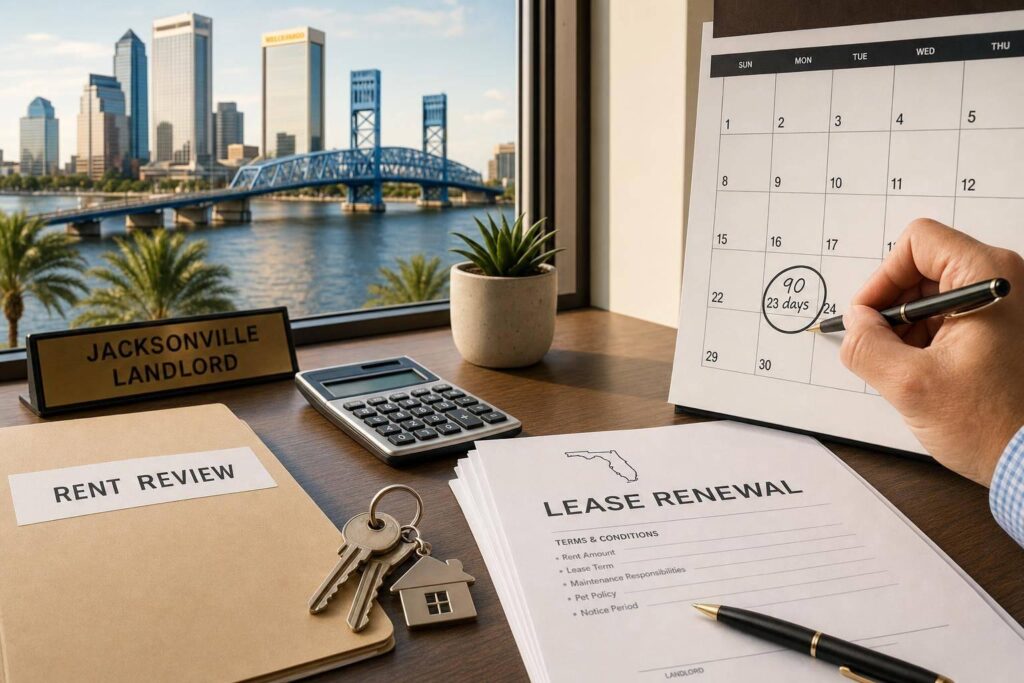
A bad renewal decision can cost more than a small rent bump helps. Working with the right property management company can help you navigate these financial trade-offs. In Jacksonville, just 1 vacant month can cost about $1,500 to $2,500+, so I’d treat lease renewals as a math problem first, not a guess.
Here’s the short version: I’d check the lease, follow Florida notice rules, compare current rent to local market rates, weigh the cost of turnover, and send a clear written renewal offer early. If a tenant pays on time and takes care of the place, a 3% to 5% increase often makes more sense than pushing too hard and risking vacancy.
The main points are simple:
- I start with the signed lease to confirm notice timing and delivery rules.
- I make sure any rent change starts with the new lease term, not in the middle of the current one.
- I compare the unit to similar Jacksonville rentals before setting the new price.
- I look at whether an extra $100 per month = $1,200 per year is worth the risk of turnover.
- I use a 90/60/45/30-day timeline so nothing gets rushed.
- I put the offer in writing with the new rent, start date, term, reply deadline, and next step if the tenant declines.
- I keep proof of delivery and signed records in the file.
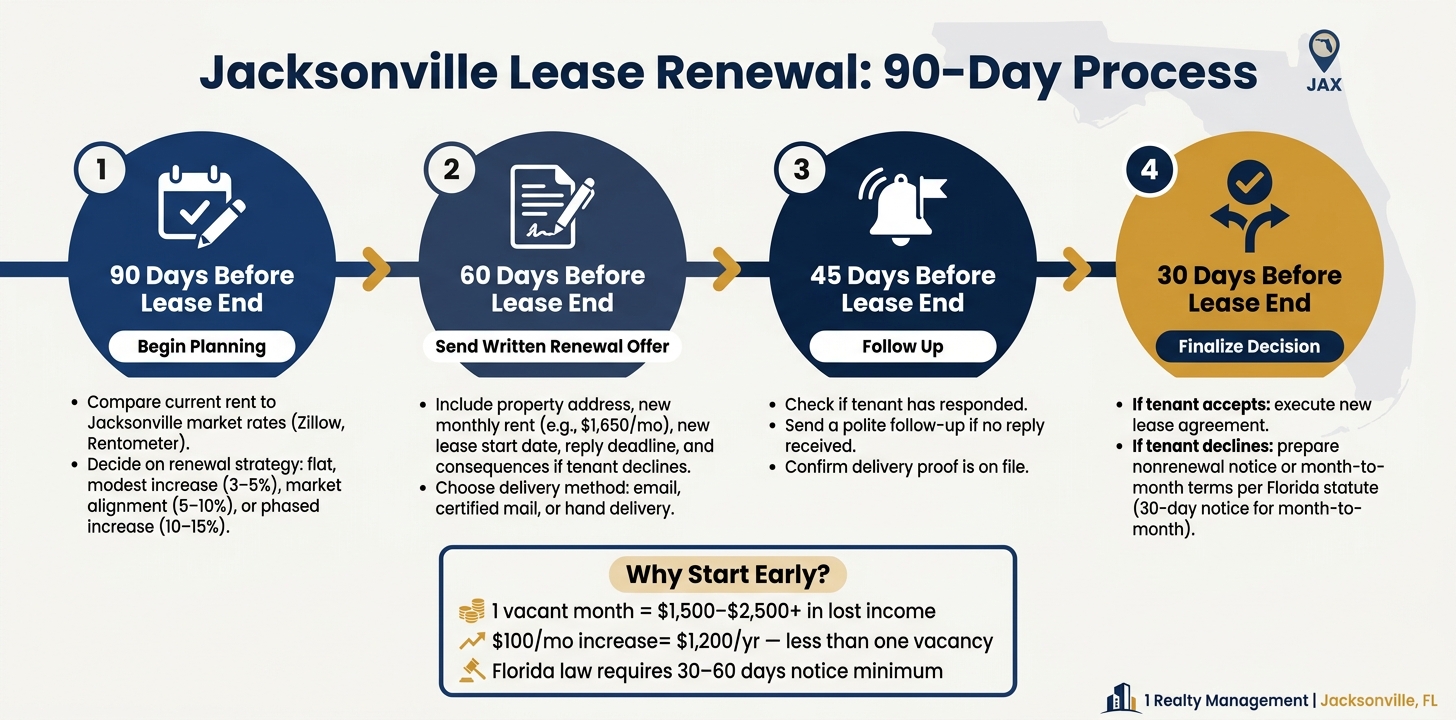
Jacksonville Lease Renewal Timeline: 90-Day Process for Landlords
Quick Comparison
| Option | Typical Rent Change | Tenant Stay Odds | Best Fit |
|---|---|---|---|
| Keep rent the same | 0% | High | Rent is already near market or tenant is very strong |
| Small increase | 3%–5% | High | Yearly update for solid tenants |
| Market catch-up | 5%–10% | Medium | Unit is below market or has recent work done |
| Step-up plan | 10%–15% total, phased | Lower | Unit is far below market and owner can accept more risk |
So if I wanted one rule to follow, it would be this: don’t chase the highest renewal number if one vacancy can wipe it out. A steady process, early notice, and plain written terms usually protect income better than a last-minute rent jump.
sbb-itb-73b3b1a
1. Review Florida Lease Renewal Rules Before Changing Rent
Start with the signed lease before you set renewal terms. That keeps the renewal talk focused on price, not side disputes. Once the rules are clear, you can figure out what rent to ask for.
Check Lease Clauses and Notice Deadlines
The lease tells you how much notice to give and how you need to deliver it. For fixed-term leases, notice is usually due 30 to 60 days before the lease ends. In Florida, it can’t be less than 30 days or more than 60 days. Month-to-month tenancies need 30 days’ notice to terminate.
If the lease says the tenant has to give notice before moving out, you must give that same amount of notice before nonrenewal.
| Tenancy Type | Florida Statutory Notice Requirement |
|---|---|
| Week-to-Week | 7 days |
| Month-to-Month | 30 days |
| Quarter-to-Quarter | 30 days |
| Year-to-Year (Periodic) | 60 days |
| Fixed-Term (Annual) | 30–60 days (as specified in lease) |
Take a look at the security deposit section too. A renewal is a new rental agreement, so any deposit you carry over counts as a new security deposit.
Confirm Rent-Change Rules and Documentation Requirements
Jacksonville landlords can reset rent to market at renewal, as long as they follow the lease terms and notice rules. But the increase still needs to be delivered the right way and start at the right time.
Check the current lease for a rent escalation clause. If there isn’t one, you can’t increase rent in the middle of the lease. The new rent begins with the new term.
Also confirm the delivery method. Email works only if the lease allows it. If not, use the method the lease requires.
Keep dated copies of the renewal offer and proof of delivery.
With the lease and notice rules locked in, the next move is to compare your renewal price with Jacksonville market rent and the cost of turnover.
2. Decide Whether to Keep Rent Flat, Raise It, or Phase In a Larger Increase
Compare Current Rent to Jacksonville Market Data
Once you’ve handled notice timing, compare your current rent with the Jacksonville market. Look at similar rentals in Southside Jacksonville with tools like Zillow and Rentometer to get a quick sense of where your unit sits.
If your rent is already close to market, a small annual bump of 3% to 5% can keep pace without putting extra strain on a good tenant. If the property is far below market, it often makes more sense to phase the increase in, like 10% now and another adjustment next year, instead of jumping straight to full market rent.
That matters because small yearly increases usually do a better job of keeping tenants than one big jump.
If the unit is below market, compare the increase with what it could cost if the tenant leaves.
Weigh Retention Against Revenue Using a Simple Framework
One vacancy can wipe out much of a small yearly increase. A $100 per month increase adds up to $1,200 per year, but that may still not cover the cost of even one vacancy if the tenant decides not to renew.
Tenant quality changes the math too. A renter who pays on time and takes care of the property can cut maintenance hassle and leasing risk in ways that don’t show up in the rent line. So if you push a steady tenant too hard with a big increase, you may lose more than you gain.
Use that side-by-side comparison to pick the smallest increase that still hits your income target.
| Renewal Option | Rent Change | Retention Impact | Cash Flow Impact | Best Used When |
|---|---|---|---|---|
| Keep Rent Flat | 0% | Very High | Neutral | Tenant is exceptional; rent is already at market ceiling |
| Modest Increase | 3% – 5% | High | Neutral/Positive | Standard annual adjustment for good tenants |
| Market Alignment | 5% – 10% | Moderate | Positive | Property has been upgraded or the market has grown |
| Phased Increase | 10% – 15% | Low | High | Unit is severely under-market; landlord accepts turnover risk |
The best call comes down to three things: how far the rent sits below market, how strong the tenant’s track record is, and whether the extra yearly income is enough to offset the cost of a possible vacancy. When those factors pull in different directions, a phased increase often gives you the best balance between revenue and retention.
3. Set a 90-Day Renewal Timeline and Send a Clear Written Offer
Use the renewal timeline to move from a pricing call to a signed offer. Early notice cuts stress, avoids rushed choices, and can help your renewal rate. It also protects your position by giving the tenant time to decide before the lease ends.
Follow a Renewal Timeline That Prevents Last-Minute Decisions
Start planning 90 days out, lock the offer at 60 days, follow up at 45 days, and get your nonrenewal notice or month-to-month terms ready by 30 days. Those legal deadlines should drive your internal 90/60/45/30-day schedule.
That 90-day window helps on both sides: you protect rental income, and the tenant gets time to think it through without a last-minute scramble.
Once the timeline is in place, keep the renewal offer simple. The goal is a notice the tenant can review and sign without a long back-and-forth.
Include All Key Terms in the Renewal Notice
The written offer should spell out every term the tenant needs to accept or reject it. Include the property address, the new lease term, the exact new monthly rent such as $1,650/month, the date the new rent starts, a clear reply deadline, and what happens if the tenant says no, whether that means a month-to-month renewal or a nonrenewal.
A renewal is legally treated as a new rental agreement, so if the security deposit carries forward, document that in the renewal file too.
Choose Delivery Methods That Create Proof of Delivery
Pick the delivery method that gives the right level of proof for the risk involved. Email works only if it complies with the lease and Florida notice rules.
| Delivery Method | Documentation Strength | Best Used For |
|---|---|---|
| High (digital log) | Routine renewals | |
| Certified Mail | Highest (delivery receipt) | High-dispute notices |
| Hand Delivery | Moderate (requires witness or photo) | Urgent notices |
| Mailed Letter | Moderate (postmark) | Formal notices |
| Posted on the Door | Low | Tenant absent |
With proof of the offer and the tenant’s response in hand, the next step is writing an offer the tenant is more likely to accept.
4. Write Renewal Offers That Improve Acceptance Rates
Once you’ve set the price and the timing, the renewal offer still has to get a yes.
Frame the Increase Around Value and Consistency
Tie the rent increase to clear value the tenant has already seen: recent repairs, fast maintenance, and any upgrades made during the current tenancy. Keep the wording plain and calm. For example: "The new rent reflects current Jacksonville market conditions and higher operating costs."
If the tenant feels the increase is fair, choice becomes the next thing that can move the decision.
Offer One or More Term Options Based on Your Goals
You can offer a 12-month renewal, a 24-month term with a slight discount, or a month-to-month option at the highest price.
| Renewal Option | Flexibility | Tenant Satisfaction | Rent Growth |
|---|---|---|---|
| Single Option (12-Month) | Low | Moderate | Steady |
| Multi-Option (Long-Term vs. Month-to-Month) | High | High | Variable (premium on month-to-month) |
| Incentive-Based Renewal | Moderate | Very High | High (offsets turnover cost) |
If your main goal is long-term occupancy, start with the 12-month and 24-month choices. Then price the month-to-month option highest, so it’s plainly the least attractive path.
Use Small Incentives When They Cost Less Than Turnover
A small incentive at the right time usually costs less than dealing with a vacancy. Good low-cost options include a professional deep clean before the new lease term starts or HVAC service. Simple moves like these can cost far less than lost rent between tenants.
Put every agreed change into the signed renewal agreement or the new lease. That way, the next renewal starts from the right terms.
Conclusion: Build a Repeatable Renewal Process to Protect Income and Keep Good Jacksonville Tenants
A good renewal process comes down to five simple steps: check the lease, price against the market, weigh turnover risk, start early, and send a clear written offer. When you use that same process each time, renewals become more predictable and occupancy is easier to protect.
This matters for a simple reason: a good renewal is usually cheaper than a vacancy. That’s why a modest increase can make sense when it helps keep a reliable tenant in place. The big thing is consistency. Use the same renewal system every year, and decisions tend to get faster while vacancies stay lower.
If renewals, lease execution, and reporting are getting harder to track across multiple properties, 1 Realty Management offers Jacksonville landlords support with renewals, tenant placement, maintenance, rent collection, and financial reporting. For landlords who want that process handled the same way every time, 1 Realty Management can manage renewals and day-to-day operations in Jacksonville.
FAQs
How do I calculate whether a rent increase is worth the vacancy risk?
Compare the extra rent you’d bring in against your true turnover cost. In Jacksonville, replacing a tenant can run $2,000 to $3,000. And if the unit sits empty for just one month, your annual rental income can drop by 8% to 10%.
Use recent signed leases from the past 60 to 90 days as your benchmark. Then add up lost rent, fees, and make-ready costs. It also helps to look at the tenant’s payment history and how well they’ve treated the property. In many cases, a fair rent increase makes more money than taking the gamble on vacancy.
What should I do if a tenant ignores my renewal offer deadline?
Follow up promptly to confirm what the tenant plans to do, and keep every message consistent and documented. That paper trail matters. It can help you avoid fair housing problems and prevent an accidental month-to-month tenancy.
If the tenant still doesn’t respond, be prepared to start the non-renewal or re-leasing process under Florida law and send all required notices on time. 1 Realty Management can help handle tenant communication and keep track of deadlines.
When does a phased rent increase make more sense than one large increase?
A phased rent increase works well when you need to move rent closer to current Jacksonville market rates after keeping prices flat for a while.
Instead of making one big jump, it’s often smarter to increase rent in small steps. Annual increases of 3% to 7% are usually easier for tenants to handle, which can help lower turnover risk.
That matters because replacing a tenant can cost $2,000 to $3,000. In many cases, steady, predictable increases make more money than pushing too hard and ending up with a vacancy.