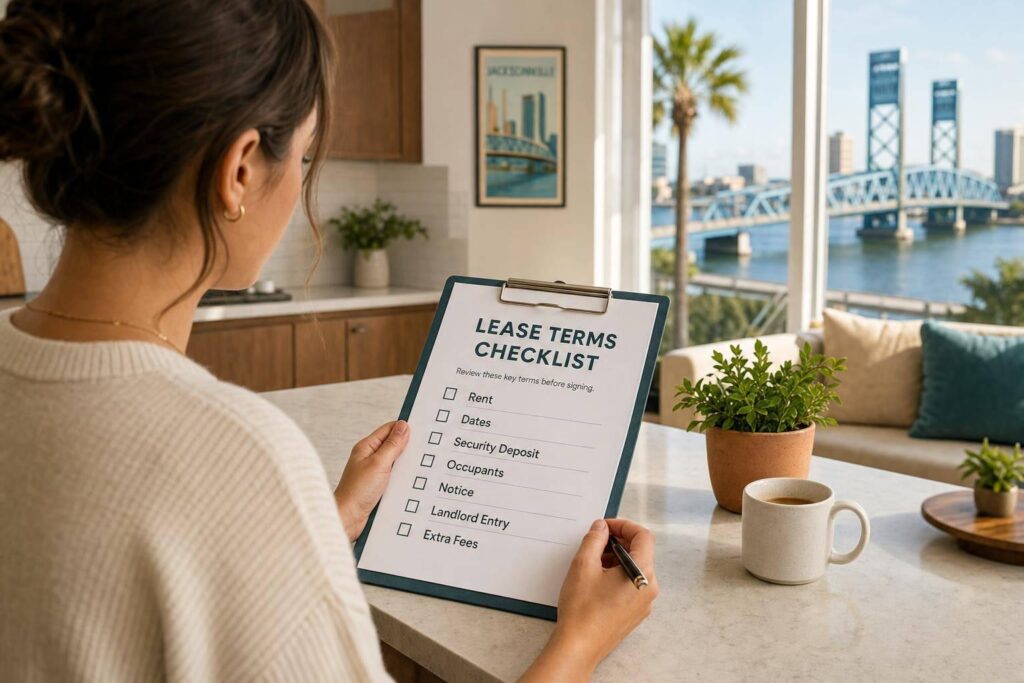
Before I sign any Jacksonville lease, I check 7 things first: rent, dates, deposit rules, who can live there, notice deadlines, entry rules, and extra fees. In Florida, a lease is a binding contract, and small details can cost you money fast.
Here’s the short version:
- Rent: Check the exact monthly rent, due date, grace period, and late fee.
- Lease term: Confirm the start date, end date, renewal terms, and holdover rules.
- Occupants: Make sure every adult is listed and guest limits are clear.
- Security deposit: Florida gives landlords 30 days to send a claim notice or 15 days to return the full deposit if there’s no claim.
- Notice: For month-to-month rentals, Florida law usually requires 15 days’ written notice before the end of the rental period.
- Entry: For non-emergency entry, Florida law generally requires at least 12 hours’ notice at a reasonable time.
- Fees: Look for pet fees, utility charges, parking costs, and move-out charges in writing.
If I had to narrow it down even more, I’d say this: match the lease to what you were told, keep everything in writing, and track every deadline. That’s how many tenant disputes start – and how many can be avoided.
Quick Comparison
| Lease term | What I check | Why it matters |
|---|---|---|
| Rent | Amount, due date, payment method, late fee | Avoid payment disputes |
| Lease dates | Start, end, renewal, holdover | Prevent surprise rent or term changes |
| Occupancy | Approved residents, guest limits, use rules | Avoid lease violations |
| Deposit | Amount, refund terms, claim deadlines | Protect move-out money |
| Notice | Non-renewal and termination deadlines | Avoid extra rent liability |
| Entry | Notice for inspections, repairs, showings | Know when access is allowed |
| Fees | Utilities, pets, parking, move-out costs | Know the full monthly and end-of-lease cost |
Below, I break down the lease terms I’d review before signing in Jacksonville.
Core Lease Terms Every Tenant Should Confirm
Start with the terms that shape your monthly housing cost and who can live in the unit.
Rent Amount, Due Date, and Payment Method
Your lease should spell out the exact monthly rent amount in U.S. dollars, the specific due date, and the accepted payment methods.
It’s also smart to check whether the lease gives you a grace period and the exact point when a late fee kicks in. Late fees need to be clearly stated in the lease. If the wording is vague, that can turn into a dispute fast.
Before you send any payment, verify the portal URL or mailing instructions written in the lease. Pay only through the method and to the address listed there.
Lease Start Date, End Date, and Renewal Terms
Check the lease start date and end date carefully. Then look at any holdover clause so you know what happens if you stay in the unit after the lease expires.
You’ll also want to find the exact notice deadline for:
- renewal
- non-renewal
- any rent increase
Florida does not have statewide rent control, so the rent at renewal may change if the lease terms and notice rules allow it.
Next, look at how the lease deals with your security deposit and any move-out charges.
Approved Occupants, Guests, and Use Restrictions
The lease should name every approved resident. Make sure each adult who will live there is listed, and check that all required signatures are on the lease. If you want to add a roommate later, written landlord approval is often required.
Then review the guest rules. Check how long a guest may stay before the lease treats that person as an unauthorized occupant. Also confirm any rules on smoking, parking, home businesses, and short-term rentals. If the property is part of an HOA, those rules may add another layer of limits.
After you’ve pinned down the occupancy rules, move on to the section covering Florida security deposits.
sbb-itb-73b3b1a
Security Deposit Rules in Florida
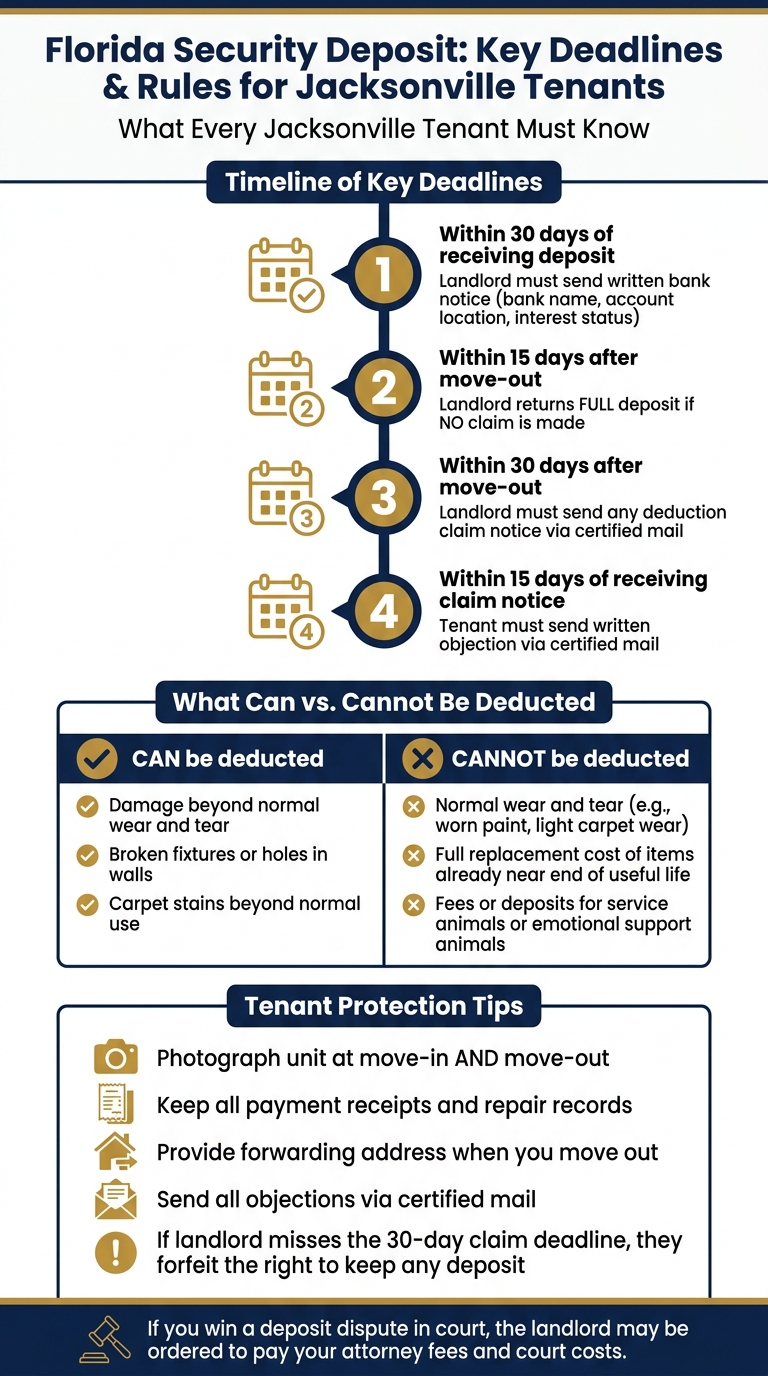
Florida Security Deposit Rules: Key Deadlines Every Jacksonville Tenant Must Know
Once you’ve confirmed who can live in the unit, the next step is your security deposit. In Florida, the big things to check are how the deposit is held, when it must be returned, and what happens if there’s a dispute.
Deposit Amount, Separate Charges, and Written Disclosure
Start with the basics: the deposit amount, any extra fees, and whether any charge is refundable.
If a Jacksonville property management company or landlord offers a nonrefundable fee instead of a standard security deposit, the lease must clearly say that the fee is nonrefundable, optional, and does not excuse unpaid rent or damage.
The landlord must also send written notice within 30 days that tells you:
- the bank where the money is held
- the account location
- whether the account earns interest
That written notice matters more than many renters think. If there’s ever a problem later, you’ll want a paper trail from day one.
Hold on to copies of your lease, every payment receipt, and your signed move-in inspection report. Separate pet deposits may apply. But a landlord cannot charge a fee or deposit for a service animal or emotional support animal.
What Deductions Can Be Made After Move-Out
A landlord can deduct money for damage that goes beyond normal wear and tear, but not for everyday aging or minor use.
That line can feel a little fuzzy, so it helps to think of it this way: worn paint or light carpet wear usually comes with normal living. Broken fixtures, holes in walls, and carpet stains that go past normal use are different and may be charged to the tenant.
There’s another limit here too. A landlord cannot charge you for the full replacement of an item that has already worn out through normal use. So if something was already near the end of its life, they don’t get to treat it like it was brand new.
Photograph the unit at move-in and move-out, and keep cleaning and repair receipts. Those small steps can make a big difference if someone later says, “That damage was already there,” or “You left the place a mess.”
Deposit Return Deadlines, Claims, and Objection Windows
Florida law sets firm deadlines for both sides:
- 30 days: landlord sends bank notice after receiving deposit
- 15 days after move-out: landlord returns full deposit if there is no claim
- 30 days after move-out: landlord sends any claim notice by certified mail
- 15 days after receiving notice: tenant objects in writing
When you move out, give the landlord your forwarding address. If you don’t, there’s no clear place to send your deposit or any claim notice within the legal time window.
If the 30-day claim deadline passes and your landlord never sends notice, they lose the right to keep any part of your deposit. That’s a big deal.
If you get a claim notice and think it’s wrong, send your written objection by certified mail within 15 days. Certified mail gives you proof that it was sent and received. If the fight ends up in small claims court, that proof can matter a lot. And if you win, the landlord may be ordered to pay your attorney fees and court costs.
Next, review notice rules, landlord entry, and when written approval is required for lease changes.
Notice Periods, Entry Rights, and Lease Changes
Next, look at three practical parts of the lease: the deadline to end or not renew it, when the landlord can come into the unit, and which changes need written approval.
How Much Notice Is Required to End or Not Renew a Lease
A fixed-term lease ends on the date listed in the agreement. That said, many leases still require written notice if you do not plan to renew. Florida sets minimum notice periods, but a lease can ask for more. So don’t guess. Check the renewal or termination clause for the exact deadline. If the lease asks for more notice than Florida law, follow the lease.
| Tenancy Type | Required Written Notice (Florida Law) |
|---|---|
| Week-to-week | 7 days |
| Month-to-month | 15 days before the end of the monthly rental period |
| Quarter-to-quarter | 30 days |
| Year-to-year | 60 days |
| Fixed-term (e.g., 12 months) | Follow the lease’s written notice clause |
Give notice in writing. Certified mail can help because it gives you proof that the notice was delivered.
Landlord Entry, Inspections, and Maintenance Access
Once move-out timing is clear, the next thing to check is when the landlord may legally enter the unit.
A landlord may enter for repairs, inspections, and showings. For non-emergency entry, Florida law calls for at least 12 hours’ notice, and the visit must happen at a reasonable time, usually during business hours or from 7:30 AM to 8:00 PM. Many Southside Jacksonville leases go a step further and require 24 hours’ written notice. In a real emergency, like a fire, gas leak, or burst pipe, the landlord can enter right away without notice. If entry rules keep getting ignored, that can turn into a serious lease dispute.
Subletting, Adding Roommates, and Written Lease Changes
Any change in who lives in the unit should be approved before that person moves in.
Most Westside Jacksonville leases require the landlord’s prior written consent before you sublet, assign the lease, or add a roommate. Check the assignment and subletting clause before changing occupants. If the landlord says yes, get the approval in a signed written amendment that spells out any change to rent, fees, occupancy, or the lease term.
Repairs, Fees, and Move-Out Costs
The last lease terms to check are often the ones that hit your wallet the hardest during the lease or when you move out.
Reporting Repairs, Handling Emergencies, and Damage Responsibility
Florida law requires tenants to report material maintenance issues in writing. So even if you call or send a text, put the repair request in writing through email or the landlord’s portal too.
For problems that affect health or safety, give the landlord a written 7-day notice. The landlord then has 7 days to begin remediation. Before you sign, make sure you know the exact phone number to call or the portal steps for after-hours emergencies. In a bad situation, that small detail can save time and stress.
Tenant-caused damage can be charged back, but normal wear and tear cannot. That’s a big difference at move-out. Keep records of repair requests and report problems fast. If a leak gets worse because it wasn’t reported, or if damage comes from misuse, your move-out bill can climb.
Once repair duties are clear, it’s time to look at every fee that can change your monthly cost or what you owe at the end.
Pet Fees, Utility Charges, Late Fees, and Other Costs in the Lease
After repair terms, review every extra charge in writing before you sign.
| Charge Type | Examples | Refundable? |
|---|---|---|
| Monthly Charges | Monthly rent, pet rent | No |
| Utility Charges | Water, trash, electric | No |
| Event-Based Fees | Late fees, returned-payment fees | No |
| One-Time Move-In Fees | Application fee, non-refundable pet fee | No |
| Refundable Deposits | Security deposit, pet deposit | Yes (subject to damages) |
| Optional Charges | Parking, storage, amenity fees | No |
Check who pays utilities. Water, trash, and electric are often separate from base rent. That means the monthly number advertised in the listing may not be your full monthly housing cost, which is why tenant screening often includes verifying your ability to cover these extras.
Late fees should be spelled out clearly, including when they apply and the exact dollar amount. If the lease is vague here, that’s a red flag.
If you have a pet, you may run into more than one pet-related charge. A lease may include:
- a one-time non-refundable pet fee
- monthly pet rent
- a refundable pet deposit
Conclusion: The Lease Terms That Matter Most in Jacksonville
Reading the lease carefully is the best way to avoid disputes over security deposit deductions, repair reporting, and surprise fees. Florida law gives tenants real protections, but those protections only help if you know what the lease says.
Before signing a Jacksonville lease, confirm the rent, dates, occupants, deposits, notice rules, entry rights, and all extra fees.
FAQs
What counts as normal wear and tear?
Normal wear and tear is the natural, gradual decline of a rental that comes from regular, careful use, not negligence or abuse. In most cases, landlords can’t take these costs out of a security deposit.
Common examples include:
- Worn paint
- Age-appropriate carpet wear
- Minor wall scuffs
- Small nail holes
- Light floor scratches
- Loose cabinet handles
- Sun-faded blinds
- Burned-out light bulbs
- HVAC filters that need replacing
What if my landlord misses the deposit deadline?
Under Florida law, timing matters A LOT with security deposits.
If your landlord wants to keep any part of your deposit, they must send you a written, itemized notice by certified mail within 30 days after you move out.
Miss that deadline? They lose the right to keep any of the deposit.
That means they must return your full deposit. At that point, you can send a formal demand letter that cites Florida law.
Can I break my lease early?
In most cases, you can’t end a lease early unless you have a valid legal reason or your landlord agrees to it. If not, you’re usually still on the hook for rent through the full lease term.
If you don’t have a legal reason, you may have to pay ongoing rent or liquidated damages listed in your lease. If you need to move, it’s smart to talk with your property manager about your options.