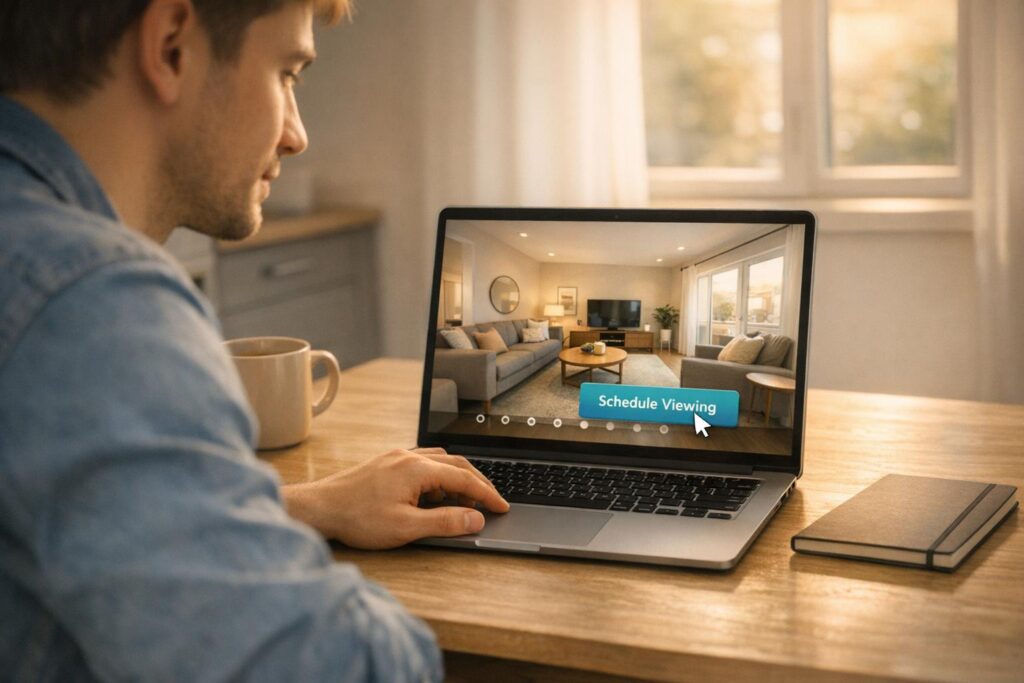
Virtual tours are transforming the rental process by helping property owners lease units faster and more efficiently. By offering a digital walkthrough of properties, potential tenants can explore spaces anytime, anywhere, without scheduling in-person visits. Here’s why virtual tours work:
- Faster Leasing: Properties with virtual tours rent up to 30% faster.
- Increased Reach: Attracts remote renters, including out-of-state professionals and relocating families.
- Lead Filtering: Helps eliminate unqualified leads by letting prospects self-screen online as part of your tenant screening strategies.
- Higher Engagement: Listings with virtual tours see up to 300% more engagement compared to static images.
- Cost-Effective: Professional virtual tours typically cost $125–$175 but significantly reduce vacancy periods.
Virtual tours not only speed up tenant decisions but also reduce vacancy costs by showcasing properties effectively across multiple platforms. For property owners, they’re a 24/7 marketing tool that simplifies the leasing process and attracts serious renters.
How Virtual Tours Cut Down the Tenant Placement Timeline
Finding the right tenant often takes more time than managing an existing one. Scheduling showings, conducting in-person tours, and following up with uninterested prospects can keep properties vacant longer than necessary. Virtual tours change the game by moving the initial “discovery” phase online, making the tenant placement process faster and more efficient. This approach not only reduces vacancies but also boosts returns. Let’s look at the different virtual tour technologies that make this possible.
Types of Virtual Tour Technology Available
Virtual tours come in different formats, each with its own level of engagement and appeal. The type you choose can impact the tenant experience and the quality of applicants you attract:
- 360° Walkthroughs: These allow users to navigate a property interactively with their mouse or touchscreen, providing a detailed view from fixed points within the space.
- 3D Matterport Tours: These create an immersive, dollhouse-style model of the property, enabling prospects to move freely between rooms and view a floor plan overlay – ideal for properties with complex layouts.
- Video Walkthroughs: Pre-recorded tours, often with narration, guide viewers through the property in a set sequence. These are particularly effective for sharing on social media.
- Drone Footage: This format highlights the surrounding neighborhood, parking areas, and the overall scale of the building – details that static photos often miss.
Each option serves a specific purpose. Short videos (30–60 seconds) are perfect for grabbing attention on social platforms, while longer, detailed tours (5–7 minutes) cater to serious renters ready to make a decision. These tools not only showcase properties effectively but also help pre-qualify interested tenants.
How Virtual Tours Filter Out Unserious Applicants
One of the biggest advantages of virtual tours is their ability to reduce wasted time on in-person showings. Prospects can explore a property online, assessing room sizes, finishes, and layout. If the space doesn’t meet their needs, they can self-select out, leaving property managers with fewer no-shows and more meaningful conversations with serious applicants.
To enhance this process, property managers can require prospects to complete a virtual tour before scheduling an in-person visit. Adding a brief pre-qualification form at the end of the tour helps capture high-intent leads and ensures only serious applicants move forward. For example, a mid-size landlord who replaced traditional open houses with self-guided 360° tours cut vacancy days by 30% and sped up the application-to-move-in timeline by 20%. This streamlined process naturally leads to quicker and more decisive leasing decisions.
How Virtual Tours Speed Up Leasing Decisions
Virtual tours empower renters to explore properties on their own schedule, which speeds up decision-making. By allowing prospects to visualize furniture placement, imagine daily routines, and get a real sense of the space, these tours help them feel confident in their choices before ever stepping inside.
A clear online view of the property reduces uncertainty and helps renters decide more quickly. Property management companies, like 1 Realty Management (https://propertymanagementjacksonvillefl.com), have found that virtual tours ensure in-person visits are reserved for serious prospects. This efficiency not only shortens the leasing timeline but also sets the stage for benefits that extend well beyond the initial placement process, as we’ll explore in the next section.
sbb-itb-73b3b1a
Benefits of Virtual Tours for Property Owners
Virtual tours do more than just replace traditional in-person showings – they’re a powerful marketing tool that works 24/7. They help property owners by boosting visibility, attracting a wider audience, and supporting multi-channel promotion. Let’s break down how these benefits make a real difference.
More Online Visibility and Increased Engagement
Listings with virtual tours grab attention. In fact, nearly 90% of renters consider features like 3D tours and walkthrough videos a must-have when apartment hunting. High-quality 360° visuals provide an interactive experience that static photos simply can’t match. This interactivity leads to more clicks, inquiries, and faster lease signings – helping property owners cut down on vacancy periods and reduce carrying costs.
Attracting Remote and Out-of-Town Applicants
Virtual tours also open doors to a broader audience. Without them, your pool of applicants is limited to those who can physically visit the property. With a virtual tour, anyone with an internet connection – whether they’re out-of-state professionals, relocating families, or students moving to a new city – can explore the property on their own schedule. This flexibility allows prospective tenants to feel confident enough to commit, turning what could have been missed opportunities into signed leases.
Expanding Reach Through Multi-Channel Marketing
Virtual tours aren’t just engaging – they’re versatile. You can feature them on your website, Google Business Profile, social media platforms, and popular listing sites. This multi-channel approach amplifies your marketing efforts and speeds up tenant placement.
“Virtual tours shouldn’t be thought of as a one-off production expense, but as an asset library that powers your entire marketing suite.” – Adam Locklear
The numbers back this up – a single 3D digital twin can generate up to 300% more engagement compared to static images. Considering that professional virtual tours for residential properties usually cost between $125 and $175, they’re one of the smartest marketing investments a property owner can make.
Best Practices for Creating Effective Virtual Tours
What to Include in a Virtual Tour
Start your virtual tour at the front door and guide viewers through each room, covering all shared spaces like parking areas, laundry facilities, hallways, and outdoor amenities. Make sure to showcase every room – bedrooms, bathrooms, kitchen, and living areas – and don’t skip shared facilities. If your property offers multiple floorplans, create a separate tour for each. Renters want to see the exact layout they’d be living in, not just a generic model unit.
To make your tour more informative, add text overlays with useful details like room dimensions, utility options, and nearby transit access. This helps answer common questions upfront, saving time and building confidence in potential renters.
Once you’ve mapped out your content, shift your focus to technical quality to make the tour visually engaging.
Tips for Improving Virtual Tour Quality
Lighting is key. Shoot during the day with curtains and blinds open to let in natural light. For rooms that are naturally darker, use warm artificial lighting to create a welcoming vibe.
To keep the footage professional, use tools like a tripod or a gimbal for smooth, steady shots. Stage the space thoughtfully to highlight open areas and make it feel inviting. After filming, edit the footage to remove slow or unnecessary parts and add seamless transitions. However, stay honest – don’t digitally erase permanent fixtures or add features that aren’t there. Misleading edits can erode trust when prospects visit in person.
“A virtual tour isn’t just a digital replica – it’s a tailored communication tool that can do real work for your brand.” – Gary Booth Jr.
Once your tour is polished, it’s time to get it in front of the right audience.
How to Distribute Virtual Tours for Maximum Exposure
Even the best virtual tours need smart placement to reach potential renters. Embed the tour on the specific floorplan page of your property website rather than hiding it in a general gallery. This keeps prospects focused on the unit they’re interested in, reducing bounce rates and encouraging inquiries.
Expand your reach by sharing the tour on your Google Business Profile, popular rental listing sites, and social media platforms. For example, short clips from your walkthrough can be repurposed as Instagram Reels or TikTok posts, targeting renters where they’re most active. Think of your virtual tour as a versatile content asset – it can be embedded in email campaigns, retargeting ads, and shared across multiple channels without extra production costs. This broader exposure helps speed up tenant decisions and highlights how virtual tours can effectively reduce vacancies.
How to Measure the Results of Your Virtual Tours
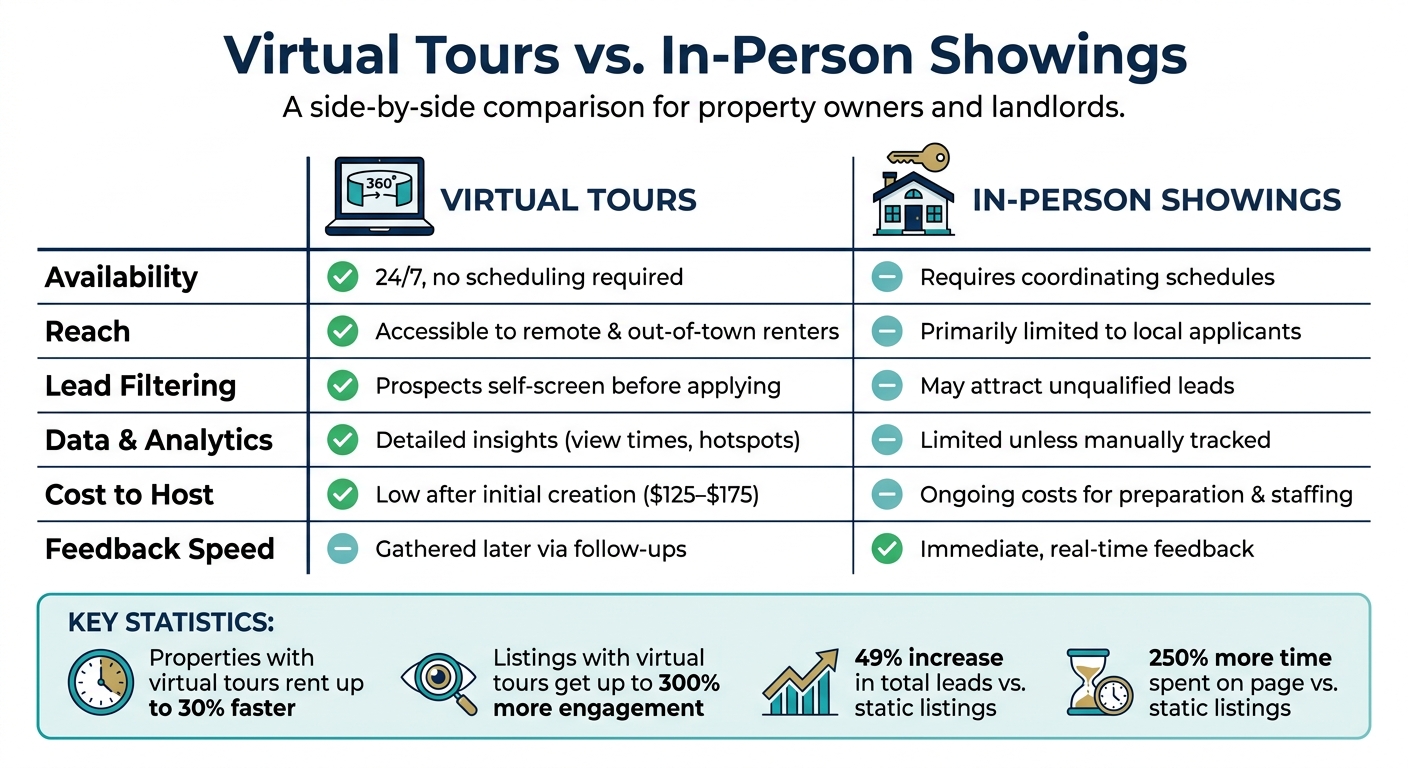
Virtual Tours vs. In-Person Showings: Key Differences for Landlords
Metrics to Track for Virtual Tour Performance
Once you’ve launched your virtual tours, it’s important to monitor their impact. Start by comparing leasing timelines before and after introducing the tours to see if vacancy durations have improved. Another key metric is the tour-to-application conversion rate – the percentage of viewers who go on to apply. This helps gauge how effective your tours are at driving engagement.
Other useful metrics include tracking no-show rates and calculating your cost-per-lease. To do this, divide your total marketing spend by the number of signed leases. For reference, professional virtual tours for residential properties generally cost between $125 and $175. Additionally, digital data like average view times and hotspot interactions can highlight which parts of the tour are grabbing the most attention.
These numbers give you a clear connection between your virtual tours and outcomes like shorter vacancies and smoother tenant selection.
Using Tenant Feedback to Refine Your Tours
While analytics tell you what’s happening, tenant feedback can help you understand why. For example, during the application process, ask prospective renters if the virtual tour gave an accurate depiction of the property. If you notice repeated comments like “the kitchen seemed smaller in person” or “the living room looked larger online,” it might be time to adjust your camera angles or include room dimensions.
Feedback collected after in-person visits is also valuable. If renters feel the property doesn’t match their expectations from the virtual tour, certain aspects may need fine-tuning. Michael Zimmerman from RentVision puts it perfectly:
“Your virtual tours accomplish one of two things. They either attract and qualify prospective renters… Or they force prospects to quickly move on because your visuals are outdated, uninformative, and misleading.”
Additionally, any major updates – like renovations or new fixtures – should prompt an immediate refresh of the virtual tour. Keeping your tours up-to-date builds trust with prospective tenants.
Virtual Tours vs. In-Person Showings: A Results Comparison
Combining analytics and feedback gives you a well-rounded view of how your virtual tours are performing. Listings with virtual tours often see a 49% increase in total leads and a 250% boost in time spent on the page compared to static listings. To put this into perspective, here’s how virtual tours stack up against traditional in-person showings:
| Feature | Virtual Tours | In-Person Showings |
|---|---|---|
| Availability | 24/7, no scheduling required | Requires coordinating schedules |
| Reach | Accessible to remote and out-of-town renters | Primarily limited to local applicants |
| Lead Filtering | Helps prospects self-screen before applying | May attract unqualified leads |
| Data & Analytics | Offers detailed insights (e.g., view times, hotspots) | Limited unless manually tracked |
| Cost to Host | Low after initial creation | Ongoing costs for preparation and staffing |
| Feedback Speed | Gathered later via follow-ups | Immediate, real-time feedback |
While virtual tours are excellent for attracting and pre-qualifying renters, in-person showings remain essential for certain prospects – especially those who prefer to physically experience a property before making a decision. Virtual tours often act as a first step, narrowing the pool to serious, qualified applicants who are ready for an in-person visit.
Conclusion: Using Virtual Tours to Fill Vacancies Faster
Virtual tours have become a game-changer for cutting down vacancy periods. Properties that feature virtual tours rent up to 30% faster than those that don’t. This is thanks to their ability to filter leads more effectively, reach a broader audience, and keep the leasing process running outside of normal business hours. Together, these perks make leasing more efficient and less time-consuming.
Licensed property manager Andee Jessee highlights that integrating virtual tours into a well-organized leasing system is key to achieving this 30% faster leasing speed.
The real power of virtual tours lies in pairing them with other tools like online applications, automated scheduling, and tenant screening. This combination turns virtual tours from a standalone feature into a seamless leasing pipeline, simplifying tenant selection and boosting engagement at every step.
For Jacksonville property owners, the advantages are especially clear. The city’s market consistently attracts out-of-state and remote renters who often need to make housing decisions without visiting in person. Virtual tours make it easier for these prospects to explore properties and make decisions quickly. If you’re looking to simplify the process, 1 Realty Management provides professional property marketing services in Jacksonville, Florida. Their comprehensive approach to tenant placement, screening, and lease execution ensures your property stays occupied and your investment continues to thrive. By incorporating virtual tours into your leasing strategy, you create a 24/7 marketing tool that speeds up tenant placement and keeps occupancy rates high.
FAQs
Which virtual tour type is best for my rental?
When choosing the right virtual tour, it all comes down to your specific needs. 3D virtual tours are perfect if you want to highlight your rental’s layout and finer details in an interactive way. They let potential tenants explore the space remotely, saving time and speeding up the rental process.
For even broader access, immersive virtual tours are a great choice. These are especially helpful for remote applicants or individuals with mobility limitations. Both options streamline tenant screening and make it easier for renters to make confident decisions.
How do I keep virtual tours accurate and trustworthy?
To make virtual tours reliable and believable, focus on using high-quality, realistic visuals that accurately represent the property’s dimensions, layout, and features. It’s important to keep the content up to date, especially after any renovations or changes. Incorporating high-definition images and 360-degree views adds a layer of realism, making it easier for prospective tenants to trust what they see. This ensures clear expectations and helps avoid any misunderstandings.
What metrics prove my virtual tours are working?
Metrics that show how well virtual tours work include increased tenant engagement, shorter leasing timelines, and fewer in-person showings needed. These benefits combine to speed up tenant placement and streamline the rental process.