I’d start your 2026 rental tax review with one folder per Jacksonville property – not a pile of receipts. Match gross rental income to your records now, then finalize totals after December 31, 2026.
Here’s what I’d check before filing:
- Income: Reconcile rent, fees, reimbursements, and security-deposit records.
- Expenses: Gather proof of payment, separate mortgage interest from principal, and check actual escrow payments for taxes and insurance.
- Repairs and assets: Review repairs versus improvements, update depreciation schedules, and document when new assets were ready for rental use. Residential rental buildings generally depreciate over 27.5 years.
- Contractor forms: Check W-9s, current 1099 rules, deadlines, and which forms your property manager will prepare.
- Final records: Match each property’s totals to your books, send unresolved questions to your tax professional, and keep purchase and asset records through ownership and the required period afterward.
My rule: <u>keep proof, avoid counting expenses twice, and flag unclear tax treatment</u>. A paid invoice alone doesn’t tell you whether a cost is deductible now or recovered through depreciation.
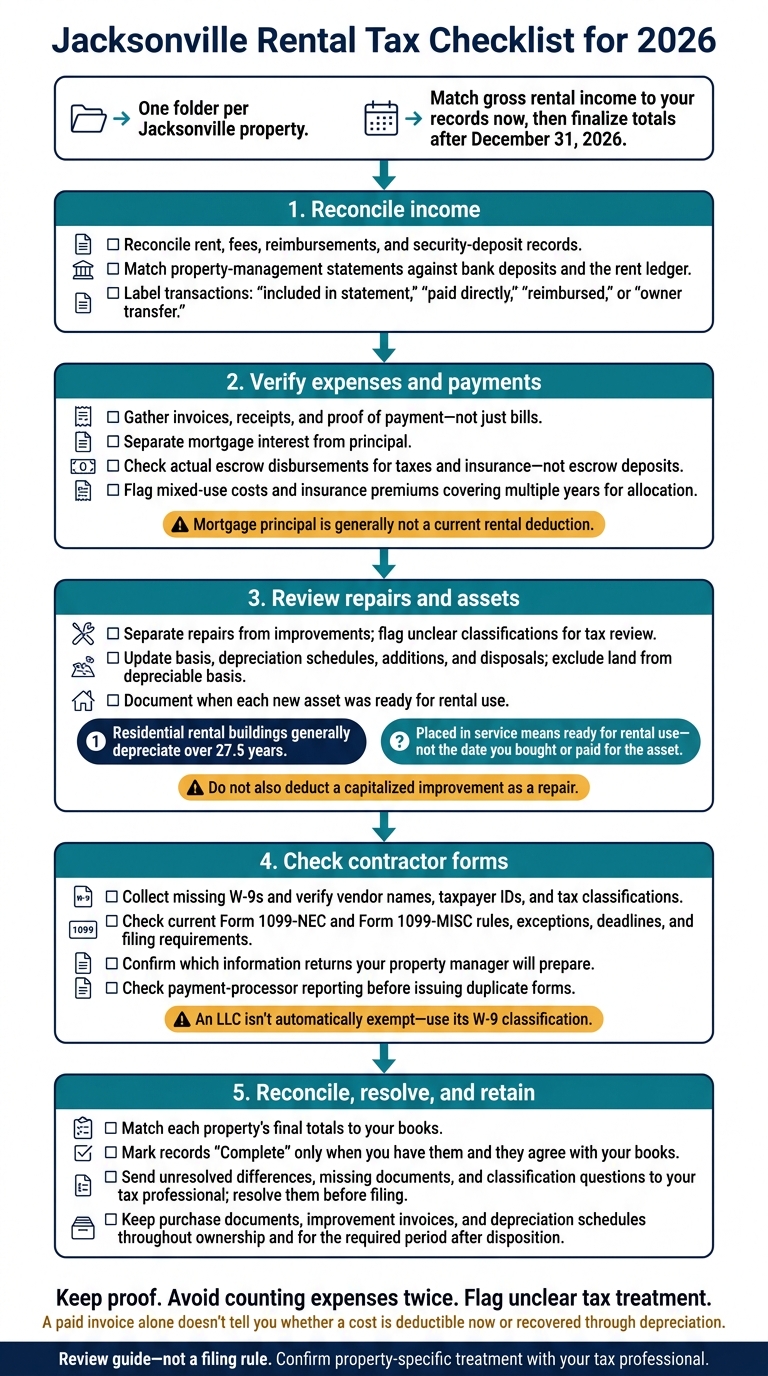
Jacksonville Rental Tax Checklist for 2026
2. Expense and Payment Checklist
Once you’ve reconciled income, gather the records that support your expense deductions.
Gather Receipts and Property Management Statements
Collect repair invoices, contractor bills, expense receipts, and bank or credit card payment records. Each invoice should include the property address, vendor, service date, work description, payment date, amount, and payment method. Mileage logs should record the date, starting point, destination, property visited, business purpose, and miles driven. Under the cash method, deduct expenses when you pay them. Keep proof of payment – not just the bill.
Match each property-management statement against bank deposits and the rent ledger. Separate management fees, maintenance charges, reserves, refunds, owner distributions, and ending balances. Label items as “included in statement,” “paid directly,” “reimbursed,” or “owner transfer.” 1 Realty Management’s financial reporting can help organize rent, fees, maintenance, distributions, and balances.
Check Mortgage, Property Tax, and Insurance Records
Keep annual mortgage statements, Form 1098 when issued, and escrow records. Separate interest from principal. For taxes and insurance, check actual escrow disbursements – not deposits and match those lender payments to the underlying bills.
Duval County property-tax bills generally arrive by mail in November. Save the bill, payment confirmation, and documentation of any early-payment discount.
For landlord, liability, flood, and other rental insurance policies, keep declarations pages, renewal invoices, and payment records. Flag premiums that cover multiple years for allocation instead of automatically deducting the entire payment.
Identify Deductible and Nondeductible Payments
Use these records to classify each payment before filing.
| Payment | Tax Treatment |
|---|---|
| Mortgage interest attributable to rental use | Potentially deductible; check the lender’s annual interest total. |
| Rental property taxes | Potentially deductible when properly attributable to the rental activity and paid under the applicable accounting method. |
| Applicable rental insurance premiums | Potentially deductible, with allocation for mixed-use properties or premiums covering multiple periods. |
| Mortgage principal | Generally not a current rental deduction; it reduces the outstanding loan balance. |
| Capital improvements | Generally capitalized and recovered through depreciation rather than deducted immediately. |
Treat this table as a review guide, not a filing rule. Flag mixed-use costs, partial ownership, tenant-paid bills, and insurance reimbursements for tax review.
sbb-itb-73b3b1a
3. Depreciation and Improvement Checklist
Once you’ve separated current repairs from capital costs, update each property’s depreciation schedule. Make sure your 2026 asset records match the return.
Separate Repairs From Improvements
Review renovation invoices using the IRS betterment, restoration, or adaptation test. Work that restores routine function is a repair; replacing a major component or adapting the property to a new use is an improvement. Keep separate files for repairs and improvements, including the work description, permit, payment date, property address, and photos.
Review closing statements, settlement-fee details, and asset receipts instead of treating each total as a single expense. For mixed projects, ask contractors for itemized bills and flag any unclear classifications for tax review.
The de minimis safe harbor allows up to $2,500 per invoice or item without an applicable financial statement, or $5,000 with one, if you consistently expense the cost and file the election on a timely return. Add anything you capitalize to the asset schedule.
Update Asset Basis and Service Dates
Carry forward each property’s prior-year depreciation schedule and check it against the filed return. Verify basis, accumulated depreciation, recovery period, method, convention, and prior- and current-year deductions. Leave land out of depreciable basis, and document any split between rental and personal use. Residential rental buildings generally use 27.5-year straight-line MACRS depreciation with a mid-month convention. Appliances and furnishings may use different recovery periods.
For each current-year addition, record the asset description, vendor, property and unit, acquisition date, cost, rental-use percentage, and placed-in-service date. Placed in service means ready for rental use – not the date you bought or paid for the asset. Keep installation and completion records to confirm whether it entered service by December 31 for the 2026 depreciation schedule. Ask your preparer whether the addition requires Form 4562 and how to report it on the updated schedule.
Record assets sold, scrapped, abandoned, or replaced. Include disposal dates, proceeds or insurance reimbursements, accumulated depreciation, and adjusted basis. Flag major replacements for possible partial-asset disposition review. Before filing, check that every addition is recorded, every disposal is adjusted, and no capitalized improvement is also deducted as a repair.
4. Contractor and Tax-Form Checklist
After reconciling expenses, check the contractor records tied to those payments.
Check Forms W-9 and 1099 Requirements
Collect missing W-9s before year-end. Verify each vendor’s legal name and taxpayer ID, and flag contractors who haven’t provided valid tax information. An LLC isn’t automatically exempt – use its W-9 classification.
Review contractor and rent payments that may require Form 1099-NEC or 1099-MISC. Before preparing forms, confirm the current IRS rules, exceptions, and filing method. Credit-card and qualifying third-party-network payments are generally reported by the payment processor, so check before issuing duplicate forms.
Track both filing and recipient deadlines for Forms 1099-NEC and 1099-MISC. If a deadline falls on a weekend or holiday, move it to the next business day. Confirm applicable electronic-filing requirements before submitting.
Match Vendor Payments and Save Tax Schedules
Use W-9 and 1099 forms to check contractor payments against your books. Match contractor totals to invoices and issued Forms 1099, and check every payment against your property records. Separate reimbursable items from reportable contractor payments, and record each expense only once.
If you use 1 Realty Management, request the year-end owner statement, vendor-payment summary, and written confirmation of which information returns the manager will prepare.
Securely save issued and received Forms 1099, W-9s, payment confirmations, corrected forms, and filing receipts by property and tax year. Before filing, reconcile any differences between information returns and your ledger. Don’t add the forms as separate income or expenses.
5. Final Filing Checklist
Before filing, check that each property’s records match the return.
Complete the Records Review Table
Use one table per property. Mark Complete only when you have the record and it agrees with your books. Flag missing documents and unexplained differences – don’t estimate amounts.
| Record | Action | Status | Follow-up |
|---|---|---|---|
| Income records | Match year-end totals to your books | ☐ Complete ☐ Missing | Explain any unreconciled differences |
| Repair invoices | Check invoice details, proof of payment, and whether the work is a repair or improvement | ☐ Complete ☐ Missing | Get missing invoices or resolve classification questions |
| Mortgage statements | Separate interest, principal, escrow, and loan fees | ☐ Complete ☐ Missing | Ask about refinancing or closing costs |
| Property-tax bills | Check the bill year, payment date, and any corrected bill | ☐ Complete ☐ Missing | Resolve unpaid, prepaid, or corrected bills |
| Insurance records | Include landlord, flood, windstorm, liability, and claim records | ☐ Complete ☐ Missing | Identify refunds or casualty-related claims |
| Depreciation schedules | Match assets, placed-in-service dates, basis, prior depreciation, and current-year depreciation | ☐ Complete ☐ Missing | Flag renovations, appliances, and additions |
| 1099 forms | Match issued and received forms to vendor payments and taxpayer identification information | ☐ Complete ☐ Missing | Get a W-9 or investigate discrepancies |
| Property-management statements | Confirm that the final annual statement matches your books | ☐ Complete ☐ Missing | Request the final annual statement |
Resolve Tax Questions and Keep Records
Once the table is complete, send only unresolved items to your tax professional. Use one folder per property, labeled with the address, owner, and tax year.
Include a short issues memo covering missing documents, unexplained differences, major renovations, personal use, mixed-use expenses, refinancing costs, casualty losses, ownership changes, and any tax forms still pending. Resolve missing records and classification questions before filing.
For Jacksonville property taxes, check the payment date and escrow records to confirm the reporting year.
Keep records for the required retention period. Save purchase documents, improvement invoices, and depreciation schedules throughout ownership and for the required period after disposition. Ask your tax professional for a property-specific record-retention schedule.
FAQs
Can I deduct expenses while my rental is vacant?
Yes, you can still deduct many rental property expenses while the unit is vacant, as long as it remains available for rent and ready for occupancy. These expenses include property taxes, mortgage interest, insurance premiums, and utilities.
Keep the property well-maintained and ready for a new tenant. Save all maintenance and service invoices to support your deductions.
How do I report security deposits I keep?
Security deposits aren’t taxable income when you receive them because the money still belongs to the tenant. In Florida, keep deposits in a separate, dedicated bank account. Mixing them with other funds – known as commingling – is a serious compliance violation.
Keep a detailed security deposit ledger that matches your trust account balance so your records are ready for an audit.
If you retain any portion of a deposit at the end of a lease to cover damages or unpaid rent, document that amount and report it as income.
Can rental losses reduce my other taxable income?
Yes, rental losses may reduce other taxable income, including salary or business income, under passive activity loss rules. Limits depend on your participation in the rental activity and your adjusted gross income.
These rules can be complex, and your financial situation affects which deductions you can claim. Work with a qualified tax professional or accountant when filing to make sure you claim them correctly.