

Tenant screening protects landlords from unreliable tenants who might cause financial losses, legal issues, or property damage. This article compares five tenant screening services, highlighting their features, costs, and best use cases. Here’s a quick breakdown:
- Credit & Background Checks: Offers financial and legal history for $25–$48 per applicant. Best for landlords needing raw data quickly.
- Multi-Factor Platforms: Combines credit, criminal, eviction, and income checks. Costs $39.99–$49.99. Ideal for landlords managing multiple properties.
- Rental History & References: Focuses on past rental behavior. Costs $16.95–$55. Great for validating tenant reliability.
- Predictive Risk Tools: Uses AI to assess eviction risks. Costs $15–$40 per application. Useful in high-risk markets.
- Full-Service Placement: Handles marketing, screening, and leasing. Costs $500–$2,000. Perfect for landlords seeking hands-off management.
Quick Comparison:
| Service Type | Cost (Landlord) | Cost (Applicant) | Turnaround Time | Best For |
|---|---|---|---|---|
| Credit & Background Checks | $0–$29 | $25–$48 | 1–2 days | Quick financial and legal insights |
| Multi-Factor Platforms | $0 | $39.99–$49.99 | ~2 hours | Managing multiple units |
| Rental History & References | $0–$9/month | $16.95–$55 | 1–3 hours | Validating tenant behavior |
| Predictive Risk Tools | $12–$99/year | $15–$40 | Instant–1 day | Fraud prevention, eviction risk |
| Full-Service Placement | $500–$2,000 | N/A | Up to 72 hours | Out-of-state or busy landlords |
Tenant screening is a small investment compared to the cost of evictions, which range from $5,800 to $15,000. Choose the service that matches your needs, property type, and management style.
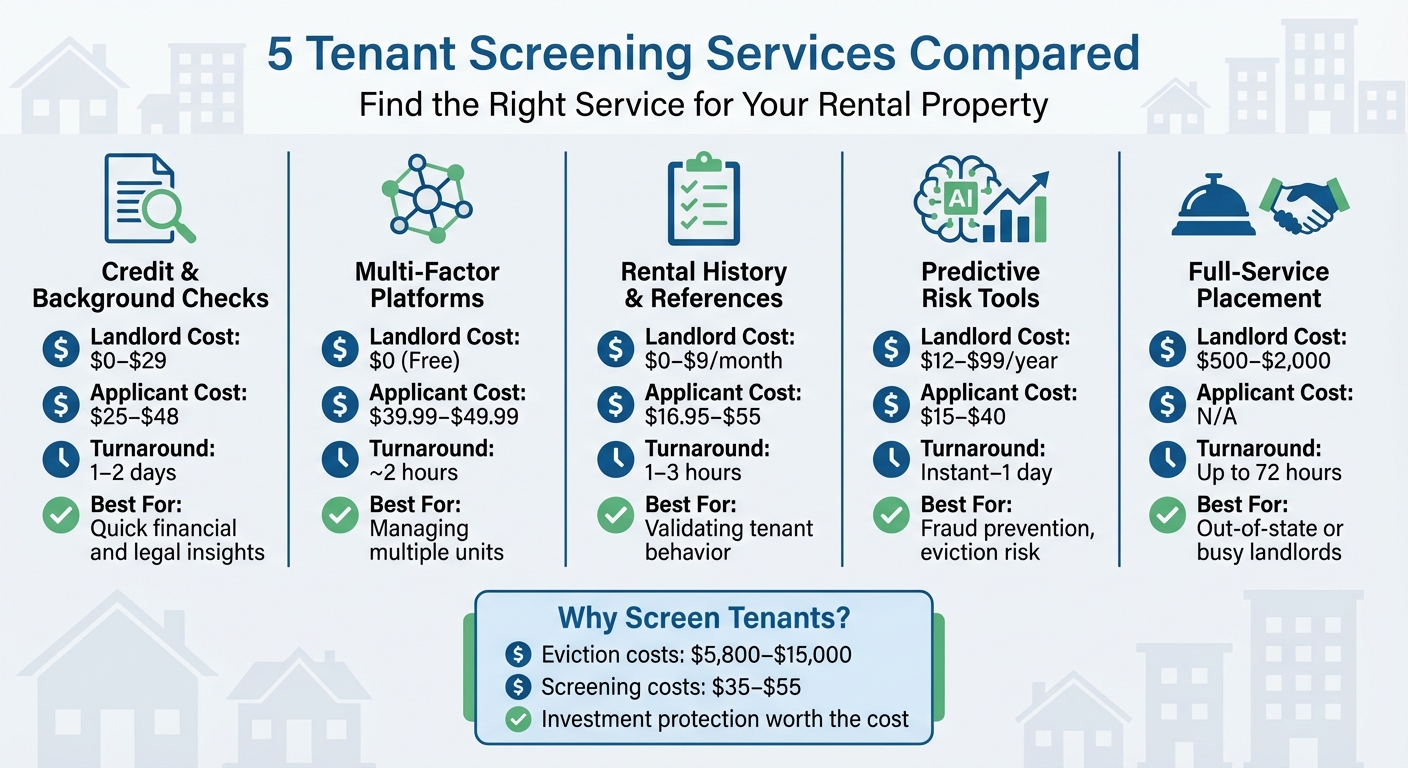
Tenant Screening Services Comparison: Costs, Turnaround Times, and Best Use Cases
Option 1: Credit and Background Check Services
Credit and background check services are a cornerstone of tenant screening, offering insights into an applicant’s financial reliability and legal history. These services pull data from major credit bureaus to create detailed reports, typically costing between $20 and $40 per applicant.
What These Services Include
A typical credit and background check package combines financial and legal details in one report. The credit portion provides a snapshot of credit scores (including rental-specific scores like TransUnion’s ResidentScore), payment history, debt-to-income ratios, and potential red flags like bankruptcies, foreclosures, or collections. ResidentScore, designed for rental applications, improves eviction risk prediction by 15% for applicants in the bottom 20% credit range. This allows for a more accurate review while protecting tenant credit scores.
The background check aspect examines nationwide criminal records, including sex offender registries, Most Wanted lists, and watchlists (such as those from OFAC or the Patriot Act). Many packages also include eviction history and identity verification, which cross-check Social Security Numbers, reference the Social Security Death Index, and highlight aliases or past addresses.
Premium packages go a step further with employment history and bank-verified income reports, helping to identify the roughly 12% of applicants who may submit fake pay stubs.
Pricing depends on the depth of the report. For example, TransUnion SmartMove charges $25 for a basic report and $48 for a premium version that includes eviction history. Other providers, like E-Renter and RentSpree, offer similar pricing, with RentSpree‘s reports ranging from $39.99 to $49.99 when income verification is added. These tools are especially useful for targeted screening needs.
When to Use This Type of Service
Understanding when to invest in these services can help protect your rental property. Credit-focused screening is particularly valuable for properties with higher monthly rents. Considering that the average eviction costs around $5,800 in legal fees, lost rent, and turnover, spending $25 to $48 on detailed screening is a smart choice for properties renting above $1,500 per month.
These services are also crucial in competitive rental markets where quick decisions are necessary. Most reports are automated and available within minutes, enabling landlords to act fast. However, relying solely on credit scores can be misleading.
The credit score alone tells you almost nothing. I have seen people with 720 credit scores who had $80,000 in debt on a $45,000 income.
To ensure thorough screening, combine credit and background checks with direct income verification and manual reference calls. This is particularly important given that nearly one in three U.S. adults has some form of a criminal record.
Be aware that some states and cities, including Delaware, New Jersey, and parts of California, have restrictions on using criminal records in tenant screenings or limit the fees landlords can charge applicants. Always check local laws to ensure compliance with regulations.
By leveraging these detailed reports, landlords can safeguard rental income while adhering to legal standards, aligning with the strategies covered earlier in this guide.
Additional Resources:
- What to Evaluate in Any Screening Service
- Tenant Screening Comparison Guide
- Matching Screening Services to Your Property Type
sbb-itb-73b3b1a
Option 2: Multi-Factor Screening Platforms
Multi-factor screening platforms bring together credit reports, criminal records, eviction histories, and income verification into a single, automated process. By cutting out the need for manual data entry, these platforms streamline everything from application submission to approval, reducing errors and saving time – especially for landlords juggling multiple properties. This efficiency not only speeds up decision-making but also minimizes costly mistakes.
What These Platforms Offer
These platforms don’t stop at basic credit checks. They provide a detailed report that combines identity verification, financial analysis, and legal history. Key features include Social Security Number validation, address history checks, and cross-database name matching to catch fraudulent applications. Some services even take financial analysis a step further, offering tools like debt-to-income ratio calculations, algorithms to detect regular deposits in bank statements, and "Income Insights" that estimate earnings based on credit history.
Certain platforms integrate directly with over 300 MLS systems, enabling screening to start as soon as an application is submitted. Others include automated, FCRA-compliant adverse action notices to help landlords avoid legal missteps, which could otherwise cost up to $1,000 per violation. Workflow integration is another standout feature. For instance, platforms like Buildium can autofill over 50 fields in lease documents using screening data, making the transition from application to lease signing – and even rent collection – smooth and efficient.
"A good screening process is your first line of defense for protecting your owners’ investments."
Most platforms deliver instant database results within minutes, but more detailed county court verifications may take 24 to 72 hours for added accuracy. Some advanced systems now use AI to enhance data accuracy by up to 80%, helping differentiate between genuine concerns and false positives in tenant behavior.
These features make multi-factor platforms particularly useful for landlords managing a large number of properties.
Best Situations for Multi-Factor Platforms
Thanks to their robust capabilities, these platforms shine in high-volume property management. With the national median rent for single-family homes around $2,100 per month, even a brief vacancy can be expensive – costing nearly $500 per week. Unified dashboards allow property managers to monitor application statuses and approvals across multiple properties efficiently. Additionally, bidirectional data flow ensures seamless integration with property management software.
Integrated systems also flag about 14% of applications for further review, helping landlords avoid costly mistakes. One property manager shared how using a less comprehensive screening service led to significant financial losses across several units. Many platforms also offer applicant-pay models, which allow landlords to avoid screening costs while maintaining a professional workflow.
For applicants who fall into a gray area, these platforms cross-reference multiple data sources to provide a clearer picture, offering more confidence than single-source checks. Thorough screening ultimately helps landlords avoid the high costs of evictions, including legal fees, lost rent, and turnover expenses.
Additional Resources:
- What to Evaluate in Any Screening Service
- Matching Screening Services to Your Property Type
- Tenant Screening Comparison Guide
Option 3: Rental History and Reference Checks
Rental history and reference checks focus on a tenant’s behavior in previous rentals rather than their financial status. While a credit score can indicate financial reliability, it doesn’t shed light on whether a tenant maintained the property, respected neighbors, or followed lease terms like providing proper notice before moving out. This type of screening fills the gaps that automated systems often leave behind.
What These Services Check
These services dig into tenancy details, such as previous rental addresses and occupancy dates. They also review rent payment history, including late payments, bounced checks, and any unpaid balances. Lease compliance – covering issues like noise, pet policies, and occupancy rules – is another key area of focus. A common question asked of previous landlords is: "Would you rent to this tenant again?".
For example, in February 2026, Hemlane reported a case involving an applicant in Portland with an impressive 820 credit score and a $120,000 annual income. Despite their spotless credit and criminal record, a manual reference check revealed eight noise complaints and a history of late rent payments – issues that hadn’t escalated to eviction but were enough for the landlord to reject the application.
This level of detail highlights why landlords value reference-based screening so highly.
Why Landlords Choose Reference-Based Screening
Looking beyond financial data, a tenant’s behavior in past rentals provides critical insight. Reference checks uncover issues that a credit score simply can’t. For instance, about 12% of applicants have been found to submit fake employment letters or pay stubs – something that thorough verification can expose.
"A 750 credit score means someone pays their credit cards on time. It doesn’t mean they pay rent on time."
When speaking with previous landlords, ask specific questions like: "Did you return their full security deposit? If not, why?" Be cautious if a reference only confirms tenancy dates without additional details, as this could indicate reluctance to share negative feedback. Always verify that the person providing the reference is a legitimate landlord.
When paired with credit and background checks, reference checks offer a more complete picture of tenant reliability. Services like TenantAlert provide reference checks for $16.95, while RentSpree PRO offers automated checks for $19.99 per month. These tools can help landlords avoid costly evictions, which can range from $5,800 to $15,000.
Additional Resources:
For more tips on tenant screening, explore these articles:
- Comprehensive Tenant Screening Strategies
- Eviction Cost Management
- Best Practices in Rental History Verification
Looking to refine your tenant screening process? Take Our Tenant Screening Quiz
Option 4: Predictive Risk Assessment Tools
Predictive risk assessment tools rely on advanced algorithms to evaluate eviction risk and tenant reliability. By analyzing hundreds of data points that traditional methods often miss, these tools go beyond credit scores and manual references. They assess behavioral patterns, payment habits, and alternative data to predict tenant behavior. Instead of a simple pass/fail outcome tied to credit score cutoffs, landlords receive a detailed risk probability – like "15% default risk" – to guide their decisions.
How Risk Scoring Works
These tools analyze over 300 data points, such as utility records, bank transactions, employment history, and income stability, to forecast tenant behavior. They track behavioral signals like frequent address changes or short employment durations to predict whether a tenant will complete their lease or move out early.
Fraud detection is another critical component. Using Natural Language Processing (NLP) and anomaly detection, these systems can identify synthetic identities, mismatched SSNs or IP locations, and altered document metadata. AI screening achieves over 95% accuracy in fraud detection, compared to the 50–70% success rate of traditional methods. This is especially important considering nearly 24% of U.S. eviction filings involve fraudulent applications, costing property managers an average of $4.2 million in bad debt per property each year.
For a deeper dive into improving screening efficiency, check out our Tenant Screening Process. These insights translate into measurable benefits for landlords.
Benefits of Predictive Scoring
The detailed data analysis provided by these tools offers landlords tangible advantages, such as reduced costs and better compliance. AI-powered screening significantly lowers lease defaults. Considering that a single eviction can cost between $15,000 and $25,000, investing in improved screening methods is a practical choice. Learn more about data-driven tenant screening strategies.
These tools are especially useful for applicants with limited credit histories, including students, recent immigrants, and young professionals with "thin credit files." Instead of relying solely on traditional credit data, predictive models evaluate factors like bank account management and employment stability, providing a more balanced assessment of tenant reliability. For example, a Resident Score below 520 corresponds to a 25% eviction risk, while scores above 740 carry only a 1% risk.
"AI tenant screening multifamily is the use of machine learning algorithms and predictive analytics to evaluate rental applicants, assess default risk, and streamline the leasing process." – The AI Consulting Network
These systems also support compliance with Fair Housing laws by standardizing data evaluation. However, landlords should maintain human oversight for borderline cases and regularly audit screening criteria to stay aligned with changing regulations. Learn more about Fair Housing Compliance.
AI-powered tenant screening typically costs between $15 and $40 per application, making it a viable option for both single-family landlords and large multi-family property managers. This small investment leads to fewer evictions, reduced property damage, and more consistent rental income.
Option 5: Full-Service Tenant Placement with Screening
Full-service tenant placement offers a more seamless way to handle property leasing compared to standalone reports or automated platforms. These services combine thorough tenant screening with end-to-end support for filling vacancies. Instead of just providing reports, they take care of everything – from marketing your property to handing over the keys to a qualified tenant. Typically, landlords pay a one-time fee (often equivalent to one month’s rent or between $500 and $2,000), and professionals manage the entire leasing process.
What Full-Service Placement Includes
This service begins with professional marketing across major real estate websites, social media platforms, and even traditional advertising channels, ensuring your property reaches a wide pool of potential renters. Additionally, they handle property showings, which can save landlords a significant amount of time.
Tenant screening is thorough, covering credit history, criminal background, eviction records, and employment verification – all conducted in compliance with Fair Housing standards. Once a tenant is selected, the service prepares legally compliant lease agreements, explains the terms to both parties, and oversees the financial transactions, including collecting the first month’s rent and security deposit.
A move-in inspection is another key feature. It documents the property’s condition before the tenant moves in, which helps avoid disputes over the security deposit later on. Some companies even provide a guarantee to replace the tenant at no additional cost if they leave within the first year.
"By outsourcing these tasks to professionals, landlords can benefit from shorter vacancy periods, responsible tenants and significant time savings." – SmartAsset
This all-in-one approach simplifies the leasing process and appeals to a wide range of property owners.
Who Benefits from Full-Service Options
This service is ideal for landlords who prefer to avoid the day-to-day responsibilities of leasing. It’s especially helpful for new property owners who want to avoid tenant-related issues, investors looking to expand their portfolios without adding administrative stress, and anyone who prioritizes reducing risks and ensuring legal compliance.
"The wrong tenant can quickly turn a promising investment into a headache." – Osprey Property Management
In competitive rental markets, full-service placement minimizes vacancies and helps protect your return on investment. While the upfront costs are higher compared to DIY screening tools (which typically cost $29–$55 per applicant), the benefits – like shorter vacancy periods, legal compliance, and saved time – can make the expense worthwhile. However, landlords should review the fee structure carefully, as some providers may charge additional fees for services like advertising, background checks, or lease preparation beyond the standard placement fee.
For more tips on successful property management, check out our articles on Tenant Screening Best Practices and Effective Lease Preparation. You can also learn more about our services by taking our Quick Quiz.
Side-by-Side Comparison of All 5 Options
Choosing the right tenant screening method depends on your needs, budget, and how involved you want to be in the process. Here’s a table comparing five service types based on cost, turnaround time, and ideal use case:
| Service Type | Landlord Cost | Applicant Cost | Turnaround Time | Best For |
|---|---|---|---|---|
| Credit & Background Checks | $0–$29 | $25–$48 | Within 1–2 days | Landlords needing raw data with human-reviewed reports |
| Multi-Factor Platforms | $0 (Free) | $39.99–$49.99 | Within 2 hours | Landlords managing multiple units who prefer integrated leasing tools |
| Rental History & References | $0–$9/month | $55 | 1–3 hours | Validating tenant reliability through automated reference checks |
| Predictive Risk Tools | $12/month–$99/year | $39.99–$49.99 | Instant to same day | High-risk markets or fraud prevention using AI and ResidentScore |
| Full-Service Placement | $30–$209/month | $35–$45 | Up to 72 hours | Out-of-state owners or busy landlords seeking professional vetting |
This table summarizes the key details to help you decide at a glance.
Modern platforms often shift most costs to applicants, with screening fees typically ranging from $35 to $55. Full-service placements, on the other hand, involve monthly subscription fees. The speed of results varies widely: automated credit and eviction checks can be completed in hours, while manual checks like criminal background and references may take up to three business days.
"Every day a rental unit sits vacant costs money. At the national median of $2,100/month for a single-family home, you’re losing nearly $500 a week per property." – Kimberly Mingo
For landlords managing one or a few properties, basic credit and background checks or free multi-factor platforms provide fast and cost-effective solutions. However, those with larger portfolios might find predictive risk tools or full-service options more valuable, as they help reduce vacancy periods and prevent costly evictions. Evictions, when factoring in legal fees and lost rent, can cost anywhere from $3,500 to $5,800.
Each option has its own strengths. Use the table to quickly compare features, and for more details on tenant screening, check out our comprehensive guide on tenant screening. You can also take our quick quiz to find the best fit for your property.
What to Evaluate in Any Screening Service
When choosing a tenant screening service, it’s important to understand what each report offers. Some services provide only surface-level details, while others dive deeper into vital information that can help you steer clear of risks like unpaid rent or property damage. Knowing what to look for ensures the service you select genuinely protects your investment.
Credit and Financial Checks
A thorough credit report should include tradelines, detailed payment histories, collection records, and debt-to-income ratios to give you a clear view of a tenant’s financial health. For instance, some reports feature a payment history calendar, where green checkmarks indicate on-time payments, and specific numbers show how many days a payment was late.
It’s also worth noting that a high credit score doesn’t necessarily mean a tenant is financially stable. For example, someone with a high score but maxed-out credit cards might struggle to pay rent, while an applicant with a moderate score and low debt could be more reliable. Some platforms even offer rental-specific scores, like TransUnion’s ResidentScore, which are designed to better predict eviction risks compared to general credit scores.
Criminal Records and Eviction History
Opt for services that search across national, state, and county databases, including sex offender registries and OFAC watchlists, to ensure you’re getting a complete background check. Automated searches are fast but may miss local court records that haven’t been digitized. To address this, some services, like Cisive, offer manual courthouse record checks, which provide a higher level of accuracy but may take one to three days to complete.
Eviction history is another critical area to review. Look for reports that go beyond simply listing eviction filings and show the outcomes. For example, a dismissed case is very different from a judgment against the tenant. Since many evictions don’t appear on credit reports, dedicated eviction searches are a must. Keep in mind that some states – such as Delaware, Hawaii, Kentucky, Massachusetts, New Jersey, South Dakota, and Wyoming – have laws that limit the inclusion of criminal data in screening reports.
These checks, combined with financial reviews, provide a well-rounded tenant assessment.
Employment and Income Verification
After evaluating credit and legal records, the next step is verifying income stability. Around 12% of rental applicants may attempt to use fake pay stubs or employment letters. Services offering bank-verified income verification are more reliable, as they pull data directly from financial accounts, making it nearly impossible to falsify.
Look for platforms that display recurring deposits, as these indicate steady, long-term employment. Additionally, services that automate compliance with the Fair Credit Reporting Act (FCRA), including "Adverse Action" notices, can help you avoid legal complications.
By considering these factors together, landlords can choose screening services that offer the best protection for their Jacksonville rental properties.
Additional Resources:
Matching Services to Your Property Type
Adjusting your screening approach to fit your property type can help you avoid long vacancies and ensure a steady income stream. By choosing services that align with your specific needs, you can fill vacancies faster and more effectively.
Screening for Single-Family Homes
For single-family landlords, a vacancy means losing all income from that property. This makes finding a tenant quickly, while ensuring quality, absolutely crucial.
All-in-one platforms are ideal for single-family rentals. They simplify the process by combining listing, screening, and lease management in one place. Popular options include RentSpree, Avail, and TurboTenant. RentSpree, for example, integrates with over 300 MLS systems, making it a great choice for agents managing these properties. Avail, on the other hand, caters specifically to DIY landlords.
"At the national median of $2,100/month for a single-family home, you’re losing nearly $500 a week per property." – Kimberly Mingo, RentSpree
Most screening services cost $35–$55 per report, which helps keep landlord expenses low. Some platforms, like Zillow Rental Manager, offer reusable reports for $35. These reports remain valid for 30 days and can be shared with multiple landlords, encouraging more applicants by avoiding repeated fees.
For better accuracy, consider services offering bank-verified income checks. Platforms like RentSpree and RentRedi use tools like Plaid or Finicity to pull income data directly from applicants’ bank accounts, making it harder to falsify information. Additionally, TransUnion’s ResidentScore can predict eviction risks 15% more effectively than traditional credit scores.
This approach ties into earlier discussions on minimizing eviction risks and staying compliant. For more tips on managing single-family rentals, check out our single-family rental management tips.
Screening for Multi-Family and Apartment Buildings
Managing larger portfolios or apartment buildings requires a different strategy – one focused on efficiency, cost savings, and integration with advanced property management tools.
Platforms like MyRental (CoreLogic) and RentPrep‘s Custom tier cater to professional managers handling 10 or more units. RentPrep even offers bulk pricing for landlords managing 50+ properties, with FCRA-certified human screeners ensuring accurate record verification. TurboTenant, which allows unlimited properties on its free tier, also has a Premium plan ($12.42/month) that lowers screening fees from $55 to $45.
For larger portfolios, automated compliance tools are essential. With FCRA lawsuits doubling in the past decade, services that generate adverse action notices and maintain proper documentation can protect landlords from legal risks. Bank-linked income verification is also critical for processing high volumes of applications efficiently.
Unlike single-family landlords, multi-family managers often cover screening costs themselves or use subscription models to retain control. Platforms like DoorLoop charge $69–$209 per month, offering features like maintenance ticketing, financial reporting, and dedicated support – tools that become indispensable when managing multiple buildings.
For more strategies on optimizing multi-family management, explore our comprehensive guide on multi-family management.
Conclusion
Picking the right tenant screening service depends on what you, as a landlord, truly need. Whether it’s a simple credit check or a full-service tenant placement, each option offers different levels of support. Full-service placements, for example, handle everything for you but come with a higher price tag.
Your decision should align with the size of your rental portfolio, your budget, and how much time you can dedicate to managing tenants. For a deeper dive into this topic, take a look at our guide on tenant screening best practices.
Here’s why investing in screening is worth it: a bad tenant could cost you anywhere from $5,800 to $8,200 in eviction costs, legal fees, and property damage. Compare that to the $35–$55 it typically costs to screen a tenant – it’s a small price to pay for peace of mind. Before you list your property, set clear minimum standards for income, credit score, and rental history. And remember to apply these standards consistently to comply with Fair Housing laws.
FAQs
Which tenant screening option fits my rental best?
When it comes to tenant screening, the right choice depends entirely on what you’re looking for. Think about things like your budget, how detailed you need the reports to be, and whether you’d benefit from extra tools like rent payment tracking. If you’re aiming for a thorough screening process, platforms that include background checks and income verification are a solid pick. On the other hand, if you’re working with a tighter budget, there are options designed to offer good value without breaking the bank. Ultimately, it’s about aligning the service with your rental goals and how you manage your property.
What should I check besides a credit score?
To make a well-rounded decision about a potential tenant, it’s essential to look beyond just their credit score. Consider reviewing their criminal background, eviction history, rental history, employment and income verification, and references from previous landlords. These checks give you a clearer understanding of their reliability, financial stability, and overall behavior as a renter.
How do I stay legal with screening and fees?
When conducting tenant screenings, it’s crucial to follow the Fair Credit Reporting Act (FCRA) and any relevant state laws. Always obtain written consent from applicants before running background or credit checks. Additionally, ensure you provide any legally required disclosures during the process.
Be upfront about screening fees. Clearly communicate these costs to applicants, ensuring they are both reasonable and transparent. Taking these steps not only keeps your process fair but also helps you stay on the right side of the law.