
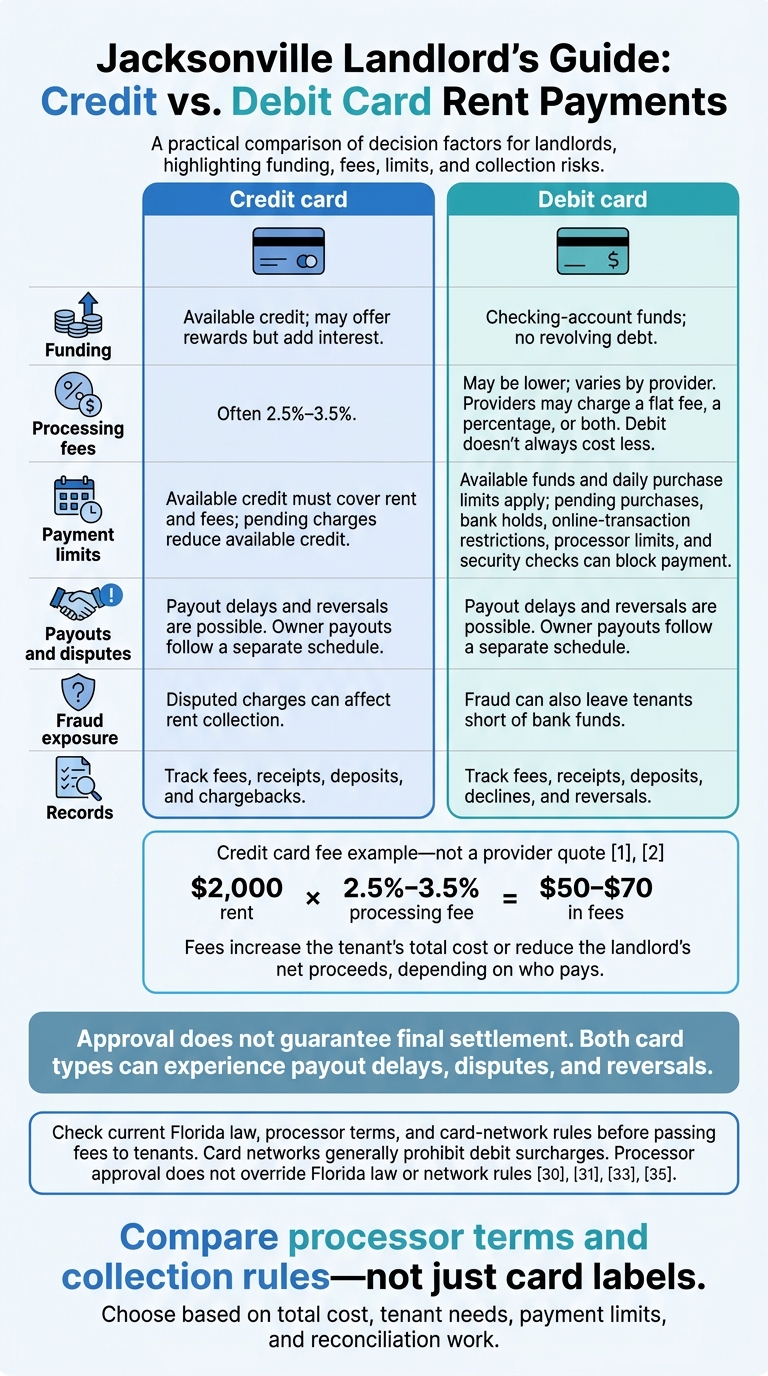
Debit cards often cost less; credit cards let tenants pay with borrowed funds. For Jacksonville landlords, the choice comes down to fees, payment limits, payout timing, and dispute risk. At a 2.5%–3.5% processing fee, a $2,000 credit card rent payment adds $50–$70.
Both card types create payment records, but approval does not guarantee a final deposit. Before accepting either, check processor terms, confirm which fees tenants can be charged, and set clear rules for failed payments and disputes.
Quick Comparison
| Factor | Credit card | Debit card |
|---|---|---|
| Funding | Available credit; may offer rewards but add interest | Checking-account funds; no revolving debt |
| Fees | Often 2.5%–3.5% | May be lower; varies by provider |
| Payment limits | Available credit must cover rent and fees | Available funds and daily purchase limits apply |
| Payouts and disputes | Payout delays and reversals are possible | Payout delays and reversals are possible |
| Fraud exposure | Disputed charges can affect rent collection | Fraud can also leave tenants short of bank funds |
| Fee rules | Check current Florida law and processor terms | Card networks generally prohibit debit surcharges |
| Records | Track fees, receipts, deposits, and chargebacks | Track fees, receipts, deposits, declines, and reversals |
The best fit is the option that keeps total costs and collection work in check while meeting tenant needs.
Credit vs. Debit Card Rent Payments
Credit Card Rent Payments: Pros and Cons
Tenant convenience can mean higher landlord costs. Credit cards can help tenants pay on time, but they also add processing costs and dispute risk for landlords.
Credit Card Fees, Rewards, and Interest
Processing fees either increase the tenant’s total rent cost or reduce the landlord’s net proceeds. Check who pays before turning on card payments.
At an illustrative 2.5%–3.5% processing fee, $2,000 in rent adds $50–$70.
Rewards may appeal to tenants, but they don’t offset the landlord’s processing fees. If the tenant carries a balance that accrues interest, rewards rarely justify the added rent cost.
Fees aren’t the only concern. Payments can also be reversed.
Credit Limits and Chargebacks
Tenants should check their available credit, not just the card’s stated limit. Pending charges reduce available credit, and the remaining amount must cover both rent and fees.
Approval does not guarantee final settlement. Payment, clearing, and owner payout happen at different times. Owner payouts follow a separate schedule.
Tenants can dispute unauthorized charges, and landlords may lose funds even after payment confirmation. Debit payments can also be disputed. Keep the lease, receipt, and tenant messages together so you can respond to chargebacks quickly.
sbb-itb-73b3b1a
Debit Card Rent Payments: Pros and Cons
Debit card rent payments pull money from a tenant’s checking account rather than revolving credit.
For landlords, the tradeoff is lower borrowing risk versus stricter funding and bank limits. Cost and available funds are the first things to check.
Debit Card Fees and Account Funds
Payment providers may charge a flat fee, a percentage, or both. Check the current debit-specific fee schedule and disclose the full cost to the tenant before they authorize payment. Debit doesn’t always cost less.
Tenants should check their available balance, not just their account balance. Pending purchases and bank holds can leave less money for rent and fees. Insufficient funds may trigger a decline. Depending on account settings, overdraft arrangements may let the payment go through but add bank fees.
Processor reviews and banking days can delay payouts. Even when enough money is available, bank rules can still block the payment.
Debit Limits, Declines, and Fraud
Having enough money doesn’t guarantee approval. Daily purchase limits, online-transaction restrictions, processor limits, and bank security checks can all block rent payments. Require tenants to confirm their limits before rent is due and use another approved payment method if a transaction fails, or consult a professional to choose the right property management company to handle these complexities.
Fraud can leave tenants short on rent while their bank investigates. Federal rules can limit liability for unauthorized transfers. According to the Consumer Financial Protection Bureau, reporting a lost or stolen debit card within two business days generally limits liability to no more than $50. Unauthorized transactions listed on a statement generally require notice within 60 days.
Tenants should contact their bank immediately, lock or replace the card, and tell their landlord if rent may be affected. Recovery depends on the facts and how soon the tenant reports the issue – not the card type.
Disputes can also lead to payment reversals. Receipts and timestamps help landlords respond to those disputes.
Credit vs. Debit: Which Fits Your Rental?
Choose a payment method based on your fee policy and collection workflow. Compare processor terms and collection rules – not just card labels.
| Decision factor | Credit card | Debit card |
|---|---|---|
| Lowest total cost | Usually higher because of processing fees; Florida restricts credit-card surcharges. | Often lower, though processor and network fees vary. |
| Tenant flexibility | Offers rewards and short-term cash flow, but may add interest. | Helps tenants budget from a checking account without borrowing. |
| Fraud control | Requires authentication and monitoring. | Requires similar controls; fraud directly affects bank funds. |
| Funding reliability | Payments can reverse after authorization. | Payments can decline because of insufficient funds or bank limits. |
| Recordkeeping burden | Requires payment records, including chargebacks. | Requires payment records, including declines and permitted returned-payment charges. |
Your lease execution and payment portal need to spell out how these choices work.
Fee Disclosures and Payment Rules
State the accepted payment methods, fee amount or formula, cutoffs, limits, authorization requirements, and steps to take after a decline.
Florida Statutes § 501.0117 restricts landlord-imposed credit-card surcharges. Check current legal and processor guidance before charging tenants. Visa and Mastercard generally prohibit debit surcharges, even when a transaction is processed without a PIN.
Processor approval does not override Florida law or network rules. Your payment records should also match the rules you publish.
Fraud Checks and Payment Records
- Use an encrypted portal, tokenized card storage, staff access controls, and multifactor protection where available.
- Check that the tenant is associated with the lease and has the cardholder’s permission. Flag mismatched names and repeated attempts.
- Track claims of card use without permission separately from disputes about duplicate charges, amounts, or fees.
- Keep authorization logs, receipts, fee disclosures, processor deductions, net deposits, declines, refunds, reversals, and chargebacks.
- Reconcile gross rent, fees, processor deductions, and net deposits.
Update the ledger after every adjustment. Payment confirmation does not prevent a reversal.
Tenant Preferences and Portfolio Needs
Ask tenants whether they prefer rewards and short-term flexibility or checking-account budgeting without borrowing. Accepting both card types may make payment easier, but keep fee disclosures, due dates, verification, receipts, and procedures for disputes and failed payments consistent.
For a single rental, use simpler reconciliation. For a portfolio, use unit-level reporting, staff permissions, and exception alerts.
A property manager such as 1 Realty Management can standardize rent collection and reporting across Jacksonville properties.
Conclusion: Choose Based on Collection Goals
Compare fees, declines, and dispute risk, then choose the card option that fits your collection goals, payment controls, and tenant needs. Offer both only if the gains outweigh processing costs, decline risk, and the work of reconciling payments.
Set a review date after implementation. Compare fees, failed payments, disputes, and net deposits received. Check how fraud controls, payment limits, and tenant habits affect results. Use the findings to see whether the method improves collection or adds work. Keep disclosures current, document fraud controls, and track each payment through to the bank deposit.
1 Realty Management provides Jacksonville rent collection, financial reporting, and lease administration. Ask which payment methods it supports, how it handles failed payments and disputes, and how those items and fees appear in the owner portal.
FAQs
How should I handle rent reversed after the due date?
Act promptly to protect your legal position. Apply any late fees allowed by your lease and Florida law, then prepare and deliver a formal 3-Day Notice to Pay or Vacate that meets Florida’s requirements. State the exact unpaid rent due, excluding late fees from the notice’s rent demand. Keep time-stamped records of the reversed payment and notice delivery in case you need to pursue eviction.
Can tenants split rent between credit and debit cards?
It depends on the tenant’s online payment portal and its settings. Most portals accept ACH bank transfers, credit cards, and debit cards, but some don’t let tenants split a single rent payment across payment methods.
Tenants should check their portal or ask their property manager whether they can split rent between credit and debit cards.
How can I tell if accepting cards improves rent collection?
Accepting card payments through an online portal lets tenants pay 24/7, helping them make regular, on-time payments. A digital ledger shows current balances and payment history in real time.
To check how well it’s working, look for steadier cash flow, fewer receipts to process by hand, and automated reports that help you spot overdue payments sooner. These signs point to less administrative work and a reliable payment record.