
Florida HOA boards must do more than approve a budget. Under Chapter 720, they must follow spending rules, track reserve funds, prepare financial reports, and generally provide access to requested records within 10 business days.
For 2026, boards should check the enacted law, effective dates, and governing documents before making financial decisions. The main duties cover:
- Budgets and assessments: Follow notice, approval, and voting rules.
- Contracts and payments: Check spending authority, bidding requirements, and conflicts of interest.
- Reserves and capital work: Calculate funding needs and obtain required votes before reducing funding or changing how reserves are used.
- Reports and records: Meet reporting deadlines, retain records, and follow inspection and website-posting rules.
For Jacksonville communities, that also means matching available funds to expected road, roof, and drainage work. Hiring a manager or accountant does not remove the board’s oversight duties.
Board Duties for Budgets, Assessments, and Spending
Overseeing association funds is a core part of the board’s fiduciary duty. Board approval alone does not authorize every expense. Under Section 720.303, directors should review reliable financial information, document expenditures, and prevent spending that falls outside the association’s authority. Chapter 617 applies only where relevant; Chapter 720 and the governing documents control HOA financial duties.
That work starts with the annual budget and the authority to collect assessments.
Annual Budgets and Assessment Approval
Section 720.303 requires an annual budget that states estimated revenues, operating expenses, and the estimated year-end surplus or deficit. It must also list fees or charges the association pays for recreational amenities separately.
Compare the proposed budget with prior-year results, contracts, insurance, utilities, maintenance, delinquencies, reserve funding, and planned capital work. Before adoption, check the statutory delivery deadline and any notice requirements in the governing documents.
The approved budget sets funding needs, but not every assessment requires an owner vote. Section 720.308 and the governing documents determine assessment authority, caps, and approval thresholds. Meeting notices should identify any assessment being considered. Special-assessment notices should state the purpose, amount, and payment schedule.
Once funding is set, the board must control how it commits and pays those funds.
Contracts, Payments, and Conflicts of Interest
Before approving spending, the board should confirm its authority, document its decisions, and address conflicts of interest. Under Section 720.3055, covered contracts and purchases generally must be in writing. Competitive bidding generally applies when payment exceeds 10% of the association’s total annual budget, including reserves.
The board does not have to choose the lowest bid, but it should record why it selected another proposal. Statutory exceptions include association employees and attorney, accountant, architect, community association manager, engineering, and landscape architect services.
Under Section 720.3033, disclose potential conflicts at least 14 days before the vote or contract. Disclosure does not replace requirements for abstention, review, or meeting minutes.
For each payment, confirm vendor approval, match the invoice to the contract and completed work, authorize payment, and retain supporting records. Back up those checks with dual approval, separate reconciliation, restricted bank access, prompt removal of former signers, and monthly variance reviews. Record material spending decisions and how conflicts were handled in the minutes.
These controls also need to account for the spending limits attached to each funding source.
Operating Funds, Reserves, and Special Assessments
| Funding category | Purpose | Authority | Supporting records | Spending restrictions |
|---|---|---|---|---|
| Operating funds | Insurance, utilities, maintenance, and administration | Approved annual budget, assessments, and governing documents | Budget, general ledger, invoices, contracts, and bank statements | Spend only for authorized association purposes and within applicable approval limits |
| Statutory or designated reserves | Capital expenditures and deferred maintenance | Section 720.303 reserve provisions, governing documents, and approved budget | Reserve schedule, component inventory, funding calculations, inspections, transfers, and project records | Do not use statutory reserves for other purposes except as permitted by statute, governing documents, or properly obtained owner approval |
| Special-assessment proceeds | A defined project, shortfall, or other authorized expense | Section 720.308, declaration, bylaws, budget authority, and assessment approval rules | Notices, resolution, assessment roll, collections, and invoices | Use for the stated purpose and follow any governing-document or approval limits |
A special assessment is a funding source – not a requirement to open a separate bank account. Track the money by project, and do not redirect reserves without the approval required by statute and the governing documents.
sbb-itb-73b3b1a
Reserve Funding and Capital Expenses
Establishing and Calculating Statutory Reserves
Under Section 720.303(6), an account’s reserve status depends on how it was created and whether the declaration, articles, bylaws, or contracts require it. Owners may elect fully funded statutory reserves with approval from a majority of the total voting interests at a meeting or by written consent where permitted.
Once statutory reserves exist, each budget must fund them unless owners approve a legally permitted reduction or waiver. Begin with the assets the HOA must maintain or replace. Calculate reserves by component or use a permitted pooled analysis. Either approach must account for estimated remaining useful life, replacement or deferred-maintenance costs, and available balances. Update estimates for inflation, investment earnings, and completed deferred maintenance, and show reserve contributions separately in the budget.
Full, Partial, and Waived Reserve Funding
The board must do more than calculate reserves. It must also document how owners approved the funding level. Each choice affects assessments, cash flow, and future capital work.
| Funding approach | Approval rule | Budget treatment | Disclosure and duration | Main financial risk |
|---|---|---|---|---|
| Full funding | Follow the statutory reserve process and governing documents. Owners may elect fully funded statutory reserves with approval from a majority of total voting interests at a meeting or by written consent where permitted. | Base contributions on the required asset analysis and projected replacement or deferred-maintenance costs. | Identify components and funding assumptions. Update calculations as estimates change. | Higher regular assessments, but less exposure to sudden funding gaps. |
| Partial funding | Once reserve accounts exist, members may approve funding below the statutory amount by majority vote at a meeting where a quorum is present. | Contribute less than the calculated amount and identify the resulting shortfall and assumptions. | A reserve reduction applies to only one budget year. | Lower current owner payments, but more exposure to accelerated deterioration, borrowing, or special assessments. |
| Waived funding | Members may approve no reserves or reduced reserves through the statutory voting process, subject to governing-document restrictions. | Omit or reduce contributions within governing-document and statutory limits. | A waiver or reduction applies to only one budget year. Use the required conspicuous financial-report disclosure when the budget does not fully fund capital-expenditure or deferred-maintenance reserves that could lead to a special assessment. | Greatest risk of large future assessments, cash-flow disruption, and delayed work. |
Required financial-report language distinguishes between unfunded capital needs, voluntary deferred-expenditure accounts, and reserves owners have not elected. Before presenting a funding vote, check the association’s quorum requirements, voting rules, governing documents, and developer-control status.
Before developer turnover, a developer-controlled association cannot use statutory reserves for unrelated purposes without approval from a majority of all nondeveloper voting interests. Those interests must vote in person or by limited proxy at a properly called meeting. Record the affected component, amount, motion, vote, and any repayment terms.
Capital Planning for Jacksonville Owners
Reserve rules come into focus when a roof, road, or drainage project is due. As part of the board’s fiduciary duty, reserve planning helps the association maintain common assets without sudden assessments.
Review the declaration’s maintenance duties alongside reserve balances, project dates, inspections, bids, warranties, and insurance coverage. For HOA-owned roads, drainage systems, roofs, and other assets, compare available cash with expected work – not just the account balance. Jacksonville weather makes up-to-date condition data critical. A funding shortfall does not remove the maintenance duty; it can mean higher assessments or a special assessment.
Rental owners should review the budget, reserve schedules, project calendar, and approved assessment notices before buying or renewing leases, then update their cash-flow forecasts. Chapter 720 does not require a condo-style structural integrity reserve study for every HOA. The reserve analysis depends on the association’s assets and governing documents.
Financial Reports and Owner Access to Records
2026 Florida HOA Financial Reporting Requirements
Once the board sets the budget and spends association funds, owners need a clear way to check where the money went.
Annual Financial Reports and Deadlines
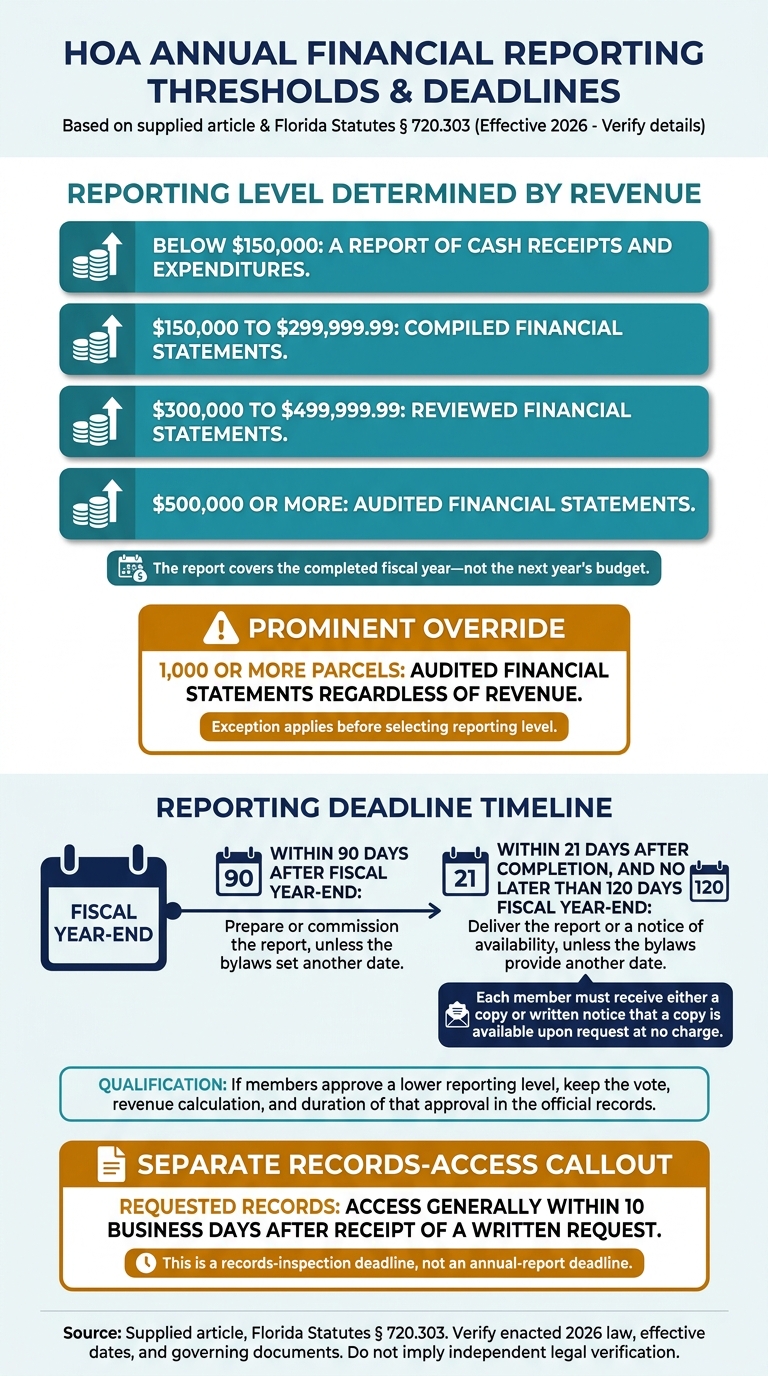
Section 720.303 sets financial reporting requirements based on gross annual revenue:
- Below $150,000: A report of cash receipts and expenditures.
- $150,000 to $299,999.99: Compiled financial statements.
- $300,000 to $499,999.99: Reviewed financial statements.
- $500,000 or more: Audited financial statements.
Associations with 1,000 or more parcels must prepare audited financial statements regardless of revenue. The report covers the completed fiscal year – not the next year’s budget.
Prepare or commission the report within 90 days after fiscal year-end, unless the bylaws set another date. Deliver the report or a notice of availability within 21 days after completion, and no later than 120 days after fiscal year-end, unless the bylaws provide another date. Each member must receive either a copy or written notice that a copy is available upon request at no charge.
If members approve a lower reporting level, keep the vote, revenue calculation, and duration of that approval in the official records.
Record Requests, Access Deadlines, and Exemptions
The annual report is a starting point. Owners may also inspect the supporting records to check how the association used its money.
Submit a written request that identifies the documents and date range. Access generally must be provided within 10 business days after receipt, at a location within 45 miles of the community or within the county.
The association should log receipt, review exemptions, redact protected information, arrange access, and keep proof that it fulfilled the request. Confirm permitted copying and production charges before billing. Late access can lead to statutory remedies, damages, and attorney fees, depending on the violation.
| Record category | Examples | Required handling |
|---|---|---|
| Generally inspectable | Budgets, annual financial reports, general ledgers, bank statements, reserve schedules, assessment ledgers, invoices, contracts, payment records, and board minutes discussing expenditures | Provide access when maintained as official records and covered by the request. |
| Inspectable with redactions | Assessment ledgers or invoices containing protected personal or payment information | Remove only protected information. Keep the original and document the basis for each redaction. |
| Exempt or restricted | Privileged attorney communications, certain personnel or personal information, and protected security records | Withhold only what the applicable exemption protects – not an entire financial file without justification. |
Record Retention and Website Posting Rules
Florida generally requires associations to keep official records for at least seven years. Before disposing of records, check governing documents and other applicable laws for longer or permanent retention requirements. Organize annual-report files so each reported total can be traced to its source records.
Online posting does not replace an owner’s right to inspect records.
Website or app posting is a separate duty. Current Florida law imposes posting requirements on associations with 100 or more parcels. Confirm the controlling 2026 text, access controls, and required documents.
Not every inspectable invoice, bank statement, or owner record must be posted online. Use protected member access, redact protected information where required, and fulfill inspection requests for records beyond those posted.
Conclusion: HOA Financial Compliance Checklist
Annual Workflow and Compliance Table
At the start of each fiscal year, check the current Chapter 720 text, effective amendments, and the association’s governing documents. Keep copies of the versions reviewed.
Use this checklist to track each duty, required record, and deadline.
| Duty | Statutory section | Responsible party | Required action | Supporting record | Deadline or review frequency | Possible consequence |
|---|---|---|---|---|---|---|
| Verify governing requirements | Chapter 720; § 720.303 | Board; counsel as needed | Check current Chapter 720 text, effective amendments, and governing documents. | Legal-update checklist; governing documents | Annually and when requirements change | Procedural defects; corrective costs |
| Approve budget and assessments | § 720.303(6); governing documents | Board; members when required | Adopt the annual budget and levy assessments under statutory and governing-document rules. | Budget worksheets; notices; minutes; assessment schedule | Annually; before applicable deadlines | Assessment disputes; cash shortfalls |
| Control contracts and payments | Chapter 720; governing documents; applicable conflict rules | Board; officers; manager | Record contract approval, payment review, and required disclosures. | Contracts; bids; disclosures; approvals; payment records | Before commitment or payment; monthly review recommended | Spending without approval; vendor disputes |
| Reconcile funds and monitor reserves | § 720.303(6); governing documents | Board; treasurer; accountant | Track operating and reserve activity separately and check that reserve use is permitted. | Reconciliations; reserve schedules; transfer approvals | Monthly reconciliation; quarterly reserve review | Errors; improper-use claims; funding pressure |
| Complete annual reporting | § 720.303(7) | Board; qualified preparer | Prepare or commission the required annual financial report. | Engagement letter; report | Within 90 days after fiscal year-end or by the bylaw date | Reporting disputes; corrective action |
| Preserve and provide records | § 720.303(4)–(5) | Association; records custodian | Retain official records and respond to access requests on time. | Records index; request and response log | Throughout the year; quarterly file checks recommended | Owner remedies; fee exposure |
Delegating work doesn’t remove the board’s oversight duties. Require a monthly board packet covering reconciliations, budget variances, unpaid invoices, reserve balances, and payments awaiting approval. Where practical, assign invoice approval, payment processing, and reconciliation to different people. Liability depends on the facts and applicable law.
If the checklist reveals a gap, review the records before it becomes a compliance problem.
Warning Signs and Legal Support
Undocumented transfers or payments, improper commingling, unexplained overruns, and delayed record access call for review – not an assumption of wrongdoing. Preserve the records, obtain an independent reconciliation, and document corrections.
Consult qualified Florida HOA counsel about disputed authority, conflicts, or access exemptions. Bring in an accountant for reporting issues or unexplained transactions.
FAQs
What if our HOA documents conflict with Florida law?
If your HOA documents conflict with Florida law, state law takes precedence. Provisions that try to waive or block rights, remedies, or requirements established by statute are generally void and unenforceable.
When your HOA’s rules set a lower standard than state law, the stricter state requirements apply – even if internal agreements or outdated governing documents say otherwise.
What can I do if my HOA denies financial records?
Start by reviewing the Florida statutes that govern your HOA’s financial records, including budgets, reserve accounts, and spending. Then send a formal written request to the board or property management that clearly identifies the documents you want to review.
If your HOA doesn’t respond or keeps denying access, consult an attorney who specializes in Florida HOA law. They can explain your rights and possible enforcement options.
Can board members be personally liable for misusing HOA funds?
Yes. Florida board members can face personal liability for misusing HOA funds. Their fiduciary duty requires them to act in the association’s best interests. Mismanaging funds or mixing association money with personal assets violates that duty. Keeping operating and reserve funds in separate accounts helps board members meet these obligations.
At 1 Realty Management, we prioritize transparent financial reporting and thorough account reconciliation to help track funds accurately, support compliance, and give owners financial oversight.