

I use Jacksonville ZIP data to plan rental ads – not to set rent by itself. Before spending, I compare similar properties, check total monthly costs, and record inquiries and days on market. The article’s three rent examples each represent just one undated listing, not a ZIP-wide average.
My approach comes down to four steps:
- Check the location and data. Confirm ZIP boundaries, then choose single-ZIP, grouped-ZIP, or citywide reporting based on the available inventory and leads.
- Describe what’s actually offered. Match the ad to the home, apartment, or private room, with clear fees, amenities, availability, and shared-space terms.
- Keep ads compliant. Follow fair housing and platform rules for both copy and audience settings.
- Measure signed leases – not just clicks. Track qualified leads, tours, applications, tenant screening results, vacancy costs, and leasing expenses, then fix where people drop off.
<u>My bottom line:</u> use local data to guide decisions, test one change at a time, and connect marketing results with leasing and monthly financial reports.
Plan Campaigns With Local Rental Data
Use the baseline rents and lead volume above to choose the narrowest campaign that can still deliver usable results.
Choose Single-ZIP, Grouped-ZIP, or Citywide Campaigns
Use ZIP codes to organize reporting – not to justify restricted targeting.
| Campaign structure | When to use it | Data needed | Limits |
|---|---|---|---|
| Single-ZIP | One ZIP has enough inventory and inquiries for meaningful testing | Inventory, comparable rents, and enough leads to judge performance | Small samples can mislead, and ZIP targeting may be restricted |
| Grouped-ZIP | Nearby ZIPs have similar rental markets | Comparable property types, rents, amenities, and geographic features | Group by market traits, not neighborhood demographics |
| Citywide | Local data is sparse or the property has broad appeal | Citywide inquiry patterns and property-level comparisons | Broader reach can make results less precise |
Write Local Listings and Set Test Budgets
Once you choose a campaign structure, match the listing copy and budget to the property’s actual market.
Mention access to I-95, I-10, or NAS Jacksonville only when it applies to the property. Don’t make commute-time claims you can’t support. Include bedrooms, square footage, parking, laundry, pet policy, utilities, rent, deposits, fees, and availability. Clearly distinguish washer/dryer hookups from included appliances, and list mandatory monthly charges alongside the rent.
Calculate cost per qualified lead by dividing ad spend by qualified inquiries. Test one variable at a time, such as the photo or headline, so you can tell what affected the results. Before increasing spend, fix maintenance or leasing issues that keep people from applying.
Before launch, confirm that the campaign’s copy and audience settings meet the rules.
Follow Fair Housing and Advertising Rules
Check federal, Florida, Jacksonville, and platform rules. Use the required housing ad category and include applicable Equal Housing Provider disclosures.
Review the copy and audience settings together. Use neutral property descriptions, and keep location details focused only on the property. Don’t use ZIP data, audience filters, or demographic proxies to favor or discourage protected groups. Apply the same screening criteria to every applicant.
sbb-itb-73b3b1a
Plan Ads by Rental Property Type
Once the campaign structure is set, match each ad to the property type. Use ZIP-level data to guide the message and choose the right details to highlight.
| Property type | Core features | ZIP-level research priorities | Property-specific listing details | Primary conversion metric |
|---|---|---|---|---|
| Single-family home | Yard, carports, storage | Similar detached homes, lot sizes, verified school assignments | Lawn-care and upkeep responsibilities | Lease-up time (days on market) |
| Multifamily units | Floor level, layout, renovations | Comparable units, transit access, ZIP-level vacancy rates | Floor level, A/C type, unit availability date | Lead-to-tour rate and tour-to-lease rate |
| Apartment complex | Floor plans, amenities, common areas | Occupancy trends and demand by unit type | Floor-plan availability, concession terms, maintenance access | Tour-to-lease rate |
| Private-room rentals | Private room, shared spaces | Local room demand and verified transportation access | Payment period, shared-space arrangements, house rules | Acquisition cost per newly occupied room |
Single-Family Homes
Compare the home with similar detached properties in the same ZIP—such as those found in Southside property management data—rather than citywide averages. Use photos to show the yard, parking, and storage.
Spell out total monthly cost, maintenance duties, and the pet policy. Verify school assignments, but don’t suggest that the home suits a particular household type.
Multifamily Units and Apartment Complexes
Group ads by building and floor plan. Use photos of the actual unit, and list its floor level, A/C type, and availability date. Share the full concession terms, not just the discounted price.
For apartment complexes, show the condition of common areas and explain maintenance access. Track results at both the unit and property level. Review lead-to-tour and tour-to-lease rates by property ZIP and unit type.
Private-room rentals and PadSplit housing
Label the listing as a private room, not a whole home. Explain the payment period, applicable utilities and fees, shared-space arrangements, and house rules. Verify transportation claims before publishing.
Track room occupancy, turnover, and cost per occupied room separately from whole-unit leases. Use these property-specific measures to assess leads, tours, and leases in the next section.
Measure Marketing Results and Leasing Costs
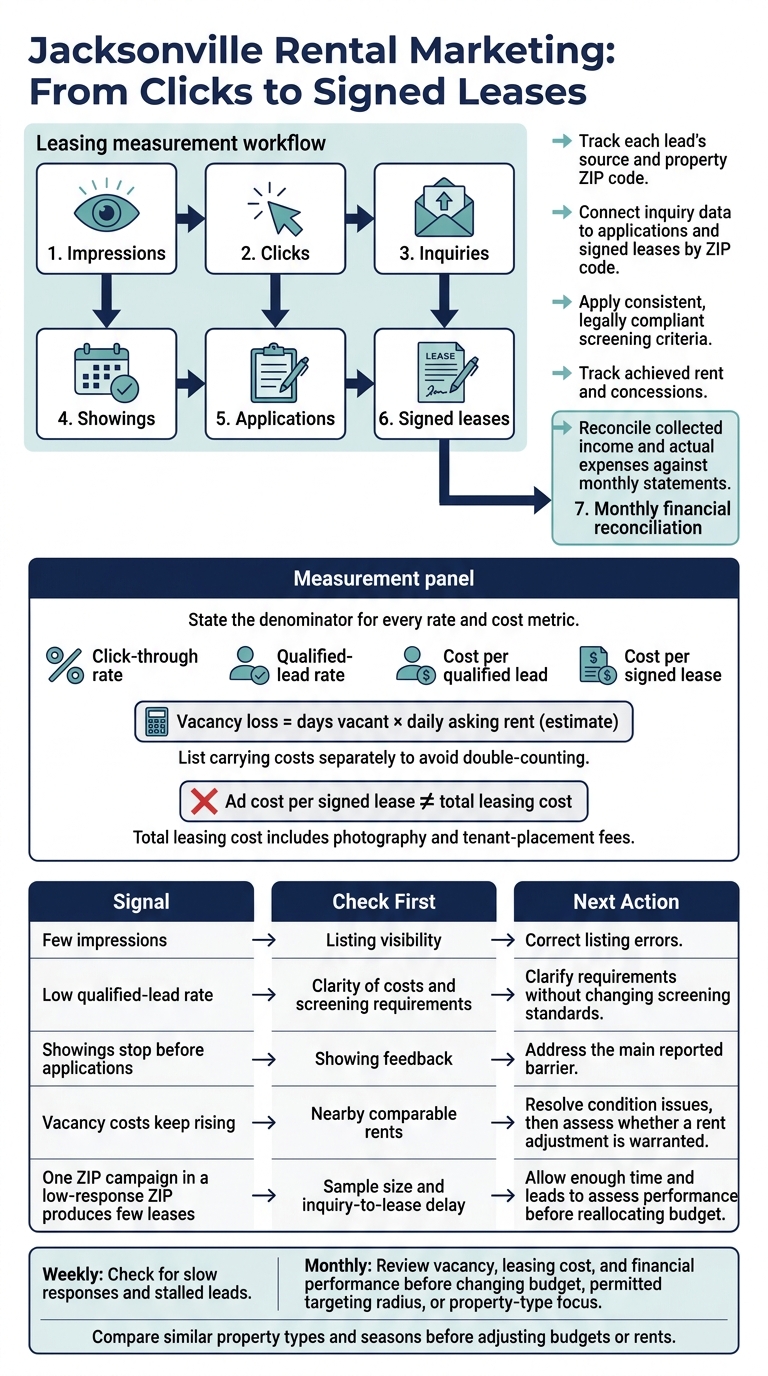
Jacksonville Rental Marketing: From Clicks to Signed Leases
After launch, use ZIP-level reporting to see which ads turn traffic into signed leases.
Track Leads and Leases by Property ZIP Code
Track each lead’s source and property ZIP code. Follow the path from impressions and clicks through inquiries, showings, applications, and signed leases. Apply consistent, legally compliant screening criteria, and connect inquiry data to applications and signed leases by ZIP code.
State the denominator for every rate and cost metric, including click-through rate, qualified-lead rate, cost per qualified lead, and cost per signed lease. Keep ad cost per signed lease separate from total leasing cost, which includes photography and tenant-placement fees.
Track achieved rent and concessions, then reconcile collected income and actual expenses against monthly statements. Estimate vacancy loss as days vacant × daily asking rent. List carrying costs separately to avoid double-counting.
Use Results to Guide Campaign Changes
Check campaigns weekly for slow responses and stalled leads. Review vacancy, leasing cost, and financial performance monthly before changing the budget, permitted targeting radius, or property-type focus. Compare similar property types and seasons before adjusting budgets or rents.
Use these signals to check whether the issue is visibility, qualification, follow-up, or property condition.
| Signal | Check first | Next action |
|---|---|---|
| Few impressions | Listing visibility | Correct listing errors. |
| Low qualified-lead rate | Clarity of costs and screening requirements | Clarify requirements without changing screening standards. |
| Showings stop before applications | Showing feedback | Address the main reported barrier. |
| Vacancy costs keep rising | Nearby comparable rents | Resolve condition issues, then assess whether a rent adjustment is warranted. |
| One ZIP campaign in a low-response ZIP produces few leases | Sample size and inquiry-to-lease delay | Allow enough time and leads to assess performance before reallocating budget. |
Coordinate Leasing With 1 Realty Management
When reporting needs to feed into leasing and monthly statements, use 1 Realty Management to connect marketing reports with showing feedback, screening outcomes, lease execution, and monthly financial reporting. Its services include tenant placement, rent-ready services, maintenance, rent collection, and financial reporting. Discuss property-specific services and fees so marketing and leasing stay aligned.
Conclusion: Jacksonville Rental Marketing Checklist
Use the metrics above for your final pre-launch check. Compare current data from similar properties – not citywide averages or outdated figures.
Set a baseline, then use ZIP data to choose a single-ZIP, grouped-ZIP, or citywide campaign. Keep every ad fair-housing compliant and match the details to the property type: private amenities for homes, unit details for apartments, and clear utility terms for rent-per-room housing.
Measure results by qualified leads and signed leases. Then adjust your follow-up, budget, or copy based on where prospects get stuck. Local data and fair-housing compliance matter more than ZIP targeting alone. ZIP codes support permitted targeting and reporting; they don’t replace property-level judgment.
FAQs
How many leads do I need before comparing Jacksonville ZIP codes?
There’s no fixed minimum number of leads you need to compare Jacksonville ZIP codes. Instead, track vacancy days, tour-to-lease conversion rates, and lead response times.
Compare these metrics across ZIP codes to see which submarkets perform well and where you may need to adjust pricing or marketing tactics.
How can I market locally when ZIP targeting is restricted?
Focus on hyper-local SEO and neighborhood-specific content. Claim your Google Business Profile, and keep your business name, address, and phone number consistent across directories. Use Jacksonville neighborhood names, such as San Marco or Southpoint, on your website and in your listings.
You can also reach nearby renters with broader geo-targeting. Try targeting a 10-mile radius around landmarks or business hubs to connect with renters who may be ready to tour.
How should I split my ad budget across rental types?
Let property type and market demand guide your budget – not fixed percentages. Jacksonville’s single-family homes are in high demand, while new apartment construction adds competition for multi-family units.
Track vacancy days and tour-to-lease rates to see which properties need more support. Put more money into social ads and digital tools for units with higher vacancy. In established neighborhoods like Mandarin or Arlington, focus on local search visibility to bring in lower-cost organic leads.