
I’d build a Jacksonville repair budget around the property’s condition – not a percentage alone. Start with 1%–2% of property value or 8%–12% of annual gross rent, then check that estimate against inspections, system ages, and the past 2–3 years of invoices.
Here’s how I’d turn that estimate into a funding plan:
- Separate the costs: Routine repairs, tenant turnovers, and major replacements need their own targets. Keep emergency cash separate, too.
- Match the property: Budget for each home or unit, but fund shared roofs, plumbing, and other building systems only once.
- Plan for Jacksonville weather: Allow for humidity-related problems, storm response, insurance deductibles, and payment delays.
- Fund and track monthly: Divide annual targets by 12, record invoices once, and fund reserve shortfalls before owner payouts.
- Review the numbers: Update replacement dates, quotes, and cash targets after inspections or major repairs – and at least annually.
My rule: <u>money set aside for a future roof is not spare emergency cash.</u> Keep both funded, and confirm permit requirements and tax treatment before treating every job as a routine repair.
Plan for Scheduled and Unexpected Jacksonville Repairs
Once you set your annual target, divide the expenses by when they’re likely to hit: scheduled, seasonal, or unexpected.
Compare Contracted Services, Scheduled Work, and Failures
Split repair costs by both timing and risk. Landscaping, pest control, HVAC service, and gutter cleaning are predictable only within the contract’s scope. Damaged parts, access problems, and extra visits can increase the bill.
Review renewal terms, extra-visit fees, and exclusions. Get updated Jacksonville quotes each year rather than relying on an unsupported inflation percentage.
| Expense type | Expected timing | Cost certainty | Budget treatment | Operating or capital classification |
|---|---|---|---|---|
| Landscaping and pest-control contracts | Contracted visits | High within scope and term | Monthly operating budget; add termite inspections if needed | Usually operating |
| HVAC tune-ups | Annual or seasonal, before peak cooling demand | Moderate; parts cost extra | Scheduled maintenance plus repair allowance | Operating |
| Gutter cleaning | Seasonal; after heavy storms or leaf buildup | Moderate; access and debris affect cost | Preventive maintenance | Cleaning: operating; major replacement: potentially capital |
| Turnover work | Between tenants | Variable until move-out inspection | Turnover funding | Cleaning and repairs: usually operating; improvements: potentially capital |
| Unexpected HVAC failure | Unscheduled | Low until diagnosis | Emergency cash; replacement reserve if needed | Repair: usually operating; replacement: generally capital |
| Plumbing or sewer failure | Unscheduled | Low; hidden damage can increase the scope | Emergency cash | Repair: usually operating; qualifying system replacement: capital |
| Electrical failure | Unscheduled | Variable by diagnosis and scope | Emergency cash for safety work | Repair: usually operating; major replacement: potentially capital |
| Storm damage | After severe weather | Low | Storm-response reserve and deductible funding | Minor repairs: usually operating; qualifying replacements: capital |
Urgency doesn’t determine tax treatment. Classify the work based on what was repaired or replaced, then confirm with your tax professional. Before approving work, verify permit requirements with Jacksonville’s Building Inspection Division, which provides permit and inspection services.
Budget for Heat, Humidity, Storms, and Aging Systems
National Weather Service climate material reports Jacksonville’s 1991–2020 average relative humidity at 71%. Schedule HVAC checks before peak cooling season, including condensate lines, pans, pumps, filters, and insulation. If stains or odors keep returning, trace them to the source.
Inspect drainage, exhaust ventilation, and exterior seals. Set termite-inspection timing based on treatment warranties and professional recommendations. At coastal or salt-exposed properties, check exterior metal components, fasteners, HVAC equipment, railings, and condensers for corrosion.
Jacksonville weather can turn routine repairs into urgent work. Keep a storm-response reserve available for tarping, water extraction, debris removal, and overtime labor. Review hurricane deductibles, limits, exclusions, ordinance-or-law coverage, and loss-of-rents coverage. Convert percentage deductibles into dollars using the insured structure limit – not the repair invoice. Also budget for uncovered costs and claim delays. Set vendor contacts and authorization limits before storms, and save damage photos and mitigation invoices. Professional property management in Jacksonville can help coordinate these emergency responses and vendor relationships.
Review 24–36 months of work orders to spot repeat failures by system, location, cause, and cost. Pair those records with inspection reports, contractor proposals, equipment dates, insurance declarations, permits, and current Jacksonville quotes.
Repeated condensate blockages call for a corrective plan and a larger near-term repair allowance. Roof deterioration calls for replacement planning and water-intrusion reserves. Jacksonville permit records can help verify earlier projects, but the property’s current condition should drive the budget.
Repeat failures show where to increase funding, not just where to make another repair. Use those patterns to determine how much cash each property type needs to keep monthly spending steady, then set replacement reserves and emergency cash in the next section.
sbb-itb-73b3b1a
Set Replacement and Emergency Reserve Targets
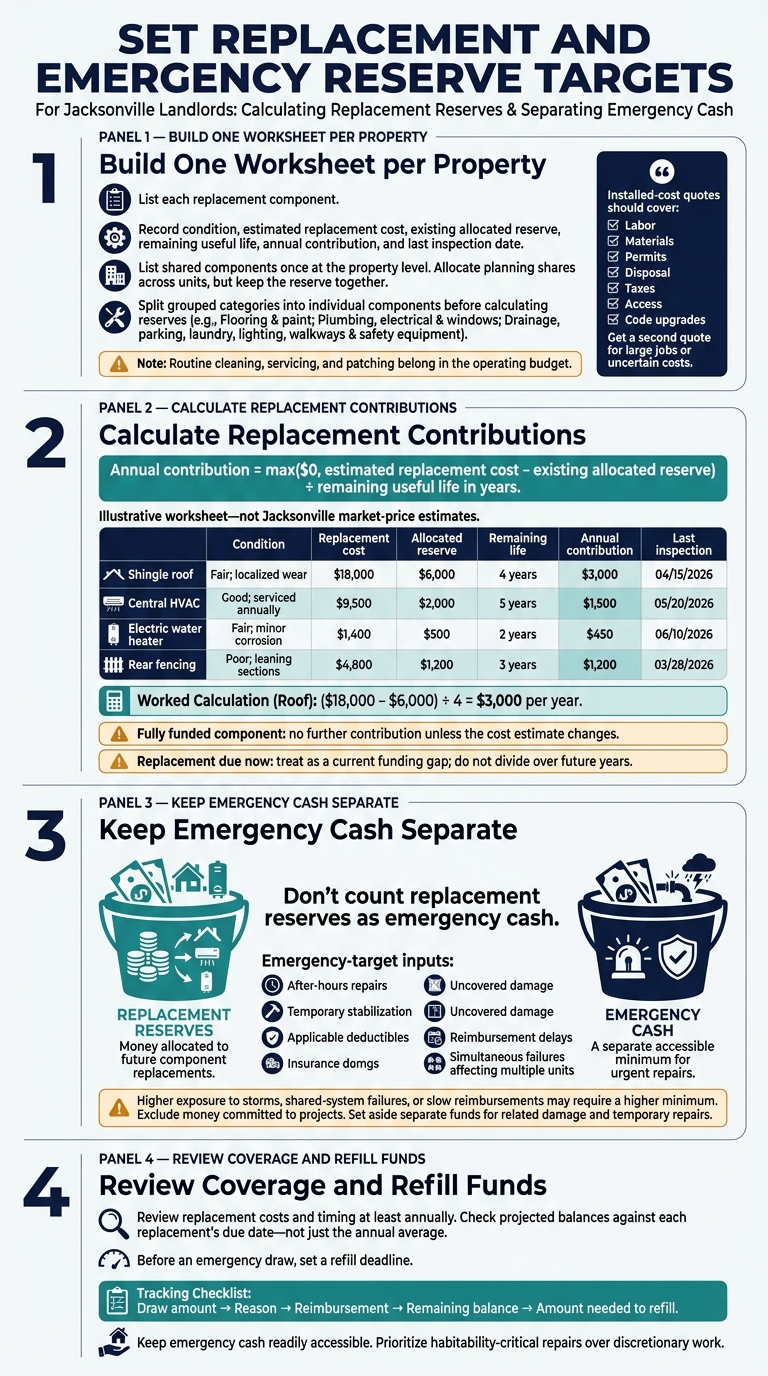
Jacksonville Repair Reserves: Calculate and Separate Your Funds
Use the repeat-failure patterns from the prior section to set reserve targets.
Build a Component Reserve Worksheet
Build property-level replacement and emergency targets using the reserve buckets from the introduction. Keep one worksheet per property. For duplexes and small multifamily buildings, list shared components once at the property level. Estimate remaining useful life using inspection findings, maintenance history, and current condition.
Example reserve worksheet
Component Condition Estimated replacement cost Existing allocated reserve Remaining useful life Annual contribution Last inspection date Shingle roof Fair; localized wear $18,000 $6,000 4 years $3,000 04/15/2026 Central HVAC Good; serviced annually $9,500 $2,000 5 years $1,500 05/20/2026 Electric water heater Fair; minor corrosion $1,400 $500 2 years $450 06/10/2026 Rear fencing Poor; leaning sections $4,800 $1,200 3 years $1,200 03/28/2026 Interior finishes: flooring and paint Record condition by scope Installed quote Allocated balance Estimated years Apply formula below MM/DD/YYYY Building systems: plumbing, electrical, and windows Record condition by component Installed quote Allocated balance Estimated years Apply formula below MM/DD/YYYY Shared site features: drainage, parking, laundry, lighting, walkways, and safety equipment Record condition by component Installed quote Allocated balance Estimated years Apply formula below MM/DD/YYYY
For replacements coming due soon, get an installed-cost quote covering labor, materials, permits, disposal, taxes, access, and code upgrades. Get a second quote for large jobs or work with uncertain costs.
Split grouped categories into separate component rows when calculating reserves, especially for expensive items or those prone to failure. Routine cleaning, servicing, and patching belong in the operating budget, not the replacement allowance.
Calculate Annual Replacement Contributions
Annual contribution = max($0, estimated replacement cost − existing allocated reserve) ÷ remaining useful life in years.
A fully funded component needs no further contribution unless its cost estimate changes. If replacement is due now, treat it as a current funding gap – don’t spread the cost over future years.
For duplexes and small apartment buildings, calculate shared-component contributions at the property level. Then allocate planning shares across units, but keep the reserve together.
Review costs and timing at least annually. Check that projected balances will cover each replacement when it’s due; meeting an annual average isn’t enough. Use these projections to set the monthly transfers in the next section.
Set a Minimum Emergency Cash Balance
Base the minimum on urgent costs and payment timing. Account for after-hours repairs, temporary stabilization, applicable deductibles, uncovered damage, and reimbursement delays.
Also consider events that could happen together, especially when shared plumbing or electrical systems serve several units. Set a higher minimum for properties exposed to storms, shared-system failures, or slow reimbursements.
Track total liquid funds, exclude money committed to projects, and maintain a separate minimum for urgent repairs. Don’t count replacement reserves as emergency cash. Set aside separate funds for related damage and temporary repairs.
Before using emergency funds, set a refill deadline. Record each draw, its reason, any reimbursement, the remaining balance, and the amount needed to refill the fund. Keep the cash readily accessible, and put habitability-critical repairs ahead of discretionary work.
Use the reserve targets to schedule monthly funding and compare actual spending against the budget.
Fund Repair Reserves and Track Cash Flow
Schedule Transfers and Compare Budget to Actual Costs
Once you’ve set reserve targets, fund any shortfall before making owner distributions. To calculate cash available to distribute, subtract operating expenses, management fees, debt payments, reserve contributions, and approved but unpaid maintenance from collected rent.
Treat transfers between operating and reserve accounts as internal cash movements. Record each vendor invoice only once, and confirm its tax treatment with a tax professional.
Update Budget Targets After Repairs and Inspections
After each inspection or major repair, update the remaining useful life estimates and reserve refill schedule. Adjust funding when repairs recur, vendor prices change materially, storms cause damage, or reserves drop below the minimum cash balance.
Budget Tracking With 1 Realty Management
Outsourcing management doesn’t change these cash-flow controls. If 1 Realty Management manages the property, require monthly reports that separately show paid repairs, reserve transfers, open work orders, committed costs, owner contributions, and distributions.
Conclusion: Review and Fund Your Budget Each Year
Budget by property type, not a one-size-fits-all percentage. Add to replacement reserves monthly and maintain a minimum emergency balance to avoid cash-flow spikes. A year with few repairs doesn’t mean future costs will stay low. Low spending may simply reflect postponed work. Before cutting funding, check the property’s condition and its exposure to Jacksonville’s weather. Use those findings to adjust next year’s budget.
Each year, review the past 12 months of invoices and inspect property systems. Get updated quotes for work due in the next 1–3 years, then revise replacement dates and monthly transfers to keep repairs funded and cash flow steady.
FAQs
How do I budget repairs for a newly purchased rental?
For a rental property in Jacksonville, budget 1% to 3% of the property’s value each year for maintenance and emergencies. Set aside another $100 per unit each month for unexpected repairs. If you’re a first-time landlord, keep $5,000 to $10,000 in cash reserves for immediate repairs or upgrades.
For tax purposes, separate routine repairs from capital expenditures. Routine repairs are fully tax-deductible in the year they occur, while capital expenditures must be depreciated over 27.5 years.
What if rent doesn’t cover my repair reserve targets?
Review your property’s net operating income, factoring in property taxes, insurance, maintenance, and management fees. If your reserves keep falling short, consider adjusting rent at lease renewal to match market trends.
Keep a separate repair reserve to cover unexpected repairs without straining cash flow. For first-time landlords, aim for $5,000 to $10,000. 1 Realty Management can help with financial reporting and maintenance coordination.
How do I prioritize repairs across multiple units?
Put safety first, followed by habitability and functionality. Handle immediate risks, such as electrical hazards, before other repairs. Then fix HVAC, plumbing, and appliances to meet Florida habitability requirements. Save cosmetic repairs and non-urgent maintenance for later.
Keep a separate profit and loss statement for each property. Use a digital maintenance log or property management software to track recurring issues before they turn into bigger, more expensive problems.