If I want to change rent in Jacksonville, I need to follow the lease, give written notice on time, and avoid any move that looks like retaliation or discrimination.
Here’s the short version:
- Jacksonville has no local rent cap , particularly in high-demand areas like the Southside rental market
- Florida does not set a percentage limit on rent changes
- Fixed-term leases usually lock rent in until the lease ends
- Month-to-month tenancies need at least 30 days’ written notice
- Notice timing runs from the end of the rental period
- The notice should clearly state the current rent, new rent, address, tenant names, and start date
- A legal rent change can still be illegal if it targets a tenant for complaints, repairs, or protected-status reasons
That means the main rule is simple: I can’t change rent whenever I want just because there’s no cap. I have to check the lease first, match the notice period to the tenancy type, and keep records that show the decision was based on market data, taxes, insurance, or upkeep costs.
A few dates and numbers matter most:
- 30 days: minimum written notice for month-to-month tenancies in Florida since January 2024
- 7 days: week-to-week notice
- 30 days: quarter-to-quarter notice
- 60 days: year-to-year notice
- $0 statewide cap: Florida has no set percentage limit on rent changes
If I’m dealing with a fixed lease and there’s no escalation clause, a mid-lease rent change is usually not allowed unless both sides agree in writing. If the tenant is periodic, the change can start only with proper written notice for the next rental period.
| Situation | What I need to do |
|---|---|
| Fixed-term lease | Wait until renewal unless the lease allows a mid-term change |
| Month-to-month | Give at least 30 days’ written notice |
| Recent tenant complaint or repair issue | Stop and check for retaliation risk |
| Similar units, different pricing | Keep written business reasons in the file |
Bottom line: I should treat rent changes like a legal process, not just a pricing decision. That means lease review, correct notice, clean records, and the same standards across similar tenants.
Jacksonville And Florida Rent Adjustment Rules Explained
Jacksonville property management experts know that rent increases come down to two things: there’s no local rent cap, and the lease plus Florida law decide when a change can happen.
No Rent Control In Jacksonville
Florida has no statewide rent control and no statutory percentage cap on rent increases. State law also preempts cities and counties from creating local rent control ordinances, so Jacksonville cannot impose its own rent caps. Put simply, Florida does not cap how much a landlord can increase rent. What it does control is notice and timing.
That brings the focus to when an increase can take effect, because that’s where the lease starts to matter.
Florida Law And The Lease Set The Rules
Once the rent cap issue is off the table, the lease becomes the main guide for whether rent can change before renewal. A fixed-term lease generally locks in the rent for the full term unless it contains a specific escalation clause. If the tenancy is periodic, Florida Statute §83.57 governs changes in terms, which means a rent increase has to follow the right notice rules for that tenancy type.
This is where landlords often get into trouble. Most legal exposure comes from:
- late notice
- the wrong notice format
- a mid-lease increase with no lease authority
After the lease rules are clear, the next step is checking when a rent increase is legally allowed.
sbb-itb-73b3b1a
When Rent Can And Cannot Be Increased
Timing errors often make a rent increase unenforceable. Once you know what the lease allows, the next issue is when the new rent can start.
Fixed-Term Leases Generally Block Mid-Lease Increases
If a tenant is in an active fixed-term lease, the rent is locked for the full lease term unless the lease has a specific escalation clause or both sides sign a written amendment that allows the change. If neither one exists, the landlord has to wait until renewal.
That timing piece matters more than many people think. Some leases require 30 to 60 days’ notice before the lease ends if the landlord wants to set new rent or offer renewal terms. And there’s an important difference here: a renewal creates a new lease with new terms, while an extension keeps the current lease terms in place.
After the timing is lined up, the notice still has to satisfy Florida’s written-notice rules.
Month-To-Month And Periodic Tenancies Allow Changes With Proper Notice
For month-to-month tenants, a rent increase is treated as a change in terms for the next rental period. As of January 2024, Florida law increased the minimum written notice period for changing terms or ending a month-to-month tenancy from 15 days to at least 30 days.
This is where landlords can trip up. Miss the renewal window, and you may end up with an unintended month-to-month tenancy. That shifts both the notice rule and the date when the new rent can begin.
| Tenancy Type | Minimum Notice for Rent Increase | Key Action Before Serving Notice |
|---|---|---|
| Fixed-Term Lease | By the notice deadline in the lease | Review escalation clauses and renewal dates |
| Month-To-Month | At least 30 days | Confirm the effective date lines up with the next rental period |
| Mid-Lease (Fixed, No Clause) | Not permitted | Wait for renewal or negotiate a signed written amendment |
Once the timing is set, the next step is serving a written notice that matches Florida’s rules.
Written Notice Requirements For Rent Increases In Jacksonville
After you’ve got the timing right, the notice still has to follow Florida’s written rules. A rent increase counts only when the notice is in writing, delivered on time, and clearly gives the effective date. If even one of those pieces is missing, the increase may not be enforceable under Florida law.
Notice Periods By Tenancy Type
The minimum notice period depends on the tenancy type. Match the notice period to the rental arrangement before sending anything out.
| Tenancy Type | Required Notice Period | When Notice Must Be Given | When New Rent Can Begin |
|---|---|---|---|
| Week-to-Week | 7 days | At least 7 days before the end of any weekly period | Start of the next weekly period |
| Month-to-Month | 30 days | At least 30 days before the end of any monthly period | Start of the next monthly period |
| Quarter-to-Quarter | 30 days | At least 30 days before the end of any quarterly period | Start of the next quarterly period |
| Year-to-Year | 60 days | At least 60 days before the end of the annual period | Start of the next annual period |
One part that often trips landlords up: the notice window is counted back from the end of the current rental period, not from the next day rent is due. That sounds like a small difference, but it can throw off the whole notice if you get it wrong.
What To Include In A Rent Increase Notice
A rent increase notice should list the current rent, the new rent, the effective date, the property address, and the names of all tenants on the lease. It should also say whether the increase applies to a lease renewal or to an existing periodic tenancy.
Florida also allows a few delivery methods. You can use:
- Hand delivery
- Posting at the property
- Authorized email
Whatever method you use, keep proof that the notice was delivered.
Once the notice is in good shape, the next issue is whether the increase could be viewed as retaliatory or discriminatory.
How To Avoid Illegal Rent Increases
A rent increase can still be illegal even if the timing looks fine. The big issue is why the rent went up.
Retaliation And Fair Housing Violations
Florida law does not let landlords increase rent because a tenant used their legal rights. That covers things like reporting needed repairs using a rental property maintenance checklist, speaking up about bad property conditions, contacting code enforcement, or joining a tenant union. If rent goes up soon after one of those actions, that can lead to a retaliation claim.
Fair Housing adds another risk. Rent increases need to be handled the same way across similar units and tenants. If one tenant in a comparable unit gets charged more than another and there is no written business reason for the difference, that can look like illegal discrimination based on race, religion, family status, or another protected class. The issue is not only whether the increase is allowed at that point in time. It is also whether the landlord can show that the decision was based on business facts, not bias or pressure.
Here’s where the legal risk usually falls:
| Type of Increase | Characteristics | Legal Risk Level | Compliance Step |
|---|---|---|---|
| Market-Based | Aligned with local Jacksonville rental data and rising costs | Low | Document market comps and cost increases in the tenant file |
| Cost-Based | Driven by higher property taxes, insurance, or maintenance costs | Low | Keep receipts, tax bills, and insurance renewal notices as proof |
| Retaliatory | Issued shortly after a tenant complaint or repair request | High | Illegal. Ensure all repair requests are resolved before proposing an increase |
| Discriminatory | Applied inconsistently across tenants of different protected classes | High | Illegal. Apply a uniform increase formula across all similar units in the portfolio |
Documenting A Legitimate Business Reason For The Increase
Proper notice is only part of the job. A landlord also needs a reason they can back up.
Before sending notice, document the basis for the increase with market comps, tax bills, insurance renewals, and maintenance records. Many landlords make this simpler by using the same formula for all renewals, tied to operating costs or local market movement. That helps show the decision was objective and easier to defend if someone pushes back.
Using a rent increase to pressure a tenant to leave, instead of using the formal eviction process, can backfire in a big way. It can lead to major liability, including damages of up to three times the monthly rent. Those records also set up the compliance checklist that follows.
A Rent Adjustment Compliance Workflow For Jacksonville Landlords
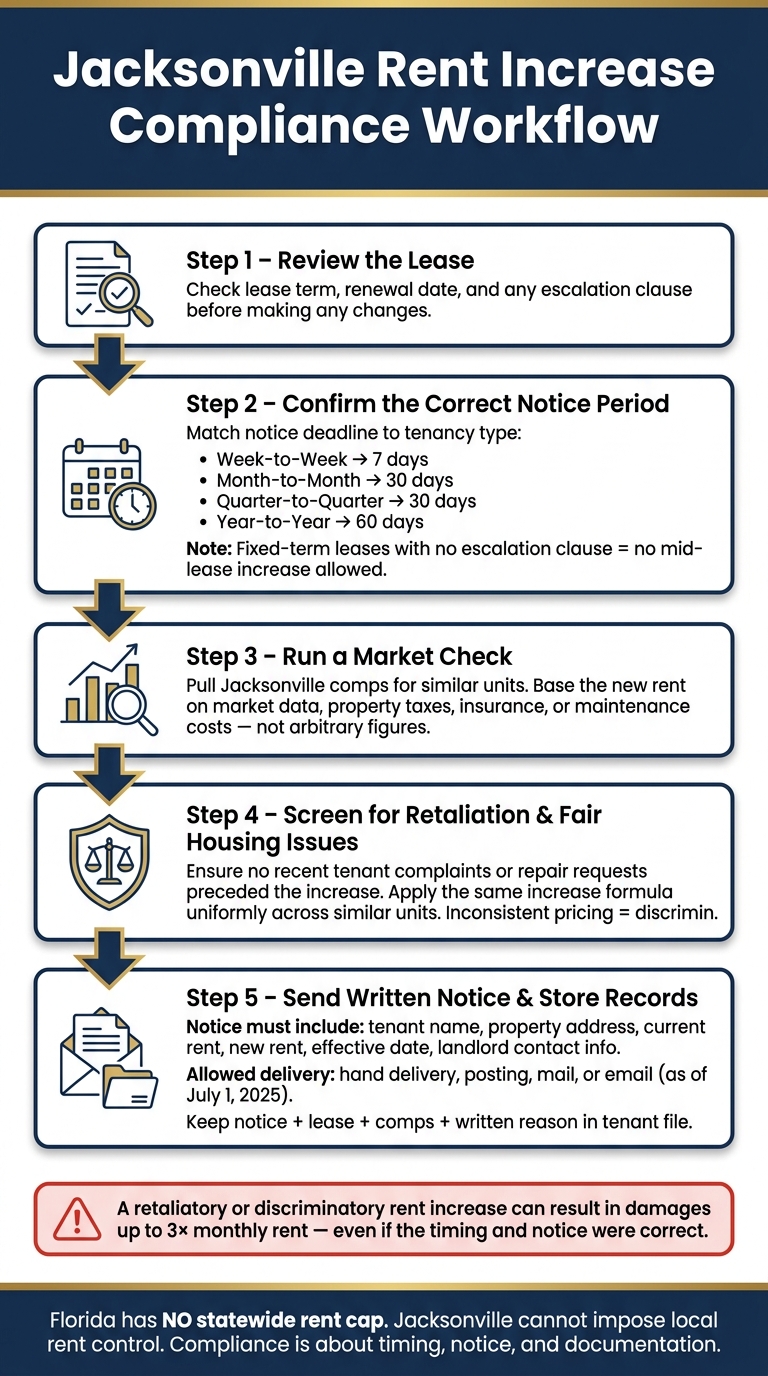
Jacksonville Rent Increase Compliance Checklist for Landlords
A simple workflow helps Jacksonville landlords handle rent changes in the right order. The goal is pretty plain: check the lease, verify timing, set the new rent with local data, and keep a paper trail.
Step-By-Step Rent Adjustment Checklist
- Review the lease
Check the lease term, renewal date, and any escalation clause. This is the first place to look before you change anything.
- Confirm the correct notice period
Make sure the notice deadline is correct before sending any increase. Once the timing is set, you can move to the rent amount using current market data.
- Run a market check
Look at Jacksonville comps for similar units before setting the new rent. That gives you a rent figure that matches the market instead of a number pulled out of thin air.
- Screen for retaliation and Fair Housing issues
Base rent increases on payment history, property condition, and lease compliance. Use the same process for similar units so your approach stays even and well documented.
- Send written notice and store the records
Once the amount is set, serve notice and keep proof in the file. The written notice should include the tenant name, property address, new rent, effective date, and landlord contact info. Florida law allows email notice as of July 1, 2025. Keep the notice with the lease, comps, and written reason.
FAQs
What happens if I give rent increase notice late?
Giving rent increase notice late can trigger legal and money problems fast. If you miss the written notice deadline required by your lease or Florida law, you may lose your chance to increase the rent and open the door to disputes with the tenant.
The impact can go beyond a delayed increase. Based on your lease terms, you may have to keep the current rent for another lease period. In some cases, you could even end up creating a month-to-month tenancy by accident.
That’s why it’s smart to check your lease first and confirm the exact notice deadline before sending anything.
Can a tenant reject a rent increase in Jacksonville?
No. In Florida, landlords can legally increase rent when a lease comes up for renewal.
If the tenant doesn’t agree to the new amount and won’t renew under those terms, the landlord isn’t required to offer a new lease.
What happens next depends on the setup. The landlord may:
- send a non-renewal notice, or
- let the tenancy continue on a month-to-month basis, as long as Florida notice rules are followed.
How can I prove a rent increase is not retaliatory?
Show that the increase is based on objective, non-discriminatory criteria. In plain terms, you should be able to point to clear facts behind the new rent. Keep solid records, like current Jacksonville market data and a comparable rent analysis, so you can show the change reflects market conditions across the area, not anything tied to a tenant’s behavior.
It also helps to apply the same rent increase policies across your properties. That creates a clean paper trail and gives you a stronger record if someone pushes back. If a dispute comes up, consult an attorney to make sure your actions are well supported and comply with the law.