
If you’re a rental property owner in Jacksonville, understanding property management fees is crucial. Here’s a quick breakdown of what you can expect:
- Monthly Management Fees: Typically 8%–12% of the monthly rent. For a $1,500 rental, that’s $120–$180 per month. Flat fees ($150–$300/month) are also common, especially for higher-rent properties.
- Leasing Fees: Charged for placing new tenants, usually 50%–100% of the first month’s rent. For a $1,500 rental, this could range from $750–$1,500.
- Lease Renewal Fees: When tenants renew, expect fees between $200 and $1,000, or 25% of one month’s rent.
- Additional Fees: Watch out for maintenance markups (10% of repair costs), setup fees ($200–$500), and eviction/legal fees.
Factors like property type, location, and service level can influence costs. Coastal properties or historic homes often require higher maintenance, while flat-fee models may save money for high-rent properties. Always review contracts carefully to avoid hidden charges.
Understanding these fees helps you budget effectively and choose a property manager who aligns with your financial goals.
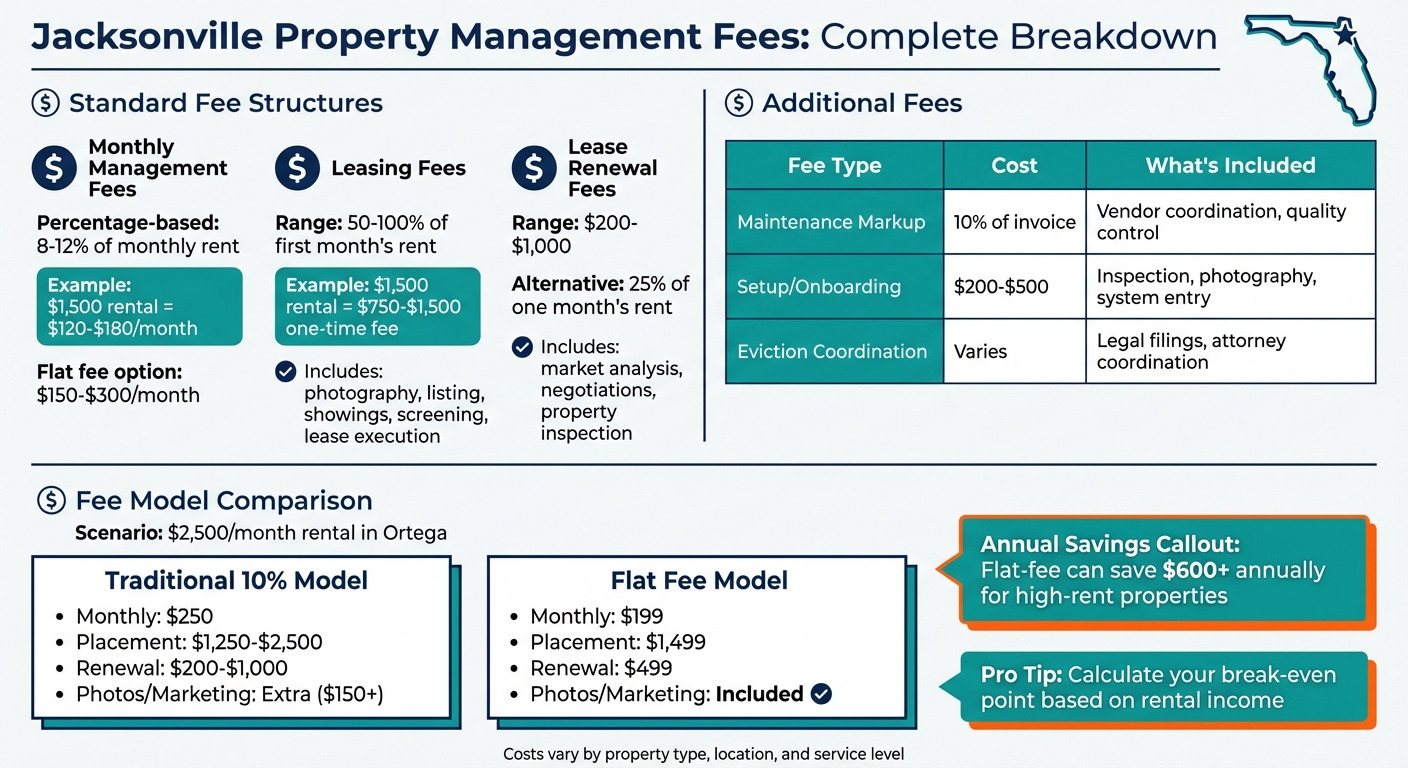
Jacksonville Property Management Fees Breakdown and Comparison Guide
Standard Property Management Fee Structures
Most property management companies in Jacksonville rely on three main fees: monthly management fees, leasing fees, and lease renewal fees. Knowing how these fees work can help you plan your budget and steer clear of unexpected costs.
Monthly Management Fees
The monthly management fee is the regular cost you’ll pay for day-to-day property management services. In Jacksonville, this fee typically ranges from 8% to 12% of your gross monthly rent. For example, if your property rents for $1,500, you’d pay between $120 and $180 per month.
This fee generally includes services like rent collection, tenant communication, coordinating maintenance, financial reporting, and ensuring compliance with Florida’s rental laws. Some companies also offer flat-fee options, usually between $150 and $300 per month. If you own a higher-rent property – like a $3,000/month home in Jacksonville Beach – a flat fee could be more cost-effective than a percentage-based fee.
Now that you understand the ongoing monthly costs, let’s dive into the one-time leasing fees.
Leasing Fees
Leasing fees are charged when a property management company finds and places a new tenant. In Jacksonville, these fees typically range from 50% to 100% of the first month’s rent. Matty Miller breaks down his approach:
“In my case, I typically charge 50%, which includes professional photos, listing the property, showing it, and handling all scheduling.”
This one-time fee covers services like professional photography, advertising the property, tenant screenings, and executing the lease. For a rental priced at $1,500, you can expect to pay between $750 and $1,500 for tenant placement.
Once your property is rented, the next step is keeping your tenant through lease renewals.
Lease Renewal Fees
When a tenant decides to renew their lease, you’ll likely face a lease renewal fee. In Jacksonville, these fees usually range from $200 to $1,000, though some companies charge a percentage – typically 25% of one month’s rent.
For example, a 25% renewal fee would cover services like negotiating lease terms, performing a market rent analysis, and conducting a video walkthrough inspection. Compared to the cost of finding a new tenant, lease renewal fees are significantly lower, making tenant retention a smart financial move. These services also ensure your property remains competitively priced and in good condition.
sbb-itb-73b3b1a
Other Fees Landlords May Encounter
Jacksonville property managers often charge additional fees that can affect your overall expenses. Here’s a breakdown of some common extra costs landlords should be aware of.
Maintenance and Repair Fees
Many property management companies in Jacksonville apply a 10% markup on vendor invoices. This fee typically accounts for time spent coordinating repairs, vetting contractors, and ensuring the work meets quality standards. While some companies include this service in their monthly management fee, others charge it separately.
If the company uses an in-house maintenance team, repair costs can be further inflated due to internal markups. Additionally, factors like property location can influence repair expenses. For instance, coastal or historic properties often require specialized maintenance, leading to higher costs.
Eviction and Legal Fees
If tenant problems lead to eviction, landlords may be charged fees for coordinating legal processes. This includes issuing notices, collaborating with attorneys, and adhering to Florida’s landlord-tenant laws. These charges are often billed as a flat fee per incident and can vary depending on the management company. To address these risks, some Jacksonville firms now provide premium eviction protection plans for property owners.
Setup and Onboarding Fees
When adding a new property to a management system, landlords may face a setup fee ranging from $200 to $500 in Jacksonville. This one-time charge typically covers property inspections, professional photography, data entry, and marketing setup. However, some flat-fee management providers waive these fees to attract new clients. It’s essential to review your contract to see if these costs are included.
Here’s a quick reference table summarizing these additional fees:
| Fee Type | Typical Jacksonville Cost | What It Covers |
|---|---|---|
| Maintenance Markup | 10% of invoice | Coordination of vendor repairs |
| Eviction Coordination | Varies | Legal filings and attorney coordination |
| Setup/Onboarding | $200 – $500 | Inspection, photography, system entry |
What Affects Property Management Fees in Jacksonville
If you’re looking to understand property management fees in Jacksonville, it’s essential to know what influences those costs. Several factors come into play, and being aware of them can help you plan better and make informed decisions for your investment.
Property Type and Size
The type and size of your property are major factors in determining management fees. For example, historic homes in neighborhoods like Springfield and Riverside often come with higher costs. Why? They usually require specialized repairs and must meet stricter compliance standards. Similarly, coastal properties in areas such as Jacksonville Beach, Neptune Beach, and Mayport face unique challenges like salt air corrosion, leading to more frequent exterior maintenance and HVAC servicing.
If you’re managing larger properties or multiple units, expect higher fees due to the increased labor involved. Seasonal or vacation rentals, which are common in Jacksonville’s tourist hotspots, also add to the cost because of frequent tenant turnovers and maintenance demands. Each property type brings its own set of challenges, which directly impacts the management approach and associated fees.
These property-specific details lay the groundwork for how location further shapes fee expectations.
Location Within Jacksonville
Where your property is located has a big impact on management fees. Urban areas typically have higher fees than rural ones. For instance, in high-rent neighborhoods like Ortega or Avondale, flat-fee models (around $199 per month) might save you money compared to percentage-based fees, which could run as high as $300 for a $3,000 rental. On the other hand, in lower-rent areas like Cedar Hills, a percentage-based model may be more economical. For example, 10% of a $1,200 monthly rent would amount to about $120.
Emerging areas like Nocatee or the Westside often require frequent price adjustments to keep up with shifting rental trends. Properties near Jacksonville University or close to the beaches may also face higher marketing and turnover costs due to seasonal rental patterns.
But property type and location aren’t the only factors – your choice of services plays a huge role in shaping the final cost.
Service Levels and Customization
The level of service you select has a direct effect on your fees. Full-service management, which handles everything from rent collection to legal compliance, usually costs between 8% and 12% of the monthly rent – or a flat fee of $150 to $300. If you only need tenant placement, expect a one-time fee ranging from 50% to 100% of the first month’s rent.
Customization can also drive up costs. Add-ons like professional photography, property inspections, or eviction protection come with additional fees. Some companies offer all-inclusive flat-fee packages, bundling these extras for a predictable monthly rate. To avoid surprises, always ask for a detailed fee schedule before signing any contract. This will help you spot potential extra charges, such as maintenance markups or setup fees.
| Service Level | Typical Cost | Best For |
|---|---|---|
| Full-Service Management | 8–12% of monthly rent or $150–$300 flat fee | Owners wanting a hands-off approach |
| Tenant Placement Only | 50–100% of first month’s rent | Owners who manage after tenant placement |
| All-Inclusive Flat Fee | $150–$300 per month | Owners with high-rent properties seeking predictability |
How to Assess Property Management Fee Value
Comparing Costs to Services Provided
When evaluating property management fees, it’s important to look beyond the price tag and focus on what you’re actually getting. Always request a detailed, written fee schedule before signing any agreements. This can help you identify potential extra charges, such as maintenance markups, vacancy fees, or administrative costs.
Take a close look at what’s included in the base fee. Some companies offer bundled services, like professional photography, 3D virtual tours, and eviction protection, as part of their standard monthly rate, while others charge for these services individually. For example, if you’re paying a flat $199 per month, check if that includes extras like professional photography (which typically costs $150 to $500) or 3D virtual tours (usually $250 to $400).
Maintenance fees, in particular, deserve scrutiny. Find out if the management company uses in-house teams with added markups or third-party vendors billed at cost. Without transparency, a simple $17 repair could balloon into an $80 charge. As Matty Miller, a Jacksonville broker managing a $50 million single-family portfolio, explains:
“Clear communication and honest pricing build long-term relationships. You should always know what you’re paying for and why”.
These considerations are key to understanding the overall value of a property management service.
Sample Fee Breakdowns
To better understand how fees compare, let’s look at two scenarios. For a single-family home renting at $2,500 per month in Ortega, a traditional percentage-based model charging 10% would cost about $250 monthly. On top of that, tenant placement fees might range from 50% to 100% of one month’s rent ($1,250–$2,500), and lease renewal fees could fall between $200 and $1,000. Alternatively, a flat-fee model might charge $199 per month, with a placement fee around $1,499 and a lease renewal fee of about $499. Over time, the flat-fee approach could save you money, depending on your rental income and turnover rate.
For properties with lower rents, like a $1,200 home in Cedar Hills, the equation changes. A 10% fee would amount to $120 per month, potentially making the percentage-based model more cost-effective than most flat-fee options. The key is to calculate your break-even point based on your property’s rent and the specific fee structures.
| Fee Type | Traditional 10% Model ($2,500 Rent) | Flat Fee Model ($2,500 Rent) |
|---|---|---|
| Monthly Fee | $250 | $199 |
| Placement Fee | $1,250 – $2,500 | $1,499 |
| Lease Renewal | $200 – $1,000 | $499 |
| Marketing/Photos | Often extra (typically $150+) | Included |
These examples highlight the importance of balancing service quality with cost. Carefully reviewing your property’s specific needs and fee structure can help you make an informed decision.
Conclusion
Understanding property management fees in Jacksonville equips you to make better decisions for your rental property. Typical management fees range between 8% and 12% of the gross rent, though flat-fee options might be more appealing for higher-rent properties. Don’t forget to account for leasing fees (usually 50–100% of one month’s rent) and renewal fees (ranging from $200 to $1,000) when calculating your overall costs. These details can help you determine the best management structure for your investment.
Pay close attention to fee schedules to avoid surprises like maintenance markups or administrative charges. Knowing these costs upfront ensures your decision aligns with your financial goals.
Professional property managers offer more than just fee transparency. They help you comply with Florida’s rental laws, handle hurricane preparedness, and navigate tricky deposit regulations – areas that can lead to legal issues if not managed properly. For properties in areas like Neptune Beach or Riverside, experienced managers also bring insights into unique challenges, such as salt air corrosion or maintaining historic homes.
For example, a $2,500 rental could save over $600 annually with a flat-fee model, while a $1,200 property might perform better under a percentage-based fee structure. Take the time to calculate your break-even point and confirm that essential services like professional photography, inspections, and legal compliance are included in the package rather than treated as extras.
Selecting the right property manager – one who offers clear pricing, local expertise, and proactive service – can enhance tenant retention and help you minimize turnover costs.
FAQs
What’s the break-even rent for a flat fee vs. a percentage fee?
When deciding between a flat fee and a percentage fee, the break-even point depends on the specific amounts involved. Typically, a flat fee ranging from $150 to $300 per month becomes more economical than a percentage fee of 8–12% once the rent hits $1,250 to $3,750 per month. The exact threshold depends on the specific flat fee and percentage rate in question.
Which fees are usually negotiable in a management contract?
Management contracts often include management fees, which usually fall between 8–12% of the monthly rent. The exact percentage can depend on factors like the type of property and the scope of services offered. It’s worth having a conversation with the management company about your specific requirements to see if there’s room for negotiation.
What hidden charges should I look for before signing?
Hidden fees can pop up beyond the typical 8–12% management fee. These might include charges for tenant placement, leasing, lease renewals, maintenance, or even marked-up costs. To avoid surprises, take the time to thoroughly review your agreement and clarify exactly what’s covered.