
Keeping a good tenant is usually far cheaper than replacing one. If a unit rents for $1,800 per month, just 2 weeks vacant can cost about $900 before cleaning, paint, repairs, and leasing costs. In many cases, one turnover runs $1,500 to $4,000+ per unit.
If I want to keep tenants longer, I focus on a few simple things:
- Start renewals early, about 120 days before lease end
- Keep rent changes reasonable, often around 3% to 8%
- Handle repairs fast, especially AC, leaks, locks, and plumbing
- Use screening rules the same way for every applicant
- Set clear move-in and communication rules
- Track numbers like renewal rate, vacancy days, and turnover cost
In Jacksonville, this matters even more. Many owners choose a property management company to handle these local complexities. Heat, humidity, heavy rain, pests, and hurricane season can wear down a rental fast. Add in Florida notice rules – like 30 days’ notice for most month-to-month tenancies – and it’s clear why lease timing, maintenance, and communication all affect whether a tenant stays.
The short version: if I make the home easy to live in, easy to renew, and easy to get help in, I cut move-outs and protect rental income.
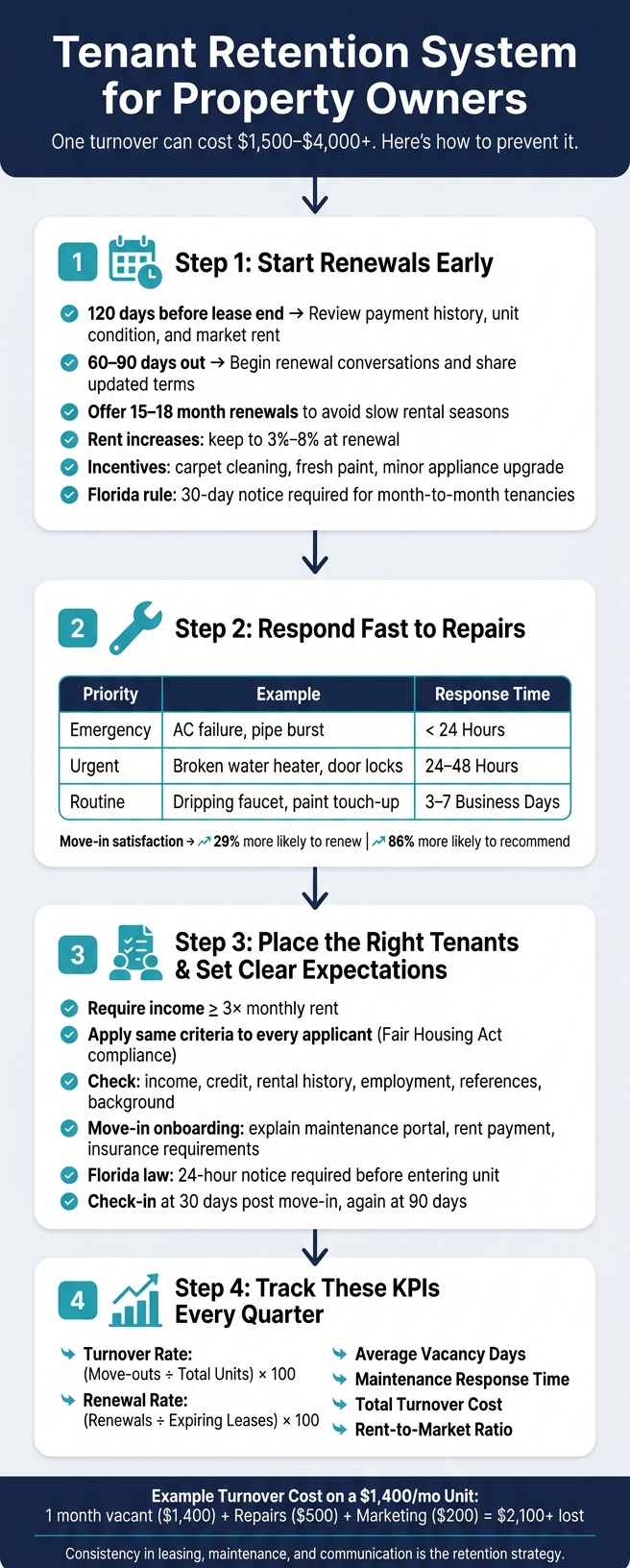
Tenant Retention System: Lease, Maintenance & Communication Workflow
Lease Terms and Renewal Systems That Reduce Turnover
Use lease terms to make staying feel easier than moving out. The idea is pretty simple: remove friction before a tenant starts checking other options.
Build a Renewal Timeline Before the Lease End Date
Set up a three-step renewal timeline and stick to it.
Start 120 days before the lease expires. Review payment history, check the unit’s condition, and compare the current rent to market rent. Then, at 60 to 90 days out, begin renewal conversations and share any updated terms or incentives.
Pay close attention to Florida’s 30- to 60-day notice window for fixed-term leases, and send nonrenewal notices on time. Florida now allows authorized notices by email, which makes it easier to document renewal outreach. Written notices still matter, so send those too, along with tracked reminders, to avoid missed deadlines.
Use Lease Options and Renewal Incentives Wisely
Once the timing is handled, the lease setup itself can do a lot of the heavy lifting.
A 15- to 18-month renewal can move the next lease end date away from a slower rental season. That can give you a better shot at steadier occupancy. Month-to-month terms can make sense for long-term residents who want more flexibility, but they need closer follow-up because Florida now requires at least 30 days’ notice to end a month-to-month tenancy.
Rent changes matter too. Small increases are often easier for tenants to handle than a sharp jump. Many landlords increase rent by 3% to 8% at renewal to keep pace with market conditions. A small perk can also help tip the decision toward staying, like:
- carpet cleaning
- fresh paint
- a minor appliance upgrade
Standardize the Renewal Process for Consistency
A repeatable renewal workflow helps you avoid missed dates and uneven terms. Keep lease expiration dates in one system, log tenant responses, record rent changes, and note why someone decides not to renew. Those patterns can point to issues you can fix before the next renewal cycle.
Treat each renewal like a new agreement. Update deposit records, and make sure every new term is clearly documented.
Once renewals run on a steady system, maintenance quality becomes the next big lever for retention.
sbb-itb-73b3b1a
Maintenance Standards That Keep Tenants Longer
Lease renewals and rent deals matter. But in day-to-day life, maintenance often decides whether a tenant stays. When repair requests sit too long, frustration builds fast, and many renters start looking for another place to live. In Jacksonville, that problem can get worse in a hurry. The city gets 117 rainy days each year, which increases the risk of mold and rot.
That’s why HVAC failures, major leaks, and lockouts need to be treated as immediate retention risks.
Set Response Times for Emergency, Urgent, and Routine Repairs
Not every repair is equal. Still, every repair affects how a tenant feels about the property. Fast response helps protect habitability and gives tenants one less reason to move.
| Issue Type | Example Problem | Target Response Time | Retention Impact |
|---|---|---|---|
| Emergency | Failed AC in extreme heat, major pipe burst, electrical failure | Immediate / < 24 Hours | Critical: Inaction often triggers an immediate search for new housing |
| Urgent | Broken water heater, failed refrigerator, broken door locks | 24–48 Hours | High: Affects daily living; prompt response builds trust |
| Routine | Dripping faucet, cabinet repair, interior paint touch-up | 3–7 Business Days | Moderate: Consistent follow-through prevents frustration from piling up |
Florida law also requires landlords to keep plumbing, electrical systems, and structural elements in habitable condition.
Speed matters. Consistency matters just as much. A tenant can forgive a problem more easily than they can forgive silence.
Use Preventive Maintenance to Avoid Avoidable Breakdowns
Preventive maintenance cuts down on emergency calls and helps tenants feel that the property is being looked after. A simple monthly and seasonal schedule goes a long way: change HVAC filters and check for leaks each month, inspect roofs and siding in spring, service HVAC systems and clean gutters in summer, trim trees and test drainage in fall, and insulate pipes and verify heat in winter.
Pest control should be part of that routine too. Jacksonville’s warm weather means ants, termites, and roaches can be a year-round issue, so monthly spot checks are worth adding to the schedule.
Make Move-Ins, Inspections, and Follow-Up Predictable
Move-in sets the tone for the entire lease. If that first experience feels organized and smooth, tenants notice. Residents who are satisfied with move-in are 29% more likely to renew and 86% more likely to recommend their property manager to others.
Start with a documented move-in walkthrough. Use detailed photos, written notes, and a signed condition report. That protects both sides and clears up confusion later. It also helps to give tenants a short maintenance cheat sheet that explains how to submit requests, how often to change HVAC filters, and how to avoid drain and sewer clogs. Keep it short, plain, and easy to use.
The last piece is follow-up. After each repair, check that the fix actually held. That small step can turn a basic service call into trust. Satisfied tenants are less likely to move and more likely to recommend the property manager.
Tenant Screening, Communication, and Resident Experience
Once your maintenance process and lease systems are set, retention comes down to two things: placing the right residents and setting clear expectations early.
Screen Tenants for Long-Term Fit, Not Just Quick Placement
It’s easy to treat a filled vacancy like a win. But a fast placement can backfire if the tenant isn’t a good match. In many cases, a short vacancy costs less than turnover, missed rent, conflict, or damage.
The goal isn’t to approve the first person who qualifies on paper. It’s to screen for residents who are likely to stay and follow the lease.
Just as important, use the same criteria for every applicant to stay compliant with the Fair Housing Act. A written standard helps a lot here. For example, you might require income of at least 3x the monthly rent and no evictions in the past five years. That kind of clear, documented rule also gives you support if someone later questions a decision. Florida Statutes Chapter 83 governs the screening and lease process, so your criteria should match current state law.
| Screening Component | What It Measures | How It Supports Retention |
|---|---|---|
| Income Verification | Financial stability and ability to pay rent consistently | Reduces stress-related turnovers caused by payment struggles |
| Credit Review | History of meeting financial obligations | Predicts future risk and identifies tenants with a history of stability |
| Rental History | Past behavior as a tenant and adherence to lease terms | Identifies tenants who have a track record of long-term stays |
| Employment Check | Consistency of income and local ties | Ensures the tenant has the means to stay for the full lease term and beyond |
| References | Qualitative feedback from previous landlords | Confirms the tenant treats property with respect, reducing conflict |
| Background Screening | Criminal and eviction history | Protects the community and reduces the likelihood of forced turnover |
Once screening is done, the next test is everyday communication.
Set Communication Standards from Day One
A smooth move-in can shape the entire resident relationship. Residents who are happy with their move-in experience are 29% more likely to renew and 86% more likely to recommend their property manager. That doesn’t come from doing more for the sake of it. It comes from being clear.
A short digital onboarding flow can help cover the basics:
- How maintenance requests should be submitted
- What insurance is required
- Where and how rent should be paid
It also helps to define your communication channels right away. If maintenance requests and rent payments go through a resident portal, you create a clean record from the start. That matters later when details get fuzzy.
Florida law requires at least 24 hours’ notice before entering a unit. If you explain and document that standard at move-in, there’s a lot less room for confusion later.
When communication is clear early on, renewals and check-ins tend to go more smoothly.
Use Feedback and Check-Ins to Increase Renewals
Most tenants don’t say, “I’m unhappy and thinking about leaving.” Usually, they stay quiet until they’ve already made up their mind. That’s why simple check-ins matter.
Reach out around 30 days after move-in to catch small issues before they grow. Then check in again at 90 days to spot any friction before it turns into a move-out plan.
For multifamily and apartment properties, small resident events can help too. A barbecue or holiday gathering can build a sense of belonging and make people more likely to stay longer. It’s not magic. It just helps the property feel less transactional.
Resident portals also make life easier on both sides. Using them for maintenance and rent creates a clear record and cuts down on the back-and-forth of phone calls and text messages. Digital signing and online payment options make renewals easier and reduce paperwork headaches. And when renters feel good about communication, they’re less likely to plan a move.
Measure Results and Build a Repeatable Retention Plan
You need to measure retention if you want to know which lease terms, maintenance habits, and communication changes are cutting turnover. Once those systems are in place, the numbers tell you what’s helping and what’s just noise.
Review Retention Data Quarterly and Annually
Review the same KPIs every quarter and then look at them again at the end of the year. That gives you a short-term read on what’s changing and a longer view of what’s sticking.
| KPI Name | How to Calculate It | How It Informs Decisions |
|---|---|---|
| Turnover Rate | (Total Move-outs ÷ Total Units) × 100 | Flags screening, condition, or pricing problems. |
| Renewal Rate | (Total Renewals ÷ Total Expiring Leases) × 100 | Shows whether pricing and communication are working. |
| Average Vacancy Days | Total Days Vacant ÷ Number of Turnovers | Shows how fast units are re-rented. |
| Maintenance Response Time | Average time from ticket submission to completion | Shows service speed. |
| Total Turnover Cost | Vacancy loss + Marketing + Repairs + Cleaning | Quantifies the cost of turnover. |
| Rent-to-Market Ratio | Current Rent ÷ Market Rent | Helps balance rent growth and retention. |
A turnover on a $1,400/month unit can exceed $2,100 with one month vacant, $500 in repairs, and $200 in marketing. That’s why even small drops in turnover can have a big effect on cash flow.
Use a Simple Action Plan to Improve Retention Over Time
Don’t try to fix everything at once. Pick one issue, make one or two changes, then measure what happens next quarter. If it works, keep it. If it doesn’t, adjust and test again.
Exit interviews can reveal maintenance problems or restrictive lease terms, such as no-pet policies. In many cases, that kind of direct feedback points to a fix that costs less than another turnover.
1 Realty Management supports this process with reporting, maintenance oversight, and lease renewal management.
Conclusion: The Basics That Keep Good Tenants in Place
The goal isn’t more process. It’s fewer move-outs.
Retention usually comes down to a few simple things: placing the right tenants, setting clear expectations at move-in, handling maintenance fast, and starting the renewal conversation early. Each part supports the others.
When turnover drops, rental income is better protected, day-to-day disruption goes down, and the portfolio becomes more stable over time. The owners who do this well aren’t doing anything flashy. They stay consistent, watch the right numbers, fix what the data points to, and treat good tenants like the asset they are.
FAQs
How can I tell if my rent increase is too high?
First, figure out whether the rent increase is actually necessary. For example, higher property taxes or rising maintenance costs can justify a change. But if the main goal is simply more profit, tenants are more likely to leave.
Then compare your proposed rent to similar rentals nearby. After that, give tenants clear written notice and send it on time. Rent hikes that feel sudden or poorly explained often hurt renewal rates.
What maintenance issues make tenants move out fastest?
HVAC failures are often the main reason tenants move out fast, especially in Florida, where a broken air conditioner can be a dealbreaker.
Other common triggers include slow maintenance response times and ignored plumbing or electrical repairs. When those issues drag on, a home can start to feel uncomfortable, unsafe, or simply uncared for.
Which retention metrics should I track first?
Start with metrics tied to renewal and satisfaction:
- on-time rent payment and collection performance
- lease compliance issues
- maintenance response time, completion rate, and outstanding work orders
- communication resolution speed
- lease renewal rate and tenant turnover rate
You should also track what happens around those headline numbers. Look at property condition during inspections, exit-feedback themes, missed renewal or notice deadlines, and renewal window coverage across your portfolio.
That extra context matters. A renewal rate can look fine on the surface, but the story changes if work orders are piling up, tenants are leaving over the same complaint, or notices are slipping past deadline. When you put these signals side by side, patterns start to show up fast.
For example, if one property has slow maintenance completion and low renewal rates, that’s not bad luck. It points to a service problem. If another property has solid payment performance but poor renewal window coverage, the issue may be process, not resident satisfaction.