
The short answer: if the work simply fixes the rental, I can usually deduct it now. If it makes the property better, restores a major part, or changes its use, I usually have to depreciate it over 27.5 years.
That single tax call can change my current-year deduction by 100%. A $900 leak repair may go on Schedule E this year. A $12,000 roof replacement usually gets spread out over 27.5 years instead. In Florida, that line gets harder after storms, roof claims, water damage, HVAC failures, and tenant move-outs.
Here’s the core of it in plain English:
- Repairs fix wear, damage, or small problems without major upgrades.
- Improvements must be capitalized if they meet the IRS BAR test:
- Betterment
- Adaptation
- Restoration
- The IRS also looks at the part of the property involved, like the roof, plumbing, electrical, or HVAC.
- Some costs may still be deducted now under safe harbors, such as the $2,500 de minimis rule.
- If one invoice mixes repair work and capital work, the IRS may treat more of the bill as an improvement.
- In Florida, storm damage, insurance proceeds, code-driven roof work, moisture issues, and full-system replacements often push a project into capitalization.
- Good files matter: photos, invoices, permits, contracts, work orders, and insurance papers can help support the tax treatment.
A few fast examples:
- Replacing a few shingles: often a repair
- Replacing the whole roof: usually an improvement
- HVAC tune-up: often a repair
- New HVAC system: usually an improvement
- Patch and paint after tenant damage: often a repair
- Major remodel during turnover: usually an improvement
If I want to lower audit risk, I need to classify each job by scope, system affected, and invoice detail – not by what the contractor calls it.
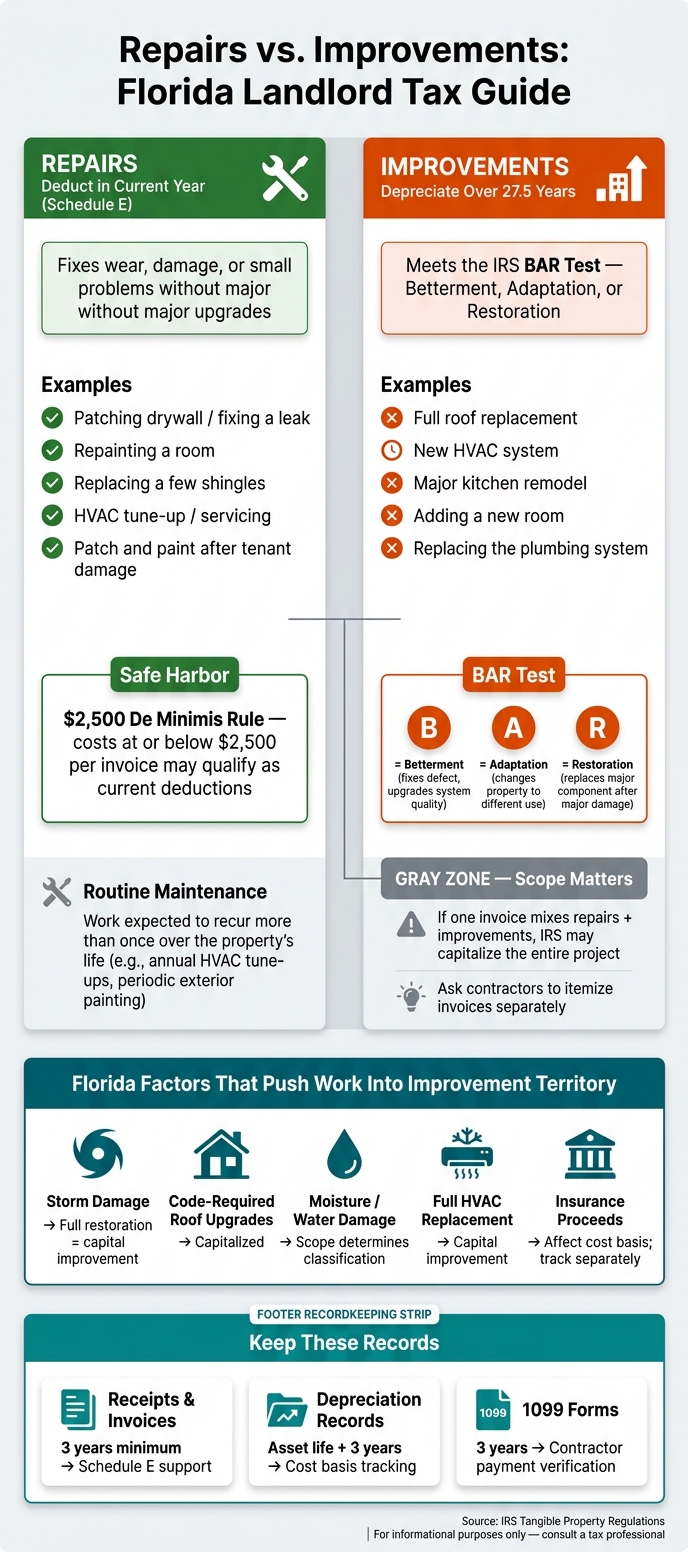
Repairs vs. Improvements: Florida Landlord Tax Guide
How the IRS Classifies Repairs and Improvements

The IRS sorts rental property work based on what it does to the property: deduct it now or capitalize it and depreciate it over time. That sounds simple on paper. In practice, it gets messy fast.
In Florida, this comes up all the time with storm repairs, roof work, and HVAC replacements. The line can get blurry after a hurricane, tenant damage, or a big turnover between renters.
What Qualifies as a Repair
Repairs bring the property back to working condition without materially upgrading it. In plain English, you’re fixing what’s there, not making it better in a major way.
These costs are usually deductible in the current year.
What Qualifies as an Improvement Under the BAR Test
The IRS uses the BAR test to decide whether work counts as a capital improvement. If the work meets even one of these three tests, you add the cost to basis and depreciate it over time instead of deducting it in the current year:
- Betterment: Fixing a pre-existing defect, materially improving quality, or upgrading a system
- Adaptation: Changing the property to a different use
- Restoration: Replacing a major component or returning the property to working order after major damage
One key point: use the BAR test after you identify which part of the property the work affected. That step matters more than many landlords expect. For residential rentals, improvements are depreciated over 27.5 years in equal annual amounts.
| Expense Type | Repair or Improvement | Tax Treatment | BAR Concept |
|---|---|---|---|
| Patching drywall / fixing a leak | Repair | Deduct in current year | Maintenance |
| Repainting a room | Repair | Deduct in current year | Maintenance |
| Replacing a few shingles | Repair | Deduct in current year | Maintenance |
| HVAC tune-up / servicing | Repair | Deduct in current year | Maintenance |
| Full roof replacement | Improvement | Depreciate over 27.5 years | Restoration |
| New HVAC system | Improvement | Depreciate over 27.5 years | Betterment |
| Major kitchen remodel | Improvement | Depreciate over 27.5 years | Betterment |
| Adding a new room | Improvement | Depreciate over 27.5 years | Adaptation |
| Replacing the plumbing system | Improvement | Depreciate over 27.5 years | Restoration |
Some projects sit in a gray area. A repair can start to look like an improvement once the scope gets bigger or the work affects a major part of the property. When that happens, the BAR test alone usually isn’t enough. The next step is to look at the unit-of-property rules and the safe harbors.
A Practical Framework for Classifying Florida Rental Expenses
After the BAR test, the next step is simple: look at which property system the work touched. If a cost passes the BAR test, you then need to decide whether it affected a major building system or just a small piece of it.
The Unit of Property and Scope of Work Test
The IRS looks at the specific system the work affected. For rental buildings, that improvement test applies to systems such as HVAC, plumbing, electrical, fire protection, security, gas distribution, and the building structure, including the roof.
The main issue is scope. Did the work replace a major component or a structural part? That’s what the IRS cares about. In plain English, the IRS is asking whether you fixed a small part of a system or swapped out a large chunk of it.
A few examples make this easier to see:
- Replacing a few shingles is usually a repair.
- Replacing the entire roof is usually an improvement.
- Swapping out a full HVAC system is usually an improvement.
This is where the line starts to show up between small repairs, full system replacements, and messy invoices that mix both.
Safe Harbors That May Allow Current Deductions
Even if the BAR test points to capitalization, some costs may still be deductible under IRS safe harbors. Two safe harbors can help keep small or recurring costs deductible now:
| Safe Harbor | Threshold / Criteria | Example |
|---|---|---|
| De Minimis Safe Harbor | $2,500 per invoice or item | Replacing a single broken window or a small appliance |
| Routine Maintenance | Work expected to recur more than once over the property’s life | Periodic exterior painting or annual HVAC tune-ups |
Costs of $2,500 or less per invoice or per item may qualify for a current deduction.
How to Handle Borderline Make-Ready and Turnover Work
This is where things can get tricky. Work that looks like normal turnover can still get different tax treatment based on how the invoice is written. Florida rentals run into this all the time after a tenant moves out or after storm-related repairs.
If a single invoice bundles repairs together with improvements, the IRS may require you to capitalize the entire project. That’s why it helps to ask contractors to break out invoices by line item and keep repair work separate from capital work.
A little cleanup on the front end can save a headache later. Review bigger jobs before the work starts, make sure costs are grouped the right way, and keep records tied to each invoice, date, and work category. Clean invoices and early review make the tax treatment much easier to defend.
sbb-itb-73b3b1a
Florida and Jacksonville Factors That Affect Expense Classification
In Florida, everyday maintenance can get messy fast. A small issue with a roof, moisture, or HVAC system can turn into a much bigger tax call after one storm or one leak. That’s why expense classification is often harder here than landlords expect.
Storm Damage, Roofs, Moisture, and HVAC in Florida
After a storm, the tax treatment still comes down to the scope of the work. Minor patching is usually treated as a repair. But a full roof replacement, or rebuilding required by code, is usually treated as a restoration. Florida building codes may also require upgraded decking or different ventilation layouts during roof work, and that can move the project into improvement territory.
HVAC work tends to follow the same logic. If you fixed one part, it’s often a repair. If you replaced the whole system, that usually points to a capital improvement.
Insurance Proceeds and Large Restorations
When storm damage leads to a larger restoration, the tax treatment changes again. Insurance reimbursements can affect your property’s cost basis, which changes how future depreciation is figured.
Under the BAR test, work that returns a property to working condition after major damage is generally treated as a restoration, not a repair, no matter how the contractor labels the invoice. In plain English, the invoice title doesn’t decide the tax result. The actual work does.
That means the full replacement cost may need to be capitalized, and any insurance proceeds should be tracked with equal care alongside it.
How 1 Realty Management Supports Cleaner Expense Tracking

Good records matter most when a property has repeat repairs, tenant turnovers, or storm-related work. 1 Realty Management helps Jacksonville landlords keep everything in order with:
- maintenance history
- invoices tied to specific dates and work categories
- detailed monthly financial reports
That kind of paper trail makes it much easier to sort repairs from capital improvements before tax time.
Recordkeeping and Reporting That Supports Your Tax Position
If the IRS questions a deduction, your records – not your memory – are what back you up.
What to Keep in Your Files
Hold on to photos, work orders, permits, contracts, and invoices that show what was done and how far the work went. If a project includes both repairs and improvements, document the damage, the work performed, and the date the improvement was placed in service.
For insured work, keep the insurance settlement papers with the contractor invoices. That way, you can show what insurance covered and what you paid out of pocket.
With that paper trail in place, it’s much easier to match each cost to Schedule E or to your depreciation records.
How Expenses Flow to Schedule E and Depreciation Records
Once your file is in order, reporting gets simpler. Deductible repairs go on Schedule E in the year you paid them. Each improvement should be recorded as a fixed asset with its cost, placed-in-service date, and recovery period.
| Document Type | Retention Period | Purpose |
|---|---|---|
| Expense receipts/invoices | 3 years (minimum) | Support Schedule E deductions |
| Depreciation records | Asset life + 3 years | Support cost basis and recovery |
| 1099 forms | 3 years | Verify payments to contractors |
Conclusion: Classify Carefully, Document Thoroughly, and Review Large Projects Early
Classify each project with care, and document all of it. In Florida, large jobs or storm-related work can include both repairs and improvements, so it helps to review those projects early with a tax professional. Good records make repair deductions easier to defend and capital improvements easier to track.
FAQs
How do I tell if a job is a repair or an improvement?
Ask whether the work simply gets the property back into working order or whether it adds value, extends its useful life, or changes it for a new use.
Repairs – like fixing leaky faucets or repainting – are generally deductible in the year you pay for them.
Improvements – like a new roof, an added room, or a major kitchen remodel – must be capitalized and depreciated over time.
Can I deduct part of a mixed invoice now?
Yes. If one invoice covers both repairs and improvements, you can deduct the repair part this year if the bill clearly breaks out each line item.
Here’s the key difference:
- Repairs are deductible in the year you pay for them.
- Improvements must be capitalized and depreciated over 27.5 years.
That split matters. If the invoice just shows one lump sum, it can be much harder to show what counts as a current repair versus a capital improvement.
Keep detailed, itemized records that show the separate charges for each type of work. If the IRS asks for proof, those records help support the deduction.
How do insurance proceeds affect my tax treatment?
Insurance proceeds are generally taxable income when they replace lost rental income.
For property damage, the tax treatment depends on how you use the money. If you use it for repairs, those costs are usually deductible in the current year. If you use it for an improvement that restores the property or adds to it, those costs are usually capitalized and recovered through depreciation over time.