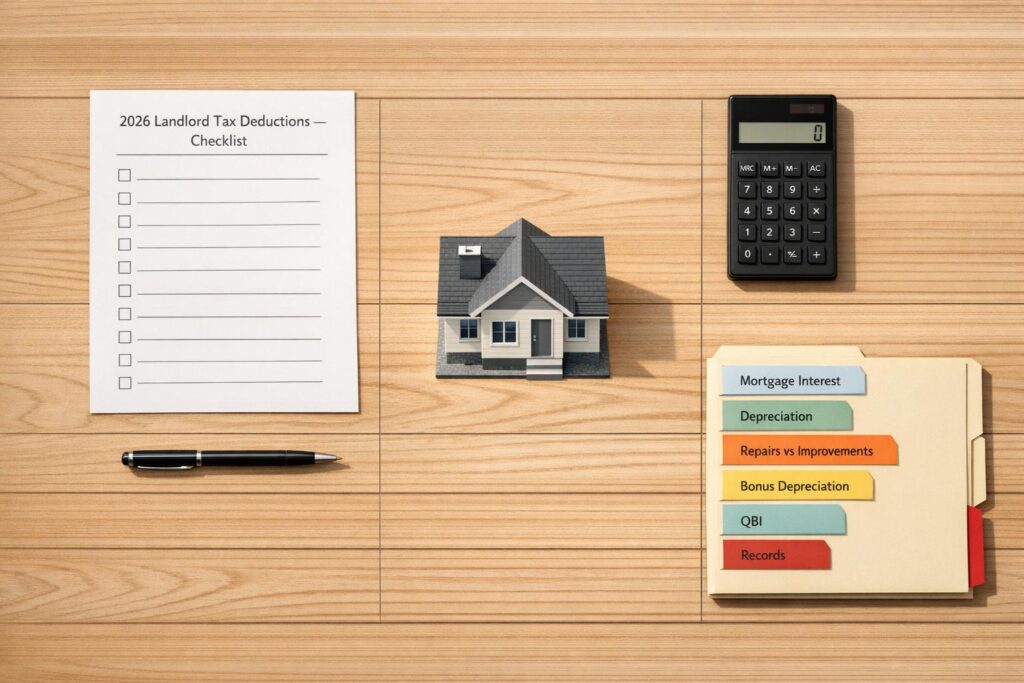
Want to save thousands on taxes in 2026? If you’re a landlord, understanding tax deductions is key to keeping more of your rental income. Here’s a quick breakdown of what you need to know:
- Mortgage Interest: Deduct 100% of interest paid on loans for your rental property.
- Property Taxes: Fully deductible without the $10,000 SALT cap that applies to personal residences.
- Repairs vs. Improvements: Repairs (like fixing a leak) are deductible immediately, while improvements (like a new roof) are depreciated over 27.5 years.
- Depreciation: Spread the cost of your property (excluding land) over 27.5 years, plus take advantage of 100% bonus depreciation for qualifying improvements.
- Insurance Premiums: Deduct costs for landlord insurance and other policies.
- Professional Services: Write off fees for accountants, attorneys, and property management.
- Travel Costs: Claim $0.70 per mile for property-related trips.
- Utilities and Marketing: Deduct costs for tenant-attracting ads, utilities, and HOA fees.
New for 2026: The reinstated 100% bonus depreciation and permanent 20% QBI deduction can further reduce your taxable income. Keep detailed records, issue required 1099 forms, and maintain logs for compliance.
Whether you’re managing properties with Jacksonville property management experts, or elsewhere, these deductions can make a big difference in your bottom line. Start tracking expenses now to maximize your savings!
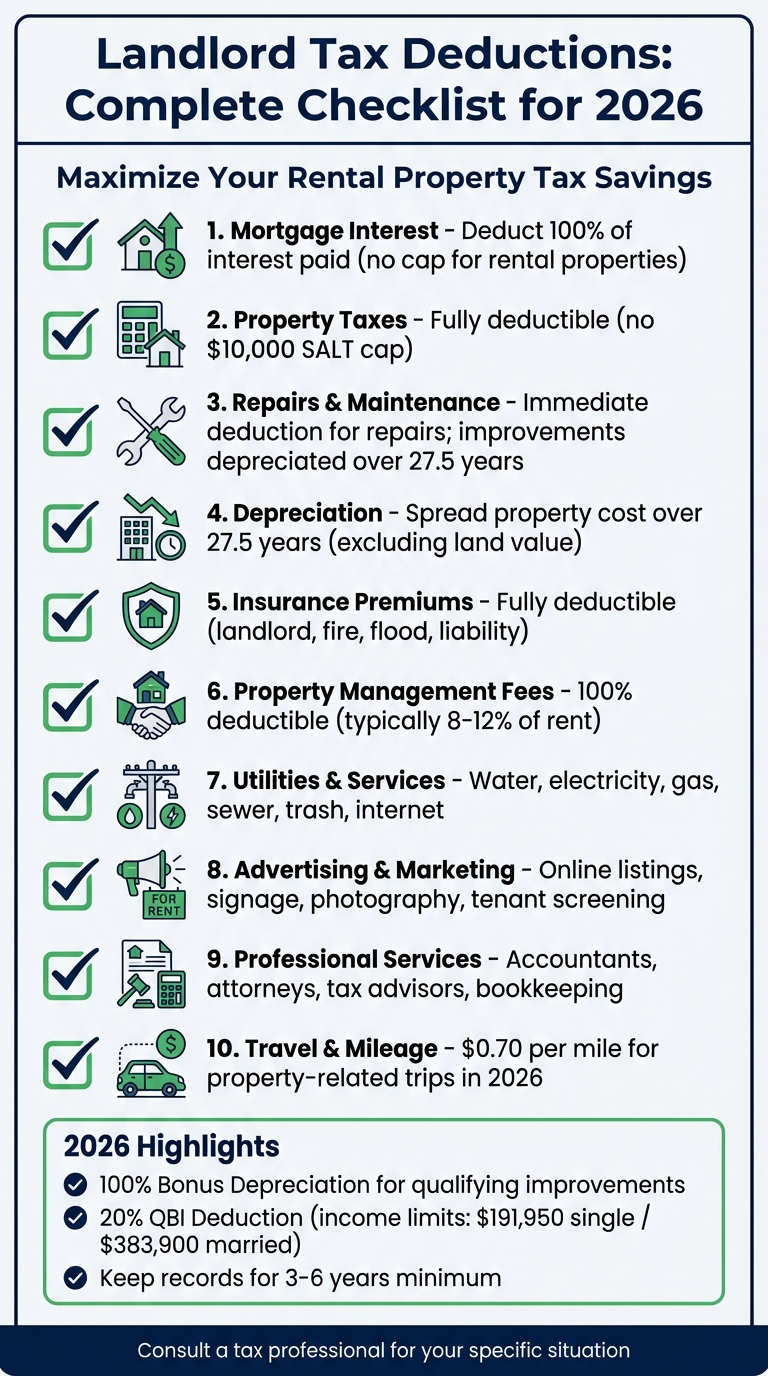
Top 10 Landlord Tax Deductions for 2026
Complete Checklist of Landlord Tax Deductions
Mortgage Interest Deduction
If you own rental properties, the mortgage interest you pay is entirely deductible on Schedule E (Form 1040), Line 12. Unlike the deduction for your primary residence – which is capped at mortgage debt up to $750,000 – there’s no limit for rental properties. This means you can deduct the interest on the full loan balance, no matter how much you borrowed.
You can deduct interest from various types of loans, including conventional mortgages, HELOCs, private loans, or hard money loans, as long as the funds were used exclusively for rental property expenses. To calculate your deduction, refer to Form 1098, which outlines the total interest paid. Keep in mind, though, that only the interest portion is deductible; the principal portion goes toward building your equity and isn’t eligible for a tax write-off.
"On a typical 30-year mortgage, the majority of early payments are interest, making this one of your largest deductions." – RentSolve AI
For origination fees or points, you’ll need to amortize these costs over the life of the loan. If you’re using a HELOC, ensure you have clear documentation showing the funds were used specifically for rental property improvements or purchases.
Property Tax Deduction
Property taxes on rental properties are another fully deductible expense. Unlike the $10,000 SALT cap that applies to personal residences, rental property taxes are not limited and can be deducted in full on Schedule E. For landlords in Jacksonville, this is especially useful, given Florida’s relatively low average effective property tax rate of about 0.8%. You can deduct the total amount of property taxes paid during the tax year, even if the assessment covers a different period. Be sure to save tax bills and payment receipts to back up your deduction in case of an audit.
Repairs and Maintenance Deduction
When it comes to operational costs, repairs and maintenance are fully deductible in the year they’re paid. Repairs are defined as expenses that restore the property to its original condition. Common examples include fixing leaky faucets, patching drywall, repainting rooms, repairing broken windows, and unclogging drains.
In contrast, improvements – such as replacing an entire plumbing system, adding a room, or installing a new HVAC system – add value or extend the useful life of the property. These must be capitalized and depreciated over time instead of being deducted immediately. The IRS uses the "BAR" test (Betterment, Restoration, or Adaptation) to determine whether an expense qualifies as an improvement.
For smaller expenses, the De Minimis Safe Harbor rule allows you to immediately deduct items costing $2,500 or less per invoice. Additionally, the Routine Maintenance Safe Harbor lets you deduct costs for recurring activities expected to occur more than once during the property’s life, such as regular HVAC servicing or periodic exterior painting.
Insurance Premiums Deduction
Insurance premiums paid to protect your rental property are fully deductible. This includes policies like landlord liability insurance, fire insurance, flood insurance, theft coverage, and umbrella policies. These expenses are reported on Schedule E and deducted in the year they’re paid. If you pay premiums annually, you can deduct the entire amount in the year of payment, even if the coverage extends into the next year. Always keep copies of your insurance policies and payment receipts for your records.
Depreciation Deduction
Depreciation allows landlords to recover the cost of their rental property (excluding land) over its useful life. Residential rental properties are depreciated over 27.5 years using the Modified Accelerated Cost Recovery System (MACRS). To determine your depreciable basis, subtract the land value – typically estimated at around 20% of the total purchase price – from the property’s purchase price. You can also add certain closing costs, like title insurance, recording fees, and transfer taxes, to the property’s cost basis. The property is considered "placed in service" when it’s ready for rent.
"The IRS requires you to recapture depreciation whether or not you claimed it. Skipping depreciation means you lose the annual deduction but still owe recapture tax." – Slava Akulov, Jupid
Recent updates to tax laws allow for bonus depreciation, enabling you to immediately deduct the full cost of qualifying assets – such as appliances, carpeting, and land improvements – instead of spreading the deduction over several years. Use IRS Form 4562 to file for depreciation. However, when you sell the property, the accumulated depreciation must be recaptured and taxed at a maximum rate of 25%. For landlords in Jacksonville, strategies like accelerated depreciation or cost segregation can help boost cash flow by reclassifying building components into shorter recovery periods (5, 7, or 15 years) for quicker deductions in the early years of ownership.
sbb-itb-73b3b1a
NEW 2026 Real Estate Tax Loopholes Under The Big Beautiful Bill
Additional Deductions to Reduce Taxable Income
In addition to the standard deductions, there are several other expenses that can help lower your taxable income.
Property Management Fees Deduction
You can deduct 100% of property management fees on Schedule E, Line 11. These fees usually fall between 8% and 12% of your gross monthly rent. Beyond the basic management fee, you can also write off costs like leasing and placement fees for new tenants, charges for maintenance coordination, tenant screening, and even eviction processing. For example, if you hire a company like 1 Realty Management to handle tasks such as marketing your property or coordinating repairs, all these expenses are deductible. Keep detailed invoices for each service, as they can serve as proof if the IRS requests documentation. Other operational costs, like utilities, also qualify as deductible expenses.
Utilities and Services Deduction
If you’re paying for utilities on behalf of your rental property, those costs are fully deductible. This includes water, electricity, gas, sewer, trash collection, and even internet service if you provide Wi-Fi for your tenants. While tenant reimbursements for utilities must be reported as income, you can still claim the full utility payment as a deduction. For multi-unit properties, it’s important to maintain separate records for each unit’s utility expenses to ensure accuracy when reporting on Schedule E. Additionally, expenses like HOA fees or condo association dues also fall under deductible operating expenses, directly reducing your taxable income.
Advertising and Marketing Deduction
The money you spend to attract tenants is deductible in the year it’s spent. This includes costs like online listing fees for platforms such as Zillow, Apartments.com, and Facebook ads, as well as physical signage and printed marketing materials. You can also deduct expenses for professional photography, virtual tours, and property staging services. Tenant screening costs, such as background checks and credit reports, are included as part of these marketing expenses, and using proven tenant screening strategies can help ensure you find quality renters. Keep accurate records of these costs to ensure proper reporting.
"Every dollar spent finding tenants is deductible." – HonestCasa
Professional Services Deduction
Fees paid to professionals like accountants, attorneys, and tax advisors for rental property–related services are also deductible. These include charges for preparing your Schedule E, legal fees for drafting leases or handling evictions, and bookkeeping services. Subscriptions to property management software or smart monitoring solutions used for managing properties can also be written off. Be sure invoices clearly identify rental-related expenses to ensure compliance with tax rules.
Travel and Mileage Deduction
For business-related travel in 2026, the IRS allows a deduction of $0.70 per mile. This applies to trips for tasks like inspecting your property, meeting with tenants, purchasing supplies, or showing the unit to potential renters. To claim this deduction, maintain a log that includes dates, destinations, and the business purpose of each trip. For properties located farther away, you can also deduct lodging costs and 50% of business meal expenses. For instance, driving 300 miles in a year could result in a deduction of about $210, so tracking your mileage carefully can make a difference.
2026 Tax Law Changes Affecting Landlords
New tax laws for 2026 bring opportunities for Jacksonville landlords to reduce taxable income. These updates focus on property improvements and business structuring, offering ways to maximize deductions.
Bonus Depreciation for Property Improvements
The 2026 tax law introduces 100% bonus depreciation for qualifying property improvements placed in service after January 19, 2025. This allows landlords to deduct the full cost of eligible improvements in the same year they’re completed, rather than spreading the deduction over several years.
Eligible assets include those with a recovery period of 20 years or less, such as appliances, HVAC systems, flooring, roofing, carpeting, and landscaping. While the building structure itself continues to depreciate over 27.5 years, many internal components qualify for accelerated depreciation. To take full advantage, consider a cost segregation study. These studies separate shorter-life assets from the building structure and typically cost between $8,000 and $20,000, making them worthwhile for properties valued at $250,000 or more.
On average, these engineering-based studies can shift 20%-40% of a property’s cost into early deductions, with first-year deductions averaging $171,243. To claim bonus depreciation, use IRS Form 4562, ensuring the property is ready for use by December 31, 2026.
Next, let’s look at the updates to the Qualified Business Income deduction.
Qualified Business Income (QBI) Deduction Updates
The 20% QBI deduction remains a valuable tool for Jacksonville landlords, provided your income falls below the 2026 thresholds: $191,950 for single filers or $383,900 for married couples filing jointly. If your income exceeds these limits, the deduction is reduced based on W-2 wages paid or the property’s basis.
To qualify, your rental activity must meet the IRS Safe Harbor criteria outlined in Revenue Procedure 2019-38. This includes logging at least 250 hours per year of rental-related services, such as advertising, tenant screenings, lease negotiations, rent collection, and coordinating repairs. Keep detailed, contemporaneous records, as the IRS requires logs created in real time – not reconstructed later. Activities like reviewing financial statements, financing, or simply traveling to the property won’t count toward the 250-hour requirement.
These changes also come with stricter IRS compliance standards.
New IRS Compliance Requirements
For 2026, the IRS has increased documentation standards. If you claim the QBI deduction or Real Estate Professional Status (which requires 750+ hours annually), you must maintain contemporaneous time logs. Courts often reject claims based on records created after the fact.
Additionally, landlords must issue Form 1099-NEC or 1099-MISC to any contractor or service provider paid $600 or more during the year. To simplify this process, collect Form W-9 from contractors before making payments to secure their Taxpayer Identification Number. Keep all relevant documents for at least three years after filing your taxes, though seven years is safer. For depreciation-related records, retain them for the asset’s lifespan plus three years.
Since Florida doesn’t have a state income tax, these federal deductions – especially bonus depreciation and the QBI deduction – are key tools for Jacksonville landlords aiming to reduce their tax burdens. Staying informed about these updates is crucial for maximizing savings and ensuring compliance with IRS requirements.
Record-Keeping and Compliance Best Practices
Keeping accurate and detailed records is crucial for safeguarding your deductions and staying prepared for potential audits. The IRS requires landlords to maintain thorough documentation to justify every expense claimed on Schedule E. Without proper records, you could lose out on legitimate deductions during an audit, costing you thousands.
Organizing Receipts and Financial Statements
Hold onto all receipts, invoices, and bank statements for at least three years. If you’ve underreported income by more than 25%, this retention period extends to six years. For depreciation-related documents, such as closing statements or cost segregation studies, keep them for the asset’s entire lifespan plus an additional three years.
To avoid confusion, separate your rental property finances from personal spending. Use dedicated bank accounts and credit cards exclusively for rental operations. This practice not only simplifies recordkeeping but also reduces the risk of commingling funds, which is a known red flag for audits. Organize your records by property and category, with folders for specific expenses like mortgage interest (Form 1098), repairs, utilities, insurance, and professional fees.
Take photos of repairs to distinguish between maintenance and improvements. Visual evidence can help prove that an expense was a necessary repair rather than a capital improvement, which would need to be depreciated over time. For short-term rental owners in Jacksonville, document the collection of the 6% state sales tax and the Duval County tourist development tax for stays under six months.
"Organized records protect you during tax season and audits." – TG Property Management
Using digital tools can further simplify the process of tracking expenses.
Using Technology for Expense Tracking
Digital tools make recordkeeping easier and more efficient. Property management software like Landlord Studio, Baselane, or Stessa can sync with your business bank accounts to automatically import and categorize transactions in line with IRS Schedule E requirements.
Snap photos of receipts with your smartphone immediately after making purchases. Many apps can auto-fill expense details and securely store digital copies. For tracking business mileage, GPS-based apps automatically log your trips at the 2026 standard rate of $0.70 per mile.
Adopt a consistent file naming system, such as "YYYY-MM-DD_vendor_amount_category", to make files easy to locate during tax preparation or audits. Reconcile your software ledger with your bank statements every month to catch missing entries or errors early.
"Landlords were leaving thousands of pounds on the table because they did not track the smaller expenses: mileage to the property, materials for repairs, even their phone bill for coordinating with tenants." – Slava Akulov, CEO, Jupid
These tools not only simplify daily expense tracking but also help ensure you’re ready for an audit.
Preparing for an IRS Audit
With organized records and digital tracking in place, you’ll be better prepared for an IRS audit. The IRS expects contemporaneous records – documentation created at or near the time an expense occurs. If you’re claiming the Qualified Business Income (QBI) safe harbor (250+ hours) or Real Estate Professional Status (750+ hours), keep a daily time log recording dates, hours, and specific activities like tenant screenings, lease negotiations, or repair coordination.
"A reconstructed log created at audit time is much less credible than one maintained throughout the year." – Slava Akulov, Jupid
Maintain detailed mileage logs for every business-related trip, noting the date, destination, purpose, and miles driven. For repairs, document the "betterment, restoration, or adaptation" test using receipts, contractor invoices, and before-and-after photos. If you use the De Minimis Safe Harbor to deduct items under $2,500 immediately, attach a formal statement to your tax return each year.
When paying contractors, ensure compliance by issuing Form 1099-NEC or 1099-MISC for payments of $600 or more annually and collecting Form W-9 from service providers before making payments. Store all documentation – whether in physical filing cabinets or cloud storage – securely and ensure you can retrieve any record quickly if the IRS requests it.
Conclusion: Maximizing Tax Savings as a Jacksonville Landlord in 2026
For landlords in Jacksonville, every dollar saved on taxes adds up. As Slava Akulov, CEO of Jupid, puts it: "The difference between a diligent landlord and a careless one is often $3,000-$5,000 in missed deductions per property per year". That’s a significant amount, especially for those managing multiple properties. Overlooked deductions like mortgage interest, depreciation, and property taxes can quickly drain your potential savings.
Prioritize the most impactful deductions: mortgage interest, depreciation (spread over 27.5 years), and property taxes. Don’t forget smaller but valuable opportunities, like deducting mileage for site visits – currently set at $0.70 per mile. Using the De Minimis Safe Harbor rule, you can immediately expense qualifying items, which can simplify your tax calculations. For short-term rental owners, ensure compliance with state sales and local tourist tax rules to avoid penalties.
The key to unlocking these savings lies in maintaining meticulous records. To claim the 20% Qualified Business Income deduction, document at least 250 hours of rental-related services each year. Keep separate accounts for your rental activities, store digital receipts, and hold onto all relevant documents for at least three years – or up to six years if there’s underreported income. These steps ensure you’re prepared to make the most of every deduction available.
FAQs
How do I know if something is a repair or an improvement?
For tax purposes, repairs are expenses that bring a property back to its original condition or ensure it remains functional. These costs can be fully deducted in the year they occur. On the other hand, improvements are expenses that increase the property’s value, extend its useful life, or adapt it for a different use. These must be capitalized and depreciated over a period of time.
To figure out the correct category, ask yourself: Does this expense simply restore the property (repair), or does it enhance its value or lifespan (improvement)? Getting this classification right is crucial for accurate tax reporting.
What do I need to qualify for the 20% QBI deduction in 2026?
To claim the 20% QBI deduction in 2026, your rental activity must align with IRS Safe Harbor rules. This means you’ll need to:
- Keep separate books and records for your rental activity.
- Perform at least 250 hours of rental services during the year.
- Maintain real-time documentation of your work and activities.
On top of that, your LLC must be structured as a qualified trade or business. Meeting these criteria is essential to fully take advantage of the tax benefits available.
Which rental upgrades qualify for 100% bonus depreciation in 2026?
Rental upgrades that qualify for 100% bonus depreciation in 2026 include qualified improvement property, select used assets, and property with a recovery period of 20 years or less. This can cover items like equipment, machinery, and certain interior upgrades to nonresidential buildings. To take advantage of this, make sure these upgrades align with IRS guidelines.