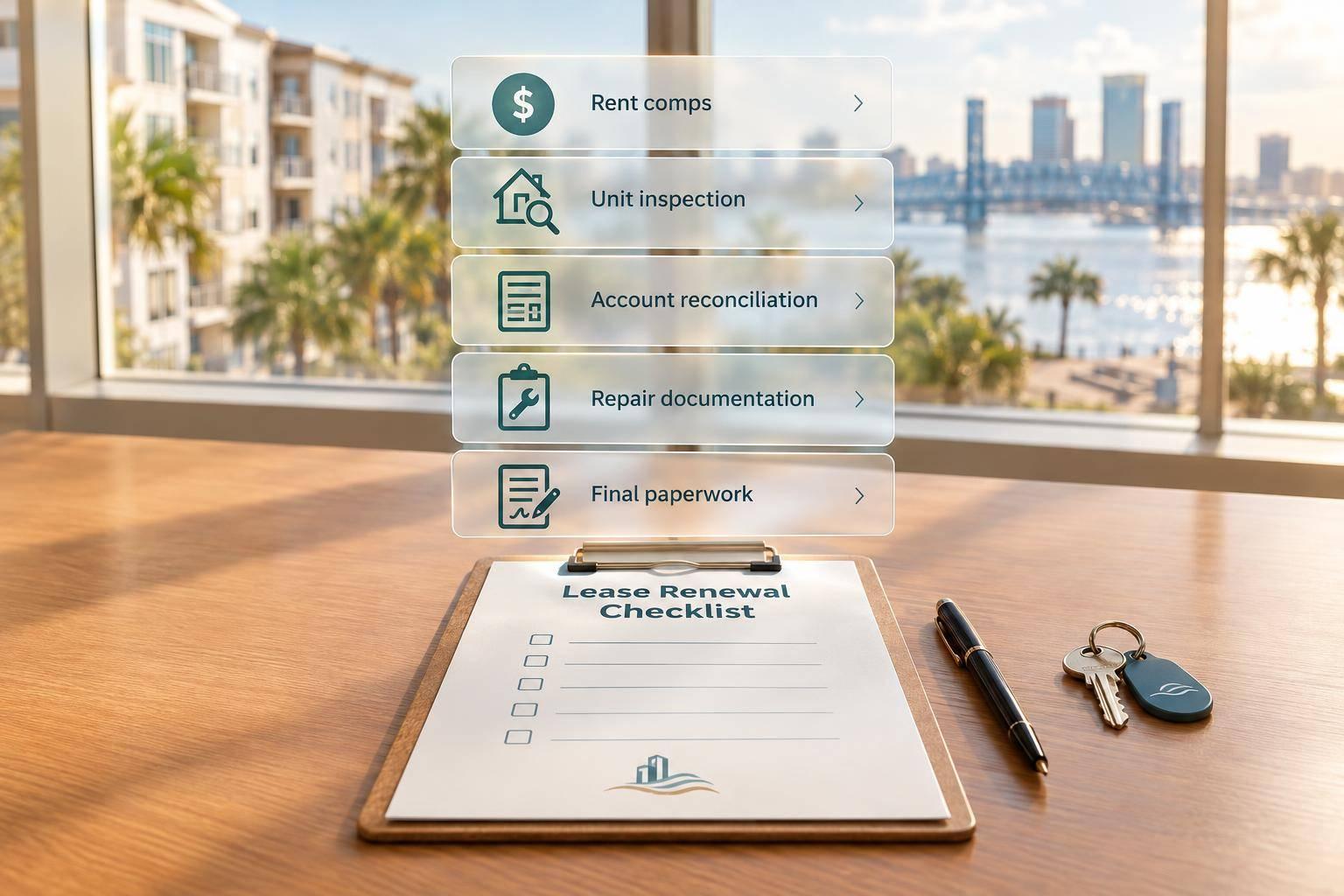
Start Jacksonville lease renewal reviews 60–90 days before expiration – but check legal and lease notice deadlines first. That window gives managers time to set terms, address repairs, and check resident accounts before the next lease begins.
A renewal checklist should cover:
- Dates and notices: Confirm lease terms, delivery rules, and required notice dates.
- Rent and charges: Review 3–5 comparable rentals, calculate costs, and document approved terms.
- Unit condition: Inspect the property, assign repairs, and verify completion.
- Resident accounts and eligibility: Correct ledger errors, check deposits, and review lease compliance and accommodation requests.
- Final paperwork: Collect signatures, deliver the agreement, update billing, and save records.
An internal response deadline does not replace required legal notice. Keep those dates separate, record each decision, and schedule the next review before closing the file.
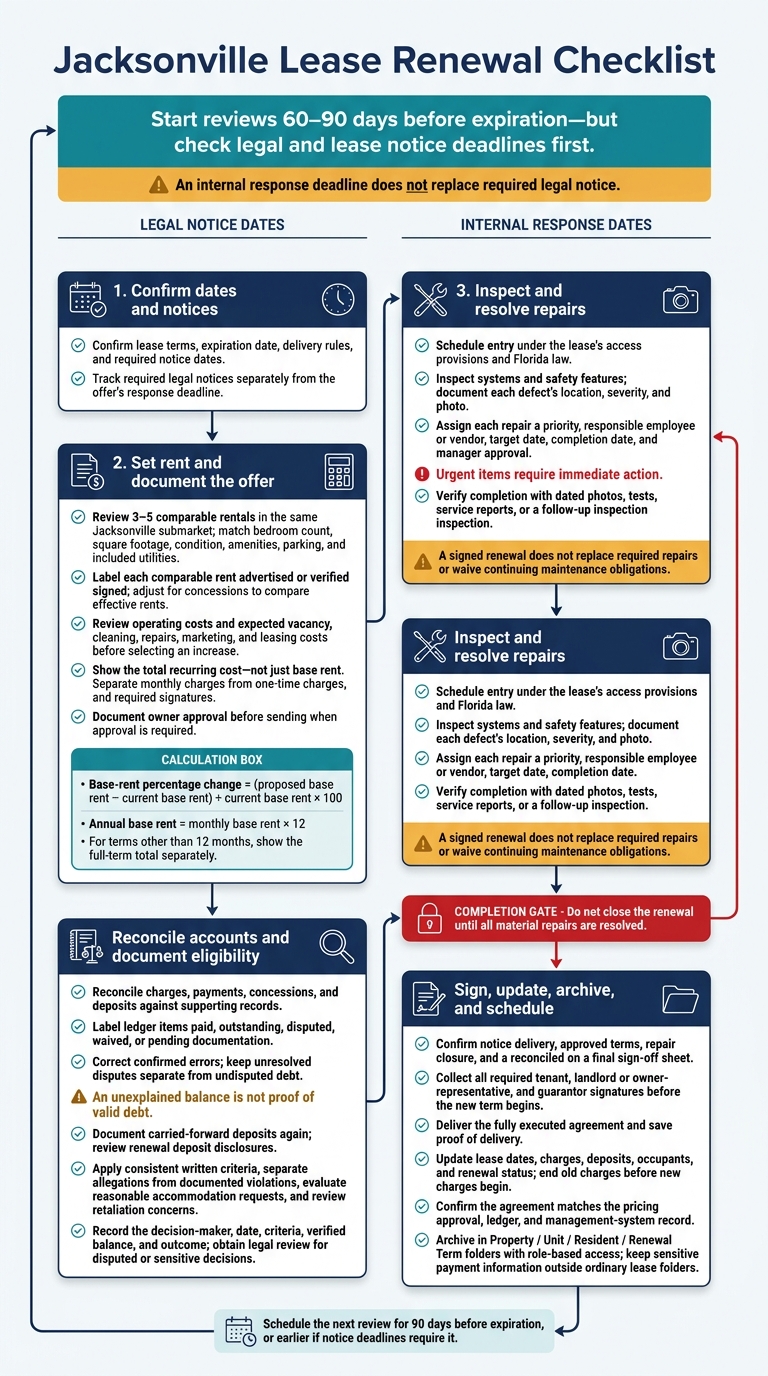
Jacksonville Lease Renewal Checklist
Review Jacksonville Rents and Renewal Charges
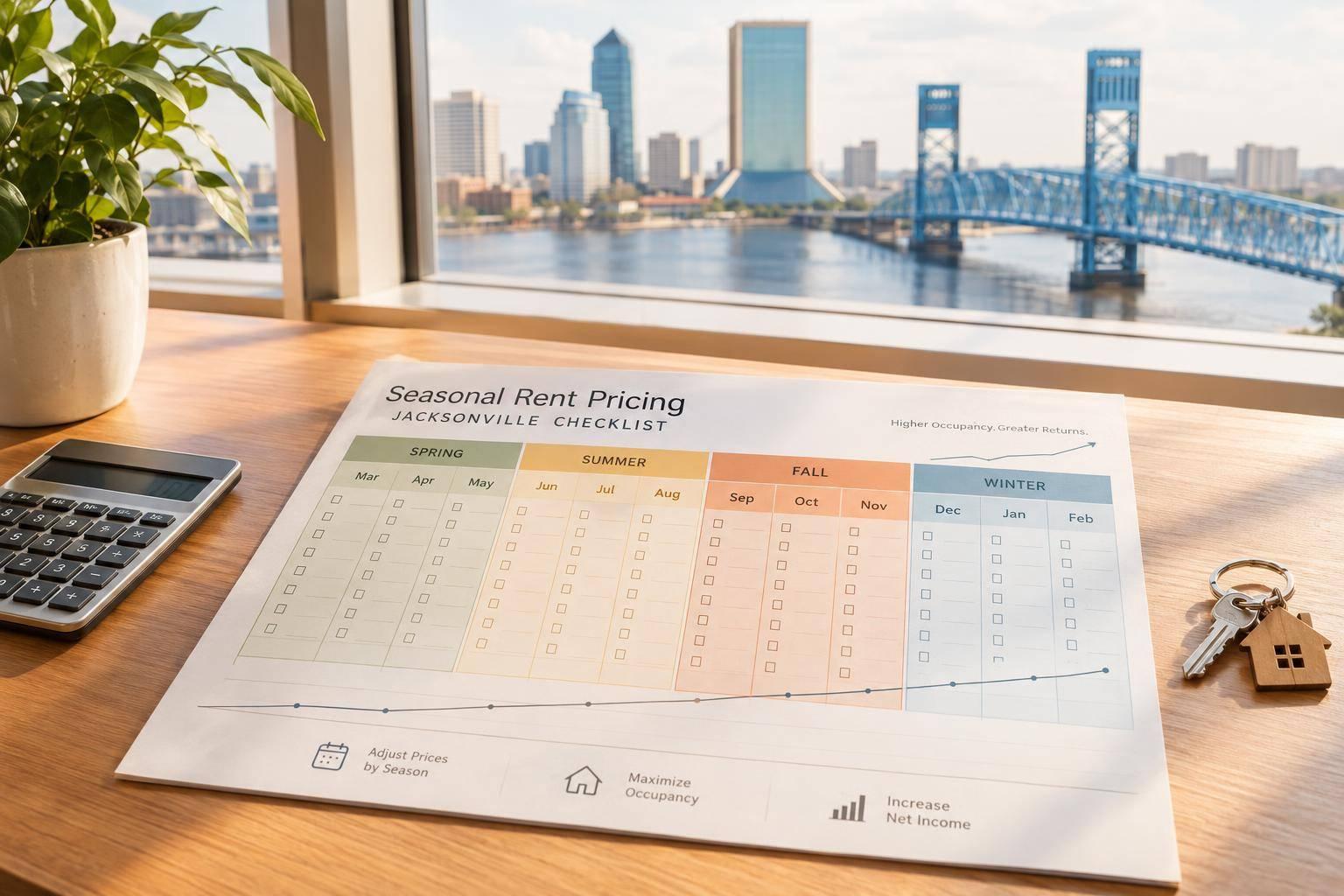
Use the date tracker to set renewal pricing before sending the offer.
Compare Rents and Set Renewal Terms
Gather 3–5 comparable units in the same Jacksonville submarket. Match bedroom count, square footage, condition, amenities, parking, and included utilities. Keep comparisons within like-for-like submarkets.
For each unit, record the property name or address, source, review date, availability date, rent, lease length, concessions, utilities, and pet or parking charges. Label each rent as advertised or verified signed. Adjust for concessions so you compare effective rents on the same basis.
Check the costs before choosing an increase. Review insurance, maintenance, utilities, and the approved budget, plus expected vacancy, cleaning, repairs, marketing, and leasing costs. Weigh those costs against the added annual rent, payment history, and lease compliance.
Apply the same criteria consistently. Do not base pricing on protected characteristics, accommodation requests, or resident complaints. Save your calculations and the reasons behind the pricing decision.
Write the Renewal Offer
Once you’ve set the price, put the full renewal terms in writing.
Show the total recurring cost – not just base rent. Review the lease length, expiring concessions, deposits, pet charges, parking, storage, utility billing, and other recurring fees. Separate monthly charges from one-time charges. Start changes with the new term unless the lease and law allow an earlier change.
Calculate the base-rent percentage change as (proposed base rent − current base rent) ÷ current base rent × 100. To calculate annual base rent, multiply monthly base rent by 12. For terms other than 12 months, show the full-term total separately.
Include the property and unit, current expiration date, proposed start and end dates, effective date, response deadline, concessions, deposit treatment, and every revised charge. State the eligibility requirements, required signatures, and acceptance method.
Document owner approval before sending when approval is required. Keep the approved offer, comparable-rent records, and supporting worksheet in the renewal file.
sbb-itb-73b3b1a
Review Unit Condition and Open Repairs
After setting the price, confirm the unit’s condition before finalizing renewal terms. Review open work orders, recurring complaints, inspection notes, move-in photos, warranty records, and unpaid vendor invoices. Flag repeat problems and log every unresolved item in the tracker below.
Inspect Systems and Safety Features
Schedule entry under the lease’s access provisions and Florida law. Send written notice stating the date, approximate time, and reason for entry. Then document the resident’s response. Emergency access may follow different rules. Check current law or consult counsel if access is disputed or an urgent condition exists.
Check plumbing, electrical fixtures, HVAC operation and filters, appliances, doors, windows, locks, smoke alarms, applicable carbon monoxide alarms, and pest activity. Record each defect’s location and severity, and take a photo.
For Southside Jacksonville apartments, compare moisture issues with past storm reports, insurance claims, roof or exterior invoices, and resident notices. Investigate recurring stains, dampness, and musty odors – don’t just repaint. Document visible moisture and staining only, and use qualified professionals for mold testing or remediation.
Assign Repairs and Track Completion
Separate urgent safety and habitability work from routine repairs and optional improvements. Each work order should include the unit, scope, assigned employee or qualified vendor, authorization limit, access plan, and proof of completion. Enter actual dates in the tracker below. Urgent items require immediate action, not a later appointment.
| Issue | Priority | Assigned person or vendor | Target date | Completion date | Manager approval |
|---|---|---|---|---|---|
| Active plumbing leak | Urgent – property protection/habitability | Licensed plumber | Immediate | Pending | After leak test |
| Failed smoke alarm | Urgent – safety | Qualified technician | Immediate | Pending | After documented test |
| Repeated HVAC condensate overflow | High – recurring maintenance | HVAC contractor | Record actual date | Pending | After diagnostic report and drain check |
| Scuffed living-room walls | Routine or optional improvement | Maintenance team | Record approved date | Pending | Schedule only if approved |
Verify repairs with dated photos, test results, service reports, or a follow-up inspection. Match invoices to approved work, check warranty coverage and duplicate charges, and track unpaid bills separately from repair completion.
A signed renewal does not replace required repairs or waive continuing maintenance obligations. Keep written records of outstanding work, access arrangements, resident communications, and completion dates. Escalate unresolved urgent conditions to the owner and appropriate counsel. Store supporting records and manager approvals in the renewal file.
Once repairs are logged and assigned, check resident balances before issuing the final renewal decision.
Check Resident Balances and Renewal Eligibility
Once repairs are logged, reconcile the resident’s account before issuing renewal terms.
Reconcile Charges, Payments, and Deposits
Compare the resident ledger with the lease, payment receipts, bank records, invoices, notices, and approved adjustments. Review base rent, fees, reimbursements, concessions, returned payments, damage charges, repayment agreements, and collection costs. Label each item as paid, outstanding, disputed, waived, or pending documentation. An unexplained balance is not proof of valid debt.
For each disputed charge, record the amount, charge date, supporting document, resident response, and resolution deadline. Look for misapplied payments, missing concessions, fees charged without permission or legal authority, and unsupported charges. Correct confirmed errors before issuing renewal terms. Keep unresolved disputes separate from undisputed debt, and get owner or legal review before using the account status to justify nonrenewal.
Verify the original deposit amount, any pet or damage deposit, current balance, deductions, notices, where the funds are held, required disclosures, and any interest treatment. Florida Statutes § 83.49 treats a renewal as a new rental agreement, so document any carried-forward deposit again. Review the renewal paperwork and deposit disclosures; don’t assume the original records meet current requirements. Do not automatically apply the deposit to unpaid renewal charges.
Record the Renewal Decision
Use the reconciled ledger and lease file to determine whether the resident qualifies for renewal.
Apply the same written criteria to comparable renewals. For occupant, pet, alteration, and other violations, document the lease clause, incident date, notice served, resident response, cure status, photographs or inspection reports, and any repeat occurrence. Separate allegations from documented violations.
Evaluate reasonable accommodation requests before making the decision. An assistance animal should not be treated as an ordinary pet. Review disability-related modifications and accommodations under applicable fair-housing requirements rather than rejecting them under a blanket policy. Keep disability information confidential.
Check the decision against the resident’s documented history and any protected activity. Florida law prohibits retaliatory rent increases, service reductions, possession actions, or other civil actions when primarily motivated by protected conduct, including certain good-faith housing or code complaints.
Record the outcome: approval, revised terms, a payment plan, a required cure notice, or lawful nonrenewal. Include the decision-maker, date, criteria applied, verified balance, violations considered, and accommodation review.
Payment agreements should state amounts, due dates, default consequences, and any effect on existing notices. Retain notices and proof of delivery. Send disputed or sensitive decisions for legal review before proceeding.
Complete the Final Renewal Checklist
Once pricing, repairs, and balances are approved, complete the renewal file with a final sign-off sheet. Confirm notice delivery, final terms, repair closure, and a reconciled ledger. Include fields for the completion date, assigned employee, unresolved items, and manager approval. Do not close the renewal until all material repairs are resolved.
Get Signatures and Update Lease Records
Check the final agreement against the approved offer. Verify names, property and unit, dates, rent, deposits, fees, concessions, utilities, parking or pet charges, duties, occupants, and addenda.
Collect all required signatures from tenants, the landlord or owner representative, and guarantors before the new term begins. Record signature dates and the delivery method. Give the resident the fully executed agreement, payment instructions, and office and emergency contacts. Save proof of delivery in the lease file.
Update lease dates, recurring charges, deposit records, occupants, and renewal status immediately. End old charges before new charges begin to avoid duplicate billing. Before approving closure, check that the signed agreement matches the pricing approval, ledger, and management-system record.
File Documents and Schedule the Next Review
After all signatures are collected, archive the renewal packet and schedule the next review.
Store offers, approvals, signed agreements, notices, delivery confirmations, inspection reports, work orders, invoices, ledgers, and correspondence in Property / Unit / Resident / Renewal Term folders. Restrict access by job role, maintain backups, and follow applicable retention rules. Keep sensitive payment information outside ordinary lease folders.
Schedule the next review for 90 days before expiration, or earlier if notice deadlines require it. For Jacksonville lease-renewal support, contact 1 Realty Management.
FAQs
What if a tenant misses the renewal deadline?
Follow up promptly to confirm whether the tenant plans to stay, and document every communication. A clear record helps prevent fair housing issues and an unintended shift to a month-to-month tenancy, which can limit your control over lease terms.
If the tenant still doesn’t respond, be ready to start the non-renewal or re-leasing process under Florida law. Serve all required notices within the applicable statutory deadlines.
How much notice must I give for a Jacksonville rent increase?
Your notice deadline depends on your lease and tenancy type. For a fixed-term lease, follow the notice period in your lease, typically 30–60 days before it expires.
For periodic tenancies, Florida law requires written notice before the rental period ends:
- Month-to-month: 30 days
- Week-to-week: 7 days
- Year-to-year: 60 days
Send your notice through an approved delivery method, such as email or mail, and keep proof of delivery.
Can I renew a lease while repairs are pending?
You can start the lease renewal process while repairs are pending. But address outstanding maintenance first to help keep tenants satisfied and more likely to stay. Complete all safety-related work and required repairs before finalizing the new lease.
Use your pre-renewal inspection findings to decide whether the property’s condition supports a rent increase – or whether repairs should come first.