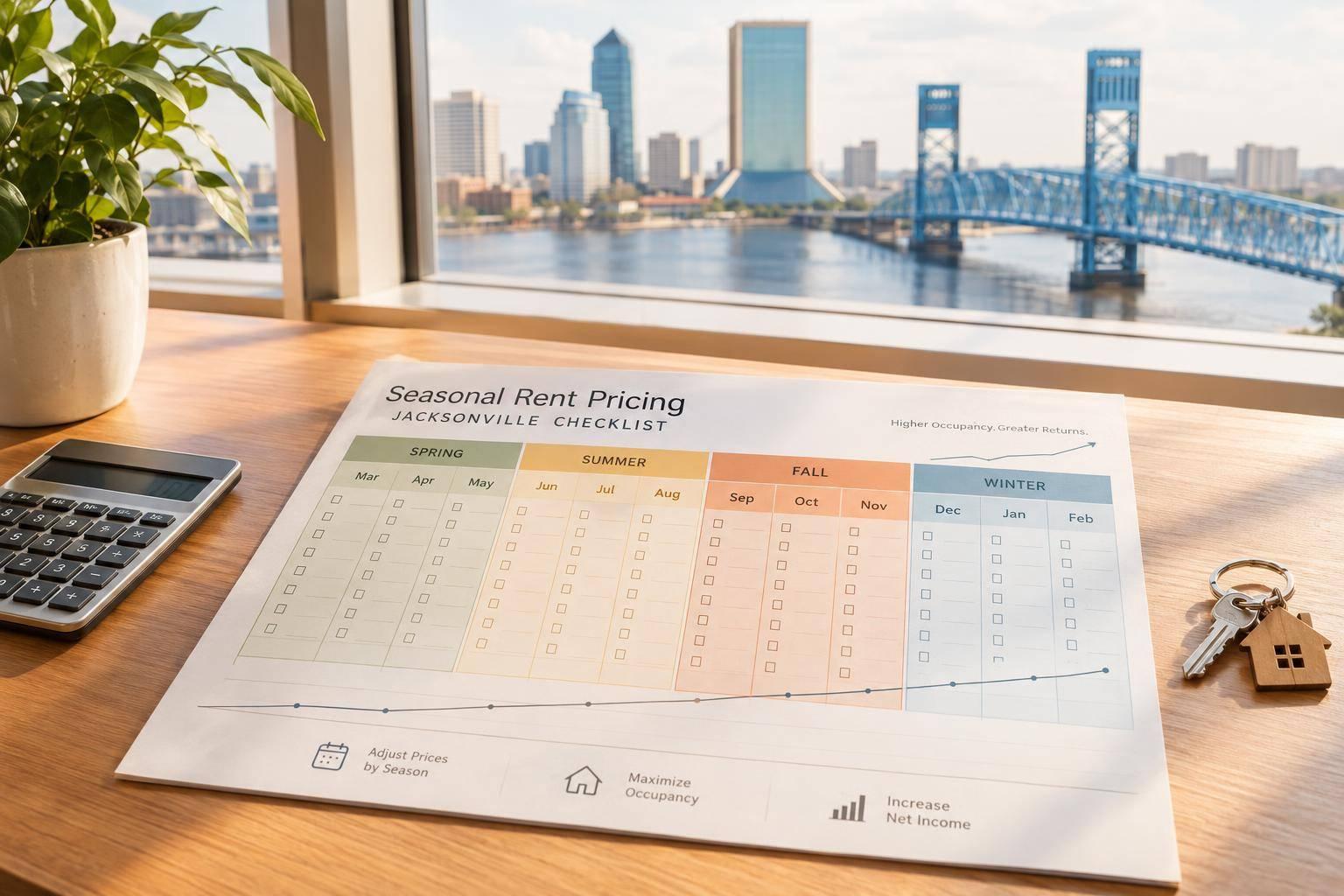
A higher rent can mean less income if the unit sits empty. Before changing seasonal rent in Jacksonville, compare at least 3 similar rentals and calculate expected income over 12 months, including vacancy, concessions, and turnover costs.
Seasonal demand varies by neighborhood and property type. The rent decision should cover:
- Local pricing: Check comparable rents, vacancy, and leasing activity.
- Lease timing: Verify expiration dates, renewal deadlines, and notice rules.
- Property condition: Inspect the unit, budget for repairs, and plan turnover work.
- Income: Compare higher rent, stable rent, and concessions over the same period.
- Marketing: Confirm listing details and review pricing every 7 to 14 days.
- Compliance: Check lease terms, notices, and fair housing rules, and keep dated records.
The goal is more rental income after costs – not just a higher asking price.
Review Jacksonville Rent Comps and Vacancy
Compare at Least 3 Similar Rentals
Document 3 to 8 close matches, grouped by Jacksonville submarket. Compare bedrooms, bathrooms, square footage, property type, condition, parking, amenities, utilities, and furnishing status. Use verified listings. Date each check, save the source, address or listing ID, and unit details, and mark missing information “not reported.”
| Property | Location | Asking rent | Concessions | Condition | Availability date | Days on market |
|---|---|---|---|---|---|---|
| First verified comp | Not reported | Not reported | Not reported | Not reported | Not reported | Not reported |
| Second verified comp | Not reported | Not reported | Not reported | Not reported | Not reported | Not reported |
| Third verified comp | Not reported | Not reported | Not reported | Not reported | Not reported | Not reported |
Asking rent is not signed rent. Record signed rent, lease date, lease term, and incentives separately. If signed rent isn’t available, mark it “not reported.” Calculate effective rent after free-rent periods or credits, and track fees separately. Use these comp ranges to assess whether current vacancy supports a seasonal rent increase.
Check Vacancy and Seasonal Demand
For each report, record the provider, date, reporting period, geography, property type, sample size, and measurement method. Mark any gaps “not reported.” Then check your comps against local vacancy, leasing speed, and demand.
Matthews reported 6.0% Jacksonville metro vacancy in Q3 2026. Cushman & Wakefield reported 90.9% stabilized occupancy in Q2 2026. These figures cover different periods and use different methods, so they aren’t interchangeable. Neither replaces your property’s vacancy days, renewal rate, or listing-to-lease time.
Track nearby inventory, price cuts, concessions, inquiries, showings, applications, and leasing time weekly. Before calling a change seasonal, compare at least 12 months of activity with school calendars, relocation cycles, coastal demand, and new apartment deliveries.
Use market vacancy as a filter – not as the basis for your unit’s rent. Set pricing from comp rent, leasing speed, and renewal risk. Increase rent only when verified comp rents and current leasing activity support it. Hold when the data conflict. Use a concession when effective comp rents are lower and vacancy risk is higher. Review pricing every 7 to 14 days, rather than every few days.
sbb-itb-73b3b1a
Check Lease Timing and Property Condition
Once the market supports a rent change, check the lease timeline and the unit’s condition before setting the new price.
Record Lease End Dates and Renewal Deadlines
Record each unit’s current rent, lease type, start and expiration dates, renewal deadline, notice requirement, and any rent increase clause. A fixed-term lease generally keeps rent unchanged until expiration unless the lease permits a change or the tenant agrees. For month-to-month tenancies, provide the required written notice before the new rent takes effect. Florida’s termination rule generally requires at least 30 days’ notice before the monthly period ends.
Price renewals and vacant units separately. Renewal pricing should account for the risk of losing the tenant. Vacant-unit pricing should reflect current comparable properties and the move-in date. Weigh the higher rent against vacancy, turnover costs, and tenant-loss risk.
Create a 12-month lease expiration calendar and flag months when several leases end. When allowed, offer 10-, 12-, or 14-month renewals to shift expirations away from slower months. Put any agreed changes in writing.
### Inspect the Unit and Budget for Repairs
Follow a rental property maintenance checklist to evaluate the HVAC system and filters;
Inspect the HVAC system and filters; water heater; plumbing; appliances; outlets and lighting; doors, locks, windows, and screens; smoke alarms; flooring, paint, and cabinets; landscaping; parking; and common areas. Check for pests, moisture, and mold, too. Save dated photos and work orders, then compare the unit’s condition with your selected comparable properties.
Separate required repairs from routine maintenance and upgrades. Give each item a cost, vendor, and due date. Don’t delay safety work or required repairs to test a higher rent. Use the inspection findings to decide whether the unit supports a higher seasonal rate or needs repairs first.
Schedule Turnover Work and Marketing
Work backward from the move-in date. Inspect before the renewal decision, send the renewal offer within the lease notice period, and confirm the tenant’s choice. Then complete repairs, photograph the market-ready unit, publish the listing, and begin showings with proper tenant coordination and notice.
Prepare listing copy and marketing materials before the unit becomes vacant, but don’t advertise a move-in date that depends on unfinished work. Allow time for vendor delays and review pricing before vacancy drags on. For multi-unit properties, stagger overlapping turnovers so the workload fits your maintenance team’s capacity.
Choose Rent and Review Marketing and Legal Requirements
Jacksonville Rent Pricing: Higher Rent vs. Higher Income
Once you’ve checked comps, vacancy, lease timing, and condition, use that data to set your final asking rent.
Compare Rent Options and Vacancy Costs
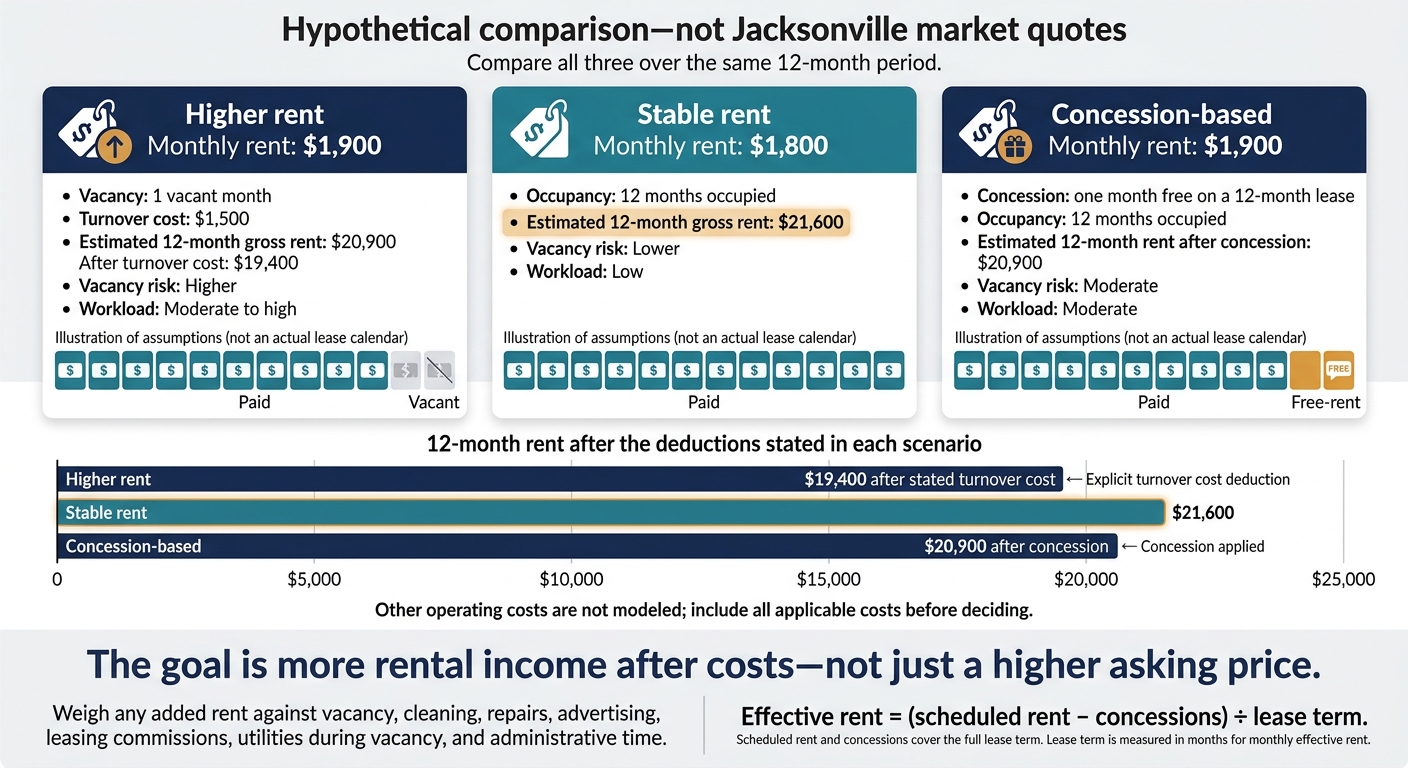
Test three pricing paths against your verified comp range: higher rent, stable rent, or a concession. Factor in the unit’s condition, concessions, vacancy risk, and expected leasing time. Compare all three over the same 12-month period.
Hypothetical comparison – not Jacksonville market quotes
Strategy Hypothetical assumptions Estimated 12-month gross rent Vacancy risk Workload Higher rent $1,900 per month; 1 vacant month; $1,500 turnover cost $20,900; $19,400 after turnover cost Higher Moderate to high Stable rent $1,800 per month; 12 months occupied $21,600 Lower Low Concession-based $1,900 per month; one month free on a 12-month lease; 12 months occupied $20,900 after concession Moderate Moderate
Weigh any added rent against vacancy, cleaning, repairs, advertising, leasing commissions, utilities during vacancy, and administrative time.
Effective rent = (scheduled rent − concessions) ÷ lease term.
Compare shorter leases separately. Another vacancy and turnover within the evaluation period can wipe out a seasonal rate’s advantage.
Prepare Listings and Set Pricing Review Triggers
Once the unit is market-ready, publish facts that support your chosen price. Check photos, unit details, fees, lease terms, and screening criteria before the listing goes live.
Disclose rent, security deposit, permitted fees, utilities, amenities, pet terms, application requirements, lease length, and furnishing status. Show concessions separately from the rent actually due.
Set a pricing review date, generally 7 to 14 days after publication, based on time on market and vacancy risk. Review sooner if you see any of these triggers:
- Fewer than five qualified inquiries in 7 days.
- No showing in 10 days.
- No application after several showings.
- A sharp rise in competing listings.
Decide your response in advance: improve photos, tighten the copy, adjust rent by $50, offer a documented concession, or review showing access. Track cancellations and new comparable inventory, too.
Check Notices, Lease Terms, and Fair Housing Rules
Before sending notice or publishing the listing, check the legal requirements that apply to the new rent.
When a lease has no stated term, Florida generally ties notice rules to the rent-payment period. Before issuing a rent change, verify the notice, delivery, and effective-date rules for that lease type. Check applicable Jacksonville requirements and confirm that the increase is not retaliatory.
Use the same pricing, screening, and showing rules for every applicant, and apply concessions consistently. HUD guidance prohibits rental advertising preferences or limitations based on protected characteristics, including in advertising content and targeting.
Keep dated comps, inspection findings, calculations, listing screenshots, notices, delivery confirmations, and tenant communications together. Record who approved the change, the decision date, the effective date, and the business reason. Finalize the rent change only after compliance is cleared.
Conclusion: Your Final Rent-Change Checklist
Before you publish the new rent, check the numbers, timing, and compliance. Change rent only when the data support it.
☐ Reviewed at least three comparable Jacksonville rentals.
☐ Confirmed current demand and vacancy support the new rent.
☐ Verified lease-end, renewal, and required notice dates.
☐ Completed the unit inspection.
☐ Completed or scheduled rent-ready work.
☐ Modeled the pricing plan and vacancy tradeoff.
☐ Prepared the marketing calendar.
☐ Checked notice, listing, and screening compliance.
☐ Filed supporting records.
Label the checklist with the address, unit type, review date, proposed rent, effective date, and approver. Leave unresolved items unchecked.
For Jacksonville pricing analysis, property marketing, maintenance coordination, and lease-renewal support, contact 1 Realty Management.
FAQs
What if I can’t find similar Jacksonville rentals?
Extend your search to nearby ZIP codes with similar property types, amenities, and geographic features. If local data is limited, look at citywide inquiry patterns to get a better sense of demand.
Focus on leases signed in the past 60 to 90 days, not current asking prices. Professional property management resources can help you access Northeast Florida MLS data on actual lease prices, giving you a more reliable benchmark.
How do I calculate my break-even vacancy period?
Add up your turnover costs: marketing, cleaning, repairs, and rent lost while the property sits vacant. Divide the total by the monthly rent increase. That tells you how many months the new tenant must stay for the increase to cover those costs.
For example, a two-month vacancy at $1,800 per month costs $3,600 in lost rent. A $200 monthly increase takes 18 months to cover that loss alone – and longer once you add the other turnover costs.
How can I test seasonal rent without losing tenants?
Avoid sudden cuts to base rent. Check your lease and follow Florida’s notice rules. Support your pricing with recently signed Jacksonville leases – not just active listings – and records of property costs and upkeep. Keep annual increases modest, often 3–5% for good tenants.
Try short-term move-in concessions or phased increases before making large, permanent changes. Begin renewal outreach about 120 days before the lease ends so you can review results early.