
If you own property in Jacksonville, understanding how property taxes work is essential. Here’s the key takeaway: Your property tax is based on its assessed value as of January 1 each year, determined by the Duval County Property Appraiser. This value is used to calculate your tax bill, which includes ad valorem taxes (based on property value) and non-ad valorem fees (flat charges for services).
Quick Facts:
- Tax Cycle: TRIM notices in August, bills in November, payment due by March 31.
- Early Payment Discounts: Save 4% if paid in November, decreasing monthly to 1% in February.
- Appeals: File within 25 days of receiving your TRIM notice if you disagree with your assessment.
- Exemptions: Limited for landlords—even in investor-friendly areas like Westside Jacksonville—but owner-occupied properties may qualify for benefits like the Homestead Exemption.
For landlords, including those utilizing Southside property management, accurate assessments directly impact cash flow and compliance. Stay ahead by reviewing your property details annually, filing required forms on time, and taking advantage of early payment discounts. Below, we’ll cover how assessments work, tax calculations, exemptions, and the appeal process in detail.
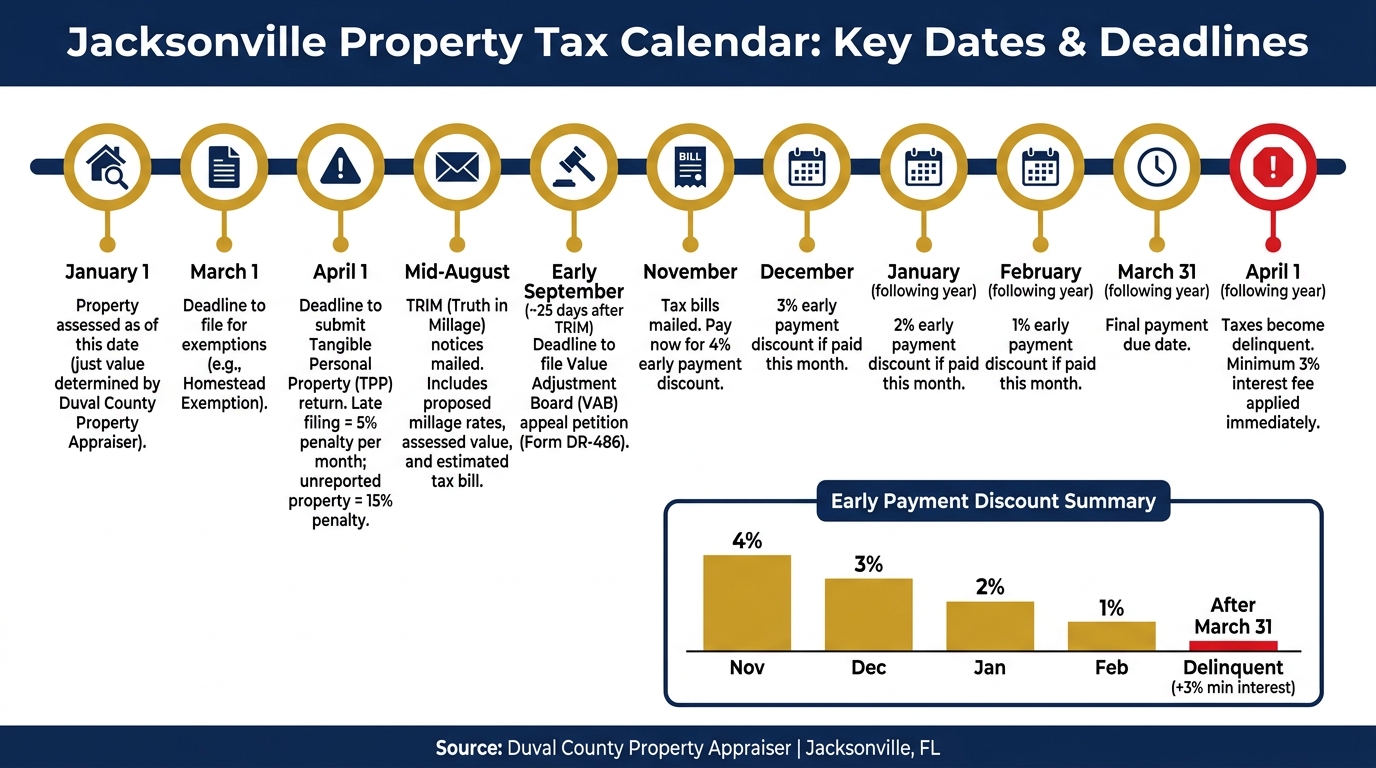
Jacksonville Property Tax Calendar: Key Dates & Deadlines
How Property Taxes Are Assessed in Jacksonville
The Role of the Duval County Property Appraiser
In Jacksonville, the Duval County Property Appraiser – currently Joyce Morgan, CFA – is tasked with valuing all properties in the county annually. This independently elected official determines the “just value” of properties, which is Florida’s term for fair market value as of January 1 each year. This valuation serves as the foundation for calculating property taxes. According to the Property Appraiser’s office:
“Our primary mission is to ensure fair and equitable property valuations that comply with Florida law, supporting local government services such as public schools, fire departments, and infrastructure.”
It’s important to note that the Property Appraiser does not set the tax rates. Instead, agencies like the Jacksonville City Council and the Duval County School Board establish millage rates. By law, every property in the county must be inspected at least once every five years. Between these inspections, tools like aerial photography and a Computer-Assisted Mass Appraisal (CAMA) system help keep property values up to date.
Now, let’s look at the factors that influence these valuations.
Factors That Affect Property Value Assessments
When determining a property’s “just value”, the Duval County Property Appraiser follows Florida Statute §193.011, which outlines eight specific criteria. Here are some key factors that play a role:
- Market Data: Includes recent comparable sales, location, and neighborhood trends.
- Physical Characteristics: Looks at details like square footage, the year the property was built, land size, and the number of rooms.
- Improvements: Considers additions such as pools, patios, fences, and the overall condition of the property.
- Economic Factors: Includes replacement costs and income potential for properties that generate revenue.
While “just value” represents the market value, the “assessed value” is adjusted based on statutory caps. For instance, non-homesteaded properties are subject to a 10% annual cap on assessed value increases. This cap helps provide some consistency in tax bills, even when market values fluctuate.
To avoid errors in your property assessment, it’s a good idea to verify your property details online. Since physical inspections only take place every five years, inaccuracies can sometimes go unnoticed.
sbb-itb-73b3b1a
How Property Taxes Are Calculated in Jacksonville
Breaking Down the Tax Calculation Formula
Once your property’s value is assessed, figuring out your tax bill is fairly simple. The basic formula looks like this:
Taxable Value × Millage Rate = Total Ad Valorem Tax
To get the taxable value, you start with the just value (essentially the market value) determined by the Duval County Property Appraiser. From there, assessment caps lower the just value to the assessed value, and exemptions – like the Homestead Exemption – reduce it further. The result is your taxable value, which is the number the millage rate is applied to.
Here’s an example: If a rental property has a taxable value of $100,000 and the combined millage rate is 18 mills, the ad valorem tax would be $1,800.
However, there’s more to your tax bill than just this formula. Non-ad valorem assessments – flat fees for specific services like waste collection or stormwater management – are added to the final amount. These fixed fees, while separate from ad valorem taxes, contribute to your total tax obligation.
| Component | What It Means |
|---|---|
| Just Value | Market value of the property as of January 1 |
| Assessed Value | Just Value minus any assessment caps |
| Taxable Value | Assessed Value minus exemptions |
| Millage Rate | Tax rate per $1,000 of taxable value |
| Non-Ad Valorem | Fixed fees for services added to the tax bill |
Now, let’s take a closer look at how millage rates influence your overall property tax.
Jacksonville Millage Rates Explained
The millage rate is the percentage applied to your taxable value to calculate your property tax. One mill equals $1 in tax for every $1,000 of taxable value. Your total millage rate combines rates from various taxing authorities, like the City of Jacksonville, the Duval County School Board, and other special districts. Each of these entities sets its rate based on their budget requirements, and the rates are added together to determine your total.
In August, you’ll receive a Truth in Millage (T.R.I.M.) notice in the mail. This notice includes proposed millage rates, your property’s assessed value, and an estimate of your tax bill. If you disagree with the assessment, you have 25 days from the mailing date to file a petition with the Value Adjustment Board.
Florida property taxes are paid in arrears. For instance, a bill sent in November 2026 covers the tax period from January 1 to December 31, 2026. Paying early can save you money through discounts: 4% in November, 3% in December, 2% in January, and 1% in February. For landlords handling multiple properties, these early payment discounts can lead to noticeable savings. But be aware – any taxes unpaid by March become delinquent on April 1, and a 3% minimum interest fee is applied immediately.
Exemptions and Caps That Lower Your Property Tax Bill
Exemptions and caps can help reduce your property tax bill, but they generally apply only to owner-occupied properties. For rental properties, these benefits are limited, making accurate property assessments especially critical to protecting your investment.
Homestead Exemption: Eligibility and Benefits
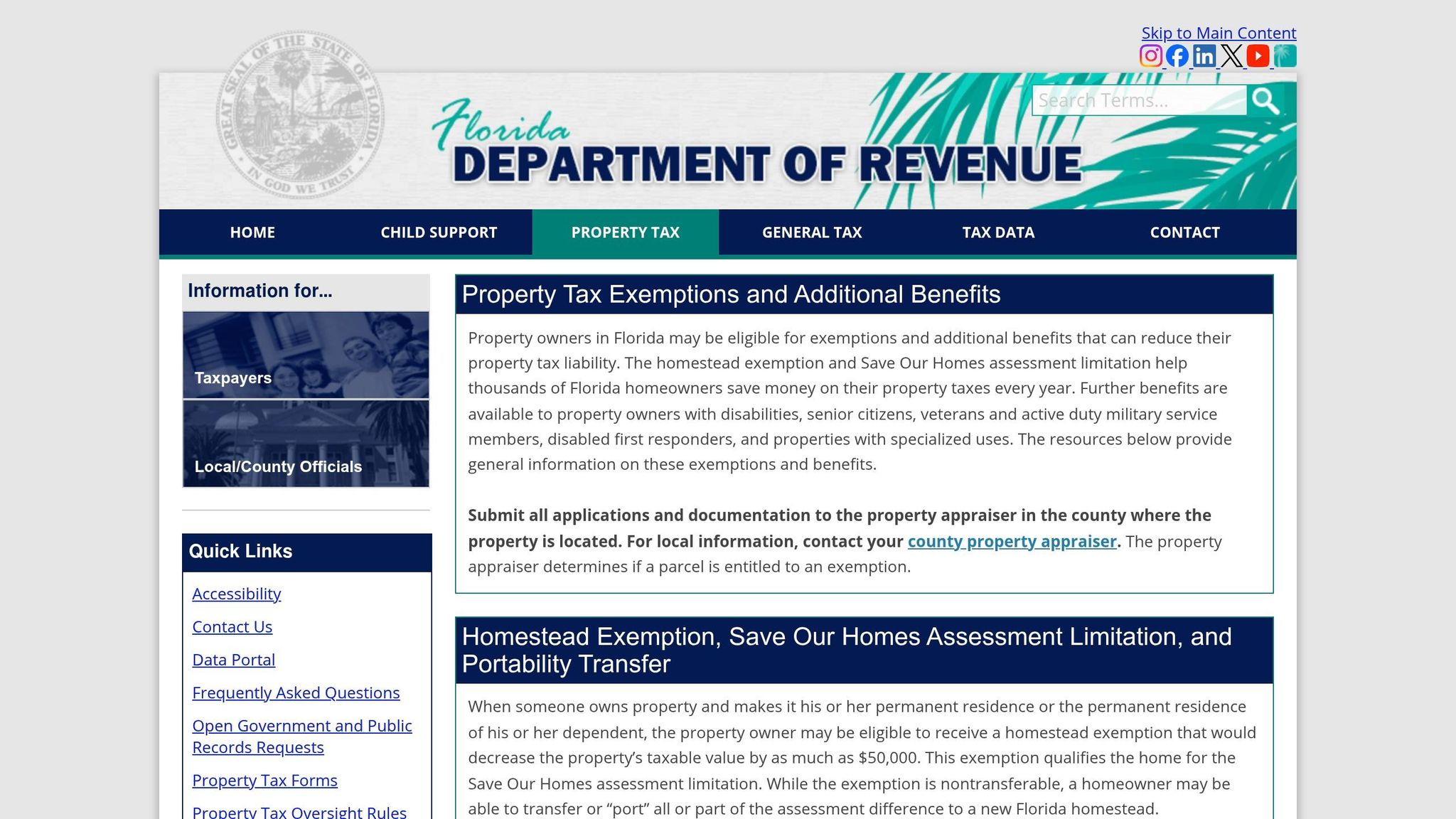
The Homestead Exemption allows up to $50,000 to be deducted from the taxable value of a primary residence as of January 1. However, this exemption does not apply to standard for-profit rental properties.
If you own a multi-family property and live in one of the units, you can claim the Homestead Exemption for the portion you occupy. While this is a partial benefit, it can still make a noticeable difference in your tax bill.
For non-profit landlords, properties used for affordable housing or as homes for the elderly may qualify for institutional exemptions, provided income requirements are met ($42,758 for single individuals and $48,003 for couples in 2026). Additionally, owners of historic properties may be eligible for a Historic Preservation Exemption through the City of Jacksonville. Most exemptions must be filed by March 1, but late applications may be accepted up to 25 days after mid-August tax notices are sent.
How the Save Our Homes Cap Works
The Save Our Homes (SOH) cap, a constitutional protection in Florida, limits annual increases in the assessed value of homesteaded properties to 3% or the Consumer Price Index (CPI), whichever is lower. Without this cap, rising property values could lead to steep tax increases over time.
“The exemption also includes the valuable ‘Save Our Homes’ benefit, which caps your annual assessment increases at 3% or the Consumer Price Index, whichever is lower, protecting you from dramatic tax increases even as property values rise rapidly.” – Jacksonville Property Tax Guide 2026
For 2026, the total homestead exemption in Jacksonville, adjusted for inflation under Amendment 5, amounts to $51,411. The SOH benefit is the difference between the property’s market value and its capped assessed value. However, when a property is sold, the cap resets, and the new owner’s assessed value is based on the full market value starting the following year.
It’s important to note that renting out a homesteaded property for more than 30 days per year for two consecutive years can result in the loss of exemption status. If you’re thinking about using a homesteaded property for short-term rentals, it’s best to contact the Duval County Property Appraiser’s office for guidance before moving forward.
Next, we’ll dive into how to challenge a property tax assessment if you believe your property valuation is incorrect.
How to Appeal a Property Tax Assessment in Jacksonville
Getting your property assessment right is crucial for managing your tax bill. If you notice discrepancies in your assessed value, you have the option to appeal – but timing is everything.
When Filing an Appeal Makes Sense
You might consider an appeal if your assessed value is higher than your property’s market value as of January 1, if there are errors in the data (like incorrect square footage or misclassification), if your property is valued inconsistently compared to similar properties, or if damage to your property that lowers its value has been overlooked. For rental property owners, these errors can add up to higher tax bills over time. Once you identify an issue, follow these steps to file your appeal.
Steps to File a Property Assessment Appeal
When you receive your TRIM (Truth in Millage) notice in mid-August, carefully review the details. If you spot errors – like incorrect bedroom counts or lot sizes – contact the Property Appraiser’s Office at 904-255-5900. If the informal review doesn’t resolve the issue, you can file a formal petition with the Value Adjustment Board (VAB). Keep in mind that you have only 25 days from the TRIM notice mailing date (usually around early September) to submit Form DR-486. Missing this deadline means losing your chance to appeal for the year.
Here’s a quick look at the appeal timeline:
| Stage | Action | Timeline |
|---|---|---|
| Informal Review | Contact the Property Appraiser’s Office at 904-255-5900 | Right after receiving the TRIM notice |
| Formal Petition | Submit Form DR-486 with the VAB | Within 25 days of TRIM mailing |
| Evidence Exchange | Provide supporting documents like sales data, photos, or appraisals | Before your VAB hearing |
| VAB Hearing | Present your case to a Special Magistrate | Scheduled after petition filing |
| Tax Payment | Pay 75% of ad valorem and 100% of non-ad valorem taxes by April 1 | Before April 1 (delinquency date) |
At the VAB hearing, a Special Magistrate – usually a certified appraiser or attorney – will review your evidence and make a recommendation. The key to a strong case is presenting clear, persuasive evidence. This might include recent comparable sales, an independent appraisal, photos showing property damage, or records of rental income and expenses. As noted by Jimerson Birr:
“The burden of proof lies with the property owner, so gathering and presenting persuasive evidence to support your case is essential.”
To keep your petition active, make sure to pay 75% of your ad valorem taxes and 100% of non-ad valorem taxes by April 1. If the VAB rules in your favor, your property’s taxable value will be adjusted, and you could receive a revised tax bill or even a refund. Successfully appealing ensures your assessed value reflects the actual market value, leading to a fairer tax bill.
Online Tools for Managing Property Tax Assessments
Keeping track of your property tax assessments throughout the year doesn’t have to be overwhelming. The Duval County Property Appraiser’s website provides several free online tools to make the process easier.
Tools Available on the Duval County Property Appraiser Website
One of the most useful tools is the Real Estate Property Search, which gives you access to detailed records for any property in Duval County. You can find current assessed values, historical data, and your TRIM Property Record Card (PRC) – a critical document for calculating your assessment. If you’re planning to file an appeal with the Value Adjustment Board (VAB), you’ll need to download your PRC here, as the VAB no longer sends out physical copies to petitioners.
Another helpful resource is the Tax Estimator, which calculates your potential tax bill based on the current millage rates. This is especially handy if you’re considering buying a rental property or preparing your budget for the upcoming tax year.
Additional tools include the Online Homestead Exemption Application, which must be submitted by March 1 each year, and the Property Fraud Alert system. This fraud alert, in partnership with the Duval County Clerk‘s office, notifies you within 48 hours if any document is recorded under your property’s name. As Duval County Property Appraiser Joyce Morgan explains:
“We are happy to be able to promote the link for signing up on our website to help our taxpayers combat criminals who desire to falsely take possession of their property.”
Here’s a quick summary of the key tools available:
| Tool | What It Does |
|---|---|
| Real Estate Property Search | Access assessed values, historical data, and TRIM cards |
| Tax Estimator | Calculate your tax bill with current millage rates |
| Online Homestead Exemption Application | File for Homestead Exemption and Portability benefits |
| Tangible Property Search | View assessments for rental furnishings and business equipment |
| Property Fraud Alert | Get alerts within 48 hours for documents recorded under your property name |
For boundary-related decisions, remember to consult a licensed surveyor.
These tools not only simplify the process of managing your property tax assessments but also help you stay prepared when professional assistance is needed.
How 1 Realty Management Can Help

While these online tools are incredibly useful, managing assessments, exemptions, and deadlines for multiple properties can still be a lot to handle. That’s where 1 Realty Management steps in. They assist Jacksonville landlords by monitoring these resources, ensuring assessments are accurate, identifying potential errors, and confirming that exemptions like the Save Our Homes cap are applied correctly. Their financial reporting and compliance services provide landlords with a clearer understanding of how property taxes fit into the overall costs of owning rental properties in Jacksonville.
Key Takeaways for Jacksonville Landlords
Jacksonville property taxes are determined based on the assessed value as of January 1, which is set by the Duval County Property Appraiser. If you spot any discrepancies in your assessment, this is the office to contact. By understanding key deadlines and early payment incentives, landlords can take advantage of opportunities to save money. Working with the right property management company can help ensure these critical dates are never missed.
Here’s what you need to keep in mind:
- March 1: Deadline to file for exemptions.
- April 1: Deadline to submit your Tangible Personal Property (TPP) return.
- Mid-August: Review your TRIM (Truth in Millage) notice and decide if you need to file an appeal. Appeals must be submitted by the early September Value Adjustment Board (VAB) deadline.
Missing these deadlines can be costly. Late TPP filings result in a 5% penalty per month, while unreported property incurs a 15% penalty. On the other hand, paying your taxes early can lead to savings: 4% in November, 3% in December, 2% in January, and 1% in February.
FAQs
Why can my tax bill rise even if my rental property didn’t change?
Your property tax bill might go up even if your rental property’s market value doesn’t change. This can happen for several reasons, such as higher assessed values, increased tax rates, or adjustments in local government budgets. Additionally, exemptions play a role. If exemptions are reduced or denied, the taxable value of your property increases, which can lead to a higher tax bill, regardless of what the market value shows.
What evidence works best to lower my assessed value in an appeal?
The most compelling evidence to support your case includes proof of errors in the assessed value, documentation of any property changes, or recent comparable sales demonstrating a lower property value. To begin, reach out to the Duval County Property Appraiser’s Office for an informal review. If that doesn’t resolve the issue, you can file a formal petition with the Value Adjustment Board. Make sure to do this within 25 days of receiving your Notice of Proposed Property Taxes and include the $15 non-refundable filing fee.
Do improvements like a new roof or renovations affect my assessment right away?
Improvements such as adding a new roof or completing renovations usually don’t influence your property assessment right away. That’s because property assessments are determined based on the property’s value as of January 1 each year. On top of that, assessment limits can cap how much the assessed value can rise, even if you’ve made upgrades.