

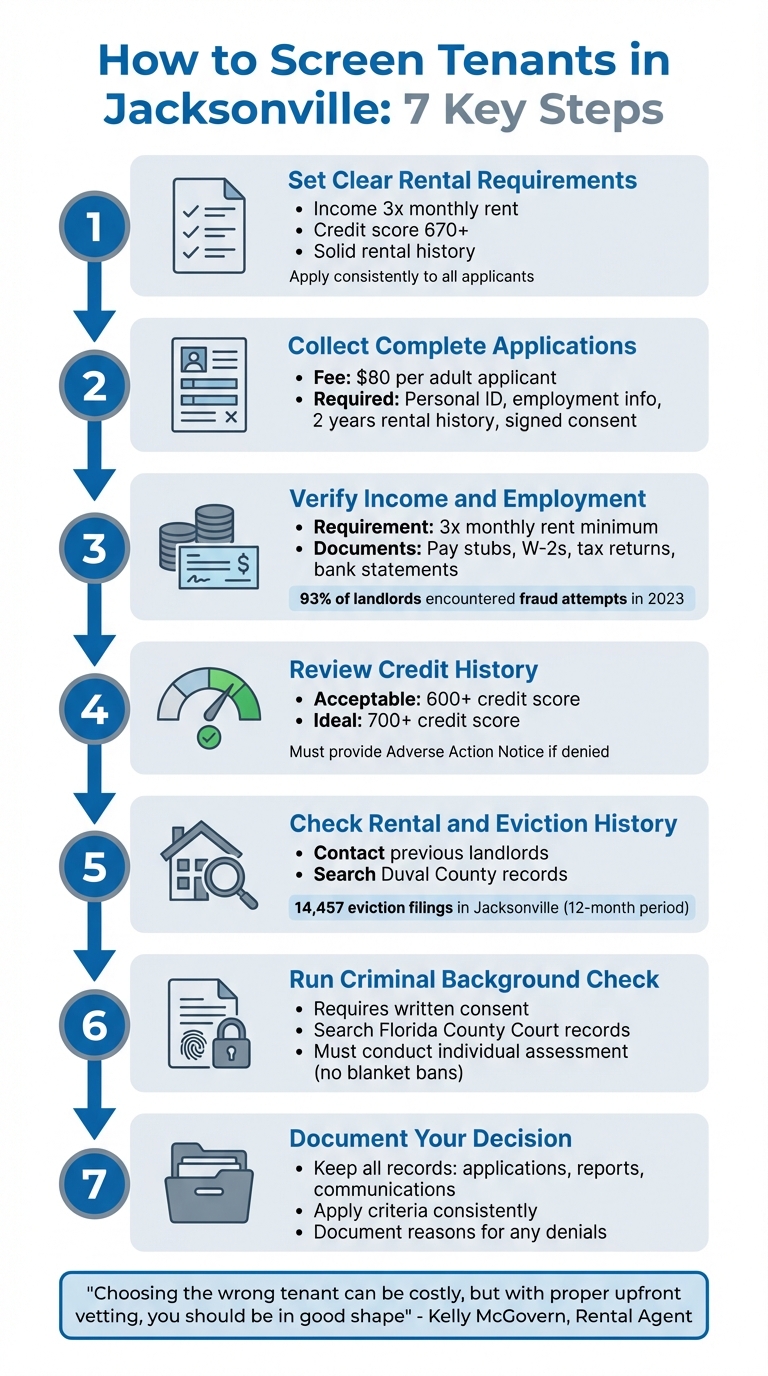
Finding the right tenant for your Jacksonville rental property is key to avoiding late payments, property damage, or legal issues. Here’s a quick summary of the steps to ensure a smooth and fair screening process:
- Set Clear Rental Requirements: Define objective criteria like income (3x monthly rent), credit score (ideally 600+), and rental history. Communicate these upfront and apply them consistently.
- Collect Complete Applications: Use a standardized form to gather personal, employment, and rental history details. Include a signed consent for background checks.
- Verify Income and Employment: Confirm income through pay stubs, tax returns, or bank statements. Contact employers directly to validate job status.
- Review Credit History: Check credit reports for payment patterns and debt levels. Scores of 670+ are often acceptable, with 700+ being ideal.
- Check Rental and Eviction History: Contact previous landlords and search public records for eviction filings in Duval County.
- Run a Criminal Background Check: With written consent, review criminal records while adhering to fair housing guidelines.
- Document Your Decision: Keep detailed records of all steps to ensure compliance with federal and Florida fair housing laws.
Caption text
Step 1: Set Clear Rental Requirements
Establish Minimum Standards
The first step in a thorough tenant screening process is setting clear, measurable rental requirements. These could include factors like verifiable income, steady employment, a solid credit score, a reliable rental history, and criminal background checks. The key here is to stick to objective criteria – steering clear of subjective judgments or assumptions.
When it comes to criminal background checks, follow HUD guidelines, which recommend assessing the nature, severity, and timing of any offenses. Also, keep in mind that assistance animals are not considered pets. They must be evaluated under Fair Housing guidelines, not standard pet policies.
“Clear written standards help keep screening fair and defensible. They also outline what you evaluate, such as financial stability or rental history, and what you must avoid, such as assumptions or personal judgments.”
By defining these standards upfront, you lay the groundwork for a fair and transparent evaluation process.
Communicate Requirements Clearly
Make sure your rental requirements are clearly stated in your listings. Use standardized application forms and focus property tours on verifying the applicant’s documented qualifications. Avoid asking informal or unnecessary questions, especially those that could relate to protected classes. Being upfront about your criteria ensures a smooth transition to the screening process.
Maintain Consistency Across Applications
Both the Federal Fair Housing Act and the Florida Fair Housing Act strictly prohibit discrimination based on factors like race, color, national origin, religion, sex, familial status, or disability. That means every applicant must be evaluated using the same set of standards and procedures.
Keep detailed records of all decisions and communications throughout the process. Documenting everything helps protect against claims of unfair treatment, ensuring that all applicants are judged solely on their qualifications rather than subjective biases.
sbb-itb-73b3b1a
Step 2: Collect Complete Rental Applications
To properly evaluate potential tenants, you need a complete rental application from every adult applicant (18+). In Jacksonville, the typical application fee is $80.00 per adult, which helps cover the costs of background and credit checks. This fee not only offsets your screening expenses but also ensures you’re dealing with applicants who are serious about renting.
Rental applications serve two purposes: they gather the information necessary to assess the applicant’s qualifications and provide written consent for conducting background checks. Without this signed consent, you cannot legally access credit reports, criminal records, or eviction histories. Make it clear in your process that incomplete applications or unverifiable details will result in rejection.
What Information to Request
Once you’ve established your application standards, be specific about the details you need to evaluate each applicant thoroughly.
Start with personal identification details like their full legal name, date of birth, and Social Security Number. These details are essential for running accurate credit and criminal checks. Next, gather employment information, including the applicant’s current employer, job title, length of employment, and gross monthly income. For self-employed applicants, request their last two years of tax returns instead of pay stubs.
Residential history is just as crucial. Ask for at least two years of verifiable rental history, including previous addresses, landlord contact information, and reasons for leaving past properties. This gives you the chance to contact previous landlords to learn more about the applicant’s behavior as a tenant. Be sure to also include questions about the number of occupants (limit two per bedroom) and detailed pet information if applicable.
This structured approach aligns with the uniform evaluation process outlined in Step 1.
Verify Identity to Prevent Fraud
After collecting all the necessary background details, it’s vital to confirm each applicant’s identity to avoid fraud.
Request government-issued photo identification from every adult applicant. Acceptable forms include a driver’s license, state ID, or passport, and ensure the details match the information provided on the application.
The Social Security Number is particularly important because it’s required for pulling credit reports and conducting criminal background checks. Without a valid SSN, you won’t be able to verify financial or legal histories. If any information appears inconsistent or cannot be verified, that’s a legitimate reason to deny the application. Verifying identity upfront can save you from potential legal or financial complications down the road.
Step 3: Verify Income and Employment
After completing the application and identity checks in Step 2, the next step is to confirm that the applicant’s income and employment details are legitimate. To qualify, applicants should earn at least three times the monthly rent. For example, if you’re renting a property in Jacksonville for $1,500.00 per month, the applicant’s pre-tax income should be at least $4,500.00 per month.
This step is crucial to protect your property. Landlords incurred nearly $4.2 million in bad debt last year, and 93% reported encountering application fraud attempts in 2023. By requesting and cross-referencing multiple documents, you can reduce the risk of fraud.
Request Income Documentation
The type of income documentation you should request depends on the applicant’s employment status:
- For W-2 employees, ask for pay stubs from the last two to three months and the previous year’s W-2 forms or tax returns. Pay stubs should include consistent pay periods, tax withholdings, and year-to-date totals. Be vigilant for warning signs like perfectly rounded numbers, inconsistent fonts, or missing deductions – these can indicate document tampering.
- For self-employed applicants or gig workers, request 1099 tax forms, personal tax returns (especially Schedule C for small business owners), and bank statements showing regular deposits from clients or platforms such as Uber or Upwork. To calculate their monthly income, average their earnings over the past 12 to 24 months.
- If the applicant relies on alternative income sources like Social Security, unemployment benefits, alimony, or child support, request official benefit statements or court-ordered payment documentation.
Cross-reference the provided documents to ensure accuracy. For instance, compare pay stubs with bank statements to confirm that reported earnings match actual deposits. This extra layer of verification can help you catch fraudulent claims before they lead to costly issues.
Confirm Employment Status
Once income details are verified, the next step is to confirm the applicant’s current employment status. Contact their employer directly using publicly listed phone numbers to avoid falling victim to fake employer scams. Speak with HR or a supervisor to verify the applicant’s job title, employment dates, and whether their position is full-time or part-time.
“Employment verification is about one simple thing: trust but verify.” – LeaseRunner Team
If the applicant is relocating to Jacksonville for a new job, an official offer letter detailing their salary and start date can suffice. However, always follow up with the hiring manager to confirm the offer. Be cautious if HR contacts use generic email domains like Gmail or Yahoo – legitimate companies typically use official corporate email addresses.
Automated verification services are another option. These services pull data directly from payroll systems, reducing the risk of tampered documents. They can verify over 90% of the U.S. workforce, including gig workers and freelancers, and often provide results in seconds. For large employers in Jacksonville, such as the City of Jacksonville (with 5,000–10,000 employees), automated services can complete verifications in under 24 hours. While manual checks remain effective, automated solutions save time and improve accuracy, particularly when screening multiple applicants.
Step 4: Review Credit History
Evaluating an applicant’s credit history is a crucial step in assessing their financial responsibility. A credit report provides insight into payment habits, outstanding debts, and any red flags like bankruptcies or accounts in collections. Once you’ve verified income, reviewing credit history helps complete the financial assessment.
Pull Credit Reports with Permission
Before accessing a credit report, ensure compliance with the Fair Credit Reporting Act by obtaining the applicant’s signed consent. You must also certify to the credit reporting agency (CRA) that the report will only be used for housing-related evaluations.
When reviewing the report, focus on patterns of on-time payments and the debt-to-income ratio, as these are key indicators of financial reliability. However, context matters. For example, some landlords may disregard older medical debts if the applicant demonstrates stable employment and has strong rental references.
“A credit score above 650 is good, but I look at the whole picture. If a person has steady income and good references but a slightly lower score, I still consider them.” – Amelia Hartley, Landlord
After reviewing the credit report, securely dispose of it to protect the applicant’s privacy. For paper records, shredding, pulverizing, or burning are recommended. For electronic files, ensure they cannot be reconstructed.
Set Credit Score Requirements
Setting a minimum credit score can help streamline the screening process by filtering out unqualified applicants early. In Florida, a score of at least 600 is often seen as acceptable. Applicants with scores of 700 or higher are typically considered low-risk due to their proven financial management. Including these requirements in your rental ads can save time by discouraging those who don’t meet the criteria.
“A credit score of at least 600 is considered acceptable. Tenants with a higher credit score, typically 700 or above, may be more attractive to landlords.” – Hal Feldman, Real Estate Agent
If you decide to take adverse action – such as denying an application, requiring a co-signer, or charging higher rent – you are legally required to provide a written Adverse Action Notice. This notice must include:
- The specific credit score used and its range within the scoring model.
- Key factors that negatively affected the score.
- The CRA’s name, address, and phone number.
- A statement clarifying that the CRA did not make the rental decision.
- Information about the applicant’s right to dispute the report’s accuracy and request a free copy from the CRA within 60 days.
Step 5: Check Rental and Eviction History
A tenant’s rental history can offer a clear picture of their future behavior. If someone has a strong track record of paying rent on time and following lease terms, it’s a good sign they’ll continue to do so. This step is especially critical for Jacksonville landlords, given the area’s notable eviction filing rates. Here’s how to gather and verify this important information.
Contact Previous Landlords
Talking to an applicant’s past landlords can provide valuable insight into their rental habits. Focus on asking specific questions, like:
- Did they pay rent on time consistently?
- Were there any lease violations or complaints from neighbors?
- Was the property well-maintained during their stay?
- Most importantly, would the landlord rent to them again?
This last question often gives the most honest feedback. If anything seems off during these conversations, it’s worth digging deeper by checking public eviction records to confirm the applicant’s rental history.
Search for Eviction Records
In Jacksonville, eviction filings are common – 14,457 were filed in the 12 months before March 2026, and 1,211 were filed in February 2026 alone. To check if an applicant has an eviction on their record, you can search the Duval County Clerk of Court website. Look under the “County Civil” category for filings like “Eviction/Distress For Rent” or “Removal of Tenant.”
When reviewing these records, pay close attention to the details. Not every filing results in an eviction – some cases are dismissed or settled. Check the “Case Status” to see if the court ruled in favor of the landlord and whether a “Writ of Possession” was issued. Be sure to match the name and date of birth on the court record with the applicant’s ID to avoid confusion. You can also include a question on your rental application about any past eviction filings to cross-check the applicant’s answers with what you find in public records.
Step 6: Run a Criminal Background Check
Running a criminal background check is an important step to safeguard your property and ensure the safety of other tenants. However, this must be done in line with legal requirements. In Florida, landlords are required to obtain written consent from applicants before conducting any background checks. To streamline this, include a background check authorization as part of your rental application. If an applicant refuses to provide consent, you are legally allowed to decline their application – just make sure this policy is applied consistently across all applicants.
This step works alongside other tenant screening strategies in Jacksonville, such as financial and rental history checks, to address safety concerns.
Check Local and State Records
Once you have the applicant’s consent, you can access criminal history records through Florida County Court records or the Florida Courts system. For applicants in Jacksonville, for example, you can search the Duval County court database for local criminal records. When reviewing records, ensure the name and date of birth match the applicant’s ID to avoid confusion with individuals who have similar names. Keep in mind that some records may be sealed or corrected by court order. If a record is sealed, it cannot legally be used as a reason to deny an application.
Follow Legal Requirements
It’s crucial not to reject applicants outright based solely on the presence of a criminal record. Bob Jones, Editor & Researcher at Tenant Rights USA, explains:
“Blanket bans that automatically reject anyone with any record can violate federal fair housing rules when they disproportionately affect people in protected classes”.
Instead, landlords should conduct an individual assessment of the applicant’s criminal history. Consider factors such as the nature of the offense, how long ago it occurred, and whether it poses a genuine risk to your property or other tenants. Focus on offenses that are recent and directly relevant to safety concerns. For example, convictions for violent felonies or arson may be valid reasons for denial due to the potential risk they pose:
“A landlord may lawfully deny an applicant when the criminal history shows a legitimate, demonstrable risk to other residents or property (for example, recent violent felonies linked to safety)”.
On the other hand, minor offenses or those that occurred many years ago should not automatically disqualify an applicant. The Fair Housing Act encourages landlords to avoid using outdated or irrelevant criminal history to make decisions.
If you decide to deny an application based on criminal history, document your reasons clearly in writing. Also, provide the applicant with an opportunity to dispute any inaccuracies in the background report, as errors can occur. Following these steps ensures compliance with Florida Statutes Chapter 83, Part II, which governs residential tenancies, and helps protect you from potential Fair Housing complaints.
Step 7: Make and Document Your Decision
Now that you’ve verified all the data from previous steps, it’s time to finalize your evaluation. Base your decision strictly on the criteria you’ve documented – such as income, employment, credit, rental history, and criminal background. Avoid relying on gut feelings or making assumptions about applicants, as this can lead to inconsistent evaluations and even legal trouble.
Treat All Applicants Equally
Both the Florida Fair Housing Act and federal laws strictly prohibit discrimination based on race, color, national origin, religion, sex, familial status, or disability. This means your criteria from Step 1 must be applied consistently to every applicant. For example, never suggest that someone might be better suited for a different property or neighborhood. Such practices, known as “steering”, are violations of Fair Housing laws.
Lease terms should always align with the documented criteria, not personal opinions or impressions. Skipping steps in the screening process for certain applicants or applying different income thresholds for different households can open you up to legal risks. A uniform application of your criteria ensures your final decision is defensible and fair.
Keep Detailed Records
Thorough documentation is your best defense in case of disputes. Save copies of all applications, consent forms, reports, and your decisions. Record dates for every communication, landlord reference call, and any notes tied to your process.
For denied applications, make sure to clearly document the specific standard the applicant did not meet – whether it’s insufficient income, a poor rental history, or another valid reason. This detailed record shows that your decision was based on objective factors like financial stability or rental behavior, rather than any prohibited considerations. Such a paper trail can be crucial if your decision is ever questioned.
Conclusion
Thorough tenant screening is key to protecting your Jacksonville rental property and avoiding expensive mistakes. By following a structured process – like setting clear requirements, gathering complete applications, verifying income and employment, reviewing credit history, checking rental and eviction records, running background checks, and documenting decisions – you can create a consistent and reliable system. This approach not only helps you find financially dependable tenants but also ensures the safety of your property and surrounding community.
Each step in the screening process addresses potential risks such as late payments, property damage, or legal challenges. For instance, background checks and reference verifications can help you spot issues like fraudulent applications, frequent moves, or exaggerated income claims. As rental agent Kelly McGovern explains:
“Choosing the wrong tenant can be costly, but with proper upfront vetting, you should be in good shape”.
Maintaining consistent standards for every applicant safeguards you against discrimination claims and ensures your methods comply with legal requirements. Keeping detailed records of applications and reference checks also provides a solid defense if your decisions are ever questioned.
Balancing tenant screening with other landlord duties – like property maintenance and rent collection – can feel overwhelming. A well-organized process makes it easier to manage, while professional services, like those offered by 1 Realty Management, can further simplify the task. Their use of anti-fraud software, comprehensive record checks, and compliance with Jacksonville’s rental laws streamlines the process, reducing your workload. They handle everything from income verification to background and reference checks, giving you peace of mind.
Whether you’re managing one property or several, a strong screening process lowers vacancy rates, reduces turnover costs, and minimizes legal risks. Letting the right process work for you ensures your investment stays protected.
FAQs
What are legal rental criteria in Jacksonville?
Landlords in Jacksonville must adhere to both the Florida Fair Housing Act and federal Fair Housing laws. These regulations strictly prohibit any form of discrimination against protected classes. To comply, landlords should establish a screening process that is consistent and impartial. Key factors to consider include income, employment status, rental history, and background checks. It’s crucial that these evaluations are applied fairly and without bias to avoid discriminatory practices.
How do I handle low credit but strong income?
When a tenant has a low credit score but demonstrates strong income, it’s essential to evaluate their overall reliability. A solid income indicates they’re capable of paying rent, so it’s worth focusing on verifying their stable employment and ensuring their earnings meet or exceed the required threshold. To mitigate risk, you might consider safeguards like requesting a larger security deposit or having a co-signer on the lease. By weighing income alongside other positive attributes, you can make a well-rounded decision while adhering to fair housing regulations.
Where do I check Duval County evictions?
To access Duval County eviction records, you can use the Clerk Online Resource ePortal (CORE). This online platform allows you to view court records, including eviction filings. Simply visit the ePortal to search for the details you need with ease.