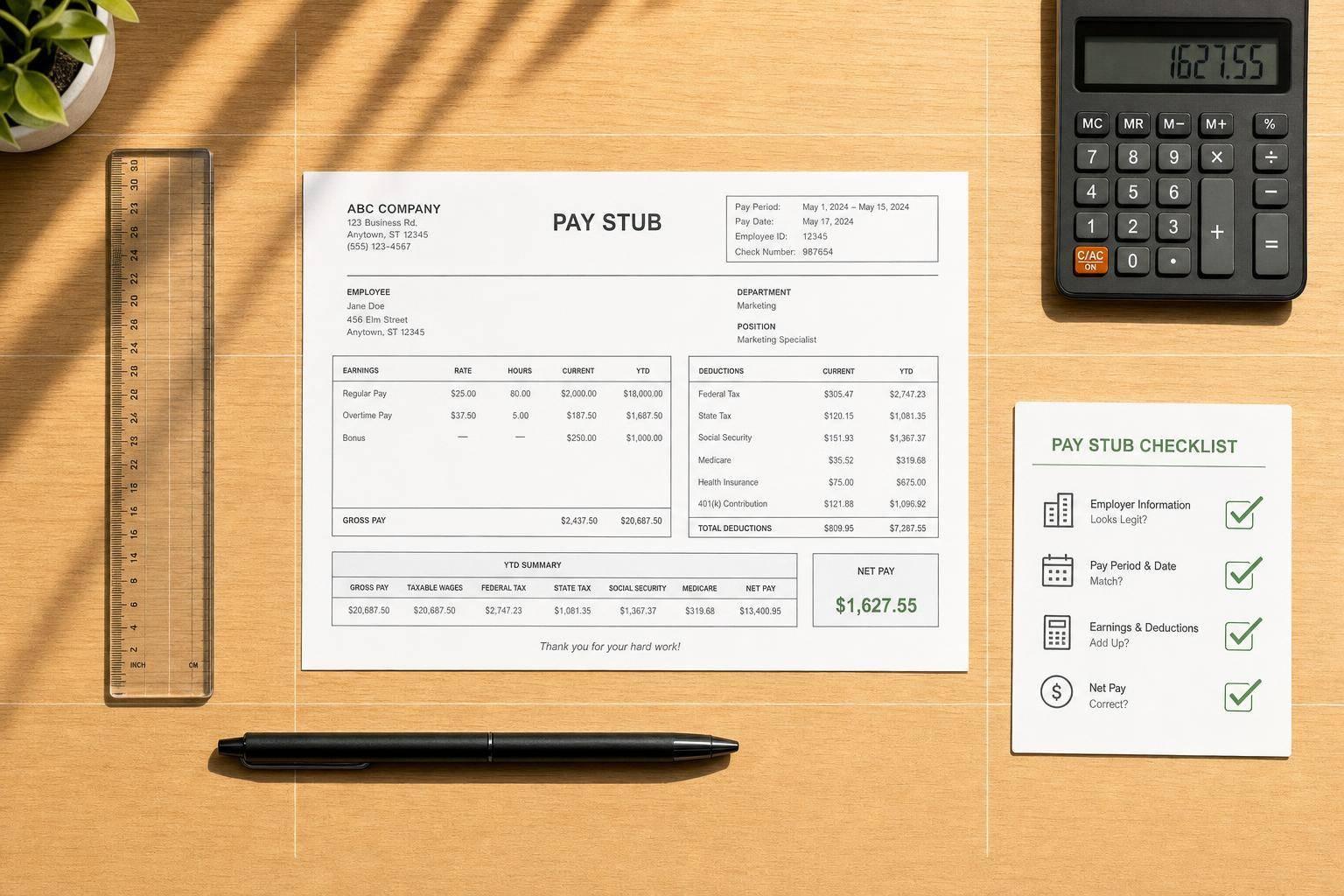
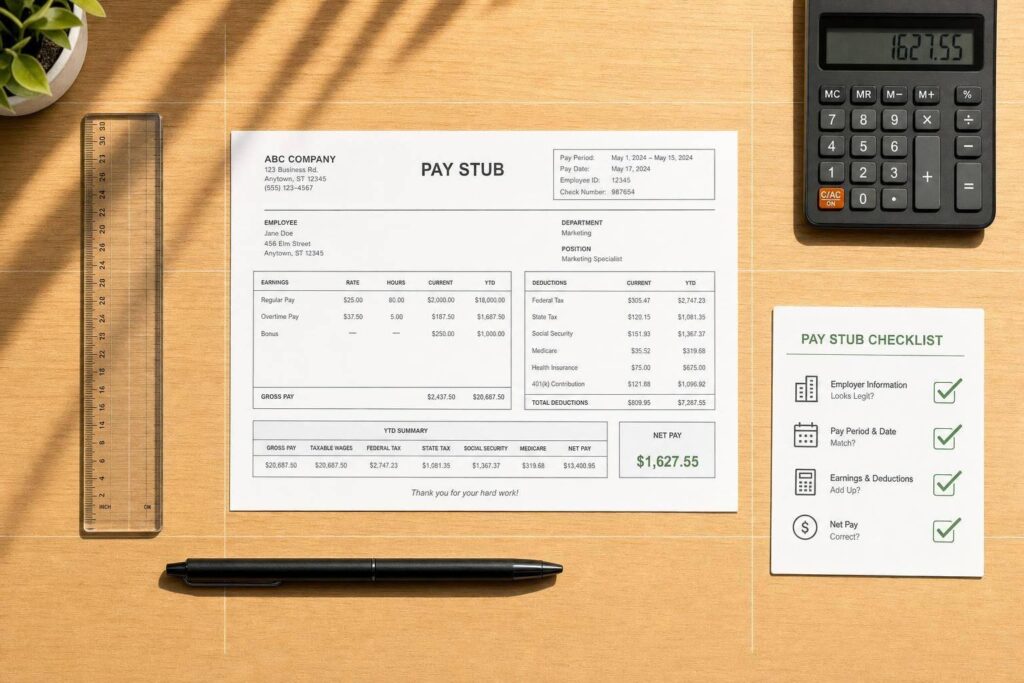
A fake pay stub can cost you months of lost rent, court fees, and an eviction case. I’d keep the process simple: collect the same income documents from every applicant, inspect each stub for errors, check the math, match deposits to bank statements, and verify the job with the employer. If one piece does not line up, I would stop and review the file before approving it.
Here’s the short version:
- I use proven tenant screening strategies and the same written income standard for every applicant.
- I ask for the right documents upfront based on income type.
- I check pay stubs for missing fields, date problems, and formatting issues.
- I confirm gross pay, deductions, net pay, and year-to-date totals.
- I match net pay to actual bank deposits.
- I compare the stub to the application, offer letter, and tax records.
- I verify employment using contact details I find myself.
- I keep notes on what I checked and why I approved or denied the file.
A few numbers show why this matters. The article notes that Duval County had more than 14,000 eviction filings last year, which was 19% above pre-pandemic averages. It also points to a common Jacksonville screening rule: income of at least 2.5x the rent. So for $1,800/month rent, I’d want to see at least $4,500/month in verified gross income.
If I had to boil the whole process down, it would be this: collect, inspect, calculate, cross-check, verify, and document.
| Step | What I check | What can go wrong |
|---|---|---|
| Collect | Pay stubs, bank statements, ID, tax records, offer letter | Missing or incomplete records |
| Inspect | Layout, dates, employer info, payroll fields | Edits, gaps, spelling errors, odd formatting |
| Calculate | Gross pay, deductions, net pay, YTD totals | Math that does not balance |
| Cross-check | Application, bank deposits, tax docs | Mismatched income or job details |
| Verify | HR or payroll confirmation | Employer info cannot be confirmed |
| Document | Notes, dates, decision reasons | Poor file records if issues come up later |
Below, I’ll walk through that review process in plain terms so you can spot red flags before they turn into missed rent.
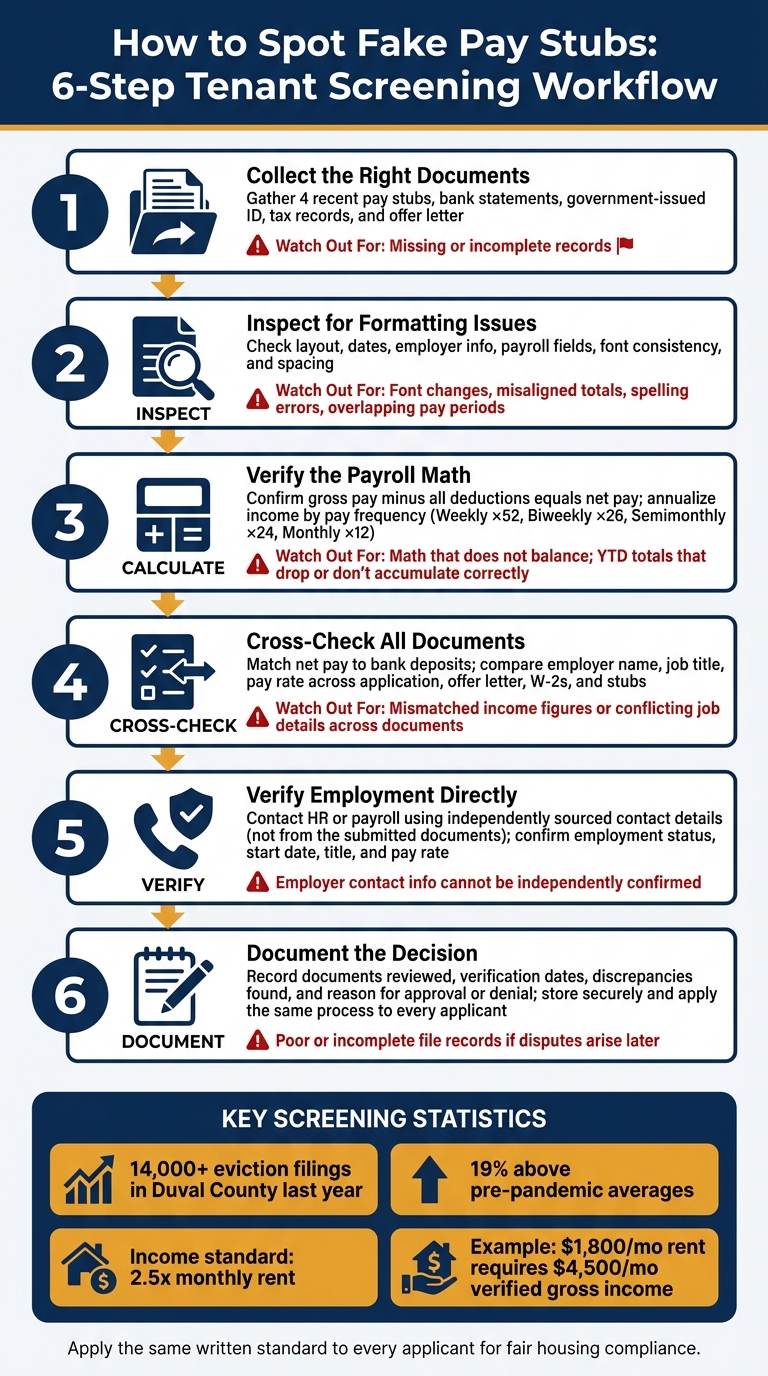
How to Spot Fake Pay Stubs: 6-Step Tenant Screening Workflow
Inspect the Pay Stub for Missing Details and Formatting Problems
Once you have the required documents, slow down and inspect the pay stub before you do any math. Even one odd detail is enough to take a closer look.
Check each required payroll field line by line
Review the stub line by line and flag any missing payroll fields. Then compare all four stubs side by side to make sure the employer name, pay dates, and year-to-date totals match from one document to the next.
Small mismatches can be a red flag. A year-to-date total that suddenly drops, for example, can point to an error that needs more review.
Look for visual signs of editing or fabrication
Pay attention to the way the document looks. If formatting changes within the same stub, that’s a problem worth flagging.
Watch for issues like:
- Font changes
- Spacing shifts
- Misaligned totals
- Spelling errors
If the stub still feels off after this review, ask for supporting records before you count the income.
Check whether the dates match a real payroll schedule
Pay periods should follow a normal weekly, biweekly, or semimonthly pattern. With four recent pay stubs in front of you, check that the pay period dates line up cleanly, with no gaps and no overlaps.
If the periods overlap, skip dates, or switch frequency with no clear reason, flag the file for review.
If the stub passes these checks, move to the payroll math before accepting the income.
sbb-itb-73b3b1a
Check the Payroll Math Before Accepting the Income
Once the stub passes a visual review, check the numbers. A pay stub can look polished and still be fake. The math needs to make sense before you accept the income.
Confirm gross pay, deductions, and net pay add up
Start with the most basic test: gross pay minus all listed deductions should equal net pay. Add every deduction on the stub, then subtract that total from gross pay. If the result does not match the printed net pay, flag it for review.
Also match the net pay to a dated bank deposit.
"All income must be verifiable. Verifiable income includes four recent pay stubs, a recent verifiable offer letter from your current employer, and bank statements to confirm income."
Test earnings against pay rate, hours, and annualized income
If the stub shows an hourly wage, multiply that rate by the hours on the stub. The result should be close to the gross pay shown. If the applicant is salaried, annualize the income based on pay frequency:
- Weekly: gross pay × 52
- Biweekly: gross pay × 26
- Semimonthly: gross pay × 24
- Monthly: gross pay × 12
For variable income, check the total against last year’s tax return and six months of bank statements.
Red-flag comparison table for common payroll inconsistencies
| Red Flag | Why It Matters | Verification Step |
|---|---|---|
| Gross pay minus deductions doesn’t equal net pay | Basic payroll math that doesn’t balance is a clear sign of alteration | Recalculate manually; request employer confirmation |
| YTD totals don’t match prior stubs | YTD should increase in a predictable way each pay period | Add up each pay period and compare the total to the YTD field |
| Net pay not reflected in bank deposits | If the money never hit the account, the stub is not backed by actual income | Match each net pay figure to a dated deposit in the bank statement |
| Pay stubs conflict across periods | Changes in dates, totals, or tax math can point to fabrication | Review four recent stubs and compare pay frequency, totals, and tax math |
| Commissions, tips, or bonuses can’t be verified | Variable income is harder to confirm and may be overstated | Request the previous year’s tax return and six months of personal bank statements |
Cross-Check the Application and Verify Employment Directly
Once the stub’s numbers check out, put it next to the rest of the file and see if the story stays the same. A pay stub can look fine on its own and still fall apart when you compare it with the other records.
Compare the pay stub with the application and other submitted records
Review the rental application with the pay stubs, a recent verifiable offer letter, W-2s, and bank statements. The goal is simple: make sure the details match across every document.
Check the employer name, job title, start date, pay type, and pay rate. If the pay stub shows a salaried role but the offer letter lists an hourly rate, that’s a mismatch worth flagging. Then match each net-pay deposit to the bank statement. If you still see holes after that, move to direct employment verification.
Contact HR or payroll using independently sourced contact details
The next step is to verify the employer through contact details you found on your own. Don’t call or email the phone number or address printed on a submitted document.
Confirm the applicant’s employment status, start date, job title, pay type, and pay rate. That information should line up with what the applicant submitted and what appears on the pay stub.
Treat incomplete verification as a reason for further review, not automatic denial
If you can’t complete verification, treat that as a reason for more review, not an instant denial. Use extra documents only to clear up missing pieces, and follow the same process for every applicant.
That last part matters. If two applicants have the same gap, they should get the same follow-up steps.
Document the Decision and Apply the Process to Every Application
Once the numbers line up, the file still needs a clean paper trail.
Keep clear records of what was reviewed and confirmed
After you finish verification, write down exactly what you checked. For each application, record the documents reviewed, verification dates, contact method, confirmed facts, discrepancies, and the reason for the final decision. That last part matters. If you approve or deny someone, the file should show why.
Keep the file focused on screening records, verification notes, and any notice or response tied to the decision. In plain English: if it supports the screening decision, keep it. If it doesn’t, don’t clutter the file.
Store screening records securely. Pay stubs, bank statements, credit reports, and government-issued IDs contain sensitive personal information. Limit access and protect those files, whether they’re stored digitally or on paper.
Follow applicable screening, privacy, and adverse-action rules
After the file is complete, apply the same written rules to every applicant.
Use your written standard the same way in every file, and document any adverse decision the same way each time. Steady screening records help support fair housing compliance.
Florida Statutes Chapter 83 also governs landlord-tenant notices, so keep copies of required notices and proof of delivery.
Write the denial rule into your screening policy and apply it the same way every time.
Conclusion: A repeatable collect-inspect-calculate-cross-check-verify-document workflow
With the process written down, the screening workflow is complete.
Run every application through the same sequence – collect, inspect, calculate, cross-check, verify, and document – and you’ll catch most fraud before it turns into a problem.
For Jacksonville property owners, 1 Realty Management provides tenant placement and tenant screening as part of its full-service property management offering.
FAQs
What are the biggest signs a pay stub is fake?
Watch for common red flags like perfectly rounded numbers, inconsistent fonts, missing tax deductions, uneven pay periods, and wrong year-to-date totals.
To help confirm the information is legitimate, 1 Realty Management recommends cross-checking the pay stub with bank statements to make sure the listed earnings line up with actual deposits.
How many pay stubs and bank statements should I request?
Request four recent pay stubs to verify income.
For self-employed applicants, ask for the previous year’s personal income tax return and the previous six months of personal bank statements.
You can also ask for bank statements in any case to cross-check that the income shown on pay stubs matches actual deposits. The goal is simple: all income must be verifiable.
What should I do if I can’t verify the employer?
If you can’t verify the employer, all income must be verified with other documents.
1 Realty Management requires four recent pay stubs, a recent verifiable offer letter from the current employer, and bank statements.
Self-employed applicants must provide the previous year’s personal tax return and the previous six months of personal bank statements.
If these requirements aren’t met, a qualified cosigner or an additional non-refundable holding fee may be required.