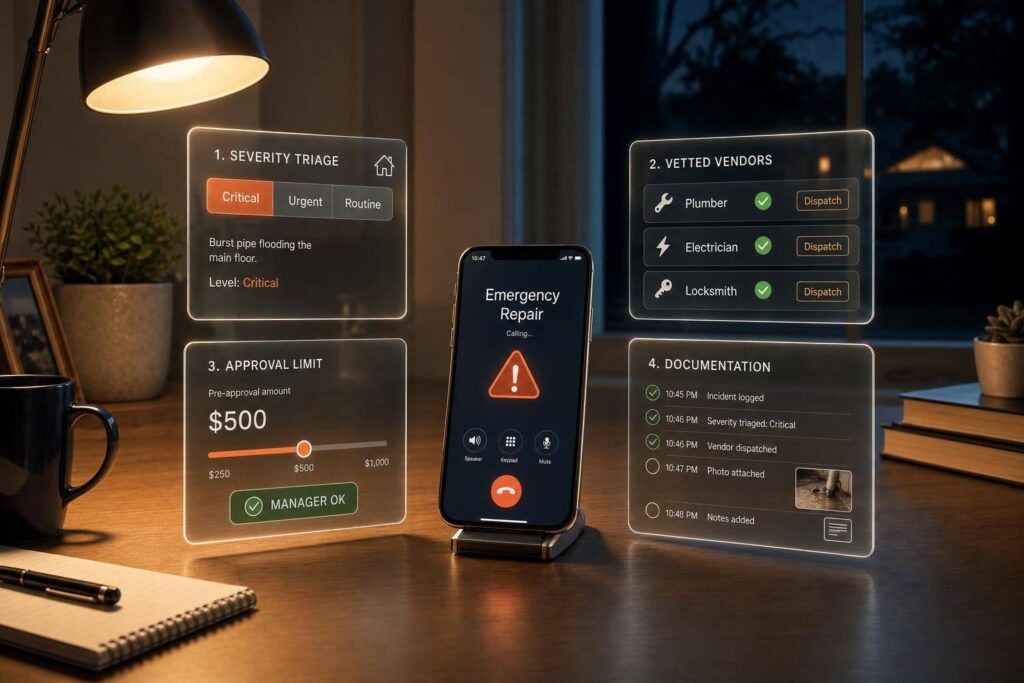
If a repair threatens safety, causes active damage, or makes the unit hard to live in, I treat it as an after-hours emergency and act right away. In Florida, that usually means I need a clear triage process, 24/7 vendor contacts, tenant reporting rules, cost limits, and a full record of what happened.
Here’s the short version:
- I separate true emergencies from repairs that can wait until business hours.
- I keep plumbers, electricians, HVAC techs, and restoration vendors ready to dispatch.
- I set written not-to-exceed limits so vendors can stop damage without delay.
- I give tenants one clear after-hours reporting path for fire, flooding, gas odor, lock issues, and major outages.
- I log call time, dispatch time, entry time, photos, invoices, and closeout notes.
- I remember that after-hours rates can run 40% to 60% higher, so wrong triage gets expensive fast.
A burst pipe at 2:00 a.m., a sewage backup on a holiday, or a sparking outlet on a Sunday all need the same thing: a simple plan that works under pressure. I’d read this as a guide to classifying the problem, sending the right vendor, limiting cost, and protecting habitability without wasting time.
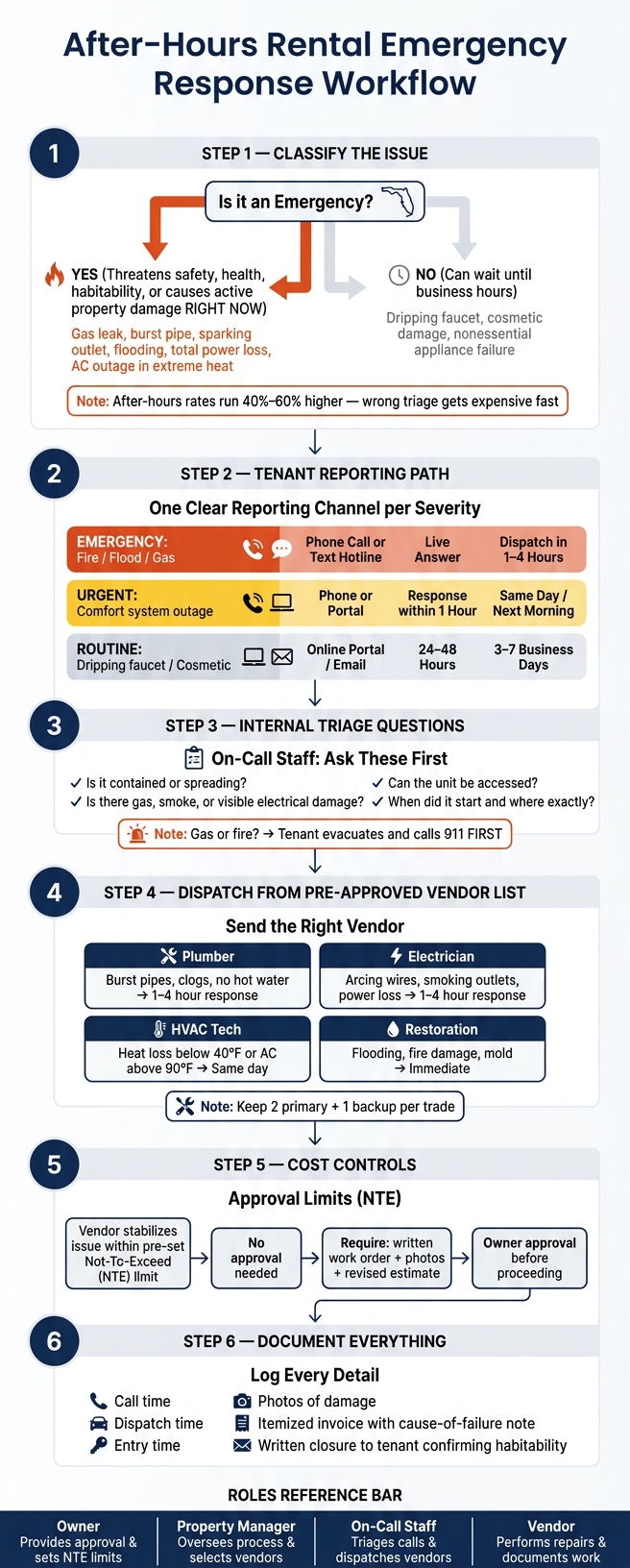
After-Hours Rental Emergency Response: Step-by-Step Workflow
Know What Counts as an Emergency and What Florida Law Requires
Start by classifying the issue. That matters more than it may seem. After-hours vendor rates are often 40% to 60% higher, so treating routine work like an emergency can burn through your budget fast.
Emergency vs. Non-Emergency: How to Tell the Difference
Use one simple test: Does this threaten safety, health, habitability, or cause active property damage right now? If the answer is yes, it’s an emergency. If not, it can usually wait.
| Scenario | Status | Target Response Time | Florida Legal Context |
|---|---|---|---|
| Gas leak | Emergency | Immediate / 1–2 hours | Life-safety hazard |
| Water intrusion causing active damage | Emergency | Immediate / 1–2 hours | Threatens structural integrity and habitability |
| Air conditioning outage during extreme heat | Emergency or urgent | Same day / 24 hours | Can become a habitability issue in Florida heat |
| No hot water | Urgent | 24 hours | Florida law requires access to hot water |
| Small leak | Routine | 3–7 days | Non-essential; does not impact habitability |
| Nonessential appliance failure | Routine | 3–7 days | Inconvenience only; not a legal emergency |
A gas leak is obvious. A small drip under a sink? Usually not. That’s the difference. Once you’ve confirmed it’s an emergency, dispatch a vendor who can get there fast.
Florida Rules on Entry, Notice, and Documentation
After classification, document entry rights and response times. In Florida, landlords generally must give 24 hours’ notice before non-emergency entry. But true emergencies – like a gas leak or active water intrusion – are different. In those cases, you or your vendor can enter right away to protect life or property. Florida leases also can’t waive habitability duties.
Keep a clear record of what happened:
- When the call came in
- When the vendor was dispatched
- When entry happened
- What repairs were completed
That paper trail can help if the repair is questioned later. Once the issue is classified, send the right vendor right away.
sbb-itb-73b3b1a
Build an After-Hours Vendor and Dispatch System
After classification and documentation, the next move is a pre-approved dispatch process. Once an issue is confirmed as an emergency, dispatch from a pre-approved vendor list. A phone list is not a dispatch system. You need pre-vetted vendors, written rates, and clear approval limits before the phone rings at 2:00 a.m.
Vendor Agreements, Rates, and Response Standards
For high-impact trades like plumbing, electrical, and HVAC, keep at least two primary contacts and one overflow backup option. For restoration vendors, which often need closer supervision, make sure licenses and insurance are verified and kept current. Keep each vendor’s license, insurance, service area, hours, lead time, and approved payment terms on file.
Use a master service agreement for baseline terms, such as insurance, indemnity, invoicing, and rate schedules. Then use separate work orders for each job to define scope and price controls. After-hours work costs more, so spell out premium rates in writing.
Use this baseline for core emergency vendors:
| Vendor Type | Typical Emergency Work | Response Expectation | Key Contract Terms |
|---|---|---|---|
| Plumber | Burst pipes, main line clogs, no hot water | 1–4 hours | Emergency rates, shut-off authority |
| Electrician | Arcing wires, smoking outlets, total power loss | 1–4 hours | Licensed status, safety sign-off |
| HVAC | Total loss of heat below 40°F or A/C above 90°F | Same day | Same-day availability |
| Restoration | Flooding, fire damage, mold remediation | Immediate | Insurance claim coordination, moisture mapping |
Require same-day HVAC coverage in Jacksonville.
Approval Limits and Steps for High-Cost Repairs
Once vendor terms are in place, set clear rules for who can approve extra costs. Put a written not-to-exceed (NTE) limit in place for emergency stabilization so vendors can act right away without waiting on approval. If the work goes past that limit, owner contact is required before the scope gets bigger.
A plumber, for example, can stop an active leak and cap a pipe on the spot. But if the repair means opening a wall or replacing a main line, require a written work order, photos of the issue found, and a revised price before more work starts.
For large repairs like flooding, fire damage, or structural issues, map out the decision chain ahead of time. The on-call team dispatches the vendor and stabilizes the problem first. Then they send the owner photos, a short summary, and an estimate before any major repair begins.
Use timestamped photos and signed work orders to verify scope and pricing.
Set Up Tenant Communication and Internal Triage Procedures
Once vendors and approval limits are in place, the last piece is a clear reporting and triage process. Even the best vendor list falls apart if tenants and staff don’t know what to do after hours.
How Tenants Should Report Issues After Hours
Use phone or text only for real emergencies – fire, flooding, gas odor, or anything that puts people at risk or causes active damage. Routine requests, like a dripping faucet or a cracked tile, should go through the online portal or email during business hours.
The goal is simple: one path for each level of severity, so tenants know exactly where to go.
| Issue Severity | Communication Channel | Acknowledgment Target | Expected Dispatch |
|---|---|---|---|
| Emergency (Fire, Flood, Gas) | Phone Call / Text Hotline | Immediate (Live Answer) | 1–4 Hours |
| Urgent (Comfort-system outage affecting habitability) | Phone Call / Portal | Within 1 Hour | Same Day / Next Morning |
| Routine (Dripping Faucet, Cosmetic) | Online Portal / Email | 24–48 Hours | 3–7 Business Days |
Treat loss of cooling as urgent when indoor conditions put habitability at risk.
Require four details with every report:
- the exact location
- when the issue started
- whether it is spreading
- whether the unit can be accessed
A photo or short video gives staff a better read on severity before dispatch.
Fast and accurate reporting helps protect habitability and can cut down on avoidable damage.
Internal Roles, Triage Steps, and Post-Incident Records
Once a report comes in, staff should confirm the severity before calling a vendor. The on-call staff member should handle triage first, then dispatch. A few plain questions go a long way: Is it contained? Is it spreading? Is there gas, smoke, or visible electrical damage? If there is a gas odor or fire, the tenant should evacuate and call 911 from outside first.
Staff should also tell the tenant how to limit damage while the vendor is on the way, like shutting off the water or flipping the right breaker.
Good records matter here. Log the call time, dispatch time, and arrival time. Save photos. Keep the itemized invoice and the cause-of-failure note. Then send written closure to the tenant confirming the home is habitable. If habitability is questioned later, that written confirmation gives you a clean record.
| Role | Primary Responsibilities |
|---|---|
| Owner | Set repair approval thresholds; maintain updated contact info |
| Property Manager | Triage calls; verify severity via photos; notify owner if over cost threshold |
| On-Call Staff | Monitor emergency line; ask diagnostic questions; dispatch vetted vendors; log all timestamps |
| Vendor | Respond within 1–4 hours; stabilize the site; submit photos and an itemized invoice with cause-of-failure notes |
When to Use Professional Property Management Support
Even with a solid vendor list, after-hours emergencies can still fall apart if no one is there to triage the issue, dispatch the right vendor, and document the repair. That setup may work for a small portfolio. But once you own several Jacksonville rentals, live out of town, or simply can’t answer a live call at 2:00 a.m., the workload can snowball.
Weak contractor oversight can eat into revenue through overbilling and repeat repairs. On top of that, maintenance issues that linger can open the door to serious legal risk.
1 Realty Management provides 24/7 maintenance response, vendor coordination, tenant communication, and repair documentation for Jacksonville rental properties.
When those gaps start showing up in your day-to-day operation, outside help starts to look less like a perk and more like a practical safety net. Before you decide, ask yourself:
- Can you reach the property within 60 minutes at 2:00 a.m.?
- Do you have licensed plumbers, electricians, and HVAC vendors on call?
- Can you document every repair from first call to closeout?
If any answer is "no", professional support may be worth considering.
Conclusion: Key Steps for Handling After-Hours Repairs
A dependable after-hours repair system comes down to a few steady habits: define what counts as an emergency, know your Florida duties under § 83.51, keep a vetted vendor bench with clear response standards, give tenants one clear way to report urgent issues, and document every incident from the first call through final resolution. Each part supports the next. If one piece is missing, the whole system gets weaker than it seems – and in a habitability dispute, that weak spot tends to show up fast. Whether you handle repairs yourself or work with local support, the goal stays the same: protect your residents and your property before the next emergency starts.
FAQs
What should tenants do before help arrives?
Before help gets there, tenants should take a few basic steps to limit the damage. If there’s a fire, a gas leak, or any immediate physical danger, leave right away and call 911 or the utility provider once you’re outside.
For water emergencies, shut off the main water valve or the valve under the fixture that’s causing the problem. If it’s safe to do so, switch off the breaker tied to the electrical hazard.
How much should an after-hours repair approval limit be?
There’s no one-size-fits-all dollar amount here. Property owners should set a pre-determined authorization limit in vendor agreements.
That limit tells vendors when they can move right away to stop more damage or make the property livable again, and when they need the owner’s approval first.
If repair costs go over that limit, work should move forward only when it’s needed to prevent more damage, restore habitability, or meet landlord-tenant law requirements.
When should a landlord hire property management for emergencies?
Hiring a property management company for emergency repairs makes sense if you want a more hands-off setup or live far from your rental.
They can take care of after-hours emergencies with 24/7 maintenance hotlines, screened licensed vendors, and a clear grasp of habitability rules. They also manage scheduling and paperwork around repairs, which can ease stress, help protect you, and keep premium dispatch costs in check.